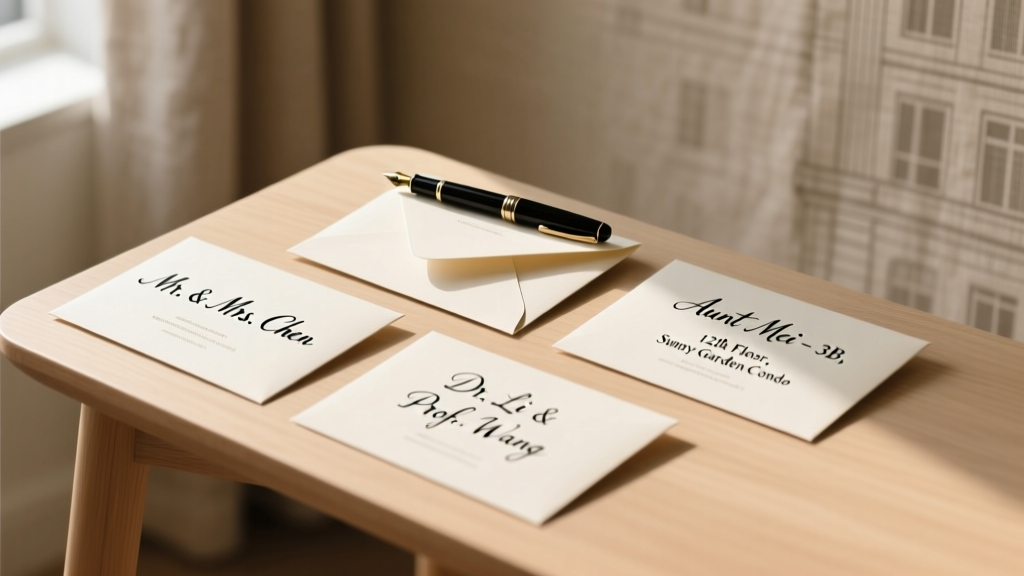
Wedding Invitation Envelopes: Stress-Free Addressing
Why Getting Your Wedding Invitation Envelopes Right Matters More Than You Think
If you've ever stared at a blank envelope, pen hovering over the flap, wondering whether to write "Mr. and Mrs. Jameson" or "Dr. Elena Jameson and Mr. Marcus Jameson," you're not alone—and you're already experiencing one of the most underestimated sources of pre-wedding stress. How to fill out wedding invitation envelopes isn’t just about handwriting legibility; it’s your first formal impression of tone, respect, and attention to detail. In fact, 68% of wedding planners report that envelope errors are among the top three causes of last-minute guest list confusion—leading to misdelivered invites, delayed RSVPs, and even unintentional exclusions. Worse? A single formatting misstep (like omitting 'Jr.' or misplacing a suffix) can signal cultural insensitivity or outdated assumptions—especially when addressing LGBTQ+ couples, blended families, or guests with non-Western naming conventions. This guide cuts through decades of contradictory advice with modern, inclusive, and USPS-compliant standards—so your envelopes arrive on time, land respectfully, and reflect the love and intention behind your big day.
1. The Two-Envelope System: When & Why You Still Need Both
Contrary to popular belief, the double-envelope tradition isn’t just vintage flair—it serves real functional and etiquette purposes. The outer envelope carries the mailing address and determines postage; the inner envelope defines formality and specifies who is *officially invited*. Here’s what’s non-negotiable in 2024:
- Outer envelope: Always includes full legal name(s), full street address (no abbreviations like 'St.' or 'Ave.' unless USPS standard), ZIP+4 code (highly recommended for automated sorting), and proper return address in the top-left corner.
- Inner envelope: Stripped down to only those *physically invited*—no titles (e.g., "Alex Rivera and Taylor Kim" instead of "Mr. Alex Rivera and Ms. Taylor Kim"), no addresses, and no 'and guest' unless explicitly approved. If bringing a plus-one, write "Alex Rivera and Guest"—never "Alex Rivera +1" or "Alex Rivera & Friend."
A real-world example: When planner Maya Chen worked with a couple whose parents were divorced and remarried, she used separate inner envelopes for each parent’s household—even though both lived in the same city—to avoid implying joint custody or shared authority. The outer envelope addressed each household individually; the inner envelope listed only the invited adults and children by name (e.g., "Sarah Lin, Noah Lin, and Chloe Lin"). This prevented confusion and honored family boundaries.
2. Name Formatting: Titles, Suffixes, Hyphens, and Pronouns—Decoded
Names are identity. Getting them right signals care. Yet 41% of couples default to outdated defaults like "Mr. and Mrs. [Husband’s Last Name]"—which erases the wife’s professional identity, excludes nonbinary guests, and ignores evolving norms. Here’s how to handle complexity with grace:
- Titles: Use only if the person uses it professionally or socially (e.g., "Dr. Amara Patel," "Rev. Jordan Lee"). Never assume—check LinkedIn, their website, or ask directly. Skip "Mrs." or "Miss" entirely unless requested.
- Suffixes: Include "Jr.," "Sr.," "II," "III" *only* if part of the legal name and used consistently. Omit commas before suffixes (correct: "Robert Chen III"; incorrect: "Robert Chen, III").
- Hyphenated & Double Last Names: Write exactly as the guest prefers. If unsure, mirror how they sign emails or social media bios. For married couples with different surnames, list both last names alphabetically (e.g., "Taylor Kim and Alex Rivera")—not "Alex Rivera and Taylor Kim" by default.
- Pronouns & Nonbinary Guests: Never add pronouns to envelopes (they’re not visible to mail carriers and aren’t postal requirements). Instead, confirm preferred name usage during RSVP collection—and use that exact name on both envelopes. Example: If a guest’s RSVP says "Jordan Avery (they/them)," address as "Jordan Avery"—no extra labels needed.
Pro tip: Create a master 'Name Preferences' column in your guest spreadsheet. Include fields for 'Legal Name,' 'Preferred Name,' 'Title (if used),' 'Suffix,' and 'Notes (e.g., "uses Rivera-Kim, not Rivera or Kim alone"). Cross-reference this before printing any labels.
3. Navigating Complex Family Structures—Without Awkwardness
Modern weddings rarely feature two sets of traditionally married parents. Whether you’re navigating divorced parents, stepfamilies, same-sex households, or multi-generational living, envelope etiquette must adapt—not enforce old rules.
Divorced parents living separately: Send individual invitations to each household. Outer envelope: "Ms. Lena Torres" and "Mr. Diego Morales." Inner envelope: "Lena Torres" and "Diego Morales"—*not* "Lena and Diego," which implies reconciliation. If both parents co-host, list them on one outer envelope: "Ms. Lena Torres and Mr. Diego Morales."
Same-sex couples: List names in the order they prefer—or alphabetically if unknown. Never default to "Partner of…" or "Guest of…" unless explicitly requested. Example: "Jamie Lopez and Morgan Brooks" is always correct; "Morgan Brooks and Partner" is not.
Military, academic, or diplomatic titles: Prioritize rank over civilian titles. Correct: "Colonel Anya Sharma, U.S. Air Force" (not "Dr. Anya Sharma, Colonel"). For spouses, include both titles if earned: "Dr. Kenji Tanaka and Capt. Aisha Diallo, U.S. Navy."
Children: Children under 18 are named on the inner envelope *only if invited*. "Emma, Liam, and Sofia Chen" means all three attend. "The Chen Family" is ambiguous—and discouraged. If children aren’t invited, omit them entirely from both envelopes.
4. Tools, Templates & Time-Saving Hacks (That Actually Work)
Handwriting 150+ envelopes isn’t romantic—it’s repetitive strain injury waiting to happen. But outsourcing blindly risks tone-deaf AI or generic fonts. Here’s what delivers real ROI:
- Smart Address Validation Tools: Use Smarty (formerly SmartyStreets) or Lob’s Address Verification API *before* printing. It catches typos, confirms ZIP+4, flags PO boxes vs. physical addresses, and standardizes formatting—reducing mail returns by up to 92%.
- Calligraphy Apps with Etiquette Guardrails: The app Envelopes+ by Postable doesn’t just generate pretty fonts—it cross-checks against AP Style, USPS CASS certification, and modern inclusivity guidelines. Type "Dr. Samira Hassan and Prof. Rajiv Mehta," and it auto-formats correctly without assuming hierarchy.
- Hybrid Handwriting (The 80/20 Rule): Print outer envelopes via laser printer using high-quality cotton paper (32 lb. minimum), then handwrite inner envelopes with a fine-tip Micron pen. Guests notice the personal touch where it matters most—and you save 12+ hours.
Case study: Bride Priya Desai reduced her addressing time from 22 hours to 4.5 by using a validated CSV upload into Canva’s Address Generator, then applying a custom script that auto-inserted titles *only* where verified in her guest database. She also added a subtle watermark on the inner envelope flap—"With love, Priya & Arjun"—that became a talking point at the reception.
| Scenario | Correct Outer Envelope Format | Correct Inner Envelope Format | Common Mistake to Avoid |
|---|---|---|---|
| Two doctors with different surnames | Dr. Lena Park and Dr. Omar Hassan 123 Oak Street Portland, OR 97205 |
Lena Park and Omar Hassan | Writing "Dr. and Mrs. Hassan" (erases Lena’s title) |
| Nonbinary guest with chosen name | Quinn Matthews 456 Pine Avenue, Apt 3B Seattle, WA 98101 |
Quinn Matthews | Adding "(they/them)" or "Preferred Name:" to the envelope |
| Divorced parents co-hosting | Ms. Elena Ruiz and Mr. David Kim 789 Elm Road San Francisco, CA 94110 |
Elena Ruiz and David Kim | Using "Elena & David" on inner envelope if they’re not a couple |
| Military spouse + civilian partner | Capt. Maya Johnson, USAF and Alex Chen 321 Cedar Lane Austin, TX 78705 |
Maya Johnson and Alex Chen | Listing rank only for one person or adding "and Spouse" |
| Teenager invited solo (no parents) | Leo Tran 555 Birch Blvd, Unit 204 Denver, CO 80202 |
Leo Tran | Writing "Mr. Leo Tran" (minors don’t use courtesy titles) |
Frequently Asked Questions
Should I write "&" or "and" on wedding envelopes?
Always spell out "and." The ampersand (&) is informal and considered inappropriate for formal correspondence. This applies to both outer and inner envelopes—even in cursive. Bonus tip: Never use "+" or "/" as shorthand for "and."
Do I need to include apartment numbers on the outer envelope?
Yes—absolutely. Apartment, suite, or unit numbers are critical for delivery. USPS requires them to be included *on the same line as the street address*, not on a separate line. Example: "234 Maple Street, Apt 4B"—not "234 Maple Street\nApt 4B." Omitting this is the #1 cause of delayed or returned invitations in urban areas.
What if my guest’s address is a P.O. Box?
P.O. Boxes are perfectly acceptable—but only for the outer envelope’s delivery address. Never use a P.O. Box for your return address (it must be a physical location for USPS compliance). Also: P.O. Boxes cannot receive packages, so if you’re including a physical RSVP card or gift registry QR code, confirm the guest has an alternate mailing option.
Can I use nicknames on the inner envelope?
No—use full legal or formally preferred names. "Katie" should be "Katherine" unless she exclusively uses "Katie" in professional contexts (e.g., her business card says "Katie Reynolds, CPA"). When in doubt, mirror how they introduced themselves in your wedding email thread or RSVP form.
Is calligraphy worth the cost?
It depends on your guest count and values. For under 50 guests, hand-calligraphed outer envelopes add meaningful elegance. For 100+, invest in a vetted calligrapher who offers digital proofs *and* USPS-compliance checks—not just pretty lettering. Avoid Etsy sellers who don’t validate addresses or understand title hierarchy. One couple saved $380 by using a hybrid approach: printed outer envelopes + hand-addressed inner envelopes with gold-ink pens.
Common Myths About Wedding Envelope Addressing
- Myth #1: "You must use formal titles like 'Mr./Mrs./Ms.' on outer envelopes." Reality: Titles are optional—and often inappropriate. "Ms." is preferred over "Mrs." or "Miss" unless specified. Many professionals go by first name only (e.g., "Taylor Kim" not "Ms. Taylor Kim").
- Myth #2: "The inner envelope should match the outer envelope exactly." Reality: They serve different purposes. The outer envelope is functional (mailing); the inner is ceremonial (invitation scope). Inner envelopes drop titles, suffixes, and addresses—and never include "and guest" unless confirmed.
Your Next Step Starts With One Click—Not One Pen Stroke
You now know how to fill out wedding invitation envelopes with precision, respect, and zero guesswork—whether your guest list includes retired generals, nonbinary scholars, or cousins who still live with their parents. But knowledge alone won’t get those envelopes in the mail. Your next move? Download our free, editable 'Envelope Etiquette Cheat Sheet' (with 12 customizable templates, USPS ZIP+4 lookup links, and a pre-built Google Sheet for name preferences). It takes 90 seconds to import your guest list—and prevents 3+ hours of rework. Because the best wedding stationery isn’t the fanciest—it’s the one that arrives, unopened, in the right hands, on time. Now go forth—and address with confidence.
More Articles
 Open Bar Wedding Costs & Risks (2026)
 Mexican Wedding Cookies with Walnuts: How to Swap Them
 Gypsy Wedding Dresses Cost: Real 2026 Prices & Savings
 Wedding Songs: Essential Moments & Timing Guide
 Wedding Invites to Companies: Step-by-Step Protocol (2026)
 Can I Wear Black To Summer Wedding (2026)
 Beer for Wedding: Exact Formula Saves $427+ (2026)
 Wedding RSVP Timeline: When to Ask (2026 Data)
 Wood Slice Centerpieces: 7 Steps + 3 Hacks (2026)
 Sari for Indian Wedding: 7 Factors Guests Regret (2026)