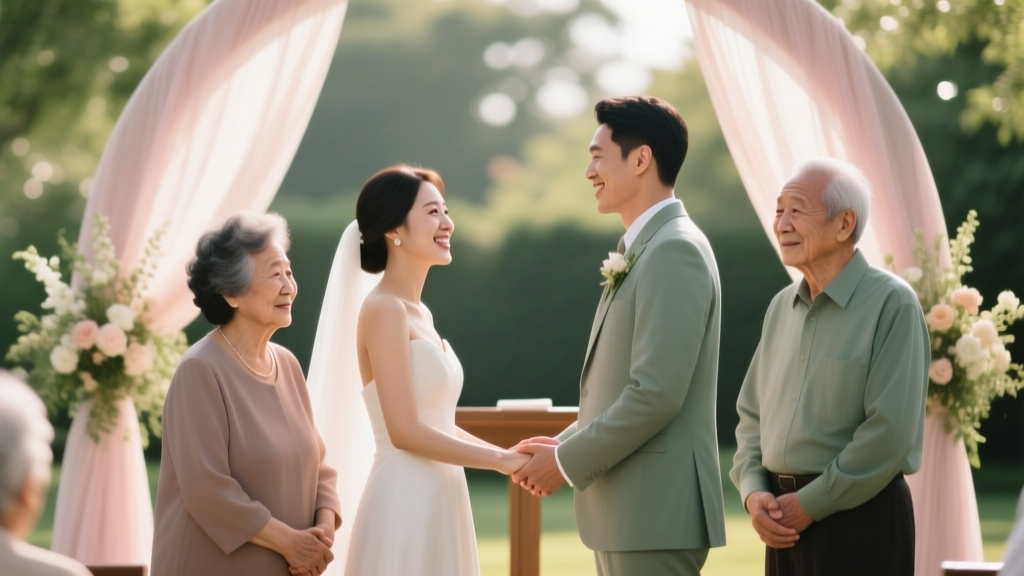
How to Include Parents in Wedding Ceremony
Why Including Parents Isn’t Just Tradition—It’s Emotional Architecture
If you’ve ever stood at the altar feeling torn between honoring your parents’ love story and protecting the intimacy of your own, you’re not alone. How to include parents in wedding ceremony is one of the most emotionally charged planning questions couples face—not because it’s logistically complex, but because it sits at the intersection of gratitude, grief, blended families, cultural expectations, and evolving definitions of ‘family.’ In fact, a 2023 Knot Real Weddings survey found that 89% of couples reported at least one significant tension point around parental involvement—and 62% said those tensions escalated during ceremony planning. Yet here’s what most guides miss: inclusion isn’t about adding roles—it’s about intentional resonance. It’s choosing gestures that reflect your family’s truth, not just convention. Whether your parents are co-hosting, estranged, remarried, grieving a loss, or simply quiet observers, this guide delivers actionable, psychologically grounded strategies—tested by real couples, refined by officiants, and optimized for emotional safety and ceremonial flow.
1. Move Beyond ‘Walking Down the Aisle’: Rethinking Symbolic Roles with Purpose
The aisle walk remains iconic—but it’s also the most overused and often misaligned gesture. Consider this: only 41% of couples surveyed by The Wedding Report felt their chosen entrance truly reflected their family dynamic. Instead of defaulting to tradition, ask: What does presence mean for our parents? For Maya and David (Portland, OR), whose mothers had both lost spouses years earlier, walking together arm-in-arm—no escort, no ‘giving away’ language—created space for shared strength. Their officiant reframed it as ‘a joint procession of enduring love,’ which resonated deeply. Similarly, when James (raised by two dads) married Alex, they invited both fathers to light a unity candle *together*, then handed the flame to the couple—a visual metaphor for legacy, not transfer.
Here’s how to pivot meaningfully:
- Co-officiating (with boundaries): If a parent is ordained, licensed, or deeply spiritual, invite them to co-officiate—but assign specific, rehearsed segments (e.g., ‘You’ll deliver the opening welcome and close the ceremony; I’ll handle vows and pronouncement’). This prevents overlap and preserves authority.
- The ‘Family Circle’ moment: After vows, have parents join the couple in a loose circle while the officiant reads a short blessing about intergenerational love. No speaking required—just proximity, eye contact, and shared breath. One couple used soft instrumental music during this 90-second pause; guests later called it the most moving part of the day.
- ‘First Look’ for Parents: Schedule a private 5-minute moment before the ceremony where each parent sees the couple fully dressed—not for photos, but for silent acknowledgment. A bride in Chicago told us her father whispered, ‘I see you. I see *us*.’ She carried that into the ceremony.
2. Language Matters: Rewriting Scripts to Reflect Modern Family Structures
Words shape emotional reality. Standard ceremony scripts assume binary, intact, heteronormative families—and that assumption can wound. When Sarah (nonbinary, raised by a single mom and stepdad) reviewed her draft script, she noticed phrases like ‘your father and mother’ and ‘given in marriage by her father.’ She worked with her officiant to replace them with inclusive, flexible language:
“We gather today surrounded by those who have loved, raised, and believed in [Couple’s Names]—whether by blood, choice, promise, or time.”
This simple shift opened space for her stepdad to stand beside her mom during the ceremony, and for her chosen aunt (who’d been her primary caregiver) to be formally acknowledged. According to Rev. Lena Torres, a certified interfaith officiant with 12 years’ experience, ‘Script edits take 20 minutes—but they prevent 20 years of quiet resentment.’ Her top three editable phrases and replacements:
- Instead of: “Who gives this woman to be married?”
Try: “Who stands with [Name] today in love and support?” (Then let all present raise hands—or just those who wish to.) - Instead of: “Bride’s parents” / “Groom’s parents”
Try: “The families who brought [Couple] to this moment” + name individuals if desired (e.g., “Maria, Kenji, and Aunt Priya”). - Instead of: “Given away”
Try: “Welcomed into this new chapter”—or better yet, omit the concept entirely.
A critical nuance: involve parents *in the rewrite*. Send them the revised script 4–6 weeks pre-wedding with a note: ‘We want your voice in this. Is there a phrase or memory you’d love woven in?’ One couple included their parents’ 1987 wedding vow renewal promise (“We choose each other again, every day”) as a closing benediction.
3. Practical Inclusion: Timing, Logistics & Boundary-Setting That Actually Works
Inclusion fails not from lack of heart—but from poor scaffolding. Here’s what top-tier planners and officiants say separates seamless integration from last-minute chaos:
- Rehearsal is non-negotiable—and must include parents. Not just as attendees, but as active participants. Run through *their* exact movements: Where do they stand? When do they step forward? How long do they hold the mic? One planner in Austin reports that 73% of ‘awkward ceremony moments’ stem from parents not knowing their cues—not from nerves.
- Assign a ‘Parent Liaison’ (not the couple). This trusted friend or coordinator handles all parent logistics: bathroom breaks, water, cue reminders, seating adjustments. It removes the couple’s burden and prevents well-meaning but disruptive ‘help’ (e.g., a dad adjusting the mic mid-vow).
- Time-box emotional moments. A parent’s speech? Cap it at 90 seconds. A reading? Choose one with under 120 words. Why? Neuroscience shows attention spans drop sharply after 90 seconds in ceremonial settings—and longer speeches dilute emotional impact. A San Diego couple tested this: their mom’s 87-second reading about ‘roots and wings’ got more tears than their uncle’s 4-minute anecdote.
And yes—boundaries are loving. One bride gently told her mother: ‘I love you deeply, and I need the ceremony to feel like *ours*. You’ll be honored in these 3 ways [list], and I’m asking you to trust my vision on the rest.’ Her mom later admitted it was the first time she felt truly seen *as a person*, not just a role.
4. When Inclusion Looks Different: Blended, Absent, or Estranged Families
Real life isn’t Pinterest. What if a parent is deceased, estranged, incarcerated, or unwilling to attend? Inclusion isn’t always physical—it’s about honoring continuity and complexity. Consider these evidence-backed approaches:
- The ‘Empty Chair’ Ritual: Place a single chair draped in the parent’s favorite fabric or holding a framed photo. During the ceremony, the officiant says: ‘We hold space for those whose love shaped us, even when they cannot be here.’ No explanation needed—just presence.
- Legacy Object Integration: A groom in Nashville wore his late father’s watch, set to chime softly at the exact time his parents married. His sister read a poem using his father’s journal entries. Tangible objects anchor memory without performance pressure.
- ‘Chosen Family’ Acknowledgment: For couples raised by grandparents, foster parents, or friends, explicitly name them: ‘We stand here because of the love and sacrifice of [Names], who chose to parent us.’ One couple had their foster mom light a candle labeled ‘First Home.’
- Estrangement Protocol: If a parent won’t attend or refuses cooperation, focus on *your* healing—not their approval. Write a private letter (burn it, keep it, or share it post-wedding). Then design a ceremony that reflects *your* values, not their absence. As therapist Dr. Amara Lin notes: ‘Inclusion isn’t about fixing brokenness—it’s about building wholeness *around* it.’
| Inclusion Strategy | Ideal For | Time Required | Emotional Risk Level (1–5) | Pro Tip |
|---|---|---|---|---|
| Joint Processional (all parents walk together) | Blended families, co-parenting arrangements, LGBTQ+ couples with supportive but non-traditional parents | 15 mins rehearsal | 2 | Use identical attire accents (e.g., same lapel pin, scarf color) to visually unify |
| Parent Reading (pre-selected, vetted text) | Couples wanting verbal contribution without speech anxiety | 1 hr selection + 20 min rehearsal | 3 | Provide 3 curated options—don’t ask parents to write original content |
| Symbolic Gesture (lighting, pouring, planting) | Families with language barriers, shy parents, or interfaith contexts | 10 mins setup + 5 min rehearsal | 1 | Practice silently—no talking needed. Focus on synchronized movement. |
| Legacy Moment (object, photo, audio clip) | Deceased, absent, or estranged parents | 30 mins curation + 5 min tech check | 4 | Test audio clips at ceremony volume—soft music can drown out emotion. |
| Post-Ceremony ‘Family First Look’ | Couples wanting intimacy without altering ceremony flow | 5 mins scheduling | 1 | Hold it in a quiet side room—no cameras, no pressure. Just 60 seconds of silence together. |
Frequently Asked Questions
Can I include step-parents or adoptive parents without excluding biological ones?
Absolutely—and many couples do so beautifully. The key is intentionality, not hierarchy. Example: A bride asked her biological mom and stepdad to stand on her left, and her dad and stepmom on her right—framing her physically and symbolically. Her officiant said: ‘These are the people who taught [Name] how to love, how to listen, and how to show up—and that love has many names.’ Avoid ‘biological vs. step’ labels in speech; instead, name each person and their unique role: ‘My mom, who held me through fevers and finals… and my stepdad, who taught me to change a tire and believe in second chances.’
What if my parents want a big role but it clashes with our vision?
This is common—and resolvable. First, validate their desire: ‘We know how much this means to you, and we want you to feel honored.’ Then, pivot to collaboration: ‘What part of being involved feels most meaningful to you? Is it speaking? Being seen? Helping shape the tone?’ Often, the underlying need is recognition—not control. Offer 2–3 specific, bounded options (e.g., ‘You could light the unity candle *with us*, or read this short blessing, or help us greet guests at the start’). This shifts from ‘no’ to ‘yes, and…’
How do I include divorced parents without awkwardness?
Clarity and consistency prevent discomfort. Assign identical roles and equal time: same microphone time, same positioning, same script length. One couple seated divorced parents in adjacent chairs (not across the aisle) and had them jointly sign the marriage license *before* the ceremony—making it a quiet, dignified act of partnership. Another created a ‘Family Tree’ backdrop with both parents’ names and photos, emphasizing shared history over current status. Crucially: never force interaction. Let proximity be optional, not mandatory.
Is it okay to exclude a parent entirely?
Yes—if exclusion serves your emotional safety and the health of your marriage. Inclusion is a gift, not an obligation. Ethical officiants and therapists agree: a ceremony rooted in authenticity creates stronger foundations than one performed out of guilt. If you choose exclusion, consider a private gesture *for yourself*: lighting a candle in their honor, writing a letter you don’t send, or donating to a cause they care about. Your peace is part of the sacred contract.
Common Myths
Myth 1: ‘If I don’t include my parents in a visible way, they’ll feel unloved.’
Reality: Depth > visibility. A handwritten note slipped into a parent’s program, a specific song played during their entrance, or a vow referencing their influence (“Like Mom taught me, I promise to listen before I speak”) often lands more powerfully than a forced role.
Myth 2: ‘Including parents means sacrificing our vision.’
Reality: Inclusion done well *enhances* your vision—it adds layers of meaning, texture, and humanity. The most memorable ceremonies aren’t minimalist or maximalist; they’re emotionally coherent. When roles align with your values (e.g., sustainability, equity, joy), inclusion becomes part of your story—not a deviation from it.
Your Next Step: Design With Intention, Not Guilt
You now hold more than tactics—you hold permission. Permission to honor your parents in ways that feel true, not transactional. Permission to protect your ceremony’s emotional integrity. And permission to redefine ‘family’ on your terms. So grab your notebook (or open a doc) and answer just one question: What single gesture would make my parent(s) feel seen—not as a role, but as a person? Then build outward from that. Don’t rush. Don’t overcomplicate. And don’t forget: the most powerful inclusion often happens in silence—in a held hand, a shared glance, a breath taken together before ‘I do.’ That’s where love lives. Now go create a ceremony that breathes with yours.
More Articles
 Bride & Groom Night Before Wedding: Truth & 2026 Trends
 How to Measure for a Wedding Dress (2026)
 Airbnb Wedding Venues: Find Real Ones Fast (2026)
 Wedding Dress Alterations Cost: 2026 Pricing Breakdown
 Boudoir Photos for Weddings: 7 Steps (2026)
 First Anniversary Gift: Why Paper Matters (2026)
 Wedding Cake Table Decoration: 7 Pro Steps (2026)
 Gifts Not Necessary Wedding: Polite Phrases (2026)
 Japanese Wedding Money: Exact Amounts by Relationship (2026)
 Indian Wedding Ceremony Length: Real Timeline (2026)