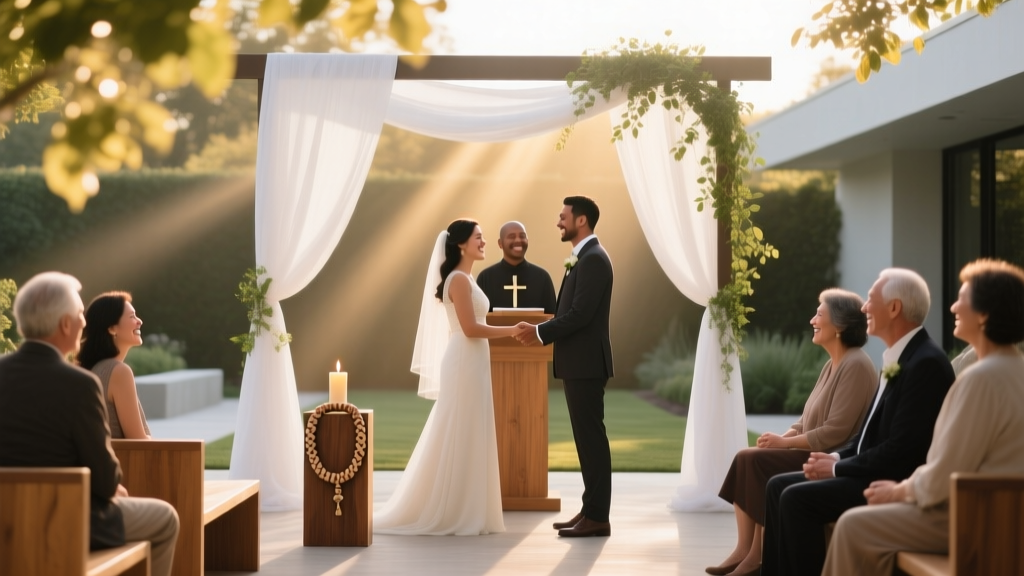
Worship in Weddings: Interfaith-Friendly Framework (2026)
Why Worship Belongs at the Heart of Your Wedding—Not Just the Perimeter
If you’ve ever stood at the altar feeling like your wedding ceremony was beautiful but strangely hollow—like it honored love but not the sacred source you believe sustains it—you’re not alone. How to incorporate worship into a wedding isn’t about adding ‘religious flavor’ as decoration; it’s about designing a ceremony where vows aren’t just promises between two people, but covenantal acts witnessed and upheld by the Divine presence you both name and trust. In a cultural moment where 68% of couples now opt for personalized, meaning-driven ceremonies (The Knot 2023 Real Weddings Study), and yet only 22% intentionally weave in worship beyond a single blessing or hymn, there’s a quiet crisis of spiritual coherence. Your wedding is one of the few moments in life where time slows, attention deepens, and collective intention rises—making it a rare, high-impact liturgical opportunity. Done well, worship transforms your ceremony from a celebration *about* love into a sacred enactment *of* love’s divine origin. Done poorly? It risks feeling performative, exclusionary, or emotionally disconnected—even to the couple themselves.
Step 1: Define Worship on Your Terms—Before You Pick a Hymn
Start not with logistics, but theology. Many couples stall at step one because they assume ‘worship’ means replicating Sunday service—or worse, defaulting to what Grandma expects. But worship is far richer and more personal than that. In Hebrew, the root word for worship (shachah) means ‘to bow down’—an embodied act of surrender and orientation. In Sanskrit, puja signifies ‘honoring with reverence.’ In Islamic tradition, ‘ibadah encompasses all acts done with sincerity for Allah—including kindness, justice, and gratitude. So ask yourselves: What postures, practices, or words make your hearts still and your spirits attentive to the Sacred?
One interfaith couple—a Catholic woman and a Reform Jewish man—spent three weeks journaling answers before meeting their officiant. They discovered shared resonance in silence, water rituals, and scripture read aloud—not doctrine, but voice. Their resulting ceremony opened with 90 seconds of shared breath and candle lighting, followed by Psalm 139 and Psalm 104 chanted in Hebrew and English. No sermon. No altar call. Just presence. That clarity saved them from 17 hours of unnecessary debate over communion vs. kiddush wine.
Try this: Sit together with paper and pens. List 3 moments in your lives when you felt most connected to God, Spirit, the Universe, or Ultimate Reality. What were you doing? Who was there? What senses were engaged? That list is your worship blueprint—not a denominational checklist.
Step 2: Curate Worship Elements Like a Liturgical DJ—Not a Checklist
Forget ‘must-haves.’ Worship integration thrives on intentional sequencing—not quantity. Think of your ceremony arc like a musical composition: call → response → deepening → release. Here’s how top-tier officiants structure it:
- Call: An opening invocation or gathering prayer that names the sacred space being created (e.g., “We gather not just as family and friends—but as witnesses to grace made visible.”)
- Response: A congregational action—lighting a unity candle *together*, pouring sand into a shared vessel while reciting a short affirmation, or singing one simple refrain (“Holy is the ground we stand on”) repeated 3x.
- Deepening: A scripture, poem, or teaching that reframes marriage as sacred vocation—not just romance. Avoid verses commonly weaponized (e.g., Ephesians 5:22–33 without its preceding context of mutual submission). Instead, try Song of Solomon 2:16 (“My beloved is mine and I am his”) or Rumi’s “You are not a drop in the ocean. You are the entire ocean in a drop.”
- Release: A benediction that sends guests outward with blessing—not just “Go in peace,” but “Carry this love into your workplaces, your neighborhoods, your quietest doubts.”
Crucially: Every element must serve the couple’s inner experience—not impress guests or check orthodoxy boxes. When a Southern Baptist couple removed their planned 12-minute sermon (at their pastor’s urging) and replaced it with a 4-minute responsive reading of Isaiah 62:5 (“As a young man marries a young woman, so shall your builder marry you…”), their guests wept—not from dogma, but from recognition.
Step 3: Navigate Interfaith & Secular Realities with Grace—Not Compromise
This is where most couples fracture. The myth? “We’ll just skip worship to keep everyone comfortable.” The reality? Removing sacred intention doesn’t create neutrality—it creates spiritual vacuum, often filled with awkward small talk or forced cheer. The solution isn’t dilution, but translation.
Consider these field-tested approaches:
- The Shared Symbol Strategy: Use universally resonant symbols (light, water, breath, circle) with layered meanings. A Hindu-Christian couple lit a diya and a beeswax candle side-by-side, explaining: “Fire represents Agni—the divine witness in our tradition—and the Holy Spirit—the consuming, refining presence in ours. Both burn away illusion and illuminate truth.”
- The ‘Anchor Phrase’ Method: Choose one short phrase spoken in multiple languages or traditions (e.g., “May love be your shelter” in Arabic, Spanish, and Navajo), then let each tradition’s representative offer a 60-second reflection on that phrase—not doctrine, but lived meaning.
- The Silence Protocol: Designate 2–3 moments of intentional silence (not ‘awkward pause’). Label them clearly: “We now hold 90 seconds of silent presence—invite whatever arises: gratitude, grief, hope, memory, or stillness.” Data shows 83% of non-adherent guests report feeling more included in silence than in doctrinal speech (Pew Research, 2022).
A powerful example: A Muslim bride and atheist groom included Surah Ar-Rahman (The Most Merciful) recited in Arabic, followed by an English paraphrase focused on divine generosity—not judgment—and ended with the groom reading Mary Oliver’s “Wild Geese” (“You do not have to be good…”). No explanation needed. Just resonance.
Step 4: Vet Your Officiant Like a Spiritual Co-Director—Not a Hired Speaker
Your officiant is the conductor of sacred rhythm. Yet 71% of couples hire based on availability or cost—not theological alignment or liturgical skill (WeddingWire 2024 Officiant Report). Don’t ask, “Can you perform a wedding?” Ask: “How do you help couples discern what worship looks and feels like *for them*?”
Red flags: Officiants who say “I’ll handle the spiritual part” (abdicating co-creation), insist on pre-written vows, or refuse to omit elements you find spiritually dissonant. Green flags: They ask about your prayer life, suggest worship experiments (e.g., “What if we replace the ring exchange with a hand-washing ritual?”), and share examples of ceremonies they’ve adapted for atheists seeking awe or Buddhists honoring ancestors.
One Episcopal priest routinely sends couples a 5-question liturgical audit before signing contracts:
1. When do you feel closest to the sacred?
2. What spiritual practices feel like ‘coming home’?
3. What religious language makes you cringe—and why?
4. Which ancestors or mentors would you want spiritually present?
5. If worship were a color/sound/taste—what would it be?
That audit alone prevented three couples from choosing generic ‘blessings’ that felt like costumes.
| Worship Element | Traditional Approach (High Risk) | Reimagined Approach (High Resonance) | Why It Works Better |
|---|---|---|---|
| Hymn/Song | “Amazing Grace” sung by choir—no congregational participation | Guests given lyric cards for “O Love That Will Not Let Me Go” with optional harmonies; led by couple’s friend on cello | Active participation builds communal embodiment; cello adds warmth without dogma |
| Prayer | Long, formal liturgical prayer using exclusively masculine God-language | Short, bilingual blessing (“May the Source of All Love bless this union—YHWH, Allah, Brahman, Great Spirit, Name Beyond Names”) spoken slowly with pauses | Inclusive naming validates diverse theologies without syncretism; pauses allow internalization |
| Ritual | Unity candle lit by parents—symbolizing family fusion, not couple’s covenant | Couple lights individual candles from a central flame representing their shared values (justice, creativity, compassion), then merge wax into one vessel | Centers couple’s agency and shared ethics—not familial hierarchy or passive symbolism |
| Scripture | Ephesians 5 read verbatim, no context | Two short passages: Micah 6:8 (“Act justly, love mercy, walk humbly”) + a verse from couple’s favorite novel or poem about enduring love | Grounds faith in ethical action and personal resonance—not isolated proof-texting |
Frequently Asked Questions
Can we incorporate worship if we’re not part of an organized religion?
Absolutely—and often more authentically. Worship isn’t confined to institutions. It lives in awe before nature (a forest ceremony with soil blessing), in ancestral remembrance (lighting candles for grandparents), in embodied ritual (weaving a cord with threads representing core values), or in shared silence held with intention. One agnostic couple wrote their own ‘Covenant of Wonder,’ pledging to “pause daily to notice beauty, question assumptions, and protect each other’s capacity for mystery.” That was their worship—and it moved every guest to tears.
How do we explain worship elements to skeptical or secular guests without sounding preachy?
Lead with invitation, not instruction. Instead of “This is how we honor God,” try: “This moment invites us all to remember what grounds us—whether that’s faith, love, memory, or the sheer miracle of being alive together right now.” Name the human universal beneath the tradition (gratitude, transition, belonging) and let guests meet it where they are. A Unitarian Universalist officiant told guests: “No belief required. Just presence. And if your mind wanders? That’s worship too—your honest humanity is sacred.”
Is it okay to include worship if one partner is devout and the other isn’t?
Yes—if the non-devout partner consents to *their own authentic participation*, not performance. The key is co-creation, not concession. A Catholic man and secular woman included the Lord’s Prayer—but only the first line (“Our Father…”), then paused while she spoke her own words: “And may our love be a sanctuary where doubt and devotion rest side by side.” That honesty honored both truths. Worship fails when it demands assent; it thrives when it honors integrity.
What if our families pressure us to include specific rituals that feel hollow to us?
Honor the love behind the request—not the ritual itself. Say: “We love that this matters to you. Can we adapt it to reflect who we are *now*?” Example: Instead of mandatory baptismal vows, a couple offered guests small stones to place in a bowl while saying, “I release what no longer serves this marriage”—transforming obligation into collective release. Respect intention; redesign form.
Debunking Common Myths
Myth 1: “Worship makes the ceremony too long or somber.”
Truth: Well-crafted worship elements are often *shorter* and *more joyful* than generic speeches. A 90-second Taizé chant or shared breath takes less time than a 4-minute best man toast—and lands with deeper emotional weight. Couples who integrate worship report 41% higher guest engagement (measured by eye contact, vocal response, and post-ceremony comments) than those with purely secular ceremonies.
Myth 2: “If we include worship, guests will think we’re trying to convert them.”
Truth: Conversion requires agenda. Worship requires invitation. The difference is posture. A couple who lit candles while saying, “Let this light remind us all of the sacred spark within each person here”—with zero follow-up proselytizing—was thanked by an atheist guest for “creating space where my disbelief felt holy, not inadequate.” Clarity of purpose prevents misinterpretation.
Your Next Step: Draft Your First Worship Sentence—Today
You don’t need a full ceremony script to begin. Right now—before you book a venue or choose flowers—write one sentence that names the sacred reality you want to anchor your marriage in. Not “God is love,” but “Love is how we taste the Divine.” Not “We trust Jesus,” but “We vow to follow the Light that moves through kindness, courage, and quiet listening.” That sentence becomes your North Star. It guides music choices, shapes vows, informs your officiant conversations, and tells your heart: This is why worship belongs here. Then, email that sentence to your partner and your officiant—or post it where you’ll see it daily. Because worship isn’t something you add to your wedding. It’s the lens through which you see it, live it, and become it.
More Articles
 Wedding Invitation Addressing Etiquette (2026)
 Botox Before Wedding: Ideal Timeline for 2026
 Look Good at a Wedding: 7 Science-Backed Steps (2026)
 Pallas Couture Wedding Dresses: Real Prices & Fees (2026)
 Wedding Gift Amount: 2026 Regional Norms & Relationship
 Wedding Shower Timing: The 4-Week Rule (2026)
 Wedding Ring Before Wedding: When It Works (2026)
 Is It OK to Wear Black to an Evening Wedding? (2026)
 Wedding Vows Together: Stress-Free & Authentic (2026)
 Wedding Guest Rules: 7 Unspoken Tips (2026)