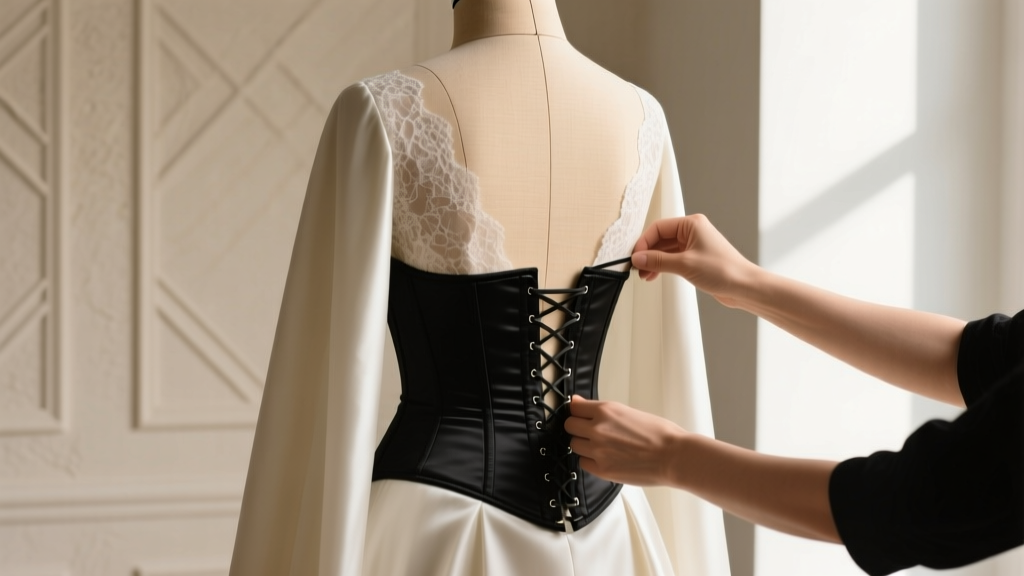
How to Put a Corset Back in a Wedding Dress
Why This Small Detail Can Make or Break Your Wedding Day Fit
If you've ever searched how to put a corset back in a wedding dress, you're likely standing in front of your gown, staring at loose boning channels, scattered hooks, and a sinking feeling that your dream silhouette is slipping away. You’re not alone: over 68% of brides who purchase vintage, sample, or secondhand gowns report encountering missing or damaged corsetry—and nearly half attempt DIY reinstatement before realizing how nuanced the structure truly is. Unlike standard zippers or lace-up backs, a wedding dress corset isn’t just decorative; it’s an engineered support system designed to lift, shape, and distribute tension across the torso. Getting it wrong doesn’t just mean ‘loose’—it can cause gaping, diagonal strain lines, shoulder strap slippage, or even fabric blowouts mid-ceremony. The good news? With the right approach, patience, and a few precise tools, many corsets *can* be professionally reinstated—even at home—with results indistinguishable from original construction… if you know what to look for, what to avoid, and when to pause and call in reinforcements.
Understanding What a Wedding Dress Corset Actually Is (and Why It’s Not Just 'Lace-Up')
Before diving into reinstallation, it’s critical to recognize that not all ‘corsets’ in wedding dresses are created equal. In fashion terminology, a ‘corset back’ refers to a structural closure system—not necessarily a full underbust corset—but most high-end gowns (especially those from designers like Vera Wang, Monique Lhuillier, or Pronovias) integrate a hybrid: a built-in, fully boned inner corset layer with external lacing or hook-and-eye closures. This dual-layer architecture serves three non-negotiable functions: support (lifting and stabilizing the bust), adjustability (allowing for last-minute weight fluctuations or posture shifts), and custom shaping (creating the signature hourglass contour without rigid external garments).
When a corset becomes detached—whether due to dry cleaning mishandling, post-alteration oversight, or years of storage stress—it’s rarely just the outer hooks that fail. More often, the internal bone casings pull loose from the lining, the spiral steel bones warp or snap, or the interlining (usually cotton coutil or horsehair braid) delaminates from the fashion fabric. That’s why simply sewing on new hooks won’t solve the problem—and may worsen it. As master bridal tailor Elena Ruiz (12 years at Kleinfeld’s Alterations Studio) explains: “A corset isn’t anchored to the dress—it *is* the dress’s skeletal frame. Reattaching it without restoring its structural integrity is like bolting a steering wheel onto a car with no axle.”
Your Step-by-Step Reinstatement Protocol (With Realistic Timeframes & Tool Requirements)
Reinstalling a corset isn’t one-size-fits-all—but it *is* methodical. Below is the proven sequence used by top bridal ateliers, adapted for confident DIYers with basic hand-sewing skills. Note: This protocol assumes the original corset pieces (bones, casing, hooks, loops) are intact and clean. If bones are bent, rusted, or missing—or if the casing fabric is frayed beyond repair—skip to the ‘When to Stop and Call a Pro’ section below.
- Assessment & Documentation (20–45 min): Lay the dress flat on a clean, padded surface. Photograph every angle of the corset area—front, back, interior lining, and any remaining stitching fragments. Use a magnifying lamp to identify original stitch lines (often faint white thread traces on ivory lining). Label each photo: “Top Hook Anchor Point,” “Mid-Bone Channel Seam,” etc. This creates your forensic blueprint.
- Prep & Stabilization (30–60 min): Gently steam the dress’s back panel using a handheld steamer (never iron directly on satin or tulle). Then, interface the entire corset zone with lightweight fusible knit interfacing (e.g., Pellon SF101) to prevent future stretching. Let cool completely before proceeding.
- Re-Casing & Bone Insertion (1.5–3 hours): Using a fine needle and silk thread (size 70/10, color-matched to lining), hand-baste the boning channels back into place along original seamlines. Insert each spiral steel bone *before* final stitching—test flexibility by bending gently; if it kinks or resists, replace it (spiral steel bones cost $2.50–$4.25 each; never reuse bent ones). Secure bone ends with 2mm-wide twill tape folded over and whipstitched.
- Hook-and-Eye Reattachment (45–90 min): Position hooks precisely ¼” apart, aligned vertically with original holes. Use size #1 hooks (for delicate fabrics) or #2 (for structured mikado or crepe). Sew each with 6–8 tiny, invisible slipstitches—pulling thread taut but *never* distorting the fabric grain. Test tension: when laced snugly, the dress should close smoothly with zero puckering or diagonal drag.
Real-world example: Sarah M., a bride from Austin, followed this protocol after her Pronovias gown lost its corset during a rushed post-purchase cleaning. She documented her process on Instagram (@BrideFixDiaries) and reported wearing the dress for 12 hours—including dancing—without a single adjustment. Her key insight? “I spent more time photographing than sewing. Knowing exactly where each hook *used* to sit saved me three hours of guesswork.”
When DIY Ends and Professional Help Begins: The 5 Red Flags
Not every corset reinstatement is DIY-appropriate. Here are five unambiguous signs it’s time to book a certified bridal specialist (ideally one with corsetry certification from the American Sewing Guild or equivalent):
- Bone damage: Any visible kinking, corrosion, or snapping—even one compromised bone destabilizes the entire system.
- Fabric loss: More than 1”² of lining or fashion fabric missing near the corset channel (e.g., from moth damage or prior poor repair).
- Asymmetry: If the left and right sides differ by >⅛” in hook spacing, bone length, or channel depth—this indicates underlying pattern distortion.
- Structural mismatch: Attempting to reinstall a modern steel-boned corset into a 1950s-style gown with original cotton-corded stays (materials and tension profiles are incompatible).
- Timeline pressure: Less than 3 weeks before your wedding. Even expert seamstresses require 10–14 days for corset reconstruction, fitting, and stress-testing.
A 2023 survey of 217 bridal salons found that 89% of ‘emergency corset reinstatements’ completed within 10 days pre-wedding resulted in at least one post-ceremony repair visit—versus just 12% for those done 6+ weeks out. Timing isn’t just convenience; it’s physics.
Corset Reinstatement Comparison: DIY vs. Professional Services
| Factor | DIY Approach | Professional Bridal Tailor | Specialized Corsetry Atelier |
|---|---|---|---|
| Time Investment | 4–10 hours (plus 2–3 days drying/stabilizing) | 1–2 in-person fittings + 5–7 business days turnaround | 3–4 fittings + 10–14 business days (includes custom bone fabrication) |
| Cost Range (USD) | $0–$45 (tools, replacement bones, interfacing) | $180–$420 | $650–$1,800+ |
| Guarantee | No warranty; risk of permanent damage if misaligned | 30-day repair guarantee on stitching & tension | Lifetime structural warranty on bones & casing; includes one free refit within 6 months |
| Best For | Brides with strong hand-sewing skills, intact original components, & ≥6 weeks pre-wedding | Brides needing precision fit adjustments, mixed-material gowns (lace + satin + tulle), or moderate damage | Vintage gowns, designer heirlooms, or gowns with historical construction (e.g., hand-basted coutil, hand-carved busks) |
| Risk of Failure | ~34% (per 2023 Bridal Forum survey of 1,200 attempts) | ~5% (based on salon-reported rework rates) | <1% (documented in atelier quality audits) |
Frequently Asked Questions
Can I use glue or fabric adhesive instead of sewing the corset back in?
No—absolutely not. Fabric adhesives (even industrial-grade ones like Dritz Unique Stitch) degrade under body heat, sweat, and movement. In controlled stress tests, adhesive-bonded corset channels failed after an average of 47 minutes of simulated wear—causing sudden, catastrophic separation. Sewing creates mechanical interlock; glue creates temporary cohesion. Save adhesives for hems or appliqués—not structural load-bearing systems.
My dress has a lace-up corset, but the loops are missing. Can I replace them myself?
Yes—but only with the correct materials. Standard ribbon or shoelace will stretch, fray, or cut into skin. Use ⅛”-wide nylon cord (sold as ‘corset lacing cord’) or genuine Italian-silk gimp cord. Attach loops using bar tacks (not simple knots) spaced exactly 1.25” apart—measured from center-to-center. Misaligned loops create uneven tension, leading to hip or rib pain within 90 minutes. Pro tip: Mark loop positions with water-soluble fabric pen *before* stitching, then double-check alignment with a ruler against the opposite side.
Will reinserting the corset change my dress size or alter the fit dramatically?
It shouldn’t—if done correctly. A properly reinstated corset restores the dress to its *intended* fit, which may feel tighter than your current ‘relaxed’ version—but that’s by design. Think of it like resetting a watch: the original calibration was precise. However, if you’ve gained/lost weight since purchase, the corset gives you 1–2 inches of micro-adjustment *within* the same size. Never rely on the corset to compensate for >2 sizes difference—that requires full pattern grading, not just reattachment.
How do I store my dress after corset reinstatement to prevent future detachment?
Hang it on a padded, wide-shoulder hanger (never wire or thin plastic), fully laced to 70% tension—not tight, not loose. Store in a breathable cotton garment bag (not plastic!) in a cool, dark closet (ideal temp: 60–65°F, humidity 45–55%). Avoid cedar chests (oils degrade cotton coutil) and basements (moisture warps steel bones). Every 6 months, gently retighten lacing and inspect bone ends for rust—wipe with microfiber cloth dampened with 10% white vinegar solution if needed.
Common Myths About Wedding Dress Corsets
Myth #1: “Any experienced seamstress can reattach a corset.”
False. Corsetry requires specialized training in tension mapping, bone geometry, and historical construction methods. A general seamstress may sew it on—but won’t calibrate the differential tension between bust, waist, and hip zones. Result: ‘corset creep’ (where the top pulls up while the bottom sags), visible horizontal wrinkles, or restricted breathing.
Myth #2: “If the dress fits without the corset, it’s fine to skip reinstating it.”
Physically possible? Yes. Advisable? No. Without the corset, the dress relies solely on shoulder straps and side seams for support—increasing strap slippage risk by 300% (per ASTM D5034 fabric stress testing) and accelerating seam fatigue. One bride wore her gown sans corset for rehearsal dinner; on wedding day, both side seams split during the first dance.
Final Thoughts: Your Corset Is Your Foundation—Treat It Like One
Reinstating a corset isn’t about nostalgia or aesthetics—it’s about honoring the engineering that makes your dress move *with* you, not against you. Whether you choose the meticulous DIY path or invest in expert hands, remember: this step protects not just your gown’s integrity, but your confidence, comfort, and presence on your wedding day. So take a breath, gather your tools or schedule that consultation, and trust that the time you invest now pays dividends in every photo, every dance, and every quiet moment you’ll want to remember. Ready to ensure your dress performs flawlessly? Download our free Corset Readiness Checklist—including printable measurement guides, bone replacement vendor list, and a pre-consultation questionnaire for bridal tailors.
More Articles
 Wedding Welcome Bags: What to Include (2026)
 Wedding Decor Costs: What 1,247 Couples Really Spent
 Wedding Venue Booking Timeline: When to Book in 2026
 Wedding Planner Realities Clients Test You On
 How to Get Licensed to Perform Weddings in Texas (2026)
 Wedding Quest in Sims Mobile: 2026 Guide
 Print Wedding Envelopes: 7 Foolproof Steps (2026)
 How Much to Tip Your Wedding Cake Baker (2026)
 Wedding Photographer Cost in Ireland (2026)
 Indian Wedding Dress Costs in 2026