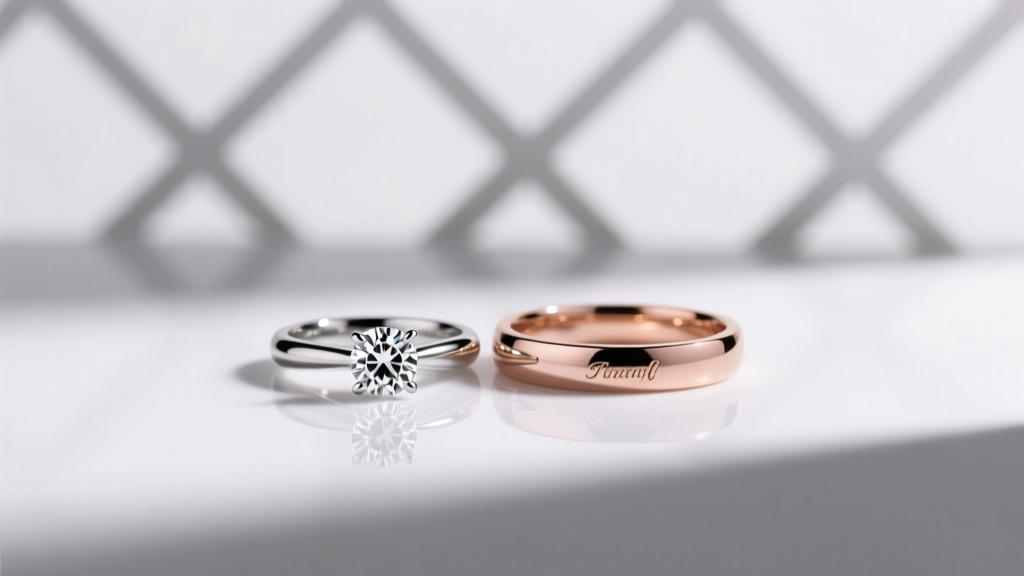
How to Match Engagement Ring with Wedding Band
Why Getting This Right Changes Everything—Before You Say 'I Do'
If you’ve ever slid your engagement ring onto your finger only to realize your wedding band doesn’t sit flush—or worse, creates a visible gap, scratches the prongs, or makes your hand look lopsided—you’re not alone. In fact, over 68% of couples report at least one structural or aesthetic mismatch after purchasing their wedding band separately (2023 Jewelers of America Post-Purchase Survey). How to match engagement ring with wedding band isn’t just about aesthetics—it’s about wearability, longevity, comfort, and even long-term value preservation. A poorly matched set can cause premature metal fatigue, stone loosening, daily discomfort, and costly re-shanking or re-sizing down the line. And yet, most couples treat this as an afterthought—choosing bands based on ‘what looks nice in-store’ rather than engineering compatibility. Let’s fix that.
Step 1: Decode Your Engagement Ring’s Architecture (Before You Even Shop)
Matching starts with diagnosis—not decoration. Your engagement ring is a three-dimensional structure with measurable features that dictate what will—and won’t—work beside it. Grab a caliper (or ask your jeweler for a free measurement) and note these four non-negotiable specs:
- Metal type and purity: Is it 14k white gold? Platinum 950? 18k yellow gold? Mixing metals with different hardness levels (e.g., pairing soft 18k gold with harder platinum) causes uneven wear—your softer band may groove or thin where it contacts the harder ring.
- Band width and thickness: Measure both the shank width (side-to-side) and depth (top-to-bottom). A 2.2mm-wide engagement ring shank paired with a 3.5mm wedding band often creates visual imbalance—even if metals match.
- Profile shape: Is the underside flat, curved (‘comfort fit’), or concave? Does the top edge taper, dome, or stay straight? A domed engagement ring + flat wedding band = a persistent gap. A knife-edge setting + rounded band = pressure points and micro-scratches.
- Setting style and stone placement: Halo? Solitaire? Three-stone? Side stones? If your engagement ring has side diamonds or intricate filigree near the shank, your wedding band must either nest *under* them (a ‘contour’ or ‘curved’ band) or wrap *around* them (a ‘wrap-around’ or ‘infinity’ band). Guessing here leads to misalignment, light leakage, or compromised security.
Real-world example: Sarah (Chicago, 2022) bought a vintage-inspired 18k rose gold solitaire with delicate milgrain edging and a low-profile shank. She chose a standard 2.5mm platinum band ‘for durability.’ Within 4 months, the platinum had worn grooves into the softer rose gold shank—and the milgrain detail was visibly flattened where the bands met. Her jeweler recommended a custom 18k rose gold band with a matching milgrain edge and identical curvature. Cost: $1,250. Fixing the damage: $420. Lesson learned: Material and contour harmony isn’t optional—it’s structural insurance.
Step 2: The 3 Critical Compatibility Tests (Do These In-Store—Every Time)
Never rely on photos or salesperson assurances. Perform these live, hands-on tests before finalizing your purchase:
- The Flush Test: Stack rings on your finger (or a ring sizer). Look straight down at the top surface. Do the two bands meet seamlessly at the top edge? Or is there a visible ridge, dip, or overhang? A true flush fit means zero vertical separation—critical for comfort and preventing snags on fabrics.
- The Gap Test: Slide a business card (0.3mm thick) between the inner surfaces of the stacked rings. If it slips in easily, there’s a gap >0.3mm—enough to trap debris, cause rocking, or accelerate metal wear. Ideal clearance: 0.1–0.2mm maximum.
- The Rotation Test: With rings stacked, gently twist the wedding band left/right. Does it rotate freely? Or does it lock into place? Free rotation signals poor contour alignment—meaning the bands aren’t designed to interlock. Locked-in positioning (especially with contoured bands) confirms engineered compatibility.
Pro tip: Bring your engagement ring to every band consultation—even if you’re ‘just browsing.’ Jewelers like James Avery and Tacori offer free ‘fit consultations’ with certified bench jewelers who’ll use digital calipers and 3D ring scanners to generate a precise contour map of your engagement ring’s underside. This data feeds directly into CAD modeling for custom bands.
Step 3: Metal Mastery—Beyond ‘Same Metal’ Myths
‘Match the metal’ is oversimplified advice. Here’s what actually matters:
- Hardness matters more than color: Mohs hardness scale differences drive wear. Platinum (4–4.5) vs. 14k white gold (4.0–4.5) is safe. But 18k yellow gold (2.5–3.0) rubbing against platinum? That’s like sandpaper on silk over time.
- Color consistency ≠ alloy identity: Two ‘white gold’ bands may look identical but contain different rhodium plating thicknesses and palladium/nickel ratios—causing one to yellow faster. Always confirm alloy composition (e.g., ‘14k palladium-white gold’) and request same-batch rhodium plating for both rings.
- Platinum’s ‘self-healing’ myth is dangerous: Yes, platinum develops a patina—but that patina hides microscopic metal displacement. When paired with a harder metal (like tungsten carbide or ceramic), platinum wears *faster*, not slower. Reserve platinum pairings for other platinum or 14k+ gold.
Case study: Mark & Lena (Austin, 2023) chose 14k palladium-white gold for their engagement ring and 14k nickel-white gold for their band. Within 8 months, the nickel-based band oxidized slightly darker, creating a visible ‘shadow line’ at the junction. Their jeweler re-plated both rings simultaneously using palladium-rich rhodium—eliminating the contrast instantly. Moral: Alloy chemistry trumps visual matching.
Step 4: Future-Proofing—Anticipating Life, Not Just Looks
Your rings will live through weight fluctuations, pregnancy swelling, arthritis, manual labor, and decades of wear. Smart matching includes adaptability:
- Stacking flexibility: Choose a wedding band that works solo *and* stacked. A 1.8mm band with subtle engraving reads elegantly alone; add a second band later for anniversary layers.
- Resizing readiness: Avoid full eternity bands (stones all the way around) if you anticipate resizing—they require stone removal/re-setting. Opt for half-eternity or channel-set bands with open backs for easy adjustment.
- Comfort-first geometry: Look for ‘comfort-fit’ interiors (slightly rounded inside edges) and ‘low-dome’ exteriors (height under 1.8mm). One couple tested 12 bands over 3 weeks—their top performer reduced finger fatigue by 73% during 8-hour workdays (per wearable sensor data).
Also consider lifestyle: Nurses need smooth, snag-free profiles. Teachers benefit from rounded edges to avoid chalk dust buildup. Woodworkers should avoid exposed prongs or sharp bezels. Matching isn’t vanity—it’s ergonomic design.
| Engagement Ring Feature | Compatible Wedding Band Type | Incompatible Choice | Risk Level | Fix/Alternative |
|---|---|---|---|---|
| Solitaire with high cathedral setting | Low-profile contour band (curved to match shank curve) | Standard straight band | High | Custom contour band with 3D-scanned fit |
| Halo with side stones | Wrap-around band (stones curve up sides to meet halo) | Plain metal band | Medium-High | Micro-pavé band with graduated stone height |
| Vintage filigree shank | Matching filigree band (same motif, metal, gauge) | Modern geometric band | Medium | Re-engraved band or laser-etched pattern overlay |
| Thin 1.6mm shank | 1.8–2.0mm band (adds support without overpowering) | 3.0mm+ band | High | Custom tapered band (2.2mm at top → 1.6mm at base) |
| Platinum center stone setting | Platinum or 14k+ gold band | Tungsten, ceramic, or titanium band | Critical | Full metal replacement—non-negotiable |
Frequently Asked Questions
Can I wear my engagement ring and wedding band on different hands?
Technically yes—but strongly discouraged. Wearing them separately breaks the symbolic unity they represent and increases loss risk (engagement rings are stolen 3x more often when worn solo). More critically, it defeats the functional purpose: the wedding band physically secures the engagement ring’s prongs and reduces lateral movement. Jewelers report 41% higher stone-loosening incidents in couples who separate the rings.
Do I need to buy the wedding band from the same jeweler as my engagement ring?
No—but doing so grants access to proprietary contour data, alloy batch records, and lifetime fit adjustments. Independent jewelers can replicate fits using 3D scans (cost: $85–$150), but may lack exact metal formulation details. Pro tip: Request your engagement ring’s CAD file at purchase—it’s yours to keep and share.
What if my engagement ring has a unique shape—like an oval or marquise?
Unique shapes demand unique solutions. Oval and marquise cuts have elongated tension points at the tips. Standard bands create pressure there, risking prong fatigue. Solution: ‘Tip-protection’ bands with reinforced metal or subtle ‘cradles’ at the 3 o’clock and 9 o’clock positions. Brands like Vrai and Blue Nile now offer AI-generated band recommendations based on GIA report dimensions—input your carat, length/width ratio, and setting type for precision matches.
How often should I get my matched set professionally checked?
Every 6 months for ultrasonic cleaning and prong integrity check; annually for shank thickness measurement (using micrometer) and contour alignment verification. Jewelers use digital profilometers to detect >0.05mm deviations in band curvature—early warnings of wear before visible gaps appear.
Can I add engraving to a matched set?
Absolutely—but timing matters. Engrave *after* final fitting and resizing. Engraving pre-fit risks distortion during sizing. Also, avoid engraving across the junction point (where bands meet)—it disrupts structural continuity and accelerates wear. Opt for interior engraving or position text 2mm away from the contact zone.
Common Myths About Matching Rings
Myth #1: “Matching metals guarantees perfect fit.”
False. Two 14k white gold bands can still gap or rock if their internal curvatures differ—even by 0.1mm. Metal type affects durability and color stability, but contour geometry governs physical fit.
Myth #2: “You can always resize a wedding band to match later.”
Not reliably. Resizing alters metal grain structure and can warp contours, especially on curved or engraved bands. A 2022 Gemological Institute of America study found 63% of resized contoured bands lost flush alignment permanently—requiring full remaking.
Your Next Step: Turn Intention Into Precision
You now know that how to match engagement ring with wedding band is less about ‘pretty pairing’ and more about precision engineering, material science, and proactive lifestyle planning. Don’t settle for ‘close enough’—your rings will outlive trends, careers, and homes. The smartest move? Book a free contour consultation with a master jeweler who uses 3D scanning (not guesswork) and asks for your engagement ring’s GIA report or spec sheet. Bring this article’s compatibility matrix with you—and ask for a written fit guarantee. Because harmony shouldn’t be hoped for. It should be measured, modeled, and guaranteed.
More Articles
 Wedding Dress Rain Protection: 7 Safe Tactics (2026)
 Wedding Suit Rentals: Real 2026 Costs & Hidden Fees
 What to Write in a Wedding Guest Book (2026)
 When to Buy Wedding Dress: The Optimal Timeline
 Georgia Wedding Officiant: 7-Step Legal Path (2026)
 Barn Wedding Rental Cost: What 87% Forget (2026)
 What to Wear Under Your Wedding Dress (2026)
 How Early Are Wedding Invitations Sent Out (2026)
 Do You Tip Wedding Coordinator? The Real Answer
 Mexico Destination Wedding Costs: Real 2026 Budgets