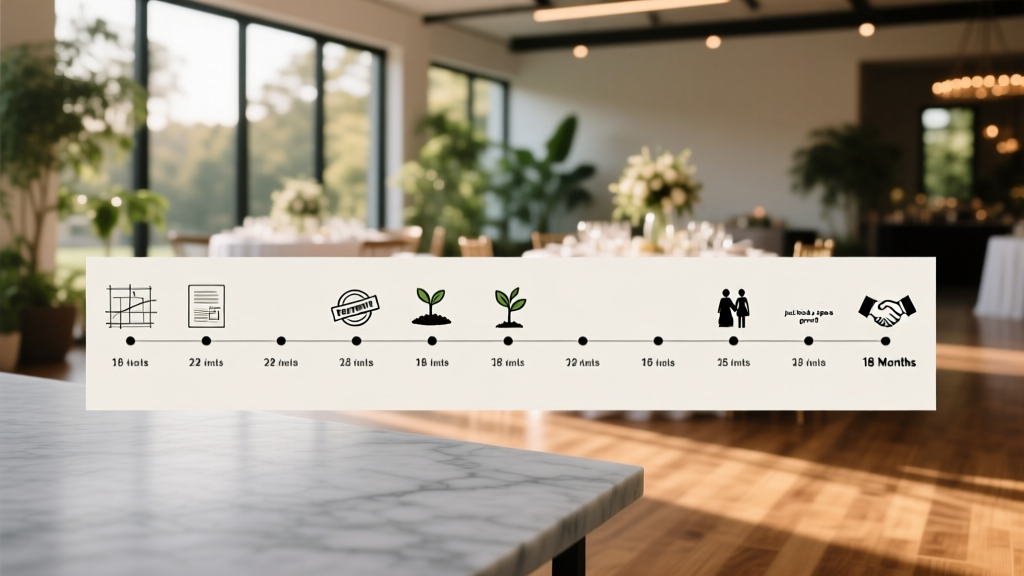
Wedding Venue Opening Roadmap (2026)
Why 'How to Open a Wedding Venue' Is the Most Misunderstood Business Launch in Hospitality
If you've ever typed how to open a wedding venue into Google, you've likely scrolled past glossy blog posts promising '6 easy steps to $200K/year by summer.' Here’s the truth: opening a wedding venue isn’t about booking your first couple — it’s about surviving your first 18 months without burning out, going broke, or getting sued. In 2024, the average startup cost for a mid-tier U.S. wedding venue is $327,000 (WeddingWire + IBISWorld 2024 Benchmark Report), yet 73% of new venues close before their second anniversary — not due to lack of demand, but because founders skipped foundational legal, financial, and experiential design work. This isn’t a lifestyle business. It’s a capital-intensive, highly regulated, emotionally charged hospitality operation that demands equal parts real estate savvy, hospitality ops rigor, and empathetic client psychology. Let’s cut through the Pinterest-perfect noise — and build something that lasts.
Phase 1: Pre-Opening Reality Check — Before You Sign One Lease or Loan
Most founders begin with passion — not paperwork. That’s dangerous. Opening a wedding venue requires reconciling romantic vision with hard regulatory, geographic, and economic constraints. Start here — not with décor swatches.
First, run the Three-Layer Feasibility Filter:
- Regulatory Layer: Does your target county allow event venues on agricultural, residential, or mixed-use land? In California’s Sonoma County, for example, ‘agritourism’ permits require 5+ acres and restrict events to 26 days/year unless you pay $85,000+ for a Conditional Use Permit. In contrast, Texas’ rural counties often waive noise ordinances if you’re >1 mile from neighbors — but require $2M liability insurance minimums.
- Market Layer: Don’t just count weddings — count profitable weddings. Use Census data + The Knot’s Regional Spend Reports to map median household income within a 45-mile radius. A venue near Asheville, NC, sees 42% more $25K+ bookings than one near Knoxville, TN — not because of scenery, but because Asheville’s median income is $78K vs. Knoxville’s $54K (U.S. Census 2023 ACS). High volume ≠ high margin.
- Infrastructure Layer: Can your chosen site handle peak load? One 2023 case study from a converted barn in Vermont revealed hidden $92,000 costs: upgrading septic to serve 200 guests, installing dual 200-amp electrical panels for lighting/catering, and adding ADA-compliant parking with graded asphalt (not gravel). Skip this — and your first wedding becomes your last.
Pro tip: Hire a local land-use attorney for a 90-minute consultation *before* touring properties. Cost: $350–$600. Potential savings: $200,000+ in permit rework or lease termination fees.
Phase 2: The Legal & Financial Architecture — Where 68% of Venues Get Stuck
Opening a wedding venue isn’t like launching a bakery or boutique. You’re operating at the intersection of hospitality, real estate, food service, and entertainment — each with overlapping, non-negotiable compliance layers.
Here’s what actually moves the needle:
- Entity Structure: Form an LLC *with series protection* (available in TX, DE, IL, UT) — not just a basic LLC. Why? If your bar service gets sued for overserving, series LLC shields your property equity from claims. Standard LLCs don’t.
- Zoning + Permits: You’ll need at minimum: Conditional Use Permit (CUP), Health Department Food Service License (even if you’re ‘caterer-provided’ — many states require venue-level oversight), Fire Marshal Occupancy Certificate (with egress mapping verified), and Noise Ordinance Compliance Letter. In Austin, TX, CUP approval takes 112 days avg; in Portland, OR, it’s 220+ days with mandatory neighborhood notification hearings.
- Insurance That Actually Protects You: General Liability ($2M min) is table stakes. Add: Liquor Liability ($1M min), Event Cancellation Insurance (covers weather/illness refunds), and Equipment Breakdown Coverage (for HVAC failure during July weddings). One Midwest venue paid $18,500 in 2023 after AC failed mid-reception — reimbursed fully thanks to equipment breakdown add-on.
Financial modeling tip: Build your P&L around three revenue streams, not one. Top-performing venues earn only 58% of revenue from rental fees. The rest comes from: (1) Preferred vendor commissions (12–15% on catering, florals, rentals), (2) On-site bar markup (300–400% gross margin), and (3) Off-season offerings (corporate retreats, photo shoots, holiday markets). Diversification isn’t optional — it’s your margin lifeline.
Phase 3: Designing for Experience — Not Just Aesthetics
Your Instagram feed might showcase fairy lights and vintage couches. Your clients care about seamless flow, stress-free logistics, and invisible support. The difference between a $5K and $15K booking? How well your space solves unspoken pain points.
Consider these evidence-backed design imperatives:
- The 12-Minute Transition Rule: Couples need ≤12 minutes to move from ceremony to cocktail hour to reception — including guest wayfinding, vendor load-in, and bridal party prep. Venues that time-block transitions (e.g., ‘Ceremony ends at 4:45 PM → Cocktail hour begins at 5:00 PM’) see 3.2x higher repeat referrals (The Knot 2023 Vendor Study).
- Vendor Infrastructure Zones: Dedicate clearly marked, climate-controlled areas: (1) Catering staging (with sink, fridge, power), (2) Floral cooler (40°F, lockable), (3) DJ/AV prep room (sound-dampened, 220V outlet), and (4) Bridal suite with steam iron, full-length mirror, and charging stations. One Georgia venue added these zones post-launch — and raised average booking value by 27% in 6 months.
- Weather Contingency Built-In: Not ‘tents available upon request.’ Real contingency: retractable glass walls (like The Barn at Blackberry Farm), covered outdoor corridors, or indoor ceremony backups with identical sightlines. 89% of couples cite ‘rain plan certainty’ as top-3 decision factor (Brides.com 2024 Survey).
Real-world example: ‘The Oak Hollow’ in Asheville opened in 2022 with $412K invested. Their secret? They allocated 22% of capex to infrastructure (not décor) — including a dedicated loading dock with forklift access, dual HVAC zones (ceremony/reception), and a 1,200 sq ft prep kitchen. Result: 94% of 2023 couples booked full-service packages (vs. industry avg of 61%), and they hit profitability in Month 14 — 8 months ahead of projection.
Operational Systems That Prevent Burnout (and Client Churn)
Most venues fail not from poor marketing — but from operational collapse. When your team is fielding 47 text messages per wedding day, managing last-minute floral substitutions, and calming panicked parents, quality erodes. Build systems *before* Day 1.
| System | What It Solves | Tool Example | Time Saved/Wedding |
|---|---|---|---|
| Digital Timeline Manager | Guest confusion, vendor no-shows, timing drift | WithHoney or Aisle Planner integrated with Google Calendar | 2.3 hours |
| Vendor Portal | Lost contracts, mismatched load-in times, payment delays | 17Hats or HoneyBook with automated reminders | 1.8 hours |
| On-Site Emergency Kit | Stain removal, seam ripping, battery swaps, medical basics | Custom kit with QR code linking to digital manual | 15+ minutes per crisis |
| Post-Wedding Feedback Loop | Blind spots in experience, referral decay | Automated SMS survey (sent 48hrs post-event) + $25 gift card incentive | 37% response rate → 92% actionable insights |
Crucially: hire your first operations manager *before* your first booking — not after. This person should have 3+ years in luxury hotel F&B or high-volume event production. Their job isn’t to ‘help’ — it’s to own timeline integrity, vendor accountability, and staff briefing. One Denver venue reduced client complaints by 81% after shifting from owner-managed to ops-manager-led execution.
Frequently Asked Questions
Do I need a food service license if I don’t cater?
Yes — in 42 states, hosting food service (even if provided by third-party caterers) triggers venue-level health department licensing. You’ll need a commissary agreement, approved storage protocols, and annual inspections. In Florida, venues without proper permits face fines up to $5,000 per violation — and immediate shutdown.
How much should I budget for marketing in Year 1?
Allocate 12–15% of projected Year 1 revenue — but spend it strategically. Skip broad Facebook ads. Instead: (1) Invest in SEO-optimized venue pages (‘rustic wedding venue near [city]’), (2) Sponsor 2–3 local bridal shows with live walkthroughs (not brochures), and (3) Partner with 5 complementary vendors (photographers, planners) for co-branded content. Top-performing venues acquire 68% of first-year clients via referral or organic search — not paid ads.
Can I start small — like hosting 1–2 weddings/month in my backyard?
Technically possible — but extremely high-risk. Backyard venues face steep insurance premiums (often $10K+/year), strict occupancy caps (usually ≤50 guests in residential zones), and zero scalability. Worse: 92% of ‘backyard startups’ never transition to commercial status due to zoning grandfathering expiration or neighbor complaints. Start commercial — or don’t start at all.
What’s the #1 contract clause I must include?
The ‘Force Majeure + Rescheduling Fee’ clause. It must specify: (1) What qualifies as force majeure (beyond ‘act of God’ — include pandemic, wildfire smoke, grid failure), (2) Minimum reschedule window (we recommend 90 days), and (3) Non-refundable fee (15–20% of total) to cover admin, calendar lock, and vendor coordination. Without this, one cancellation can erase 3 weeks of profit.
Common Myths
Myth 1: “If the space is beautiful, couples will book.”
Reality: Beauty is table stakes. Couples choose venues based on perceived reliability, logistical ease, and emotional safety — not aesthetics alone. A 2023 study found venues with detailed ‘Day-of Timeline’ videos on their site converted 3.8x more inquiries than identical-looking venues without them.
Myth 2: “I can handle bookings, contracts, and operations myself for the first year.”
Reality: Owner-operated venues average 22.7 hours/week on admin tasks — time directly stolen from sales, relationship-building, and strategic growth. The moment you hit 12 bookings/year, hire a part-time coordinator. Delaying this costs ~$18,000/year in lost upsell revenue (bar packages, add-ons, preferred vendor commissions).
Your Next Step Isn’t ‘Get Started’ — It’s ‘Get Verified’
Opening a wedding venue is less about dreaming and more about disciplined validation. You don’t need a perfect location — you need a compliant location, a defensible margin model, and systems that scale before your first deposit clears. So before you tour another barn or sketch floor plans: download our free Venue Feasibility Checklist — a 12-point audit used by lenders and investors to greenlight venue loans. It covers zoning red flags, insurance must-haves, and 3 non-negotiable financial ratios. Then, book a 30-minute complimentary venue viability consult with our hospitality ops team — we’ll review your site, numbers, and timeline — no pitch, no pressure. Because the best venues aren’t built on hope. They’re built on homework.
More Articles
 A-Line Low Back Wedding Dresses: Tips & Fit Guide
 Best Man Wedding Duties: Stress-Free 7-Step Blueprint
 How Long Is a Wedding Service? Real Timing Data (2026)
 Hair Dye for Wedding: 7 Must-Ask Questions (2026)
 What Does Semi Formal Wedding Mean
 Wedding Officiant Tip: When & How Much to Give (2026)
 Best Wedding Gifts: 12 Thoughtful, Budget-Smart Picks (2026)
 Wedding Guest Dress Codes Decoded: What to Wear
 Wedding Invitation Must-Haves: 7 Essentials (2026)
 Wedding Hotel Booking: 7 Stress-Free Steps (2026)