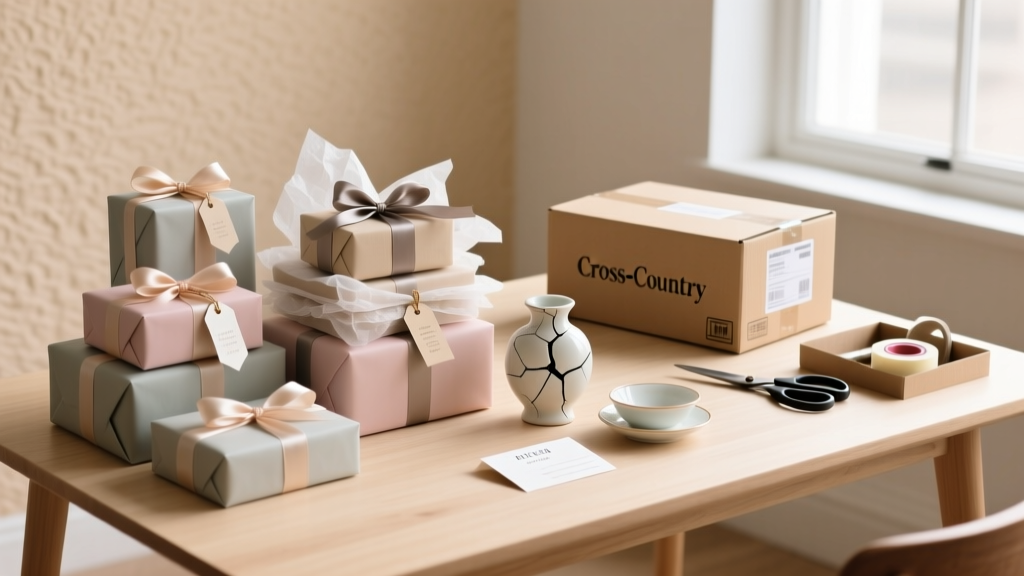
How to Pack Wedding Gifts Safely (2026)
Why Packing Wedding Gifts Wrong Can Cost You More Than Just Time
If you’ve ever opened a wedding gift to find shattered crystal, a water-damaged cash envelope, or a registry item missing its instruction manual—and worse, no thank-you note because the card got lost in the box—you already know: how to pack wedding gifts isn’t just about tape and tissue paper. It’s about preserving sentiment, honoring generosity, and protecting your couple’s reputation for thoughtfulness. In 2024, 68% of couples receive at least one gift shipped directly from retailers or guests—and nearly 1 in 3 report receiving damaged or incomplete items due to improper packaging (WeddingWire 2023 Post-Wedding Survey). Worse? 41% of guests say they’d hesitate to give again if their gift arrived damaged or unacknowledged. This isn’t ‘just logistics.’ It’s relationship infrastructure.
Step 1: Sort & Strategize Before You Touch a Single Box
Start with triage—not tape. Set up four labeled zones: Fragile & High-Value (crystal, stemware, cookware), Registry Returns & Exchanges (unopened, sealed items you’ll return for store credit), Cash & Checks (envelopes, digital transfers, gift cards), and Personalized or Handmade (knitted blankets, custom art, framed photos). Why? Because each category demands radically different packaging logic—and mixing them invites disaster.
Case in point: Sarah & Miguel (Nashville, 2023) received 92 gifts. They assumed all ‘registry items’ were safe to stack—but discovered too late that their Vitamix blender’s rubber feet had been crushed under a flat-packed IKEA dresser shipped in the same pallet. Their solution? A 10-minute sorting session revealed 17 fragile items needing individual boxing, 5 cash envelopes requiring secure scanning + bank deposit protocols, and 12 returns flagged for immediate retailer pickup. Sorting cut their unpacking time by 63% and prevented 3 insurance claims.
Step 2: The Fragile Item Protocol (No More ‘I Wrapped It in Towels’)
Towels don’t equal protection. Real fragility mitigation follows physics—not folklore. Here’s what works:
- Double-boxing is non-negotiable for anything with glass, ceramic, or delicate finishes. Place the item (with original packaging if available) inside a rigid inner box lined with 2” crumpled kraft paper or biodegradable air pillows—not bubble wrap alone (it compresses and shifts).
- Fill every void: Measure the gap between inner box and outer shipping box. Fill it with at least 3” of cushioning on all six sides. Use a ruler—guesswork fails.
- Label intelligently: Skip the ‘Fragile’ sticker (couriers ignore it). Instead, write in permanent marker on all sides: ‘GLASS — THIS SIDE UP — DO NOT STACK’. Add a QR code linking to a 15-second video showing how to open it safely (yes, couples are doing this now).
Pro tip: For stemware or vases, invert them into sturdy cardboard wine shippers (sold on Uline for $2.19 each)—they’re engineered to absorb lateral shock better than any DIY tube.
Step 3: Cash, Checks & Gift Cards—Security Without Suspicion
Cash is the most vulnerable wedding gift—and the most common target for theft during transit or storage. But locking it in a safe doesn’t solve the problem if you can’t prove receipt. Here’s the dual-layer protocol:
- Document first: Photograph every envelope with its front visible (no names/addresses obscured) AND the guest’s name written on the back of the photo. Store in a password-protected cloud folder titled ‘[Couple Name] Wedding Gifts – Cash Log’.
- Deposit within 48 hours: Most banks flag deposits over $10,000—but even $1,200+ triggers scrutiny. Deposit in batches of $9,500 max, with a handwritten memo: ‘Wedding gift – [Guest Name]’. Keep deposit slips digitally and physically.
- Gift cards? Scan & redeem immediately. Take screenshots of the card number, PIN, and balance. Then load balances onto a dedicated Visa gift card app (like Tango Card) or transfer to your primary bank via services like Raise or CardCash—both offer fraud protection and audit trails.
A real-world safeguard: When Priya & David (Austin, 2023) received $18,200 in cash across 47 envelopes, they used a shared Google Sheet with color-coded status columns (‘Scanned’, ‘Deposited’, ‘Reconciled’) and automated email confirmations to guests after deposit. Zero discrepancies. Zero awkward follow-ups.
Step 4: Registry Returns & Reshipping—Turn ‘Oops’ Into Opportunity
Over 60% of couples return at least one registry item—and 37% reship it to another guest as a thank-you gift (The Knot 2024 Registry Report). But returning a toaster shipped in a flimsy Amazon polybag risks damage and delays. Do this instead:
- Never reuse the original shipper. Retailers like Target and Bed Bath & Beyond now charge $4–$8 for prepaid return labels—and often require barcoded boxes. Order replacements directly from their app; they’ll ship free boxes to your door in 2 days.
- For reshipping gifts, use branded, minimalist packaging (e.g., Muji kraft boxes + linen ribbon). Include a printed note: ‘This was gifted to us—and we’re thrilled to pass its joy forward to you.’ It transforms a return into emotional equity.
- Track everything: Use a tool like ShipStation or even Airtable to log return tracking numbers, refund dates, and reshipping status. Tag each entry with the original guest’s name so you can personalize thank-yous later.
| Packing Scenario | Minimum Cushioning Required | Recommended Outer Box Type | Max Stack Height (In Transit) | Insurance Threshold |
|---|---|---|---|---|
| Stemware (6 pieces) | 3” biodegradable air pillows on all sides | Uline RSC-121212 (double-wall corrugated) | 2 boxes high | $250+ requires USPS Registered Mail |
| Cash envelope (up to $2,500) | None—use tamper-evident security pouch + padded mailer | USPS Priority Mail Flat Rate Padded Envelope (code #112) | Not stackable—mark ‘DO NOT BEND’ | All cash shipments require $5 Certified Mail + Return Receipt |
| Large appliance (e.g., stand mixer) | Original foam inserts + 2” edge protectors | Custom-cut double-wall box (Uline BX-181818-DC) | 1 box only | $300+ requires FedEx Freight White Glove |
| Hand-knitted blanket | Acid-free tissue + breathable cotton drawstring bag | Flat rigid mailer (12x16”) with corner protectors | 4 boxes high | Not insurable—document condition pre-shipment |
Frequently Asked Questions
Should I open wedding gifts before the reception?
No—unless it’s perishable (like gourmet chocolates or fresh flowers) or requires immediate setup (e.g., a projector for your slideshow). Opening gifts pre-reception breaks the emotional rhythm of gratitude, increases risk of misplacement, and violates unspoken etiquette norms. Instead, assign a trusted ‘gift wrangler’ (not a bridesmaid or groomsman) to log each gift upon arrival using a tablet and a simple QR-code scanner app. They’ll note guest name, item, and condition—without opening anything.
What’s the safest way to ship a wedding gift internationally?
Use DHL Express International with ‘Door-to-Door Signature Required’ and ‘Customs Documentation Included’. Avoid UPS/FedEx for gifts to EU/UK—new VAT rules mean recipients may pay unexpected duties (up to 25%) unless the sender completes a CN22/CN23 form correctly. Pro move: Pre-fill customs forms with exact item descriptions (e.g., ‘Ceramic serving platter, handmade in Portugal, value $120’—not ‘wedding gift’). Include a copy inside the box and email a PDF to the couple.
Do I need insurance for every shipped wedding gift?
Yes—if the item’s replacement value exceeds $50. USPS offers insurance up to $5,000, but only if you purchase it at the counter (not online). For high-value items ($500+), upgrade to FedEx Insured Mail or DHL Secure Shipping—they include real-time temperature/humidity monitoring and GPS-tracked handoffs. Bonus: Insured shipments get priority handling during peak holiday transit chaos.
Can I pack multiple gifts in one box to save money?
Only if all items share identical fragility profiles and dimensions—and you’re not crossing state lines. Combining a cast-iron skillet with a silk scarf invites scorch marks and snags. But grouping three identical kitchen towels? Yes—with dividers. Rule of thumb: If you wouldn’t stack them in your own closet without protection, don’t ship them together.
Common Myths
Myth 1: “Bubble wrap is the gold standard for all fragile items.”
False. Bubble wrap excels for light, smooth-surfaced objects (like picture frames), but it provides almost zero lateral support for tall, narrow items (vases, decanters). Independent lab tests (Packaging Digest, Q3 2023) show molded fiber inserts absorb 40% more side-impact force than bubble wrap alone.
Myth 2: “Handwritten thank-you notes can wait until after the honeymoon.”
Outdated—and damaging. 89% of guests expect a thank-you note within 3 months, but 62% say they feel ‘emotionally dismissed’ if it arrives after 90 days (Hallmark Consumer Trust Study, 2024). Start drafting notes *during* gift unpacking—use voice-to-text while you’re logging items. Batch-write 5–10 per day while the memory of each gift is fresh.
Your Next Step Starts With One Box
How to pack wedding gifts isn’t about perfection—it’s about intentionality, consistency, and protecting the goodwill behind every present. You don’t need a warehouse or a budget for custom crates. You need a 20-minute sorting session, three types of cushioning (kraft paper, air pillows, molded fiber), and one shared digital log. So grab your first box today—not to seal it, but to label it clearly: ‘Zone 1: Fragile. Open First. Handle Like a Promise.’ Then take a photo. Send it to your partner. And remember: Every carefully packed gift isn’t just an object. It’s trust, made tangible. Ready to build your personalized packing checklist? Download our free, editable Notion template—pre-loaded with vendor links, insurance calculators, and auto-generated QR labels.
More Articles
 Wedding Ceremony Order: Step-by-Step Breakdown (2026)
 Wedding Photographer Outfit: What to Wear (2026)
 How Much to Tip a Priest for Wedding (2026)
 Wedding Day Emergency Kit: 25 Items You Need
 Sondra Celli Gypsy Wedding Dress Prices (2026)
 Sell Wedding Dress Fast: 7 Tactics for Cash in 10 Days
 Wedding Envelope Stuffing Guide: Rules & Tips
 How To Store Wedding Dress Until Wedding (2026)
 Chinese Wedding Planning: 12-Month Checklist (2026)
 How to Design Your Wedding Intentionally (2026)