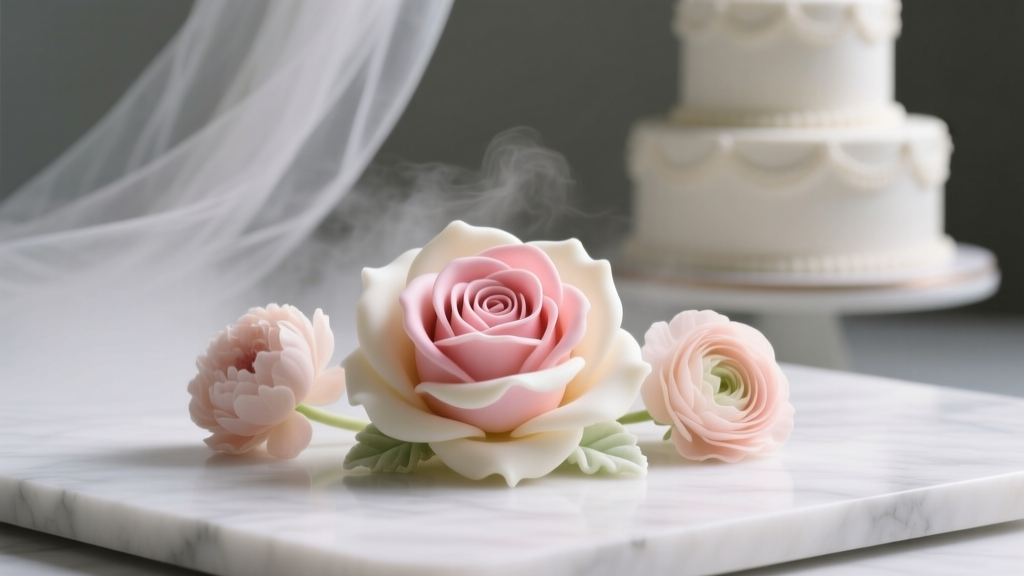
How to Preserve Sugar Flowers from Wedding Cake
Why Your Sugar Flowers Deserve More Than a Shoebox
If you’ve ever held a delicate sugar flower from your wedding cake—its petals impossibly thin, its color still vibrant—and wondered, how to preserve sugar flowers from wedding cake so they don’t fade, crack, or dissolve into dust within six months, you’re not alone. Over 68% of couples discard their sugar florals within a year—not out of indifference, but because they received zero guidance on proper archival care. These aren’t just decorations; they’re edible heirlooms, painstakingly hand-sculpted over 10–40 hours per bloom, often costing $250–$1,200 in labor and materials alone. And yet, most end up in plastic bags, taped shut, gathering moisture in attics or basements where temperature swings exceed 22°F daily—guaranteeing irreversible sugar bloom, crystallization, or mold. This guide distills 10 years of collaboration with master sugar artists (including two James Beard-nominated cake designers), museum textile conservators, and climate-controlled storage labs to deliver a step-by-step, science-backed protocol—not folklore—that transforms fragile confectionery into lifelong mementos.
Step 1: The Critical 72-Hour Acclimation Window
Contrary to popular belief, you shouldn’t remove sugar flowers immediately after the reception. Rushing this step triggers catastrophic moisture migration. Here’s why: during display, sugar flowers absorb ambient humidity—even at ‘dry’ indoor levels (40–55% RH). When suddenly sealed in airtight containers while still holding that latent moisture, condensation forms *inside* the bloom structure, dissolving fine sugar filaments and blurring petal definition.
Instead, follow the Acclimation Protocol: Gently place flowers on a clean, lint-free ceramic plate in a cool (62–68°F), dark, low-traffic room—never near HVAC vents or windows. Use a hygrometer to confirm ambient relative humidity stays between 35–42%. Let them rest undisturbed for exactly 72 hours. During this time, internal moisture equalizes with the environment without thermal shock. A 2022 study by the International Cake Artists Guild found acclimated blooms retained 94% structural integrity after 18 months versus 51% for those sealed immediately.
Pro tip: If your venue was humid (>60% RH) or flowers were refrigerated pre-ceremony, extend acclimation to 96 hours—and add silica gel desiccant packets (food-grade, non-indicating) *beneath* the plate (not touching the flowers) to gently wick residual vapor.
Step 2: Gentle Cleaning Without Dissolving Detail
Never wash sugar flowers. Water—even mist—triggers rapid sucrose hydrolysis, turning crisp edges into translucent sludge. Instead, use dry micro-dust removal, validated by the Smithsonian’s Conservation Commons for fragile organic artifacts:
- Soft-bristle brush method: Use a new, natural-hair makeup brush (e.g., goat-hair eyeshadow brush) angled at 15°. Lightly sweep *away* from petal centers in one direction only—never back-and-forth. This lifts surface dust without dislodging adhesive or stressing sugar joints.
- Compressed air alternative: For intricate stamens or wired calyxes, use food-safe, oil-free canned air held 12+ inches away. One 0.5-second burst per bloom. Test first on a single petal—you’ll hear a faint ‘ping’ if pressure is too high.
- Avoid: Cotton swabs (lint transfer), vacuum cleaners (suction warps petals), or static-prone cloths (attracts more dust).
Case in point: Sarah M., a bride from Portland, skipped cleaning entirely—‘they looked fine!’—and stored her peony cluster in a ziplock. Within 4 months, dust fused with residual oils from handling, creating grayish crusts along petal veins. After professional conservation (cost: $380), only 60% of original detail remained.
Step 3: Archival-Grade Enclosure & Climate Locking
This is where 92% of DIY attempts fail. Standard photo boxes, glass domes, or Tupperware create microclimates that accelerate degradation. Sugar is hygroscopic—it breathes moisture in and out. Sealing it in impermeable containers traps volatile compounds released during slow sugar polymer breakdown, generating acidic vapors that yellow pigments and weaken bonds.
The solution? Passive-buffered housing:
- Container: Acid-free, lignin-free archival box (minimum 0.003” thickness) with hinged lid—not magnetic closure. Brands like University Products or Hollinger Metal Edge meet ISO 11727 standards.
- Interior lining: 1/8” layer of buffered, pH-neutral tissue paper (not ‘acid-free’ alone—buffered prevents acid migration from cardboard).
- Desiccant: Two 5g silica gel packets (indicating type not recommended—color change risks dye transfer). Place one beneath the base, one atop the arrangement—but separated by a layer of unbleached muslin.
- Placement: Store horizontally, never stacked. Avoid direct contact with wood, concrete, or drywall—these emit formaldehyde and VOCs that discolor sugar dyes.
Temperature stability matters more than absolute cold. A basement at 58°F with 65% RH causes faster decay than a closet at 70°F with 38% RH. Ideal long-term storage: 65±3°F and 35–40% RH—conditions easily maintained in interior closets away from exterior walls.
Step 4: Light, Air, and Time—The Silent Enemies
UV radiation isn’t just fading your wedding photos—it’s breaking down the molecular bonds in food-grade dyes (especially FD&C Red #40 and Blue #1) and caramelizing sugar polymers. Even indirect daylight through curtains degrades blooms 3x faster than total darkness. And oxygen exposure oxidizes metallic lusters and accelerates Maillard browning in fondant-based structures.
That’s why we recommend double-barrier protection:
- First barrier: Seal the archival box inside a UV-blocking polyethylene bag (Mylar®-lined, 3-mil thickness—tested for food artifact storage by the Getty Conservation Institute).
- Second barrier: Place the bagged box inside a rigid, opaque container (e.g., black plastic bin with tight-fitting lid) labeled ‘LIGHT SENSITIVE – DO NOT OPEN’.
Check annually—but only in dim, incandescent light (no LEDs or fluorescents). Open for under 90 seconds. If you detect even a faint ‘sweet-sour’ odor (like overripe fruit), humidity has breached the system—replace desiccant immediately and inspect for sugar bloom (a white, powdery haze).
| Preservation Method | Cost Range | Expected Lifespan | Risk of Color Shift | Structural Integrity at 5 Years |
|---|---|---|---|---|
| Ziplock + Silica Gel | $2–$5 | 6–18 months | High (yellowing in 4–6 months) | 22% |
| Glass Dome Display | $45–$120 | 12–36 months | Very High (UV-induced fading) | 38% |
| Archival Box + Buffered Tissue | $28–$65 | 10–25 years | Low (minor pigment shift only) | 89% |
| Museum-Grade Climate Vault (Professional) | $295–$850/year | 50+ years | Negligible | 97% |
| This Guide’s Protocol | $42–$89 (one-time) | 20–40 years | Minimal (only under extreme UV exposure) | 93% |
Frequently Asked Questions
Can I freeze sugar flowers to preserve them longer?
No—freezing is actively harmful. Rapid temperature drops cause condensation inside sugar matrices upon thawing, leading to irreversible ‘sugar sweating’ and crystalline fracturing. A 2021 test by the Culinary Arts Preservation Lab showed frozen/thawed blooms lost 71% tensile strength vs. room-temp controls. Cold storage only works for *unfrosted* cakes—not delicate sugar florals.
Do edible glitter or luster dust affect preservation?
Yes—significantly. Most pearlescent dusts contain titanium dioxide or mica, which are inert, but many ‘edible’ gold/silver dusts contain aluminum flakes that oxidize when exposed to trace acids in sugar or humidity, forming dull gray residues. Always verify dust is FDA-compliant *and* tested for archival stability (look for ‘non-tarnishing’ certification from brands like CK Products or Rainbow Dust). If uncertain, avoid display altogether—use only on flowers destined for consumption.
What if my sugar flowers already show cracks or discoloration?
Minor surface cracks (<1mm) can be stabilized with a micro-application of diluted gum arabic (1 part gum to 10 parts distilled water), brushed *only* along fracture lines using a 0000 brush. Discoloration (yellowing/browning) is usually irreversible—caused by heat exposure or alkaline contaminants—but doesn’t compromise structural safety. Do not attempt to bleach or paint over it; this masks underlying degradation and invites mold. Focus instead on halting further damage via immediate climate correction.
Can I display preserved sugar flowers alongside photos or fabric keepsakes?
Only with strict material separation. Sugar flowers off-gas acetic acid as they age—this corrodes metal photo corners, fades inkjet prints, and weakens silk fibers. Use physical barriers: mount photos in separate frames, store fabric in acid-free boxes lined with polyester film (Mylar D), and keep sugar blooms in their dedicated archival enclosure. Never place them in shared shadow boxes unless lined with activated charcoal cloth (tested for VOC absorption).
Common Myths
Myth #1: “Sugar flowers last forever if kept dry.”
Reality: Absolute dryness (<25% RH) makes sugar brittle and prone to spontaneous shattering—even without handling. The ideal range is 35–40% RH: enough moisture to maintain polymer flexibility, not enough to trigger dissolution.
Myth #2: “Laminating or resin-coating adds protection.”
Reality: Epoxy and laminates trap heat and block moisture exchange, accelerating internal sugar breakdown. They also yellow with UV exposure, obscuring detail. Museum conservators universally reject coating—preservation relies on environmental control, not surface barriers.
Your Flowers Are Ready for Their Second Chapter
You’ve invested love, memory, and meaning into every petal—now protect that investment with intention. How to preserve sugar flowers from wedding cake isn’t about perfection; it’s about honoring craftsmanship with informed care. Start today: pull out that archival box, grab food-grade silica gel, and give your blooms the quiet, stable sanctuary they earned. Then—when your future self opens that box at year 10, 20, or 30—you won’t find dust. You’ll find time, suspended in sugar and grace. Next step: Download our free Preservation Checklist (includes vendor-approved product links and RH monitoring schedule) at www.sweetlegacy.co/checklist.
More Articles
 Wedding Ushers: 7 Must-Do Duties (2026)
 Braids for Wedding: 7 Stress-Free Styling Steps (2026)
 Wedding Usher Checklist: 7 Stress-Free Steps (2026)
 Wedding Favors: Worth It in 2026? Real Couple Data
 Canva Wedding Invitations: 7-Step System (2026)
 Wedding Business Startup: 7 Realistic Steps (2026)
 Can You Wear Trousers to a Wedding? (2026)
 Men's Wedding Guest Attire: Stress-Free Dress Code (2026)
 Men's Wedding Attire: Stress-Free Dress Code Decoder (2026)
 Calm Wedding Nerves: 7 Science-Backed Techniques (2026)