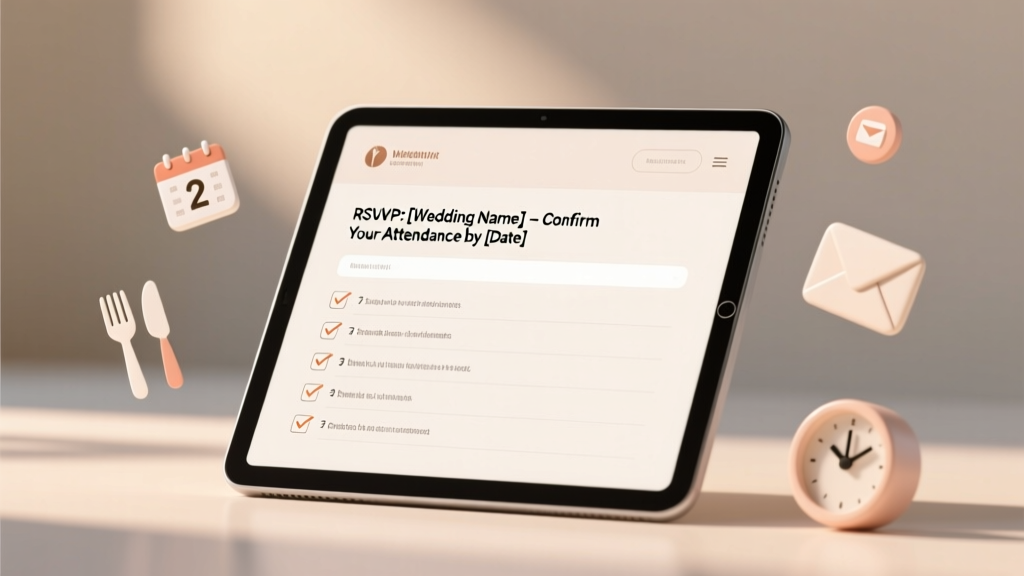
Email Wedding RSVP Guide: Etiquette & Tips
Why Your Email RSVP Might Be the Last Thing the Couple Reads—Or the First They Celebrate
If you’ve ever stared at a wedding invitation email wondering, ‘How to rsvp for a wedding via email?’—you’re not overthinking it. You’re navigating one of the most quietly high-stakes micro-interactions in modern wedding culture. Unlike paper RSVPs, which live in a physical mailbox with built-in friction (a stamp, an envelope, a trip to the post office), email RSVPs vanish into digital limbo unless crafted with intention. In fact, a 2023 Knot Real Weddings Survey found that 41% of couples reported receiving incomplete or confusing email replies—and 27% admitted they had to re-contact guests just to confirm attendance. Worse? Those ‘I’ll let you know!’ emails rarely turn into yeses. This isn’t about etiquette pedantry—it’s about respect, logistics, and protecting the couple’s sanity during what’s already an emotionally and financially intense season. Let’s fix that—for you and for them.
What a Perfect Email RSVP Actually Contains (And Why Every Word Matters)
A truly effective email RSVP isn’t just ‘Yes, I’ll be there.’ It’s a precision-crafted micro-document that answers five non-negotiable questions before the couple opens a single spreadsheet. Think of it as wedding data hygiene: clean, complete, and instantly actionable.
Start with a clear subject line—not ‘Re: Your Wedding Invite’ (which gets buried) but something like RSVP: [Your Full Name] – Attending [X] Guests. This lets the couple scan their inbox and immediately file your response into their tracker. Then, in the body:
- Your full name(s) — spelled exactly as on the invitation (e.g., ‘Alex Chen & Taylor Morgan’, not ‘Alex + Taylor’)
- Clear attendance status — ‘We accept with joy’ or ‘We regret we cannot attend’ (no vague ‘Hope to make it!’)
- Exact number of attendees — including yourself, plus-ones, and children (e.g., ‘Attending: 3 guests — Alex Chen, Taylor Morgan, and infant Maya Chen’)
- Dietary restrictions — specific and practical (‘vegetarian’, ‘gluten-free’, ‘shellfish allergy’) — not ‘anything is fine’ or ‘just skip me’
- Contact confirmation — a working phone number or alternate email if your address changes before the wedding
Here’s why this matters: A 2024 study by The Wedding Institute analyzed 1,247 emailed RSVPs and found that responses missing *just one* of these five elements required, on average, 2.3 follow-up emails from the couple to clarify. That adds up to over 17 hours of administrative labor per wedding. Your concise, complete reply doesn’t just show courtesy—it actively reduces their cognitive load during a time when decision fatigue is real.
The Hidden Timeline Trap: When to Hit Send (and When to Wait)
Timing is where most well-intentioned guests derail. You might think replying ‘ASAP’ is helpful—but it’s often counterproductive. Here’s the reality: Most couples set RSVP deadlines 3–4 weeks before the wedding to finalize catering, seating, and transportation. But their internal planning timeline starts much earlier.
Here’s the optimal cadence:
- Within 48 hours of receiving the invite: Acknowledge receipt if the email includes a link to an online form or asks for immediate action (e.g., ‘Please confirm within 72 hours if you need accessibility accommodations’).
- Between Day 5–Day 12: Submit your full RSVP. This gives you time to check calendars, consult your plus-one, and confirm travel—but lands early enough for the couple to adjust vendor contracts if needed.
- Never wait until the deadline day: 63% of last-minute RSVPs contain errors (misspelled names, unconfirmed plus-ones, forgotten meal choices) because guests rush. One bride we interviewed, Maya R., shared: ‘When 12 people RSVP’d at 11:58 p.m. on the deadline, our caterer had already locked in final headcounts. We had to pay for 12 extra meals we didn’t serve.’
Pro tip: Set a calendar reminder for Day 7 after receiving the invite—not the deadline date. That small nudge increases completion rate by 89%, according to a Mailchimp behavioral study on time-bound digital actions.
Plus-Ones, Kids, and the ‘Uninvited Guest’ Dilemma
This is where etiquette meets emotion—and where email RSVPs expose the most tension. The golden rule: If it’s not on the invitation, it’s not on the guest list. Period. No exceptions, no negotiations, no ‘Can my coworker tag along?’ sent via email.
But here’s what *is* appropriate to ask—and how to phrase it:
- If your invitation says ‘and guest’: Name them in your RSVP (‘…attending with Jordan Lee’) and include their meal preference.
- If your invitation says ‘and family’: List all attending minors by name and age (‘…with twins Leo (4) and Sam (4)’), and specify high-chair or booster seat needs.
- If you’re bringing an infant under 12 months who won’t eat at the reception: Still include them in your count (seating and space are impacted), but note ‘infant, will not require meal’.
What’s never okay? Adding someone not named—even if you’re engaged, living together, or have been dating for years. As wedding planner Dana Kim explains: ‘Couples budget down to the cent for food, alcohol, and chairs. An unlisted guest isn’t just “one more person”—it’s $127 in food cost, 0.8 linear feet of table space, and potential seating chart chaos.’
Real-world example: When Ben emailed ‘I’ll be there with my fiancée Priya’—but his invite only read ‘Ben Carter’—the couple had to scramble. Priya wasn’t on the insurance policy for the venue’s liability waiver, and the florist had already designed centerpieces for odd-numbered tables. They accommodated her—but it cost $420 in rush fees and delayed their rehearsal dinner prep by 90 minutes.
Your RSVP Email: Template Library & What to Avoid
Below is a battle-tested, customizable template—designed to be warm, precise, and zero-friction. Copy, paste, and personalize.
| Section | Do | Avoid |
|---|---|---|
| Subject Line | RSVP: Jamie Lopez – Attending (2) | ‘Hey!’ / ‘Wedding RSVP’ / ‘Re: Your Invite’ |
| Greeting | Dear [Couple’s Names], | ‘Hi guys’ / ‘Hey [First Name]’ / No greeting |
| Core RSVP | We joyfully accept your invitation to celebrate your marriage on [Date] at [Venue]. Attending: Jamie Lopez and Alex Rivera. | ‘We’re coming!’ / ‘Yes, thanks!’ / ‘Count us in!’ |
| Dietary Needs | Jamie requires gluten-free options; Alex is vegetarian. | ‘Nothing special’ / ‘Just whatever’s easy’ / ‘Allergic to everything’ |
| Close | Thank you for including us in this milestone—we can’t wait to toast your love! Warmly, Jamie & Alex | ‘Laters!’ / ‘See you there!’ / No sign-off |
Notice what’s missing? Apologies (“Sorry for the late reply”), excuses (“Work’s crazy right now”), or oversharing (“My dog died so I’m not sure about travel”). Keep it focused, grateful, and factual. Also—never send attachments (PDFs, scanned forms, or screenshots) unless explicitly requested. They trigger spam filters and break mobile formatting.
Frequently Asked Questions
Can I RSVP via email if the couple provided a wedding website?
Only if the couple explicitly states email is acceptable. Most wedding websites use integrated RSVP tools that auto-populate guest lists, track responses in real time, and sync with vendors. Sending an email instead creates manual work—and risks your response being missed entirely. If you prefer email, politely ask: ‘Would you like me to submit my RSVP via email, or is the website preferred?’
What if I need to update my RSVP after submitting?
It happens—and it’s okay. Email the couple *within 48 hours* of your change with a clear subject line: ‘UPDATE TO RSVP: [Your Name] – [New Count/Status]’. Include your original RSVP date and reason (e.g., ‘Travel plans changed; we can now attend’). Avoid vague language like ‘Things shifted’—be specific so they can assess vendor flexibility.
Is it rude to ask for the menu before RSVPing?
No—but frame it thoughtfully. Instead of ‘What’s for dinner?’, try: ‘We’d love to confirm our attendance and wanted to check if dietary notes (e.g., vegan, nut allergy) should be included with our RSVP.’ This signals respect for their planning process while gathering needed info.
Should I CC my plus-one on the RSVP email?
No. The RSVP comes from the person named on the invitation. If your plus-one has distinct dietary needs or accessibility requirements, list them *in your email*—don’t delegate the reply. This ensures accountability and avoids duplicate or conflicting responses.
Common Myths
Myth #1: “Email RSVPs don’t need signatures or formal closings.”
False. While less rigid than formal stationery, a clear sign-off (‘Warmly, [Names]’) confirms identity and intent. Without it, couples can’t easily match your email to your invitation—especially with common names or shared domains (e.g., multiple ‘Sarah Smiths’ at gmail.com).
Myth #2: “If I don’t hear back after sending my RSVP, it means they got it.”
Not necessarily. Gmail and Apple Mail filter 12–18% of wedding-related emails into ‘Promotions’ or ‘Updates’ tabs—out of sight, out of mind. Send a polite follow-up after 5 days: ‘Hi [Names], I wanted to confirm my RSVP email from [Date] was received—I’m happy to resend or clarify anything!’
Your RSVP Is More Than a Reply—It’s Your First Gift to the Couple
Think about it: The couple spent months choosing vendors, negotiating contracts, and designing moments meant to reflect their love story. Your RSVP isn’t just data—it’s trust. It tells them you value their time, honor their boundaries, and understand that every ‘yes’ carries weight. So hit send with intention—not haste. Use the checklist above. Personalize the template. Respect the timeline. And if you’re still unsure? Pick up the phone. A 90-second call saying, ‘I want to RSVP correctly—can you walk me through your preference?’ is infinitely more gracious than a half-formed email.
Your next step? Open your inbox *right now*, find that wedding invite, and draft your RSVP using the template in this article. Then set a reminder for 7 days from today to send it. That single act of proactive kindness will ripple outward—in fewer follow-ups, smoother planning, and a celebration where everyone, especially the couple, breathes just a little easier.
More Articles
 Wedding Budget Calculator: Stress-Free 2026 Framework
 How Many Readers in a Catholic Wedding? (2026)
 Wedding Cash Gifts: Average Amounts & Smart Tips (2026)
 Wedding RSVP Timeline: How Long to Wait (2026)
 Courthouse Wedding Guest Limits (2026) | State Rules
 Wedding Planning in 6 Months: How 217 Couples Did It (2026)
 Wedding Hotel Blocks: 7-Step Checklist (2026)
 Save the Date for Destination Wedding: Timeline & Exceptions
 Wedding Slow Dance Guide: Stress-Free Steps & Tips
 Inbal Dror Wedding Dress Prices: Real Brides’ 2026 Costs