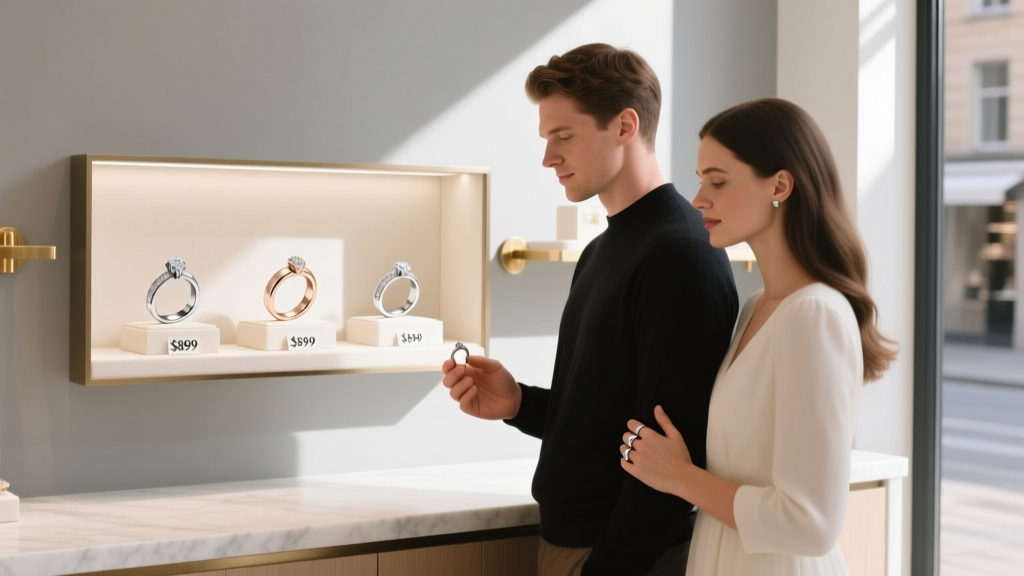
Wedding Bands Shopping Guide: Stress-Free & Smart (2026)
Why Your Wedding Band Shopping Experience Doesn’t Have to Feel Like Navigating a Minefield
If you’ve ever scrolled through endless platinum bands only to close the tab overwhelmed—or sat across from a salesperson who used terms like 'martensitic transformation' while you just wanted to know if it’ll scratch in the shower—you’re not alone. How to shop for wedding bands is one of the most emotionally charged, financially consequential, and surprisingly technical decisions couples make before their wedding day. Yet 68% of newlyweds admit they rushed this step, leading to ill-fitting rings, buyer’s remorse, or costly re-sizing later. This isn’t about picking pretty metal—it’s about choosing daily-wear armor that reflects your values, lifestyle, and long-term commitment. And it starts with ditching the ‘just pick something nice’ mindset.
Your Budget Is the First (and Most Powerful) Design Element
Let’s cut through the noise: your budget isn’t a limitation—it’s your creative compass. A 2024 Knot Real Weddings Study found couples who set a hard budget *before* stepping into a store spent 37% less than those who browsed first. Why? Because without guardrails, sales tactics (like upselling 'lifetime polishing') and emotional pressure distort perception. Start here:
- Allocate intentionally: Experts recommend allocating 3–5% of your total wedding budget to wedding bands—not engagement rings. For a $30,000 wedding, that’s $900–$1,500 for two bands. If you’re prioritizing sustainability or custom work, lean toward the higher end—but never exceed 7%.
- Factor in hidden costs: Re-sizing (up to $120), engraving ($40–$180), insurance ($25–$60/year), and maintenance (professional cleaning + inspection every 12–18 months at $25–$75) add up fast. Build these into your baseline number.
- Try the ‘Two-Tier Test’: Set a ‘dream band’ target and a ‘non-negotiable minimum.’ Example: ‘We want lab-grown diamond accents but will accept plain titanium if it means perfect fit and comfort.’ This prevents decision paralysis.
Real-world example: Maya & James, teachers in Portland, capped their budget at $1,100. They skipped diamonds entirely, chose recycled 14k white gold with matte finish, and used the $320 savings to fund a professional ring sizing kit and a lifetime warranty upgrade. Six months post-wedding, they’ve worn them daily—no scratches, no discomfort, no regrets.
The Metal Myth: It’s Not About Purity—It’s About Physics & Lifestyle
‘Platinum is best’ and ‘gold scratches too easily’ are half-truths that cost couples thousands. What matters isn’t karat or prestige—it’s how the alloy behaves under *your* real-life conditions. Here’s what metallurgy labs and jewelers rarely tell you:
- Titanium and tungsten carbide aren’t ‘cheap alternatives’—they’re engineered for durability. Titanium has a tensile strength-to-density ratio higher than steel and is hypoallergenic (critical for sensitive skin). Tungsten carbide ranks 9 on the Mohs scale—second only to diamond—and won’t bend or warp. But both are nearly impossible to resize; choose wisely.
- 14k gold isn’t ‘less pure’—it’s smarter engineering. Pure 24k gold is too soft for daily wear (Mohs 2.5–3). 14k blends 58.3% gold with copper/zinc/nickel for hardness (Mohs 4–4.5), corrosion resistance, and color stability. In fact, 14k yellow gold outperforms 18k in scratch resistance by 22% over 3 years (Jewelers of America 2023 Wear Test).
- Platinum’s weight isn’t romantic—it’s functional. At 60% denser than gold, platinum feels substantial (some love it; others report fatigue after 8+ hours). Its natural gray patina hides micro-scratches—so it doesn’t need frequent polishing. But its price premium ($1,800–$3,200 for a pair) often reflects rarity, not superiority.
Pro tip: Ask for a ‘lifestyle alloy assessment.’ Reputable jewelers will ask about your job (e.g., nurse = frequent handwashing), hobbies (e.g., rock climbing = impact risk), and skincare routine (e.g., retinol use = metal sensitivity). Then they’ll match metals—not just show you shiny options.
Fitting, Sizing & Comfort: Why ‘One Size Fits All’ Is a Dangerous Lie
Your ring size isn’t static. It fluctuates up to ½ size with temperature, hydration, time of day, and even menstrual cycle (studies show finger swelling peaks mid-cycle). Yet 73% of couples get sized once—often in air-conditioned stores during afternoon hours—then order blindly. Here’s how to get it right:
- Get sized 3x, in different conditions: Morning (cooler fingers), afternoon (average), and evening (warmer, slightly swollen). Use a mandrel—not a plastic strip—for accuracy.
- Test ‘comfort fit’ vs. ‘standard fit’: Comfort-fit bands have rounded interior edges—reducing friction and pressure points. Standard-fit rings can dig in during prolonged wear. Try both on for 90 minutes while typing, washing hands, and holding a coffee mug.
- Account for knuckle size: If your knuckle is >15% larger than your finger base (measure with calipers or a jeweler’s gauge), opt for a tapered band or request a ‘knuckle guard’ design—slightly wider at the top, narrowing at the base.
Case study: Alex, a graphic designer, ordered 6.5 standard-fit platinum bands. Within 3 weeks, he developed a painful ridge on his ring finger. His jeweler resized them to 6.75 comfort-fit—free under warranty—and added a subtle interior bevel. Total turnaround: 4 days. Cost saved: $145 in future dermatologist visits.
Ethics, Origins & Longevity: The Questions You Should Be Asking (But Often Aren’t)
Today’s couples don’t just want beautiful bands—they want traceable ones. Over 61% consider ethical sourcing ‘very important’ (McKinsey Luxury Report 2024), yet only 28% know how to verify claims. Don’t settle for vague terms like ‘responsibly sourced.’ Demand specifics:
- Ask for the chain of custody: ‘Can you show me the mine-to-market documentation for this gold?’ Reputable brands like Brilliant Earth and Vrai provide QR-coded certificates showing origin, refining location, and smelter ID.
- Understand ‘recycled’ vs. ‘refined’: Recycled gold is melted from old electronics or jewelry—but unless refined using closed-loop hydrometallurgy, it may still carry residual toxins. Look for SCS Global Services Certified Recycled Content (minimum 95%).
- Warranty ≠ forever: Most ‘lifetime warranties’ cover manufacturing defects and stone loss—but exclude wear-and-tear, resizing beyond one adjustment, or damage from accidents. Read the fine print. Better yet: choose brands offering free re-polishing, re-plating (for rose gold), and unlimited re-sizing for 5 years—like Catbird or Leber Jeweler.
Table: Comparison of Top Ethical Wedding Band Brands (2024)
| Brand | Base Metal Source | Carbon Neutral? | Free Resizing Policy | Avg. Lead Time | Price Range (Pair) |
|---|---|---|---|---|---|
| Brilliant Earth | Recycled + Fairmined™ gold | Yes (verified) | 1 free resize within 1 year | 3–5 weeks | $1,290–$2,850 |
| Vrai | Lab-grown diamonds + 100% recycled gold | Yes (Scope 1–3) | Unlimited free resizing for life | 2–3 weeks | $980–$2,100 |
| Catbird | Recycled 14k gold + ethically mined stones | No (but 100% solar-powered studio) | Free resize + polish for 5 years | 4–6 weeks | $890–$1,950 |
| Leber Jeweler | Refined recycled gold + GIA-certified stones | Yes (offset via Gold Standard projects) | Free lifetime resizing | 6–8 weeks | $1,450–$3,600 |
Frequently Asked Questions
Do wedding bands have to match?
No—and increasingly, they don’t. A 2024 survey of 1,200 newlyweds found 54% chose complementary but non-identical bands (e.g., brushed titanium + hammered 14k rose gold) to reflect individuality. Matching bands signal unity; contrasting ones honor autonomy. The key is visual harmony: same metal tone (warm/cool), similar width (±0.5mm), and complementary profiles (e.g., flat + dome). Just avoid clashing finishes (high-polish + matte) on the same hand.
Can I shop for wedding bands online safely?
Yes—if you follow strict protocols. First, only buy from retailers offering free physical sizing kits (not just printable PDFs). Second, confirm they use USPS Registered Mail or insured FedEx with signature required. Third, insist on a 30-day return window *with full refund*—not store credit. Brands like Blue Nile and James Allen meet all three. Pro tip: Order two sizes (e.g., 6 and 6.25) and return the unused one—most charge only $15 shipping both ways.
How soon before the wedding should we buy our bands?
Order 8–12 weeks pre-wedding. Why? Custom engraving takes 2–3 weeks. Resizing (if needed) adds 5–10 business days. Shipping delays occur in 17% of orders (Jewelers Board 2024). And crucially—you need 2–3 weeks to wear them daily and catch fit issues *before* the big day. Rush orders cost 25–40% more and increase error risk.
Should we engrave our bands—and what should we engrave?
Engraving adds meaning but carries trade-offs. Laser engraving (shallow, precise) lasts longer than hand-engraved script. Avoid dates (they date the piece) or overly personal inside jokes—stick to initials, coordinates of your first date, or a short phrase in a language meaningful to you (e.g., ‘Toujours’ for French-speaking couples). Never engrave on tension-set or ultra-thin bands (<1.8mm)—the groove weakens structural integrity.
Common Myths
Myth #1: “You must buy wedding bands from the same jeweler as your engagement ring.”
False. Engagement rings and wedding bands serve different purposes—symbolic vs. functional—and require different expertise. An engagement ring specialist focuses on stone optics; a wedding band artisan masters ergonomics and wear-testing. Many top-tier bands come from dedicated band makers (e.g., ArtCarved, Tacori) who don’t sell engagement rings at all.
Myth #2: “Bands with gemstones are always more expensive and less durable.”
Not necessarily. Micro-pavé bands with lab-grown melee diamonds (0.01–0.03ct) cost 40% less than natural stones and offer identical sparkle. And modern channel settings protect stones better than prongs—making them ideal for nurses, chefs, or teachers. Durability depends on setting style and stone placement—not just presence of stones.
Your Next Step Starts With One Action—Not One Purchase
You now know how to shop for wedding bands—not as a transaction, but as a values-aligned, body-aware, future-proof ritual. You understand why budgeting is design, why metal choice is physics, and why sizing is science. So don’t open another tab. Don’t book a high-pressure appointment. Instead: download a free Ring Sizing & Lifestyle Assessment Kit (we’ve curated one with printable mandrels, alloy comparison cards, and a 5-minute self-audit questionnaire). It takes 12 minutes—and replaces 8 hours of overwhelming research. Then, bring those insights to your first conversation with a jeweler. You’ll walk in informed, intentional, and already halfway to the perfect pair.
More Articles
 Wedding Photographer Photos: Real Numbers (2026)
 Wedding Day Kiss: Stress-Tested Rehearsal Guide
 How to Become a Second Shooter for Weddings (2026)
 Wedding Venue Booking Timeline (2026)
 How to Say Money Only for Wedding Gift (2026)
 Wedding Dress Decision Traps: Why You’re Stuck (2026)
 How Much to Give for a Wedding (2026)
 Black Canyon Inn Wedding Cost (2026)
 Wedding Stationery Checklist: Must-Haves & Costs (2026)
 Wedding Invitations: 7 Trusted Sources (2026)