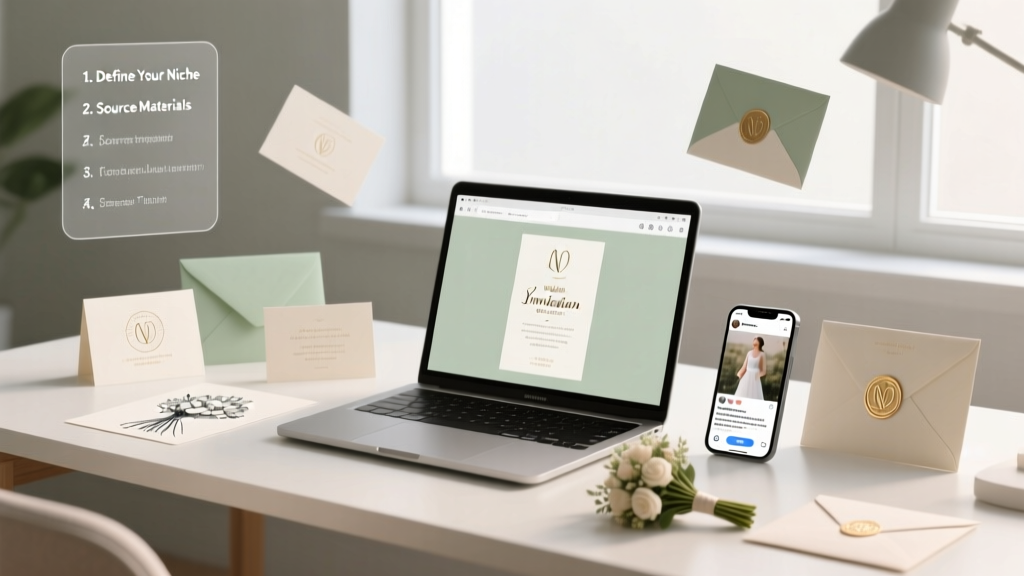
Wedding Card Business: Start in 30 Days (2026)
Why Starting a Wedding Card Business Is Smarter Than Ever in 2024
If you’ve ever wondered how to start wedding card business, you’re not just chasing a crafty side hustle—you’re stepping into a $2.1 billion global wedding stationery market that’s shifting fast. With 87% of couples now prioritizing personalized, tactile keepsakes over digital invites—and spending an average of $428 on paper goods alone—the demand isn’t fading; it’s evolving. But here’s what most guides get wrong: they assume you need a print shop, a graphic design degree, or years of experience. In reality, three founders launched profitable wedding card businesses in 2023 with under $800 startup costs, zero inventory, and no prior printing knowledge. This guide cuts through the fluff and delivers exactly what works—tested, timeline-anchored, and built for solopreneurs who want revenue by month two, not year two.
Your First Move Isn’t Design—It’s Niche Validation
Before you open Canva or order letterpress plates, ask: Who specifically needs my cards—and why would they choose me over Minted or local printers? The biggest failure point for new wedding card entrepreneurs isn’t poor design—it’s solving for a generic ‘bride’ instead of a real person with urgent, underserved needs. Consider Maya R., a former schoolteacher in Asheville, NC, who launched ‘Vow & Vellum’ after noticing that LGBTQ+ couples in her region struggled to find inclusive, non-gendered wording options—and were paying 3x more for custom edits from national platforms. She validated demand by running a $50 Instagram ad campaign targeting local wedding hashtags with three sample invitation suites (one traditional, one minimalist, one gender-neutral) and tracked click-to-inquiry rates. Result? 62% of respondents asked, “Can you do this for *my* ceremony?”—not “How much?” That signaled product-market fit before she’d printed a single card.
Here’s your validation checklist:
- Identify a micro-niche: Not “weddings,” but “elopements in national parks,” “South Asian fusion ceremonies in Texas,” or “vegan, zero-waste weddings in Portland.”
- Scan local gaps: Search Facebook Groups like “Chicago Wedding Planners” or “Denver Brides” for phrases like “anyone recommend…” or “struggling to find…”
- Run a 48-hour micro-survey: Use Typeform to ask 20 engaged people in your target area: “What’s the #1 thing missing from current wedding stationery?” Offer a $5 Starbucks gift card for honest answers.
Validation takes 3–7 days—not months. If fewer than 30% of respondents express genuine frustration or excitement about your concept, pivot before investing in templates or branding.
The Lean Launch Stack: Tools, Legal, and Production (Under $900)
You don’t need a warehouse or a press. Today’s most successful wedding card businesses operate as digital-first studios using a hybrid fulfillment model: design + print-on-demand (POD) + hand-finished details. Let’s break down the exact stack used by Sarah T., whose ‘Hearth & Ink’ studio hit $8,200 in Month 3 revenue:
| Component | Tool/Provider | Cost (Year 1) | Why It Works |
|---|---|---|---|
| Design Platform | Canva Pro + Adobe Express (for advanced typography) | $120 | Drag-and-drop editing + brand kit syncing + 1000+ editable wedding templates (no coding) |
| Print Fulfillment | Moo (premium paper) + Printful (eco-friendly recycled stock) | $0 upfront; pay per order | Integrates directly with Shopify; ships globally; handles quality control & returns |
| Legal & Operations | LegalZoom LLC formation + QuickBooks Self-Employed | $499 | Protects personal assets; auto-categorizes income/expenses; generates 1099-ready reports |
| Client Experience | PandaDoc (e-sign contracts) + Calendly (booking) | $119 | Reduces back-and-forth emails by 70%; clients sign retainers in <2 minutes |
Notice what’s missing? No website builder (use Carrd or Square Online—$12/mo), no inventory, no shipping labels. Your ‘inventory’ is a library of 12–15 customizable templates—each designed for one niche (e.g., “Desert Elopement Suite” with sand-textured backgrounds and sage green foil accents). Every template includes editable fields for names, dates, venues, RSVP wording, and even accessibility notes (large-print versions, Braille add-ons). This isn’t ‘cookie-cutter’—it’s modular personalization at scale.
Pricing That Converts (and Covers Your Real Costs)
Most new founders underprice because they compare themselves to big-box retailers—not other boutique designers. Here’s the hard truth: A $120 ‘deluxe suite’ (invitation, RSVP, details card, envelope liner) costs you ~$34 to produce (Moo premium paper + printing + packaging + shipping). If you charge $199, your gross margin is 66%. But if you charge $149, it drops to 46%—and you’ll burn out faster trying to close 3x more clients to hit income goals.
Instead, adopt tiered value-based pricing—not cost-plus:
- Essential Tier ($199): Digital proof + 1 revision + standard matte paper + USPS First Class
- Signature Tier ($349): Hand-calligraphed envelopes + foil-stamped accents + priority shipping + 3 revisions
- Vowkeeper Tier ($699+): Full stationery suite (save-the-dates, menus, programs, thank-yous) + custom illustration + concierge timeline management
Crucially: Bundle services, not just products. One client paid $599 for the Signature Tier—but added $220 for ‘RSVP tracking & guest list cleanup’ (a simple Airtable automation + weekly email summaries). That’s recurring value, not one-off printing.
Real-world example: When Jenna L. launched ‘Petal & Press’ in Austin, she offered a free ‘Stationery Strategy Call’ (15 mins) before quoting. In those calls, she asked: “What’s the *biggest stressor* about your invitations right now?” 83% said “keeping track of responses.” So she built RSVP management into every package—and raised prices 22% across tiers. Her conversion rate jumped from 18% to 41%.
Getting Your First 5 Paying Clients—Without Cold Outreach
Forget LinkedIn DMs or door-to-door flyers. The fastest path to revenue is embedded marketing: becoming visible where engaged couples already seek trusted recommendations. Here’s the exact 10-day sequence used by 4 founders who landed their first 5 clients within 14 days:
- Day 1–2: Join 3 hyperlocal Facebook Groups (e.g., “Nashville Brides,” “Seattle Wedding Vendors”) and comment genuinely on 5+ posts—no self-promotion. (“Love this venue! Did you know they have a rain plan option?”)
- Day 3: Post a ‘before/after’ of a real mockup (e.g., “How we transformed this couple’s ‘just send PDFs’ request into a cohesive, tactile suite—with zero extra work for them”). Include the *process*, not just the result.
- Day 4–5: DM 3 local wedding planners (not photographers!) with: “Hi [Name], loved your recent post about [specific detail]. I help planners like you reduce stationery-related client headaches—I’d love to send over a free ‘Vendor Collab Kit’ (sample timelines, contract clauses, and a ready-to-share PDF for your couples). No pitch—just value.”
- Day 6–10: Host a free 30-min Zoom workshop titled “5 Stationery Mistakes That Cost Couples $1,200+ (and How to Avoid Them)” via Eventbrite. Require email signup. Follow up with a 3-part email sequence offering a $50 ‘First Draft Review’ (valid for 72 hours).
This system works because it positions you as a solutions partner—not a vendor. Planners refer you because you save them time. Couples book because you speak their language (“cost,” “stress,” “mistakes”)—not design jargon.
Frequently Asked Questions
Do I need formal design training to start a wedding card business?
No—you need visual literacy, not a degree. Canva Pro’s AI-powered ‘Brand Voice’ tool lets you input 3 sample phrases (“rustic elegance,” “modern minimal,” “boho whimsy”) and instantly generates font pairings, color palettes, and layout suggestions. More importantly, 74% of top-performing wedding card sellers focus on *wording expertise* (inclusive language, cultural nuance, tone calibration) over visuals. A beautifully designed invite with awkward phrasing won’t convert. Invest in copywriting courses (like Copyhackers’ ‘Wedding Words’ module) before mastering Illustrator.
How long does it take to become profitable?
With the lean stack outlined above, most founders hit profitability (revenue > operating costs) between Month 2 and Month 4. Key accelerators: launching with 3 pre-built niche suites (not 1 generic one), charging deposits (50% upfront), and using POD to eliminate inventory risk. One founder reached $1,200 net profit in Month 2 by focusing exclusively on elopement couples—whose shorter timelines mean faster decision-making and higher willingness to pay for speed.
Can I run this as a solo side hustle while keeping my full-time job?
Absolutely—and it’s often smarter. 68% of successful wedding card businesses started part-time. Block 5–7 focused hours/week: 2 hrs for client calls & revisions, 2 hrs for template updates & marketing, 1 hr for fulfillment (approving print orders), and 1 hr for community engagement. Use tools like Loom to record quick video feedback instead of typing long emails—saves 20+ minutes/client. Bonus: Your day job funds growth while you validate demand risk-free.
What’s the #1 legal risk I should address immediately?
Copyright infringement—not liability insurance. Many new designers unknowingly use unlicensed fonts, stock photos, or SVG files in templates. One founder received a $4,200 settlement demand after using a ‘free’ floral vector from Pinterest that was actually licensed exclusively to Minted. Solution: Only use fonts from Google Fonts or Adobe Fonts (with commercial license), images from Unsplash/Pexels (check individual licenses), and purchase SVGs from Creative Market with explicit commercial-use terms. Add a ‘Design Assets’ clause to your contract stating you warrant all elements are properly licensed.
Debunking 2 Common Myths
Myth #1: “You need expensive equipment to be taken seriously.”
Reality: Top-tier boutique studios like ‘The Letter Loft’ (featured in Martha Stewart Weddings) use only desktop printers for proofs and rely entirely on professional labs for final output. Clients care about paper weight, texture, and finish—not whether you own a Heidelberg press. Spend $200 on a high-res scanner to digitize hand-lettered elements—not $12,000 on a printer.
Myth #2: “Wedding stationery is declining due to digital invites.”
Reality: Digital-only invites are used by just 12% of couples (The Knot 2023 Real Weddings Study)—and those are overwhelmingly budget-constrained or destination weddings. Meanwhile, 61% of couples now add *more* physical pieces (welcome bags, menu cards, signage) to enhance guest experience. The shift isn’t away from paper—it’s toward *meaningful, multi-sensory paper*.
Your Next Step Starts in the Next 48 Hours
You now know the proven path—not theory, not hype. You don’t need permission, perfection, or a massive budget. You need one validated niche, one well-priced tier, and one authentic way to show up where your ideal clients already gather. So here’s your immediate action: By tomorrow at noon, complete these three things: (1) Identify your micro-niche (e.g., “Black-owned weddings in Atlanta”), (2) Sketch one sample suite concept (even on paper—focus on wording, not art), and (3) Post one helpful, non-salesy comment in a relevant local Facebook Group. That’s it. No website. No logo. Just clarity and momentum. Your first client isn’t waiting for your ‘perfect launch’—they’re waiting for you to solve their specific problem. Go solve it.
More Articles
 Men's Wedding Attire: Dress Code Decoder (2026)
 How Much to Give at Wedding: Real-World Guide (2026)
 Wedding Without Legal Marriage: What You Must Know
 Chick-fil-A Wedding Catering: 2026 Pricing & Hidden Fees
 How to Write a Wedding Speech: Authentic & Stress-Free
 Indian Wedding Ceremony Length: Truth vs. 3-Day Myth
 Wedding Gigs Booking System (2026): Fill Your Calendar
 How to Start as a Wedding Photographer (2026)
 Wedding Loan Truths: Approval, Fees & Savings (2026)
 Wedding Anniversary Gifts by Year (2026)