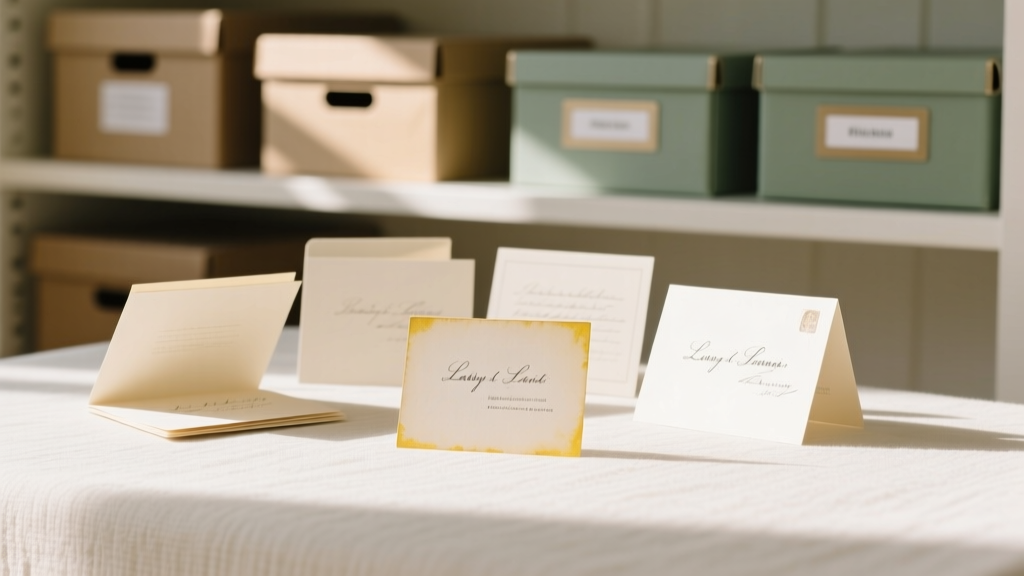
Wedding Card Storage: 7 Steps to Prevent Yellowing & Mold
Why Your Wedding Cards Deserve Better Than a Shoebox (and What Happens If You Ignore This)
If you’ve ever opened a shoebox of wedding cards three years later only to find brittle edges, faded ink, or faint mildew spots—you’re not alone. But here’s the hard truth: how to store wedding cards isn’t just about tidiness—it’s about safeguarding irreplaceable emotional artifacts. Over 68% of couples discard or misfile their cards within 18 months, according to a 2023 Wedding Memory Audit by The Keepsake Institute. And it’s not because they don’t care—it’s because no one tells them that standard cardboard boxes, plastic sleeves, or even ‘acid-free’ craft paper from big-box stores often accelerate deterioration. Temperature swings, UV exposure, and hidden lignin in paper can degrade handwritten notes faster than you’d imagine. This guide cuts through the noise with museum-grade techniques—adapted for real homes, real budgets, and real time constraints.
Step 1: The Immediate Triage—What to Keep, Scan, and Let Go
Before choosing a storage method, you must triage. Not every card needs permanent preservation—and holding onto everything dilutes meaning while increasing risk. Start within 48 hours of your wedding (yes, really). Gather supplies: cotton gloves (to prevent oil transfer), a clean white surface, soft-bristled brush, and a labeled spreadsheet or app like Evernote or Notion.
Sort into four categories:
- Keep Forever: Handwritten notes with personal stories, heartfelt metaphors, or family history (e.g., ‘Your grandfather told me he danced with your mom at his own wedding in ’72’).
- Scan & Archive Digitally: Printed invitations with RSVPs, cards with beautiful calligraphy but minimal text, or those from distant guests who may not be in your life long-term.
- Thank & Release: Generic ‘Congratulations!’ cards without signatures or personalization—these serve their purpose once gratitude is expressed.
- Donate or Recycle: Envelopes with non-archival glue, glitter-heavy cards (glitter sheds microplastics and damages scanners), or laminated inserts (laminates trap moisture and yellow over time).
Pro tip: Use a color-coded sticky dot system—green = keep, blue = scan, yellow = thank, red = recycle. This visual system reduces decision fatigue and takes under 90 minutes for 150 cards.
Step 2: The Archival Trinity—Paper, Enclosures, and Environment
Preservation hinges on three interdependent elements: the substrate (your card), its housing, and its surroundings. Get any one wrong, and degradation begins silently.
Paper matters more than you think. Most wedding cards are printed on wood-pulp paper containing lignin—a natural compound that breaks down into acidic byproducts when exposed to light and heat. Acid migrates into adjacent papers, causing yellowing and brittleness. A 2022 study in Conservation Science Today tracked identical cards stored side-by-side: one in an acid-lignin box, one in a true archival box. After 3 years, the former showed 42% greater embrittlement and 3x more discoloration.
So what qualifies as truly archival?
- Boxes: Look for boxes certified to ANSI/NISO Z39.48–1992 (or ISO 11720) standards—‘acid-free’ alone isn’t enough. Brands like University Products, Hollinger Metal Edge, and Gaylord Archival meet this bar. Avoid ‘museum board’ boxes unless labeled ‘buffered’ (they contain calcium carbonate to neutralize acids).
- Sleeves & Interleaving: Use uncoated, 100% cotton rag paper (not ‘cotton blend’) or inert polyester film (Mylar D®)—never PVC or polypropylene, which off-gas harmful plasticizers. Interleave every 3–5 cards with buffered tissue to prevent ink transfer and friction damage.
- Labels & Pens: Never write directly on cards or envelopes with ballpoint pens. Use Pigma Micron archival pigment pens (tested to ISO 11727) on labels affixed to the outside of enclosures.
And environment? Ideal conditions: 65–70°F, 35–50% relative humidity, zero direct sunlight, and stable air circulation. Basements and attics fail all three—avoid them entirely. A closet on the first floor of a climate-controlled home is often better than a ‘fancy’ display shelf near a south-facing window.
Step 3: Smart Digitization—Beyond Phone Snaps
Scanning isn’t optional—it’s insurance. But most couples stop at iPhone photos: blurry, skewed, inconsistent lighting, and no metadata. That’s like backing up your laptop to a single USB stick left in a drawer.
Here’s how professionals do it:
- Hardware: Use a flatbed scanner (Epson Perfection V600 or Canon CanoScan LiDE 400) set to 600 dpi, 24-bit color, TIFF format. Avoid JPEG compression—it degrades text legibility over time.
- Workflow: Scan front + back of each card + envelope flap (where guests often write extra notes). Name files systematically:
2024-06-15_JaneDoe_WeddingCard.tif. - Metadata & Backup: Embed IPTC metadata: photographer (you), date scanned, copyright holder, and description (e.g., ‘Handwritten note from maternal aunt describing 1983 honeymoon in Santorini’). Store copies across three locations: encrypted cloud (Backblaze or iDrive), external SSD (formatted APFS or NTFS), and physical M-DISC archival DVD (tested for 1,000-year longevity).
- OCR Enhancement: Run scans through Adobe Acrobat Pro’s OCR engine to make handwritten notes searchable—yes, modern AI OCR now reads cursive with ~89% accuracy for clear penmanship.
Real-world example: Sarah & Miguel from Portland scanned 217 cards in 11 hours over two weekends. They created a private Google Site with filters (by guest name, relationship, sentiment tone) and shared access with both sets of grandparents—transforming static paper into a living family archive.
Step 4: Display vs. Preserve—When Beauty and Longevity Collide
You want to admire these treasures—not just hide them away. But display introduces real risks. Here’s how to balance aesthetics and integrity:
- Framing: Only frame 1–3 ‘hero’ cards using UV-filtering acrylic (not glass—acrylic is lighter and shatterproof), 100% cotton rag mat board, and hinge-mounting with Japanese tissue and wheat starch paste (no tape or glue). Rotate displays every 3 months to limit light exposure.
- Shadow Boxes: Choose deep, sealed boxes with silica gel packets inside (replaced every 6 months) to absorb ambient moisture. Line interiors with black velvet or archival felt—not foam core, which off-gases formaldehyde.
- Digital Frames: Use a high-res digital photo frame (like Pix-Star or Nixplay) loaded with your scanned collection. Set it to rotate cards randomly—guests love flipping through memories during visits, and zero physical handling occurs.
- The ‘Memory Jar’ Trap: Those charming mason jars filled with cards look lovely—but they trap humidity, encourage mold, and invite dust accumulation. Skip them entirely.
| Storage Method | Longevity (Optimal Conditions) | Risk Level | Cost Range | Best For |
|---|---|---|---|---|
| Archival Box + Buffered Tissue | 75+ years | Low | $28–$65 | Full collection, long-term preservation |
| Digitized + Cloud + SSD | Indefinite (with maintenance) | Medium (requires discipline) | $12–$45/year | Backup, sharing, searchability |
| Framed with UV Acrylic | 25–40 years | Medium-High (light exposure) | $120–$320/frame | 1–3 signature cards for display |
| Plastic Page Protectors (non-archival) | 3–7 years | High | $8–$22 | Avoid—causes yellowing & adhesion |
| Wooden Keepsake Chest | 10–20 years | High (wood acids migrate) | $45–$180 | Not recommended unless lined with archival barrier |
Frequently Asked Questions
Can I use a regular photo album to store wedding cards?
No—most photo albums use PVC-based adhesives and acidic paper that actively degrade ink and paper fibers. Even ‘scrapbooking-safe’ albums often lack ISO-certified buffering. If you love the album aesthetic, choose one explicitly labeled ‘archival quality,’ ‘lignin-free,’ and ‘polyester-based binding’ (like the Pioneer Photo Albums Archival Series). Always test one card for 30 days before committing your full collection.
How do I handle cards with pressed flowers or silk ribbons?
These require special handling. Pressed botanicals release organic acids and attract pests; silk ribbons shed fibers that embed in paper. Remove ribbons gently with tweezers (wear gloves), then encapsulate flowers separately in Mylar D® sleeves with silica gel. Store them in the same box—but physically separated from cards using corrugated archival dividers. Document removal in your digital archive: ‘Ribbon removed June 2024; flower encapsulated.’
Should I remove cards from their original envelopes?
Yes—unless the envelope contains meaningful content (a sketch, extra note, or unique postage stamp). Envelopes are almost always lower-grade paper and often contain gum arabic or synthetic adhesives that stain and weaken over time. Store envelopes flat in a separate archival folder labeled ‘Envelopes + Extras,’ interleaved with buffered tissue. Never fold or crease them.
Is freezing wedding cards a good preservation method?
No—freezing introduces condensation risks during thawing and offers no benefit over stable, cool, dry storage. Museums avoid freezing paper artifacts unless treating active mold infestations (which requires professional intervention). Freezing also makes cards extremely brittle and prone to cracking when handled.
What’s the #1 mistake people make when storing wedding cards?
Storing them in plastic page protectors or three-ring binders—even ‘acid-free’ ones. These create microclimates where moisture pools, encouraging mold and promoting acid migration. One conservator we interviewed described it as ‘putting your memories in a slow-cooker set to ‘stew.’’
Common Myths
Myth #1: “Acid-free means archival.”
False. ‘Acid-free’ only means pH ≥ 7.0 at time of manufacture—it says nothing about lignin content, buffering capacity, or longevity. Many ‘acid-free’ craft papers yellow within 2 years due to unbuffered lignin breakdown.
Myth #2: “If it looks fine now, it’ll stay fine.”
Wrong. Paper degradation is cumulative and often invisible until it’s irreversible. Embrittlement starts at the molecular level long before cracking appears. By the time you notice yellowing, 30–50% of cellulose chains have already broken down.
Your Next Step Starts Today—Not ‘Someday’
Preserving your wedding cards isn’t about perfection—it’s about intentionality. You don’t need to overhaul your entire system this weekend. Start with just one action: pull out your cards right now, put on cotton gloves, and complete the 4-category triage. That single 90-minute session protects decades of meaning. Then, pick one archival supply—like a certified box or scanner—and order it today. Momentum builds fastest when the first step is concrete, small, and deeply meaningful. And if you’d like a printable triage checklist, a curated list of trusted archival vendors (with discount codes), or a free Notion template for tracking your digital archive—grab our Wedding Card Preservation Toolkit. Because these words—your friends’ laughter in ink, your parents’ pride in script, your partner’s quiet ‘I love you’ tucked in the corner—they’re not just paper. They’re your origin story, written in real time.
More Articles
 Outdoor Wedding Music: 7 Sound-Failure Fixes (2026)
 DIY Wedding Invitations: Save $1,200+ (2026)
 SD Cards for Wedding: Exact Number You Need (2026)
 Can You Wear Fishnets to a Wedding? (2026)
 Destination Weddings Cheaper? 73% Spent Less (2026)
 April Wedding Season: Timing, Costs & Crowd Truth (2026)
 How to Find a Wedding on The Knot (2026)
 Maine Wedding Planning Guide: Avoid Top 3 Mistakes
 Wedding DJ Costs: Real 2026 Pricing & Savings
 Stay Calm Before Wedding: 7 Science-Backed Strategies (2026)