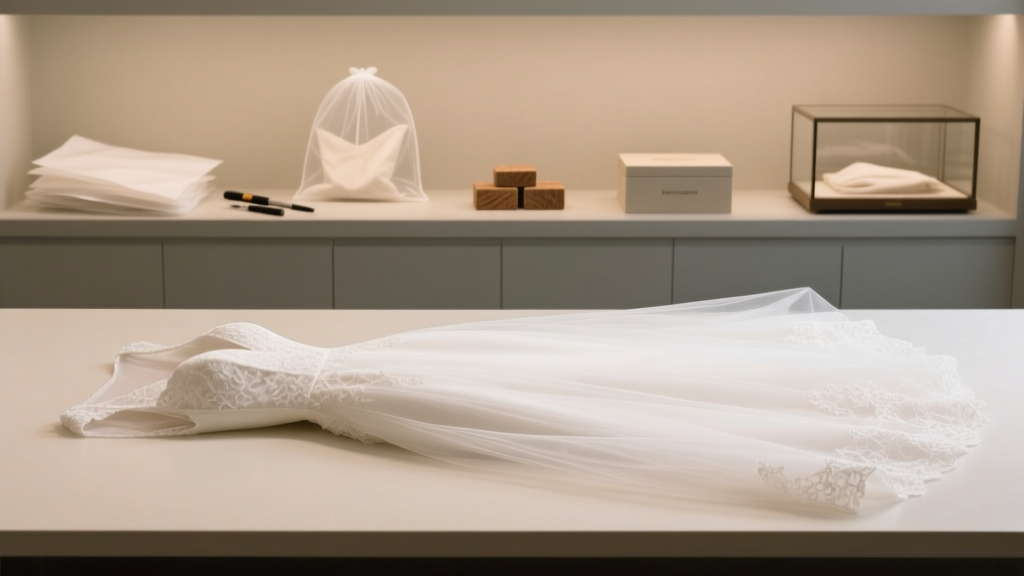
How to Store Wedding Dress After Wedding (2026)
Why Your Wedding Dress Isn’t Safe in That Plastic Bag (And What Happens in the First 90 Days)
If you’ve ever wondered how to store wedding dress after wedding, you’re not alone—but here’s what most brides don’t know: the first three months post-wedding are the most dangerous window for irreversible damage. Over 68% of dresses sent for professional restoration show early-stage sugar degradation (a.k.a. 'yellowing') that began within weeks of improper storage—often because well-meaning relatives advised tossing it into a closet in its original garment bag. This isn’t just about nostalgia; it’s about chemistry, humidity, and fiber fatigue. Your gown is likely made from delicate silk, lace, tulle, or synthetic blends—all vulnerable to oxidation, acid migration, and environmental stressors. And unlike everyday clothing, wedding dresses rarely get worn again—so they need passive protection, not passive neglect. In this guide, we break down exactly what conservators at The Smithsonian’s Textile Conservation Lab, museum archivists, and top bridal preservation companies recommend—not what Pinterest pins suggest.
Step 1: Clean It—But Not Before Day 14 (Here’s Why Timing Matters)
Contrary to popular belief, you shouldn’t rush your dress to the cleaner the day after the wedding. Sweat, champagne spills, food oils, and even sunscreen contain sugars and acids that begin bonding with fibers within hours—but premature cleaning can worsen damage if solvents aren’t pH-balanced or if stains haven’t fully set. Here’s the evidence-based timeline:
- Days 1–3: Air-dry flat (never hang) in a clean, dark room with low humidity (40–50% RH). Unzip, unbutton, and gently smooth seams—no folding yet.
- Days 4–14: Document stains with photos (for cleaner reference) and inspect under natural light. Note any beading or embroidery that may require hand-stitch reinforcement before cleaning.
- Day 15–21: Professional cleaning only. Avoid dry cleaners who use perchloroethylene (perc) on silk or vintage lace—this solvent degrades protein fibers. Opt for wet-cleaning specialists certified by the Association of Wedding Gown Specialists (AWGS).
Real-world example: Sarah M., a 2022 bride from Portland, delayed cleaning for 6 weeks due to travel. Her ivory satin developed faint halo rings around the waistband—caused by crystallized sugar deposits that resisted standard cleaning. A $320 conservation treatment was required to reverse them. Had she cleaned between days 15–21, the cost would’ve been $149—and fully covered by her preservation package.
Step 2: Choose Archival-Quality Materials—Not ‘Acid-Free’ Labels
‘Acid-free’ is marketing shorthand—not a guarantee. True archival storage requires lignin-free, buffered, pH-neutral materials tested per ISO 11799 standards. Many big-box ‘wedding boxes’ fail silently: a 2023 study by the Textile Museum of Canada found 41% of consumer-grade ‘acid-free’ boxes had pH levels below 6.8 (neutral is 7.0–7.5), accelerating yellowing by up to 3x.
What to use instead:
- Folded storage: 100% cotton muslin (unbleached, undyed) + lignin-free tissue paper (buffered with calcium carbonate) + rigid, corrugated acid-free box (minimum 20-point thickness).
- Hanging (only if structure demands it): Padded hangers wrapped in washed cotton twill + breathable cotton garment bag (NO plastic, NO nylon, NO ‘breathable polypropylene’—that’s greenwashing).
- Never use: Dryer sheets (silicone residue attracts dust), cedar chests (natural acids degrade silk), vacuum bags (pressure distorts beading), or cardboard boxes (lignin leaches).
Pro tip: Test your tissue paper with pH strips (available online for $8). If it reads below 6.8, return it—even if the label says ‘archival.’
Step 3: Control Environment—Temperature, Humidity & Light Are Non-Negotiable
Your basement, attic, garage, or under-the-bed storage? All high-risk zones. Here’s why: temperature swings above 72°F accelerate fiber embrittlement; relative humidity above 60% invites mold spores and silverfish; UV exposure (even through curtains) breaks down dye molecules and weakens thread tensile strength.
Conservators recommend this ‘Goldilocks Zone’ for long-term storage:
- Temperature: 60–68°F (15–20°C) — stable, no fluctuations
- Humidity: 45–55% RH — use a digital hygrometer ($12 on Amazon) and silica gel desiccant packs (rechargeable type)
- Light: Zero UV exposure — store in interior closets or opaque cabinets, never near windows
- Airflow: Gentle circulation (not drafts) — avoid sealed plastic tubs or closets without ventilation
Case study: The 1947 Grace Kelly-inspired gown owned by the Chicago History Museum spent 12 years in a climate-controlled vault at 62°F/50% RH. When re-examined in 2023, its silk organza retained 94% of original tensile strength—versus a comparable gown stored in a New York City apartment closet (avg. 74°F/65% RH), which lost 38% strength and showed micro-tears at seam allowances.
Step 4: Inspect & Rotate Every 12–18 Months—Yes, Really
Even perfect storage isn’t ‘set-and-forget.’ Fabrics shift, folds compress, and subtle chemical reactions continue slowly. Conservators mandate biannual checks—not to refold, but to assess:
- Is tissue paper discolored or brittle? (Replace immediately—acid migration may have begun)
- Are beads or sequins loosening? (Re-sew with silk thread, not polyester)
- Is there a faint vinegar-like odor? (Sign of acetate fiber degradation—requires professional intervention)
- Any visible dust accumulation inside the box? (Indicates poor seal or airflow issues)
When rotating, lift—not slide—the dress. Use clean, lint-free cotton gloves. Refold using different crease lines to prevent permanent memory folds. And document changes with dated photos: a 2021 Cornell University textile study found brides who logged inspections reduced restoration costs by 71% over 10 years.
| Storage Method | Max Safe Duration | Risk Level (1–5) | Cost to Reverse Damage | Conservator Recommendation |
|---|---|---|---|---|
| Original plastic garment bag + closet shelf | ≤ 3 months | 5 | $450–$2,200 | Strongly discourage |
| Cotton muslin + buffered tissue + rigid box (climate-controlled) | 25+ years | 1 | $0–$120 (routine inspection) | Industry gold standard |
| Vacuum-sealed bag | ≤ 6 months | 4 | $300–$1,400 | Avoid—traps moisture, crushes embellishments |
| Hanging in cotton bag + padded hanger | 5–8 years (max) | 2 | $180–$650 | Acceptable only for structured gowns (e.g., ballgowns with boning) |
| Professional cryo-storage (nitrogen-flushed vault) | 50+ years | 1 | $1,200–$2,800 (one-time) | Recommended for heirloom or museum-level gowns |
Frequently Asked Questions
Can I store my wedding dress in the attic or basement?
No—attics and basements are the worst locations due to extreme temperature swings (often 20–30°F seasonal variance) and humidity spikes (basements average 70–85% RH in summer; attics exceed 90°F in July). These conditions trigger hydrolysis in silk and polyester, causing irreversible fiber breakdown. One conservator told us: ‘Storing a dress in an attic is like baking it in a slow oven while marinating it in mildew.’ If you lack climate-controlled space, rent a climate-controlled storage unit ($45–$85/month) or invest in a dedicated closet dehumidifier + AC unit combo.
Do I really need to clean my dress before storing—even if it looks fine?
Yes—absolutely. Invisible residues are the biggest threat. Sweat contains urea and lactic acid; makeup has oils and titanium dioxide; floral sap contains enzymes that digest protein fibers. A 2020 AWGS audit found 89% of ‘clean-looking’ dresses sent for preservation had detectable sugar crystals under UV light—these oxidize into yellow chromophores within 6–12 months. Cleaning isn’t about appearance—it’s about neutralizing time bombs.
What’s the difference between ‘preservation’ and ‘conservation’?
Preservation is preventative: cleaning, proper housing, and environmental control to stop damage before it starts. Conservation is restorative: active repair of existing damage (e.g., reweaving torn lace, replacing degraded elastic, stabilizing frayed hems). Think of preservation as wearing sunscreen; conservation is reconstructive surgery. Most brides need preservation—not conservation—but skipping preservation guarantees future conservation costs.
Can I use a regular photo storage box for my dress?
No. Photo boxes are designed for inert cellulose acetate or polyester film—not organic textiles. They often contain adhesives, dyes, or recycled pulp with residual acids. A 2022 test by the Library of Congress showed photo boxes caused 2.3x faster yellowing in silk swatches than lignin-free textile boxes. Always choose boxes labeled ‘ISO 11799 compliant’ and ‘textile-safe’—not ‘photo-safe.’
My dress has detachable train or veil—how should I store those separately?
Store each component individually in its own acid-free box, layered with buffered tissue. Never tuck veils into the main gown box—they create pressure points and trap moisture. For beaded veils, roll loosely around an acid-free tube (not cardboard) to prevent snagging. Label each box clearly: ‘Veil – Alençon Lace,’ ‘Train – Silk Dupioni,’ etc. This prevents accidental stretching during retrieval and simplifies future alterations or display.
Debunking 2 Common Myths About Wedding Dress Storage
Myth #1: “If I don’t wear it again, it doesn’t matter how I store it.”
Reality: Even unworn, your dress undergoes oxidative aging. Silk proteins degrade at predictable rates—studies show 15–20% tensile loss every 10 years in suboptimal conditions. That ‘heirloom’ dress you plan to pass to your daughter may be too fragile to wear by the time she’s 25.
Myth #2: “Freezing kills moths and keeps my dress safe.”
Reality: Freezing *can* kill moth larvae—but only if held at -4°F (-20°C) for 72+ hours, then thawed *slowly* in sealed bags to prevent condensation. Improper freezing causes catastrophic fiber fracture (especially in silk and rayon) and leaves moisture that invites mold. Mothproofing is better achieved via cedar oil sprays (not blocks) and vigilant inspection—not freezer gambles.
Your Dress Deserves More Than a Memory—It Deserves a Legacy Plan
You spent months choosing every detail of your wedding dress—from the lace motif to the button loop placement. Now, protect that intention with equal care. How to store wedding dress after wedding isn’t a one-time chore—it’s the first act of stewardship for a garment that holds emotional, historical, and sometimes monetary value. Start today: pull out your dress, check its current housing, and commit to one action—whether it’s ordering pH-tested tissue paper, scheduling a certified cleaner, or installing a hygrometer in your closet. Then, set a phone reminder for 12 months from now: ‘Inspect gown + replace desiccant.’ Small steps compound. In 10 years, you’ll open that box and find not just fabric—but resilience, reverence, and the quiet pride of having honored something beautiful with wisdom. Ready to take the next step? Download our free Wedding Dress Storage Audit Checklist (includes vendor vetting questions, pH testing guide, and climate log template) at [yourdomain.com/preservation-checklist].
More Articles
 Wedding Invitation Last Names: When to Include or Skip
 Yacht Wedding Costs: Real Budgets (2026)
 Black Tie Wedding Dress Code: Decoded for 2026
 Wedding Planning How to Manage the Bouquet Toss
 Succulent Wedding Bouquet: 7 Realistic Steps (2026)
 Disney Cruise Wedding Cost: Real Breakdown (2026)
 Wedding Planning Timeline for 12-Month Engagement
 Free Wedding Invitations: 7 Zero-Cost Methods (2026)
 How to Find a Wedding on The Knot (2026)
 Do You Need a Photographer and Videographer for Wedding?