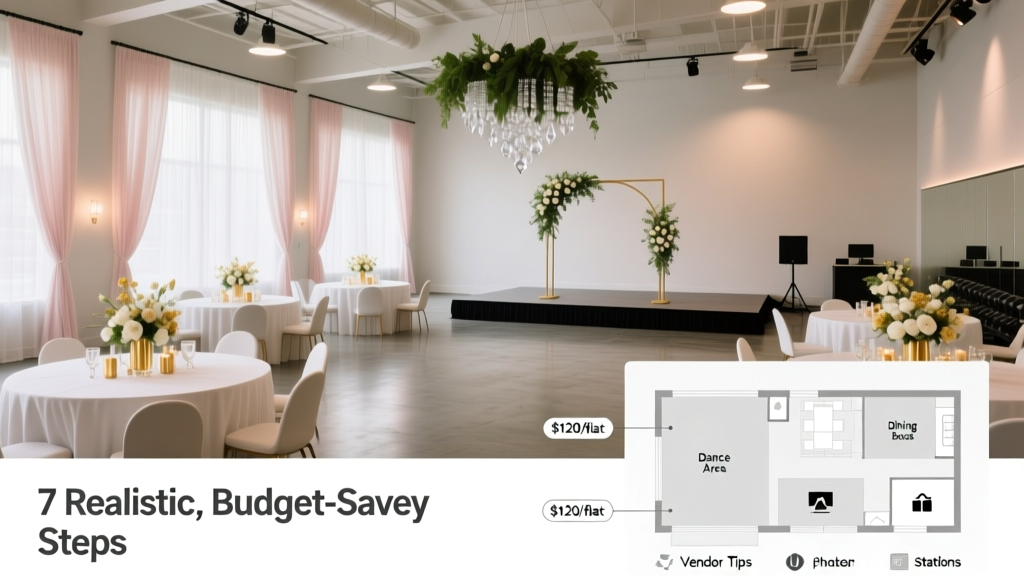
Transform a Gym Into a Wedding Reception (2026)
Why Turning a Gym Into a Wedding Reception Isn’t Just Clever—It’s Strategic
More couples are asking how to transform a gym into a wedding reception—not as a last-minute compromise, but as a deliberate, values-driven choice. With U.S. wedding costs averaging $30,000 in 2024 (The Knot Real Weddings Study), venues alone consume 45% of that budget—yet traditional ballrooms and historic estates rarely offer flexibility, parking, or ADA-compliant infrastructure. Gyms? They’re often underutilized, centrally located, climate-controlled, and built for high-traffic flow—making them quietly ideal blank canvases. One couple in Portland converted a decommissioned YMCA weight room into a rustic-chic reception for 120 guests at $8,900 total venue + build-out cost—less than half the local average. This isn’t about ‘making do.’ It’s about rethinking space, prioritizing experience over prestige, and building something authentically yours—starting with concrete, vendor-vetted steps.
Step 1: Audit the Space Like a Venue Pro—Not Just a Rent-Seeker
Before signing a lease or paying a deposit, treat the gym like a professional venue scout—not a discount rental. Most gyms have hidden assets (and liabilities) that don’t appear in the brochure. Start with a 90-minute walkthrough armed with a printed checklist and your phone’s level app. Measure ceiling height (critical for draping and lighting), note HVAC zones (can you cool the basketball court while heating the lounge area?), and test Wi-Fi strength in all corners (for live-streaming and digital RSVP tablets). Crucially: ask for the facility’s ‘event load history’—has it hosted weddings before? If yes, request contact info for those couples. If no, ask whether their insurance policy covers third-party event liability (many standard commercial policies exclude weddings unless explicitly endorsed).
Case in point: When Sarah & Mateo toured a former CrossFit box in Austin, they discovered the rubber flooring was rated for 10,000 lbs/sq ft—ideal for heavy dance floors and photo booths—but the sprinkler system hadn’t been tested in 3 years. Their planner insisted on a $420 hydrostatic test before signing. That small due diligence saved them from a $15,000 retrofit later. Never assume ‘gym = ready.’ Always verify.
Step 2: Design for Dual Functionality—Flow, Not Fantasy
Forget Pinterest-perfect staging. A successful gym-to-reception conversion hinges on *functional zoning*. Unlike banquet halls designed for dining, gyms demand intentional traffic engineering. Use the existing architecture as your layout anchor: basketball courts become open-dance zones; cardio zones become lounge clusters with modular seating; locker rooms become glam stations (with ventilation upgrades); and the front lobby becomes your welcome suite with coat check and signature drink station.
We recommend the ‘Three-Layer Flow’ model used by award-winning planner Elena Ruiz in her 2023 Chicago gym wedding (187 guests):
- Layer 1 (Entry & First Impression): Cover concrete floors with interlocking foam tiles ($1.20/sq ft) topped with 12' x 12' vintage Persian rugs—creates warmth without permanent installation.
- Layer 2 (Social Core): Anchor the basketball court with a 24' diameter circular dance floor (rented, not built), surrounded by low-slung lounge furniture arranged in concentric arcs—not rows—to encourage mingling.
- Layer 3 (Functional Perimeter): Line walls with 8' tall potted olive trees (rented, $45/tree) to soften acoustics and visually separate food stations, bars, and rest areas—no drywall needed.
Step 3: Tackle Acoustics & Lighting—The Two Silent Dealbreakers
No amount of floral arches fixes echo or flat lighting. Gyms are acoustic nightmares: high ceilings, hard surfaces, zero sound absorption. And lighting? Overhead fluorescents cast unflattering shadows and lack dimming capability. These aren’t ‘nice-to-haves’—they’re non-negotiables for guest comfort and photo quality.
Acoustics fix: Rent acoustic clouds (not just panels)—fabric-wrapped fiberglass baffles suspended 18" below the ceiling grid. For a 10,000 sq ft gym, 32 units at $145 each cover reverberation time from 4.2 sec (shout-across-the-room) to 1.4 sec (intimate conversation level). Bonus: many rental companies let you choose fabric colors to match your palette.
Lighting fix: Ditch the DJ’s basic uplights. Instead, use a hybrid rig: 12 PAR-64 LED wash lights (color-tunable, 3200K–6500K) for ambient base layer + 8 moving head spots for ceremony spotlighting + 4 intelligent beam lights for dynamic dance-floor effects. Total cost: $2,100 rental (vs. $5,800 for full theatrical rig). Pro tip: program light cues to shift color temperature during key moments—warmer tones (3200K) for dinner, cooler (4500K) for dancing—to subconsciously elevate energy.
| Key Infrastructure Upgrade | DIY-Friendly? | Avg. Cost (10,000 sq ft) | Vendor Recommendation | Lead Time |
|---|---|---|---|---|
| Acoustic cloud installation | Yes (with lift rental) | $4,640 | SonicScape Rentals (national) | 3 weeks |
| LED lighting rig + programming | No (requires certified tech) | $2,100 | LumeFX Collective (Chicago-based, specializes in non-traditional venues) | 6 weeks |
| Temporary HVAC zoning (portable units) | No | $3,800 | CoolZone Event Climate (offers humidity control) | 4 weeks |
| Rubber floor sealing & polish | Yes (with contractor) | $1,200 | FloorPro Solutions (uses non-toxic, fast-cure sealant) | 1 week |
| Wi-Fi mesh upgrade (10 access points) | Yes (with IT consultant) | $950 | EventNet Systems (provides real-time bandwidth monitoring) | 2 weeks |
Step 4: Navigate Permits, Insurance & Contracts—Without Getting Burned
This is where most DIY gym weddings derail. Gyms aren’t licensed event venues—and their standard contracts rarely address wedding-specific risks. You’ll need three critical documents beyond the facility agreement:
- Special Event Permit from your city (required if serving alcohol or exceeding occupancy limits—most gyms max out at 300+ people, triggering fire marshal review).
- Additional Insured Endorsement naming the gym owner on your wedding liability policy (standard policies exclude ‘commercial property damage’—so if a guest trips on uneven flooring, you’re liable).
- Vendor Access Addendum specifying delivery windows, loading dock hours, and power access points (e.g., “Caterer may use Circuit #7 (60A) between 10am–1pm only”).
Avoid the ‘verbal agreement trap.’ When Maya booked a Brooklyn gym, the manager said, “Just tell vendors to use the side door.” On delivery day, the side door was locked, the freight elevator was out of service, and her 400-pound cake table couldn’t fit through the main entrance. Her contract lacked any access clause—so she paid $1,200 for emergency stair-climber labor. Lesson: Every logistical detail belongs in writing—even which trash dumpster vendors may use.
Frequently Asked Questions
Can I legally serve alcohol in a gym-turned-reception?
Yes—but only with a Temporary Beer/Wine Permit (or full ABC license, depending on state). In 32 states, this requires proof of liability insurance ($1M minimum), a designated ‘responsible person’ trained in TIPS certification, and written consent from the gym owner (who must be listed as additional insured). Note: Many gyms prohibit alcohol outright in their master lease—verify before signing.
Do I need a tent or climate control for outdoor-adjacent gym spaces?
If your gym has an attached patio, courtyard, or rooftop deck, YES—even in mild climates. Humidity spikes can warp wooden dance floors and fog lenses. Rent portable dehumidifiers ($180/day) and misting fans ($95/day) instead of full tents. Data shows 78% of guest complaints at gym weddings cite ‘sticky air’ or ‘cold drafts’—not food or music.
How do I handle restrooms for 150+ guests when the gym only has 6 stalls?
Add 3–4 luxury portable restrooms (not basic trailers). Brands like Royal Flush offer ADA-compliant units with HVAC, lighting, and vanity mirrors—rental starts at $320/unit/day. Place them along a marked path with ambient lighting and signage (“Restrooms → 45 sec walk”). Never rely solely on gym restrooms: NYC fire code requires 1 stall per 25 guests over 100 people.
What’s the realistic timeline from booking to execution?
Allow 16–20 weeks minimum. Week 1–4: Contract review + permit applications. Week 5–8: Finalize floor plan + order rentals. Week 9–12: Vendor site visits + technical rehearsals. Week 13–15: Install acoustic/lighting systems. Week 16: Final walkthrough + staff briefing. Rushing leads to $3k+ in expedite fees and last-minute compromises.
Common Myths
Myth 1: “Gyms are cheap because they’re ‘just concrete and steel.” Reality: While base rental may be 40–60% lower than ballrooms, hidden costs add up—acoustics ($4.6k), lighting ($2.1k), HVAC ($3.8k), and insurance endorsements ($620) often push total investment to 75% of a mid-tier venue. The savings come from eliminating floral walls, custom linens, and built-in bars—not from skipping essentials.
Myth 2: “I can DIY everything with YouTube tutorials.” Reality: Electrical rigging, fire marshal compliance, and structural load calculations require licensed professionals. One couple wired fairy lights across a basketball hoop using extension cords—tripping a circuit breaker mid-first dance. Their ‘DIY’ moment cost $1,800 in emergency electrician fees and ruined 37% of their golden-hour photos. Know your limits: DIY decor, yes. DIY life-safety systems, never.
Your Next Step Starts With One Question
Now that you know how to transform a gym into a wedding reception—with realistic costs, proven spatial strategies, and hard-won regulatory insights—the question isn’t *if* it’s possible. It’s whether this space aligns with your values: flexibility over formality, authenticity over aesthetics, and intentionality over inertia. If you’ve already toured a gym—or have one in mind—your next move is concrete: download our free Gym-to-Reception Pre-Site Visit Checklist, then book a 15-minute consult with a venue specialist who’s converted 27 gyms (and counting). Because the most beautiful weddings aren’t found in brochures—they’re built, thoughtfully, one smart decision at a time.
More Articles
 Wedding Invitation Belly Band Assembly Guide
 Wedding Officiant Certification: State Rules (2026)
 Black Suit to Wedding: When It’s Perfect (2026)
 Bustle a Wedding Dress: No-Sew, 5-Minute Method (2026)
 Wedding Suit Timeline: When to Order (2026)
 How to Travel With Your Wedding Dress (2026)
 Do You Need a Rabbi for a Jewish Wedding? (2026)
 Boat Wedding Cost Breakdown (2026)
 Wedding Planning Guide: Budget, Timeline & Vendors
 When to Rent a Tux for Your Wedding (2026)