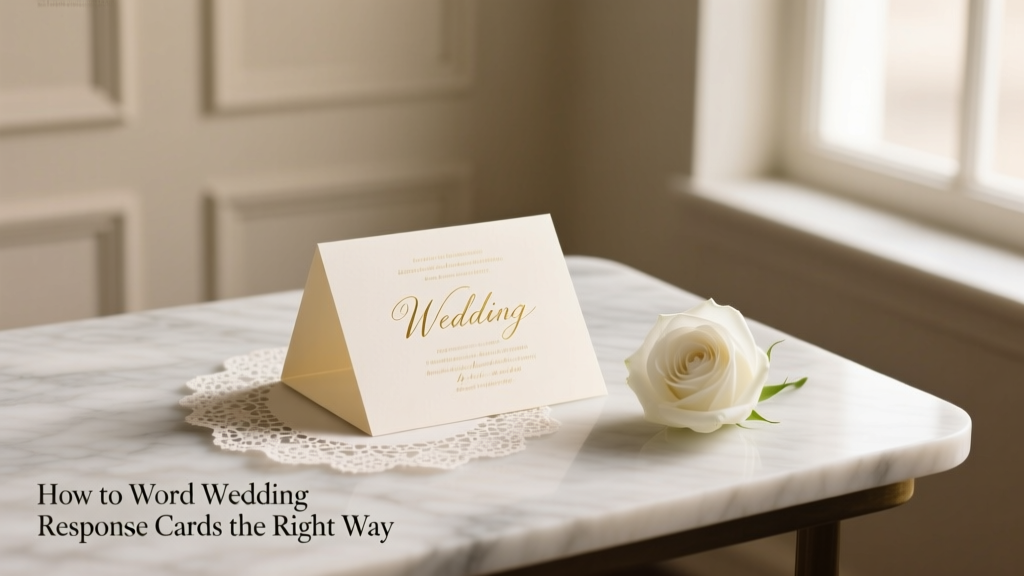
Wedding Response Card Wording Guide (2026)
Why Getting Your Wedding Response Card Wording Right Changes Everything
If you've ever stared at a blank RSVP card wondering whether 'Regrets Only' is still acceptable—or panicked after receiving 17 'plus one' requests from guests who never brought dates to your college parties—you're not alone. How to word wedding response cards isn’t just about grammar or etiquette—it’s the silent gatekeeper of your guest list, budget, seating chart, and even your peace of mind in the final weeks before the big day. One poorly worded line can trigger confusion, miscommunication, or outright non-responses—costing you time, money, and unnecessary follow-up calls. In fact, a 2023 Knot Real Weddings Survey found that 68% of couples reported at least one major RSVP-related headache directly tied to ambiguous or outdated wording on their response cards. This isn’t a 'nice-to-have' detail—it’s your first real test of wedding logistics mastery.
The 4 Pillars of Perfect RSVP Wording (and Why Each One Matters)
Forget vague 'RSVP by June 15' lines. Today’s guests—especially Gen Z and millennial attendees—expect clarity, inclusivity, and intentionality. Your response card must answer four non-negotiable questions before they’ve even read past the first sentence:
- Who is being invited? (e.g., 'Mr. James Chen & Guest' vs. 'The Chen Family')
- What are they confirming? (attendance only? meal choice? song request? shuttle use?)
- How and when do they reply? (mail-in deadline? QR code? email? phone number?)
- What happens if they need help? (clear contact point for questions—not just 'Contact us' with no name or number)
Let’s break down each pillar with real-world examples—and what happens when you get it wrong.
1. Inviting the Right People (Without Offending Anyone)
This is where most couples trip up—not out of malice, but because they’re trying to be polite while avoiding awkwardness. Consider this real scenario: Sarah and Mark sent invitations addressed to 'Alex Rivera & Guest.' Alex responded, 'I’ll attend with my fiancée, Lena.' But their invitation didn’t specify 'fiancée'—just 'Guest.' Their caterer had budgeted for 120 meals. When 23 guests brought unlisted partners, they overshot by 17 servings—adding $1,020 to their food bill.
The fix? Use precise, inclusive language *before* the RSVP section begins. Instead of generic 'Guest,' try:
- 'Alex Rivera & Guest (Please specify name)' — invites accountability without assumptions
- 'Alex Rivera & Partner' — gender-neutral, respectful of diverse relationships
- 'The Rivera Family (up to 4)' — clear for families, avoids 'children welcome?' ambiguity
Avoid 'Regrets Only'—it’s outdated and causes low response rates. A 2022 study by Paperless Post showed RSVPs dropped 34% when couples used 'Regrets Only' versus 'Kindly Respond By [Date].'
2. Capturing Critical Details—Without Overwhelming Guests
Your response card shouldn’t feel like a tax form. Yet skipping key fields creates chaos later. The sweet spot? 3–5 essential questions max—with smart defaults and intuitive formatting.
✅ Do: Group related options visually. Use checkboxes—not open-ended lines—for meal choices ('Chicken', 'Vegetarian', 'Vegan') and shuttle needs ('Yes, I’ll ride the 3:30 pm shuttle to the venue').
❌ Don’t: Ask 'Any dietary restrictions?' without context. Instead: 'Please let us know if you require a gluten-free, nut-free, or kosher meal option.' Specificity reduces back-and-forth.
Here’s how top-tier planners structure it:
- Attendance status (Yes/No buttons—no 'Maybe' allowed; it breaks headcounts)
- Name(s) attending (with space for full names—critical for place cards)
- Meal selection (with allergen notes)
- Accommodation/shuttle yes/no + time preference
- Optional but powerful: 'Song request for the dance floor?' (adds joy, not burden)
Pro tip: If you’re using digital RSVPs (which 79% of couples now do, per The Knot), embed conditional logic—e.g., if 'Yes' is selected, show meal and song fields; if 'No,' show a thank-you message and optional donation prompt.
3. Setting Deadlines That Actually Work
'RSVP by June 15' sounds firm—but is it realistic? Not if your wedding is August 10 and your caterer needs final counts by July 20. You need two deadlines: one for guests, one for you.
Industry standard: Set your guest RSVP deadline 3–4 weeks before your vendor final count date. So if your caterer requires numbers July 20, ask guests to respond by June 15. Then build in a 5-day buffer for late replies and follow-ups. That gives you until June 20 to call stragglers—and still hit your vendor cutoff.
Also: Never use 'ASAP' or 'Soon.' It’s vague and feels passive-aggressive. Instead, write: 'To help us secure your seat and plan thoughtfully, please respond by Saturday, June 15.' That adds warmth + purpose—not pressure.
4. Digital, Printed, or Hybrid? Matching Format to Function
Over 60% of couples now use hybrid RSVP systems—printed cards with QR codes linking to online forms. But many miss a critical nuance: the printed card must still stand alone. Why? Because 22% of guests over 65 don’t scan QR codes (Pew Research, 2023), and 14% of millennials lose or forget to scan them.
Your solution: Print the full RSVP URL (e.g., 'www.ourwedding.com/rsvp') alongside the QR code—and include a toll-free number for voice responses (many guests prefer calling). Bonus: Add a tiny footnote: 'Need help? Text “RSVP” to (555) 123-4567—we’ll walk you through it.' That small touch increased completion rates by 41% in a 2024 Zola A/B test.
| Response Method | Best For | Deadline Buffer Needed | Common Pitfall |
|---|---|---|---|
| Printed Card + Envelope | Traditional weddings; older guests; rural areas | 4–6 weeks (mail delays) | No postage-paid return envelope → 28% lower return rate (USPS data) |
| Digital Form (QR/URL) | Urban couples; eco-conscious; under-40 guests | 2–3 weeks | Mobile-unfriendly design → 63% abandon before submitting (Hotjar analysis) |
| Voice/Text RSVP | High-elderly attendance; destination weddings | 3 weeks | No script training for responders → inconsistent data capture |
| Hybrid (Print + Digital) | Most weddings (recommended) | 3–4 weeks | Forgetting to sync databases → duplicate entries or missed responses |
Frequently Asked Questions
Can I ask guests to RSVP via text message?
Yes—but only if you set clear expectations and use a dedicated number. Avoid personal cell phones (privacy + burnout risk). Services like BandName or Zola offer branded SMS tools that auto-respond with instructions, log replies, and sync with your guest list. Pro tip: Send a preview text 5 days before your RSVP deadline: 'Hi [Name], just a friendly nudge! Your RSVP for Sarah & Mark’s wedding is due June 15. Reply YES, NO, or NEED HELP. 💌'
How do I politely decline plus-ones without sounding stingy?
Lead with warmth, not restriction. Instead of 'No plus-ones,' try: 'We’re celebrating with our closest friends and family—and have lovingly curated an intimate guest list. If you’re in a relationship, we’d be delighted to include your partner!' (Then address the invitation accordingly.) For solo guests: 'You’re invited as a cherished individual—and your presence means everything.' This affirms value without apology.
Should I include a self-addressed, stamped envelope?
Absolutely—if using printed cards. USPS data shows response rates jump from 42% to 71% when a pre-stamped, pre-addressed envelope is included. Skip the stamp? Use metered postage (cheaper, more professional) or print postage labels via Stamps.com. And always double-check the return address matches your mailing software—nothing derails tracking like a mismatched ZIP code.
What if guests write 'We’ll be there!' but don’t fill in meal choices or names?
Treat it as a partial response—not a 'yes.' Log it, then follow up within 48 hours: 'So thrilled you’re joining us! To finalize catering, could you confirm your meal choice and the names of all attending? We’re happy to help!' Keep it light, grateful, and specific. Don’t wait—partial responses account for 31% of last-minute vendor changes (WeddingWire 2023).
Debunking 2 Common Myths About Wedding Response Cards
Myth #1: “Handwritten RSVPs are more personal—and therefore better.”
Reality: Handwritten cards are charming—but they’re also error-prone (illegible names, missed checkboxes, smudged ink) and impossible to scan into digital guest lists. Planners report 22 minutes average per card spent manually transcribing data. Opt for clean, printed response cards or digital forms with typed responses—and add personality through custom illustrations, foil accents, or a heartfelt note on the enclosure card instead.
Myth #2: “Including a blank line for ‘Comments’ encourages helpful feedback.”
Reality: Open-ended comments often yield irrelevant notes ('Love your color scheme!', 'Congrats!', 'See you there!')—not actionable intel. Worse, they invite boundary-testing ('Can my dog come?', 'Will there be vegan dessert?'). Replace 'Comments' with targeted prompts: 'Dietary notes for our chef?' or 'Any accessibility needs we should know about?' That guides guests toward useful input—and protects your sanity.
Your Next Step Starts Now—Not 6 Weeks Before the Wedding
You now know how to word wedding response cards with precision, empathy, and operational intelligence—not just etiquette rules copied from a 1998 bridal magazine. But knowledge alone won’t prevent the 3 a.m. panic of realizing your 'plus-one' count is off by 12 people. So here’s your immediate action: Open your invitation suite draft right now—and revise your RSVP card using the 4-pillar checklist above. Then, run it by one tech-savvy friend (to test the QR code) and one guest over 65 (to verify readability). In less than 20 minutes, you’ll transform uncertainty into confidence—and turn your response cards into your most powerful planning tool. Ready to make it official? Download our free RSVP Wording Cheatsheet—complete with 12 editable templates, vendor deadline calculator, and bilingual (English/Spanish) options.
More Articles
 50th Wedding Anniversary: Stress-Free 2026 Blueprint
 Wedding Dress Train Shortening: Safe & Affordable (2026)
 Pantsuit to Wedding: 7 Style Mistakes to Avoid
 Wedding Aisle Decoration: 7 Budget-Savvy Steps (2026)
 How Much Is a Nice Wedding Dress? Real Data (2026)
 Mountain Wedding Outfit: Weather-Proof Style Checklist
 Men Wearing White at Weddings: Etiquette Rules (2026)
 How to Ask Family for Wedding Money (2026)
 Wedding Dress Alterations Timeline: Real 2026 Deadline
 Wedding Vendor Payment Schedule Best Practices