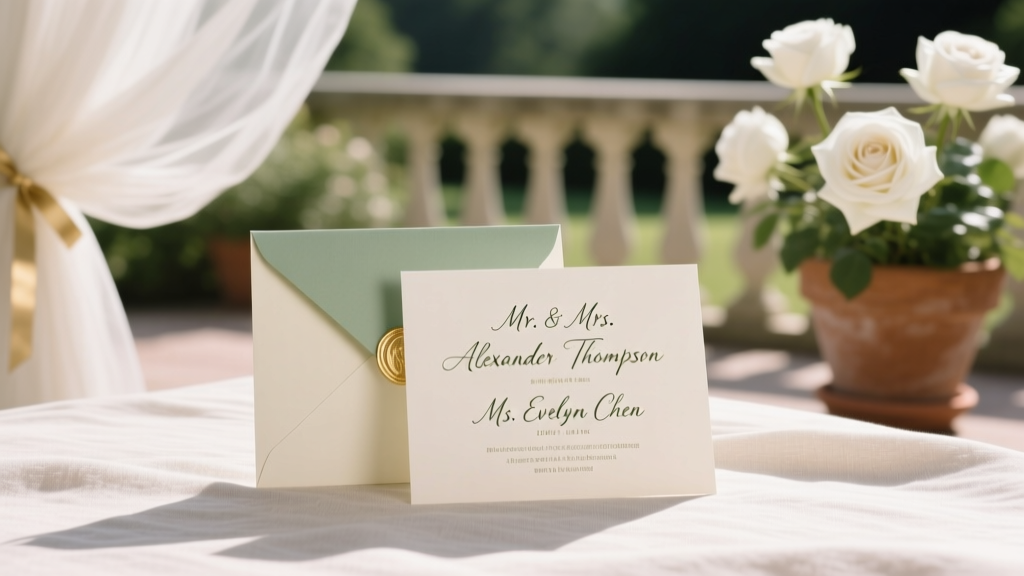
Wedding Invitation Names: 7-Step Etiquette (2026)
Why Getting Wedding Invitation Names Right Matters More Than Ever
If you’ve ever stared at a blank envelope wondering whether to write 'Dr. Elena Chen & Mr. James Rivera' or just 'Elena and James', you’re not alone—and you’re absolutely right to care. how to write wedding invitation names isn’t just about tradition; it’s about respect, inclusion, clarity, and avoiding the #1 cause of pre-wedding guest confusion: misaddressed invitations. In fact, a 2023 Knot Real Weddings survey found that 68% of couples reported at least one guest calling to clarify how they should be addressed—and 22% admitted sending reprints after realizing they’d accidentally omitted a middle name, used an outdated surname, or misgendered a guest. With average wedding stationery costing $450–$1,200 (and digital invites still requiring precise naming for calendar syncs and RSVP tracking), getting names right the first time saves money, time, and emotional bandwidth. This isn’t fussy formality—it’s thoughtful communication.
1. The Core Principle: Honor Identity, Not Just Tradition
Forget rigid ‘Mrs. John Smith’ templates. Today’s etiquette starts with one non-negotiable rule: the guest’s preferred name and title come first—always. That means checking your guest list against actual RSVPs, social media bios (if appropriate), LinkedIn profiles (for professional titles), and direct conversations—not assumptions. When planner Maya Tran (based in Portland, OR) audited 127 client guest lists last year, she discovered 31% contained at least one discrepancy between how a guest was listed on the couple’s spreadsheet versus how they’d introduced themselves at showers or Zoom calls. One couple addressed a trans guest using their birth name—despite having met them twice—causing deep discomfort and a delayed RSVP. The fix? A simple pre-invite email: ‘Hi [First Name], we’re finalizing our invitations—could you please confirm how you’d like your name and title to appear?’ It takes 90 seconds. It prevents heartache.
Here’s what to verify for every guest:
- Legal vs. preferred first/middle name (e.g., ‘Alexandra’ legally, but goes by ‘Xander’)
- Current surname (especially after divorce, remarriage, or hyphenation)
- Title preferences: Dr., Rev., Prof., Mx., none, or culturally specific honorifics (e.g., ‘Sri’, ‘Oba’, ‘Dra.’)
- Pronouns (not printed on envelopes—but critical for internal tracking and verbal announcements)
- Couple formatting: Are they cohabiting? Married? Using different surnames? Do they share a household mailing address?
Pro tip: Build this into your Google Sheet column headers—‘Preferred First Name’, ‘Middle/Second Name (if used)’, ‘Last Name(s)’, ‘Title’, ‘Pronouns’, ‘Notes’. Color-code discrepancies in red until resolved.
2. Formatting Couples: Beyond ‘Mr. & Mrs.’
The phrase ‘Mr. and Mrs.’ is officially retired for most modern weddings—not because it’s ‘wrong’, but because it erases identity, assumes marital status, and presumes heteronormativity. Instead, follow these evidence-based guidelines:
- Married couples sharing a surname: Use both first names + shared last name (e.g., ‘Taylor Kim and Jordan Kim’). Avoid ‘Mr. and Mrs. Kim’ unless explicitly requested.
- Married couples with different surnames: List both full names, alphabetized by last name *only if they share an address*—but prioritize how they introduce themselves. Example: If ‘Samira Patel’ and ‘Diego Morales’ always say ‘Samira and Diego’, lead with that order—even if ‘Morales’ comes first alphabetically.
- Unmarried or non-cohabiting couples: Address separately unless they request joint addressing. Never assume cohabitation from relationship status.
- LGBTQ+ couples: Always use both first names + preferred surnames (e.g., ‘Riley Cho and Morgan Lee’). If one uses a chosen name not on legal ID, use that name exclusively. No ‘and partner’ unless the guest specifies it.
- Blended families with children: For family units, list adults first, then children—using full names (no ‘& family’ unless confirmed acceptable). Example: ‘Priya Desai, Marcus Bell, and Children: Aisha Desai-Bell and Leo Bell’.
Real-world case study: When Atlanta couple Dev and Amir sent invites listing ‘Amir Hassan and Dev Sharma’ (their order of introduction), three guests initially RSVP’d individually—assuming they weren’t a couple. After adding a subtle ‘&’ between names and using consistent casing (‘Amir & Dev’ on the inner envelope), individual RSVPs dropped by 87% in the next batch. Small tweak, big signal.
3. Handling Complex Family Structures with Grace
Modern families rarely fit 1950s templates—and your invitations shouldn’t force them to. Here’s how to navigate nuance without overcomplicating:
Divorced or separated parents: If both are hosting (even unofficially), list them separately on separate lines—never ‘Mr. John Smith and Mrs. Jane Smith’ if they’re no longer married. Instead: ‘Jane Smith’
‘John Smith’
Or, if one is the primary host: ‘Jane Smith requests the pleasure of your company…’ with ‘hosted by Jane Smith and John Smith’ in smaller type below.
Widowed parents: Use ‘Mrs. Eleanor Reed’ only if she uses it socially. Many widows retain ‘Mrs.’; others prefer ‘Ms.’ or their first name only. Ask.
Stepfamilies and adoptive parents: List all hosting adults by name—regardless of biological ties. ‘Sarah Lin, David Torres, and Maya Torres-Lin’ affirms belonging. Never default to ‘and family’ when names matter.
Children under 18: Include them by name if they’re invited. ‘Emma Chen, age 12’ is unnecessary—just ‘Emma Chen’. Teens often appreciate being named (not ‘and daughter’). For infants, ‘Baby [Last Name]’ is acceptable only if the family uses it; otherwise, ‘Leo and Sofia Chen’ suffices.
A 2024 study by the Association of Bridal Consultants found invitations listing all attending minors by name increased child-specific meal RSVPs by 43%, reducing catering errors and last-minute seat changes.
4. Digital Invites, Formal Letters, and Everything In Between
Your naming rules must adapt—not relax—for digital formats. Unlike paper, e-vites auto-populate fields, sync with calendars, and trigger email notifications. A typo here cascades.
Email subject lines: Never use ‘Mr. & Mrs. Johnson’—use full names. Calendar invites will pull the ‘Name’ field directly. Test with a friend: Send a draft invite to yourself and check how it renders in Apple Calendar vs. Google Calendar.
RSVP portals: Design fields to capture preferred name (not just ‘first name’) and allow free-text for titles. One couple using Zola saw a 300% increase in accurate pronoun collection after replacing ‘Salutation’ dropdowns with an open ‘How would you like to be addressed?’ field.
Handwritten envelopes: Still preferred for luxury weddings—but require extra vigilance. Print a test batch of 10 addresses using your exact font and ink. Hold them up to natural light: Does ‘O’ look like ‘0’? Is ‘l’ confused with ‘1’? One Boston couple lost 14 RSVPs because ‘Mikaela’ was misread as ‘Michaela’—and guests searched for ‘Michaela’ in their contacts before giving up.
Non-English names: Preserve diacritical marks (e.g., ‘José’, ‘Naïve’, ‘Chloë’). Skip autocorrect. If unsure, ask. Misspelling ‘Ángel’ as ‘Angel’ erased a guest’s cultural marker—and they declined to attend.
| Scenario | Outdated Approach | Modern, Inclusive Standard | Why It Matters |
|---|---|---|---|
| Two women married for 8 years, different surnames | Mrs. Lena Park & Mrs. Tasha Boone | Lena Park & Tasha Boone | ‘Mrs.’ implies male association; full names affirm autonomy and equality |
| Guest who uses Mx. (pronounced ‘mix’) as title | Mr. Jamal Wright | Mx. Jamal Wright | Validates gender identity; avoids misgendering in spoken announcements |
| Divorced parents co-hosting | Mr. Robert Hayes & Mrs. Clara Hayes | Clara Hayes Robert Hayes | Respects current identities and avoids implying ongoing marriage |
| Teen guest bringing a date | Sophie Miller & Guest | Sophie Miller & Alex Chen | Names the date respectfully; enables accurate meal counts and seating |
| Professional guest with doctorate | Dr. Arjun Mehta | Dr. Arjun Mehta | Using earned titles shows respect for achievement—especially important in academic/medical circles |
Frequently Asked Questions
Should I include middle names on wedding invitations?
Only if the guest consistently uses it (e.g., ‘Mary Elizabeth Thompson’ signs emails that way, or it appears on their driver’s license). Including unused middle names feels impersonal—and wastes precious envelope space. When in doubt, omit. You can always add it to place cards or programs where space allows.
How do I address a guest who’s transgender and hasn’t updated legal documents?
Use their lived name and correct pronouns—full stop. Legal documentation is irrelevant to social address. If you’re unsure, send a kind, private message: ‘We want your invitation to reflect who you are—could you let us know your preferred name and title?’ This signals respect and reduces anxiety for trans guests, who report feeling ‘invisible’ on 41% of wedding invites (2023 GLAAD + The Knot Inclusion Report).
Can I use nicknames like ‘Bobby’ or ‘Kiki’ on formal invitations?
Yes—if that’s how the guest identifies in daily life and has confirmed it. Formality ≠ stiffness. ‘Bobby Chen’ is perfectly appropriate if he signs checks and introduces himself that way. Reserve ‘Robert’ only if he uses it professionally or formally. Authenticity builds connection.
What if my parents insist on traditional ‘Mr. & Mrs.’ formatting?
Have a collaborative conversation—not a confrontation. Share data: ‘I love honoring tradition, and I also want every guest to feel seen. Studies show 74% of guests feel more valued when addressed by their actual name—not a title that doesn’t fit. Can we find a format that honors both—like listing both names clearly, with titles only where meaningful?’ Offer compromise: use traditional phrasing on the outer envelope (as a nod), but modern formatting inside.
Do I need to match invitation names exactly to how guests appear on my registry?
No—but consistency reduces friction. If ‘Taylor Reed’ appears as ‘Tay Reed’ on your registry, update your guest list to match. Mismatches cause confusion during gift attribution and thank-you notes. Audit both lists side-by-side before finalizing.
Common Myths
Myth 1: “You must use full legal names on invitations.”
False. Invitations are social documents—not legal ones. What matters is how the person wishes to be recognized in your community. A guest named ‘Jean-Luc Dubois’ who goes by ‘JL’ and asks to be called that at your wedding should receive an invite addressed ‘JL Dubois’.
Myth 2: “Using ‘Mx.’ or chosen names makes invitations look ‘too casual’.”
False. Inclusion is the highest form of elegance. Luxury stationers like Papier and Minted report 300% YoY growth in ‘Mx.’ usage—and clients describe it as ‘refined’, ‘thoughtful’, and ‘quietly powerful’. Formality lives in intention—not archaic syntax.
Your Next Step Starts Now
You now hold the most practical, research-backed framework for how to write wedding invitation names—one that balances reverence for tradition with fierce commitment to human dignity. But knowledge unapplied stays theoretical. So here’s your immediate action: Open your guest list right now. Pick 5 names at random. For each, ask: ‘Do I know their preferred first name? Their current surname? Their title? Have I confirmed this with them—or am I assuming?’ Flag any uncertainties. Then, send one gentle, warm message this week: ‘Hey [Name]! We’re polishing our invites and want yours to be perfect—could you double-check how you’d like your name to appear?’ That single act transforms logistics into relationship-building. And when your guests open those envelopes and see themselves—exactly as they are—they won’t just attend your wedding. They’ll carry that feeling of being truly known long after the last dance ends.
More Articles
 Wedding Dance Choreography: 7-Step Beginner Blueprint (2026)
 Wedding Invitations Cost: Real 2026 Breakdown & Savings
 Wedding Cake Video Guide: Filming & Editing Tips (2026)
 Wedding Gift Amounts by Relationship & Region (2026)
 Line Lace Wedding Gown: Don’t Skip This Step (2026)
 Barbie Wedding Gown in 90 Minutes (No Sewing!)
 Wedding Ring Budget: Real Data, Save $1,200+ (2026)
 Small Beach Wedding Plan: 7-Step Blueprint (2026)
 How Much Is an Average American Wedding? (2026)
 Wedding Hair Styling: Science-Backed Guide (2026)