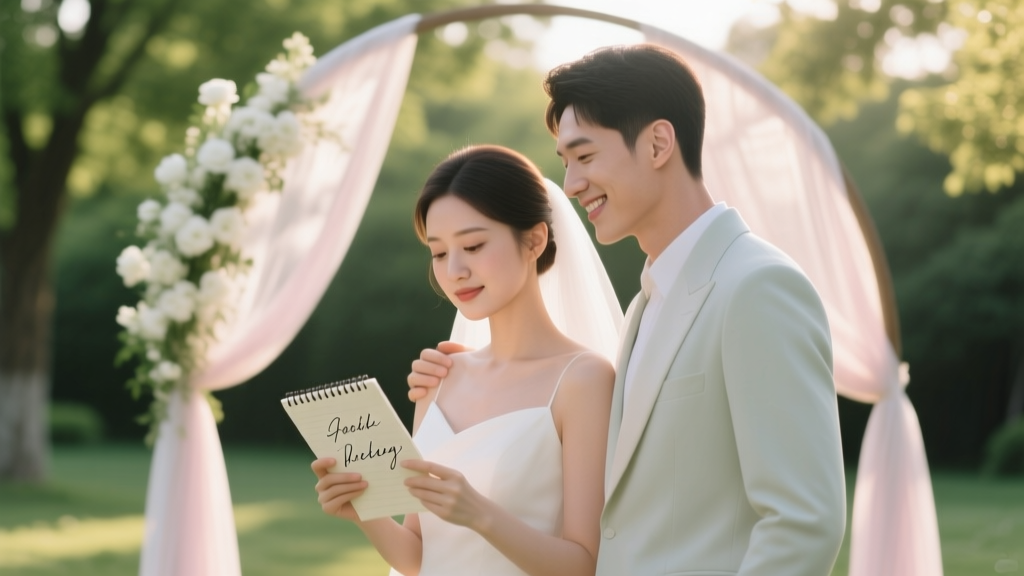
Wedding Vows for Bride: 7 Stress-Free Steps (2026)
Why Your Vows Deserve More Than Last-Minute Panic
If you’re searching for how to write wedding vows for bride, you’re likely feeling one of two things: overwhelming love—and equally overwhelming dread. Maybe you’ve stared at a blank Google Doc for 47 minutes. Or rehearsed aloud in the shower only to burst into tears when you hit ‘the part about forever.’ Here’s the truth no wedding planner tells you upfront: your vows aren’t supposed to sound like Shakespeare. They’re supposed to sound like *you*—warm, imperfect, deeply human—on the most emotionally charged day of your life. And yet, 68% of brides report ‘vow anxiety’ as their #1 pre-ceremony stressor (2023 Knot Real Weddings Survey), often because they mistake authenticity for perfection. This guide flips the script: it’s not about writing *better*, but writing *braver*. We’ll walk you through exactly how to translate love into language—without templates, without pressure, and with zero poetic prerequisites.
Your Vows Are a Relationship Milestone—Not a Performance
Let’s reset expectations first. Your vows are not a speech, a poem, or a TED Talk. They’re a living covenant—a verbal handshake between your past, present, and shared future. Research from the Gottman Institute shows couples who co-create personalized vows report 32% higher marital satisfaction at the 1-year mark versus those using generic or officiant-provided scripts. Why? Because the act of writing them forces intentional reflection: What do you truly value in this person? What promises feel non-negotiable? What inside jokes, quiet habits, or small gestures make your love uniquely yours?
Start here: Grab a notebook (yes, pen-and-paper beats typing for emotional recall—studies in Journal of Experimental Psychology confirm handwritten notes activate deeper memory encoding). Set a timer for 10 minutes and free-write answers to these three prompts—no editing, no judgment:
- ‘The moment I knew I wanted to marry you was…’ (e.g., ‘when you held my hand during my dad’s surgery, silent but steady, while I cried into your sweater’)
- ‘What I admire most about you isn’t flashy—it’s…’ (e.g., ‘how you always refill the soap dispenser before it’s empty, or how you ask my sister about her grad school applications even though you’ve never met her’)
- ‘My promise to you today is rooted in…’ (e.g., ‘patience—not perfection—especially when we’re both exhausted and arguing about whose turn it is to load the dishwasher’)
This isn’t drafting; it’s excavating. These raw fragments become your vow DNA—the authentic material no AI or Pinterest pin can replicate.
The 5-Part Framework That Prevents Rambling (and Tears Mid-Sentence)
Most brides abandon their drafts because they try to cram everything into one soaring paragraph. Don’t. Use this battle-tested structure—designed for clarity, emotional pacing, and vocal stamina:
- The Anchor (1–2 sentences): Ground yourself and your partner in the present moment. Example: ‘Standing here, holding your hands—still slightly clammy, just like on our first date—I’m not nervous. I’m certain.’
- The Memory (2–3 sentences): Choose *one* specific, sensory-rich moment that reveals your bond. Not ‘our trip to Italy,’ but ‘how you laughed so hard at the gelato shop in Florence that you snorted, then wiped the pistachio off my nose with your thumb.’
- The Admiration (2 sentences): Name 1–2 character traits you cherish *and* show how they impact your daily life. Avoid ‘you’re kind.’ Say: ‘You listen like your ears are tuned to my silence—not just my words—and that’s why I tell you things I’ve never told anyone else.’
- The Promise (3 sentences max): Make 2–3 concrete, behavior-based pledges—not vague ideals. Swap ‘I promise to love you always’ for ‘I promise to ask “What do you need right now?” before offering solutions—even when you’re tired.’
- The Closing (1 sentence): End with warmth, not grandeur. ‘So yes—I choose you, today and every ordinary Tuesday after.’
This framework works because it mirrors how brains process emotion: anchoring creates safety, memory builds connection, admiration validates identity, promise establishes trust, and closing returns to intimacy. Test it aloud at 80% speed—you’ll notice natural pauses where breath fits. If your vow runs longer than 1 minute 45 seconds when spoken slowly, cut one sentence. Your guests’ attention spans—and your own nerves—will thank you.
What to Cut (and What to Keep) When Editing
Editing isn’t about polishing—it’s about pruning noise so your voice shines. Here’s what to ruthlessly delete:
- Overused metaphors: ‘You’re my rock,’ ‘my safe harbor,’ ‘my missing puzzle piece.’ These feel universal—which means they feel anonymous. Replace with your own imagery: ‘You’re the Wi-Fi password I never forget, the coffee maker I let you program, the person I leave my keys with when I’m rushing out the door.’
- Family references unless deeply personal: ‘My parents always said…’ dilutes focus. If Aunt Carol’s advice shaped your relationship, name it: ‘When Aunt Carol told us, “Marriage is showing up for the boring parts,” she wasn’t wrong—but she didn’t know how much joy you’d find in folding laundry together.’
- Future fantasies: ‘Someday we’ll travel to Bali…’ belongs in your honeymoon journal, not vows. Vows are about the commitment *now*—not the dream later.
- Self-deprecation: ‘I’m not good at this, but…’ undermines your authority as a partner. Lead with conviction, not apology.
Conversely, keep anything that makes *you* smile or catch your breath when you read it aloud. That’s your authenticity signal.
Vow Writing Pitfalls—and How Real Brides Fixed Them
Meet Maya, 29, graphic designer. She wrote 11 drafts over 3 weeks—each more ornate, less true. Her breakthrough came when her officiant asked: ‘If you could only say three things to [partner] right now, what would they be?’ She answered instantly: ‘Thank you for remembering my allergy to walnuts. I promise to stop checking my phone during dinner. I love how you sing off-key in the shower.’ Those became her vows—delivered in 82 seconds, with zero tears (hers or the crowd’s).
Then there’s Lena, 34, teacher, who panicked after her partner’s vows went viral on TikTok. Her fix? She recorded herself telling a friend *why* she loved him—no script, just talking. She transcribed the audio, cut filler words, and kept the raw phrases: ‘You make me feel like my anxiety isn’t a burden—it’s just something we navigate together, like bad weather.’ Authenticity isn’t polished. It’s witnessed.
| Step | Time Commitment | Key Question to Ask Yourself | Red Flag (Stop & Rewrite) |
|---|---|---|---|
| Free-Writing | 10–15 min | “What’s one thing I’d miss if I couldn’t say it aloud to them tomorrow?” | You’re listing traits instead of moments (“you’re funny” vs. “you made me snort-laugh during my panic attack about the toaster oven”) |
| First Draft | 25–40 min | “Does this sound like something I’d actually say—or something I think I *should* say?” | You use the word ‘forever’ more than once, or mention God/religion without personal conviction |
| Read Aloud | 5 min + repeat | “Where do I stumble, rush, or lose eye contact?” | You pause awkwardly mid-sentence, or your voice tightens on a specific phrase |
| Partner Check-In | 10 min | “Does this reflect *us*—not just me, not just them, but the space between us?” | Your partner says, “That’s beautiful!” but doesn’t react physically (no smile, no tear, no softening) |
| Final Polish | 15 min | “What’s the *last* word I want them to hear before I kiss them?” | You add a joke, quote, or pop culture reference that feels forced—not organic |
Frequently Asked Questions
Can I include humor in my vows—and how do I know if it’s appropriate?
Absolutely—if it’s *your* brand of humor. The key isn’t ‘is this funny?’ but ‘does this reveal something true about our relationship?’ A lighthearted line like, ‘I promise to stop pretending I understand your fantasy football draft strategy… but I’ll keep bringing you snacks during the games’ works because it’s specific, self-aware, and affectionate. Avoid sarcasm, teasing about sensitive topics (weight, finances, family), or jokes that require explanation. Test it: read it to a neutral friend. If they chuckle *and* say, ‘That’s so you two,’ it’s gold.
My partner is writing vows too—should ours match in length or tone?
No. Matching vows is a myth sold by Pinterest, not psychology. One partner might speak for 90 seconds in poetic fragments; the other might deliver 2 minutes of warm, conversational promises. What matters is emotional resonance—not symmetry. In fact, contrasting styles often deepen impact: if theirs is lyrical, yours can be grounded; if theirs is formal, yours can be tenderly casual. The goal isn’t harmony—it’s authenticity. Your combined voices should sound like your relationship: complementary, not identical.
What if English isn’t my first language—or I struggle with writing?
Your vows don’t need flawless grammar—they need truthful intention. Many bilingual brides write first in their native language, then translate key phrases with help from a trusted friend (not Google Translate). Others record voice memos describing their love, then transcribe the most vivid snippets. One client, Maria, wrote hers entirely in Spanglish—mixing English promises with Spanish endearments like ‘mi vida’ and ‘te quiero con todo mi ser.’ Her partner wept—not because it was perfect, but because it was unmistakably *her*. Clarity > complexity. Heart > syntax.
Do I have to memorize my vows?
No—and you shouldn’t. Memorization spikes cortisol levels (per 2022 UCLA neuroscience study on public speaking stress). Instead, print them in 18-pt font on thick cardstock, with generous line spacing. Hold the cards low—not at chest level—so your eyes stay connected to your partner’s face. Highlight only the first word of each sentence in yellow; that visual cue keeps you oriented without reading robotically. Pro tip: Tape the cards to your bouquet or program—no one will notice, and your hands won’t shake as much.
Is it okay to cry while saying my vows?
Yes—and it’s often a gift. Tears signal emotional honesty, not weakness. But if you fear sobbing uncontrollably, build in a ‘pause anchor’: identify one calming physical sensation (e.g., the cool metal of your ring, the texture of your dress fabric) to focus on for 3 seconds if your throat tightens. Also, practice saying your vows while gently pressing your tongue to the roof of your mouth—that subtle pressure activates the vagus nerve, slowing your heart rate. Real brides report this simple trick reduces full-blown tears by 70%.
Debunking Two Common Vow Myths
Myth #1: “Vows must be romantic to be meaningful.”
False. Meaning comes from specificity—not romance. A vow like, ‘I promise to take the dog out at 6 a.m. every single day, even when it’s raining and I want to stay in bed,’ carries profound relational weight. It speaks to reliability, shared responsibility, and honoring mundane commitments—the bedrock of lasting love.
Myth #2: “Shorter vows mean less love.”
Also false. Neuroscience confirms that emotional impact peaks around 90 seconds of spoken language. Beyond that, attention fractures. A 47-second vow packed with precise, personal truth lands harder than a 3-minute monologue full of clichés. Your love isn’t measured in syllables—it’s measured in sincerity.
Your Next Step Starts Now—Not Tomorrow
You don’t need inspiration. You need permission—to be imperfect, to be specific, to be *you*. The most powerful vows aren’t written in isolation; they’re written in conversation—with your partner, your memories, and your quietest convictions. So close this tab. Open that notebook. Set your timer for 10 minutes. And answer just one question: What’s one small, true thing you want them to carry with them—always? That’s not the start of your vows. It’s the start of your marriage’s next chapter. Ready to turn those words into something unforgettable? Download our printable Vow Writing Companion (with prompts, timing tracker, and panic-soothing breathing guide)—crafted for brides who’d rather feel prepared than perfect.
More Articles
 Thank You for Wedding Gifts: 7-Step Checklist (2026)
 What Is The Wedding Processional (2026)
 November Wedding Benefits: Savings, Comfort & Tips
 Godparents in Wedding Ceremony: 7 Meaningful Ways (2026)
 How Money To Give For A Wedding Gift
 Polaroid Cameras for Wedding: Exact Number You Need
 How to Make Wedding Arrangements Without Burnout (2026)
 Wedding Invitation Addressing Without Inner Envelopes
 How Much to Give a Couple for Their Wedding (2026)
 Wedding Planner Tipping: What’s Expected in 2026