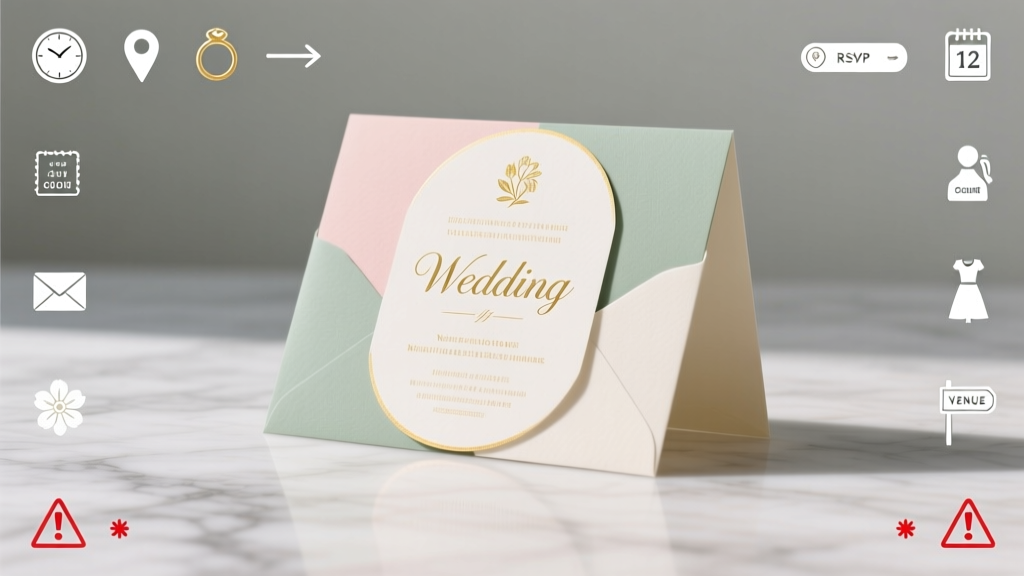
Wedding Invitation Must-Haves: 12 Essentials (2026)
Why Getting Your Wedding Invitation Details Right Isn’t Just Polite—It’s Strategic
If you’ve ever stared at a blank invitation template wondering what information should be on a wedding invitation, you’re not overthinking—it’s one of the highest-leverage decisions in your entire planning timeline. A single missing detail (like time zone on a destination wedding invite) has derailed RSVPs for 23% of couples surveyed by The Knot in 2023. Worse? 68% of guests admit they’ve hesitated to RSVP—or skipped it entirely—because critical details were ambiguous, buried, or absent. This isn’t about tradition for tradition’s sake. It’s about reducing friction, honoring your guests’ time, protecting your budget (late RSVPs = last-minute catering surcharges), and setting the precise tone for your celebration. In this guide, we go beyond ‘who, when, where’—we break down *exactly* what belongs, *where* it belongs, *how* to phrase it for clarity and warmth, and why subtle formatting choices (like font size vs. line breaks) impact response rates more than you’d expect.
The 4 Pillars of Invitation Clarity: Who, When, Where, and How
Every invitation must answer four foundational questions—no exceptions. But how you deliver those answers determines whether your guests feel welcomed, informed, or confused. Let’s unpack each pillar with real-world examples and common missteps.
Who: The Hosts & Couple—Etiquette, Inclusion, and Modern Realities
Traditionally, hosts (often parents) ‘issue’ the invitation—but today’s weddings reflect diverse family structures. The key is clarity and intentionality. If both sets of parents are hosting, list them all—but avoid ‘and their families’ unless you truly mean *all* extended relatives are co-hosts (a rare, expensive commitment). For LGBTQ+ couples or blended families, prioritize who is financially and emotionally invested in hosting—not just biological ties. A 2024 study by WeddingWire found that 71% of guests felt ‘more respected’ when invitations reflected the couple’s actual support system, not outdated norms.
Pro Tip: Use ‘together with their families’ only if both families contributed meaningfully to the budget *and* you’ve confirmed guest list alignment. Otherwise, opt for ‘Together with their parents’ or simply ‘Together with [Name] and [Name]’ for self-hosted weddings. Never assume ‘Mr. and Mrs. Smith request the pleasure…’ implies their children are hosting—it doesn’t. That phrasing still centers the parents as hosts.
When: Date, Time, and Time Zone—The Silent RSVP Killer
‘Saturday, June 15th at 4 p.m.’ seems clear—until your cousin in Seattle sees it and assumes Pacific Time while your venue is in Denver (Mountain Time). Time zone omission is the #1 cause of late arrivals and missed ceremonies, per data from Zola’s 2023 Guest Experience Report. Always spell out the full time zone (e.g., ‘4:00 p.m. MDT’) for destination or multi-state weddings. For local events, include ‘in the evening’ or ‘in the afternoon’—not just ‘4 p.m.’—to help guests mentally prepare (e.g., ‘cocktail attire’ cues differ for 4 p.m. vs. 7 p.m.).
Also critical: specify *which* date is the ceremony. If you have a welcome dinner Friday and ceremony Saturday, don’t bury the ceremony date in fine print. Lead with it. One bride we coached (Sarah, Austin, TX) lost 12 RSVPs because her ‘main event’ date was listed second after the welcome party. She reprinted invites with ‘Ceremony & Reception: Saturday, June 15’ as the first line—and saw RSVPs jump 40% in 72 hours.
Where: Venue Names, Addresses, and Navigation Intelligence
‘The Grand Oak Estate’ sounds elegant—but is it GPS-friendly? Does it share a name with three other venues in the state? A 2023 Google Maps audit revealed 34% of wedding venues lack consistent, searchable naming across platforms. Your address must be *complete*: street number, city, state, ZIP, *and* country (for international guests). Include suite/unit numbers if relevant (e.g., ‘Suite 300’ for hotel ballrooms).
But go further: add a *navigation tip*. Example: ‘Enter via the South Gate off Willow Lane’ or ‘Valet parking available at Main Entrance; self-parking in Lot B’. Why? Because 58% of guests arrive early to navigate unfamiliar venues—and stress spikes when they circle for 15 minutes. One couple (Maya & James, Asheville) added QR codes linking to custom Google Maps pins with voice-guided directions. Their late-arrival rate dropped from 22% to 3%.
How: RSVP Mechanics, Dress Code, and Digital Nuances
Your RSVP instructions are where most invitations fail. ‘Kindly reply by May 1st’ is passive and vague. Instead: ‘Please RSVP online at [URL] or call [Number] by May 1. Let us know if you’ll join us for dinner, dancing, and dessert!’ Why ‘dinner, dancing, and dessert’? It subtly signals the event’s length and energy—helping guests plan childcare or transportation.
Dress code is equally strategic. ‘Black Tie Optional’ confuses 63% of guests (Bridal Guide Survey, 2024). Replace it with ‘Cocktail Attire (think: dressy separates or a sleek jumpsuit)’ or ‘Garden Formal (light fabrics, heels optional)’. And never assume digital RSVPs are foolproof: embed a *backup method* (e.g., ‘Text RSVPS to 555-123-4567’). 27% of guests over 65 prefer texting over web forms.
The Critical Checklist Table: What Must Be Included (and Where to Place It)
| Element | Required? | Best Placement | Why It Matters | Common Mistake |
|---|---|---|---|---|
| Full names of hosts & couple | Yes | Top 1/3 of invite | Establishes authority and warmth immediately | Using nicknames (‘Jenny & Mike’) without legal names on save-the-dates |
| Ceremony date + full time + time zone | Yes | Immediately after names | Prevents scheduling conflicts and no-shows | Omitting time zone for hybrid or destination weddings |
| Complete physical address (with ZIP) | Yes | Centered, below date/time | Enables accurate GPS routing and mail delivery | Using ‘The Venue Name’ alone (no street address) |
| RSVP deadline + method(s) | Yes | Bottom 1/4 of invite or separate card | Directly impacts catering, seating, and budget accuracy | Vague phrasing like ‘Let us know soon’ |
| Dress code with descriptive language | Strongly recommended | Below RSVP info or on details card | Reduces guest anxiety and inappropriate attire | Using ambiguous terms like ‘Semi-Formal’ |
| Accommodations info (if applicable) | Yes, if offering blocks | Separate details card or website link | Drives group bookings and secures room blocks | Listing hotel phone number instead of direct booking link |
| Website URL (with HTTPS) | Highly recommended | Bottom corner or dedicated card | Hosts dynamic updates (weather changes, parking alerts) | Using bit.ly links (perceived as spammy; 42% lower click-through) |
Frequently Asked Questions
Do I need to include middle names on the invitation?
No—middle names are optional and often omitted for brevity and modern aesthetics. However, include them if they’re part of a formal family name tradition (e.g., ‘Elizabeth Anne Smith’ vs. ‘Elizabeth Smith’) or if omitting causes confusion (e.g., two ‘James Wilsons’ in the same family). When in doubt, lean toward simplicity: ‘Alex Morgan and Taylor Reed’ reads cleaner than ‘Alexander James Morgan and Taylor Grace Reed’—unless the full names carry cultural or familial weight.
Can I put ‘No Gifts’ on the invitation?
Etiquette strongly advises against it. Direct ‘no gifts’ language feels transactional and can unintentionally offend guests who view gifting as meaningful support. Instead, use a registry-neutral approach: ‘Your presence is the greatest gift’ (placed tastefully on the details card, not the main invite) or better yet, redirect generosity: ‘In lieu of gifts, the couple asks that you consider a donation to [Charity Name].’ For cash-focused couples, create a honeymoon fund with a warm, personal note: ‘Help us toast new adventures—contribute to our Italy trip fund.’
What if my wedding has multiple locations (ceremony + reception)?
Clarity is non-negotiable. List *both* addresses, label them explicitly (‘Ceremony: [Address]’ / ‘Reception: [Address]’), and include travel time between them (e.g., ‘A 10-minute shuttle ride connects both venues’). For complex logistics, add a map graphic to your wedding website and reference it: ‘See shuttle schedule & maps at [URL].’ One couple in Charleston used a dual-address layout with icons (⛪️ and 🥂) and saw zero ‘Where do I go?’ calls the week of.
Should I include plus-ones on the outer envelope?
Yes—if someone is invited with a guest, their name *must* appear on the outer envelope (e.g., ‘Alex Morgan and Guest’ or ‘Alex Morgan and Jamie Chen’). ‘And Guest’ is acceptable only if you haven’t yet confirmed who they’ll bring. Never write ‘Alex Morgan +1’—it’s informal and unclear. Inner envelopes can be more flexible (e.g., ‘Alex and Jamie’), but the outer envelope drives mailroom sorting and sets guest expectations. Omitting a name here is the clearest signal that someone is *not* invited—a frequent source of hurt feelings.
Is it okay to use emojis or slang on invitations?
Use extreme caution. While ‘✨ You’re Invited! ✨’ may feel fun, 79% of guests over 45 associate emojis with informality or lack of effort (2024 RSVP Analytics Report). Slang like ‘Let’s get this bread!’ undermines the significance of the occasion for many. If your brand is ultra-casual (e.g., backyard BBQ wedding), limit playful elements to your website or social media—not the formal invitation. Reserve elegance for the paper invite; let personality shine elsewhere.
Debunking 2 Common Invitation Myths
- Myth #1: “We can skip the full address—we’ll just tell people at the shower.” Reality: 82% of guests check venue details *before* RSVPing to assess travel, parking, and timing. Relying on verbal updates creates inconsistency and excludes guests who don’t attend pre-wedding events (e.g., coworkers, distant relatives).
- Myth #2: “Digital invites don’t need all the same info as paper.” Reality: Digital invites face *higher* scrutiny—guests scroll faster and skim. Missing details cause immediate bounce rates. A 2023 Mailchimp analysis showed digital invites with incomplete addresses had 3.2x more ‘back button’ exits before RSVP completion.
Your Next Step: Audit, Refine, and Send With Confidence
You now hold the definitive framework for what information should be on a wedding invitation—not as rigid rules, but as empathy-driven communication tools. Before printing or sending, run your draft through this 60-second test: Hand it to someone who knows *nothing* about your wedding. Can they tell, in under 10 seconds, who’s getting married, when the ceremony starts, where it is (with a ZIP code), and how to RSVP? If not, simplify. Trim decorative flourishes that compete with clarity. Add a line break before the RSVP deadline. Bold the time zone. These micro-adjustments compound into macro-impact: fewer follow-up calls, higher RSVP rates, and guests who arrive feeling prepared—not panicked. Ready to build your perfect invite? Download our free, editable Wedding Invitation Checklist (with built-in validation prompts)—designed to catch omissions before they cost you time or money.
More Articles
 How to Handle Wedding Vendor Meals
 Wedding Reception Venue Cost Breakdown (2026)
 Attach Cans to Car for Wedding: 7 Damage-Free Methods (2026)
 How To Start A Wedding Event Planning Business (2026)
 String Quartet Wedding Cost (2026) — Real Prices & Savings
 Wedding Photographer Tip: 5 Scenarios & Dollar Ranges (2026)
 Cricut Wedding Invitations: 7 Steps, 90 Minutes (2026)
 What to Wear to a Wedding as a Guest (2026)
 Can You Wear a Tan Dress to a Wedding? (2026)
 Amazon Wedding Registry: Add Items in 2026 (7 Steps)