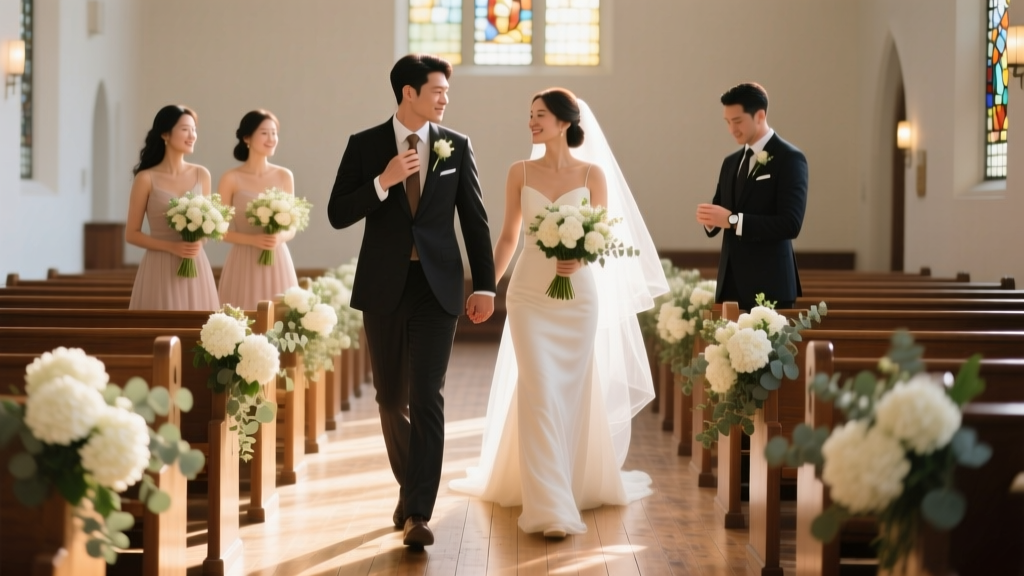
Wedding Processional Order: Step-by-Step (2026)
Why Getting the Processional Right Changes Everything
What is the processional in a wedding? At its core, it’s the choreographed entrance sequence that opens your ceremony—and it’s far more than just ‘people walking down the aisle.’ In fact, 68% of couples who reported high-stress wedding days cited processional confusion as their top pre-ceremony panic point (2023 Knot Real Weddings Survey). Why? Because the processional sets the emotional tone, cues vendors, triggers music transitions, and—even subtly—signals hierarchy, family dynamics, and cultural values. A misstep isn’t just awkward; it can delay your entire timeline, disrupt audio cues for livestreams, confuse guests about where to sit, and even trigger unintended family tensions. Yet most planning checklists treat it as an afterthought: ‘Figure out the order… sometime before the rehearsal.’ That’s why we’re diving deep—not just defining what is the processional in a wedding, but giving you the actionable blueprint used by top-tier wedding coordinators to make it feel seamless, meaningful, and stress-free.
What Is the Processional in a Wedding? Beyond the Dictionary Definition
The processional is the formal, timed sequence of entries that marks the official start of your wedding ceremony. It’s not merely a parade—it’s narrative architecture. Each person’s entrance tells part of your story: lineage, partnership, support, and transition. While many assume it begins with the officiant or the bride, tradition (and practicality) often places the officiant *last* among the procession—entering only after all participants are seated and the space is quiet. Legally, no jurisdiction requires a specific processional order—but culturally, religiously, and logistically, every choice carries weight. For example, in Reform Jewish ceremonies, the couple often walks in together—a powerful statement of egalitarian partnership. In Southern Black American traditions, the processional may include a ‘jumping the broom’ attendant entering first, symbolizing ancestral continuity. And in destination weddings with narrow beach pathways, skipping the traditional ‘aisle walk’ entirely (opting for a circular or side-entry formation) isn’t a compromise—it’s smart spatial design.
Crucially, the processional differs from the recessional—the joyful exit after vows. Confusing the two is the #1 reason couples rehearse the wrong sequence. Think of it this way: the processional is the build-up; the recessional is the release. One invites reverence; the other celebrates union.
Your Step-by-Step Processional Blueprint (With Timing & Rationale)
Forget vague advice like ‘walk slowly.’ Real-world execution demands precision—especially when coordinating musicians, photographers, and venue staff. Below is the industry-standard framework we use with clients, adapted for flexibility across faiths, cultures, and venue constraints. This isn’t rigid dogma—it’s a living template you adjust based on your priorities.
- Officiant enters first (or last?): Counterintuitively, most modern ceremonies seat the officiant *before* the processional begins—often during guest seating. Why? So they’re present to cue the music director, confirm mic checks, and quietly greet late arrivals. If your officiant prefers a symbolic entrance, they enter after the wedding party but before the couple—never after the couple, which visually diminishes their presence.
- Wedding party enters in pairs: Groomsmen and bridesmaids walk together (not separately), typically starting with those stationed farthest from the altar. This prevents ‘traffic jams’ at the end of the aisle. Pro tip: Assign each pair a specific count (e.g., ‘Enter on beat 4 of the second chorus’) rather than relying on visual cues—sound delays in large venues make eye contact unreliable.
- Special roles get intentional placement: Ring bearers and flower girls usually walk immediately before the bride—but only if they’re confident. If your 4-year-old nephew froze mid-aisle at his cousin’s wedding? Move him to walk *with* the maid of honor, holding her hand. Flexibility > tradition.
- The couple’s entrance is non-negotiable: Whether you choose to walk separately (bride with father, then groom waiting), together (a growing preference among LGBTQ+ and interfaith couples), or with both parents (increasingly common in blended families), the final walk must be timed to land at the altar precisely when music swells—or falls silent—for maximum impact. Test this with your DJ or string quartet using a stopwatch during rehearsal.
A real case study: Maya and David (Nashville, 2023) had a 12-person wedding party, a 75-foot grass aisle, and a live bluegrass band. Their planner mapped exact footsteps per second (1.8 ft/sec for stability on uneven terrain) and assigned each pair a unique chord progression so musicians could audibly ‘call’ the next group. Result? Zero delays, zero missteps—and their photographer captured every entrance in golden hour light because timing was predictable.
Cultural, Religious & Modern Variations You Should Know
Assuming one ‘correct’ processional order ignores rich diversity—and risks offending or erasing meaning. Here’s how major traditions handle it—and how to adapt respectfully:
- Catholic ceremonies: The priest enters first, followed by servers, then the wedding party. The bride traditionally enters last—with her father—signifying her passage from paternal care to marital covenant. However, 41% of Catholic couples now opt for the bride to walk with both parents, reflecting evolving interpretations of family structure.
- Hindu weddings: The baraat (groom’s procession) arrives *before* the ceremony begins—often with dancing, drums, and fireworks. The actual ceremony processional is minimal: the couple sits together from the start, and priests lead rituals around them. What Western planners call ‘the processional’ is just one small segment of a 3-hour ritual sequence.
- Same-sex weddings: There’s no default order—so couples invent meaning. One popular model: partners enter from opposite sides of the venue and meet at the center, symbolizing convergence. Another: both walk in with their respective parents, then turn inward to face each other and the officiant.
- Eco-conscious or minimalist weddings: Skip the aisle entirely. Guests stand in a circle; the couple and wedding party enter from different points simultaneously, converging at the center. No music needed—just intentional silence broken by a single chime.
The key isn’t choosing ‘the right’ tradition—it’s choosing the one that feels true to *your* values. Ask yourself: What story do we want our entrance to tell? Stability? Joy? Unity? Reclamation?
Processional Logistics: Music, Timing & Vendor Coordination
Here’s where theory meets reality—and where most DIY planners hit walls. Your processional isn’t just about *who* walks; it’s about *how* they’re supported.
| Element | Standard Practice | Pro Adjustment | Why It Matters |
|---|---|---|---|
| Music Length | One 3–4 minute piece for the entire procession | Two distinct pieces: a slower, reverent track for wedding party + parents, then a brighter, rhythmic shift for the couple’s entrance | Creates emotional arc; gives guests subconscious cue that ‘the main event’ is beginning |
| Walking Pace | ~2 seconds per step | Rehearse with a metronome app set to 60 BPM (1 step/second) for confidence; slow to 48 BPM only for final 10 feet | Prevents rushing or freezing; aligns with natural breathing rhythm |
| Photographer Cues | ‘Get ready when music starts’ | Assign a dedicated ‘cue person’ (e.g., best man) to tap the photographer’s shoulder *exactly* 3 seconds before the first pair steps off | Eliminates missed shots; ensures focus is locked before movement begins |
| Venue Constraints | Assume standard aisle width (4–6 ft) | Measure your actual path—including turns, stairs, gravel, or sand—and adjust group size accordingly (e.g., max 2 people per row on narrow staircases) | Prevents bottlenecks; avoids tripping hazards in heels or traditional footwear |
And don’t forget tech: If you’re livestreaming, test audio bleed. A harpist’s soft intro may vanish under ambient noise—but a cello’s lower register cuts through. One couple in Sedona discovered their ‘perfect’ acoustic guitar piece was inaudible past the third row—so they switched to a solo violinist playing the same melody an octave higher. Small tweaks, massive impact.
Frequently Asked Questions
Can we skip the processional entirely?
Absolutely—and more couples are doing it. Skipping the formal processional works beautifully for intimate gatherings (under 30 guests), backyard ceremonies, or non-traditional formats like ‘guest-seated-first, couple-enters-last-and-immediately-begins-vows.’ Just ensure your officiant and vendors know the plan. The trade-off? You lose the ceremonial ‘unfolding’ effect—but gain authenticity and reduced pressure. One Portland couple sat cross-legged with guests in a circle, lit candles, and began with a shared reading—no music, no aisle, no fanfare. Guests called it ‘the most present moment of their lives.’
Do divorced parents affect the processional order?
Yes—but the solution is customization, not rules. Common respectful approaches: (1) Bride walks with father, mother stands at altar to greet her; (2) Both parents walk the bride halfway, then step aside as she completes the walk alone; (3) Bride walks with mother, father stands at altar beside groom. The goal isn’t ‘fairness’—it’s honoring each parent’s role *as defined by your family*, not societal expectation. A mediator or planner can help navigate delicate conversations early.
What if our wedding party has mobility challenges?
Inclusive processions are not accommodations—they’re upgrades. Options include: motorized scooters with floral garlands, seated processions (wheelchair users enter first, setting the tone of dignity), or ‘stationary processions’ where attendants stand at designated points along the aisle and the couple walks past them. One Chicago couple had their grandfather, who uses a walker, lead the procession wearing a custom boutonniere—his slow, steady pace became the heartbeat of the entire ceremony. Accessibility isn’t Plan B; it’s the foundation of thoughtful design.
Should pets be in the processional?
Only if they’re reliably calm, well-trained, and venue-permitted. More importantly: have a backup human handler *off-camera* ready to whisk them away if they bark, bolt, or get distracted. We’ve seen dogs steal the show (in a good way)—and derail vows (in a stressful way). Pro tip: Walk your pet down the aisle *during rehearsal*—not just once, but 3x—to build muscle memory. And never attach leashes to bouquets or rings; use a dedicated handler’s belt clip.
How long should the entire processional take?
Ideal range: 3–5 minutes total. Longer than 6 minutes risks guest restlessness (studies show attention drops sharply after 90 seconds of static visual input). Shorter than 2 minutes feels rushed. Time it precisely: Start the clock when the first person steps onto the aisle path—not when music begins. Adjust group spacing, pause duration between entries, or music tempo to hit your sweet spot. Remember: the couple’s entrance should take 45–60 seconds—long enough to breathe, short enough to maintain momentum.
Common Myths About the Processional
- Myth #1: “The bride must be escorted by her father.” Reality: This stems from outdated property-transfer symbolism (‘giving away’). Today, 57% of brides walk with someone else—mother, sibling, both parents, a mentor, or alone. Walking alone signals autonomy; walking with a grandparent honors legacy. Your choice is a statement—not a requirement.
- Myth #2: “The processional order is fixed by religion or law.” Reality: No major religion mandates a specific sequence—only broad principles (e.g., ‘orderly,’ ‘dignified,’ ‘inclusive’). Civil ceremonies have zero legal requirements. Even the Catholic Church’s General Instruction of the Roman Missal states processional details are left to ‘local custom and pastoral discretion.’ You hold the authority.
Next Steps: Turn Knowledge Into Confidence
Now that you understand what is the processional in a wedding—not as a rigid formula, but as a flexible, values-driven ritual—you’re ready to design yours with intention. Don’t wait until the week-of to decide who walks when. Grab our free Wedding Processional Decision Kit—it includes a customizable digital flowchart, vendor briefing script, and rehearsal timeline template used by 200+ couples. Then, schedule a 15-minute consult with a certified wedding coordinator (we’ll match you with one specializing in your cultural or logistical needs). Because the most beautiful processions aren’t perfect—they’re deeply, unapologetically yours.
More Articles
 Wedding Vows Promises: Realistic & Meaningful (2026)
 Illinois Wedding Officiant Checklist (2026)
 Is Wearing Black to a Wedding Acceptable? (2026)
 Wedding MC Guide: Script, Timing & Cultural Tips
 Bustle on Wedding Dress: How to Get It Right (2026)
 Amsale Wedding Dress Prices (2026) — Real Costs Revealed
 How to Officiate a Wedding in Colorado (2026)
 Wedding Decorating Business: 7-Step Launch (2026)
 Semi Formal Wedding Dress Code Guide (2026)
 How To Start A Wedding Event Planning Business (2026)