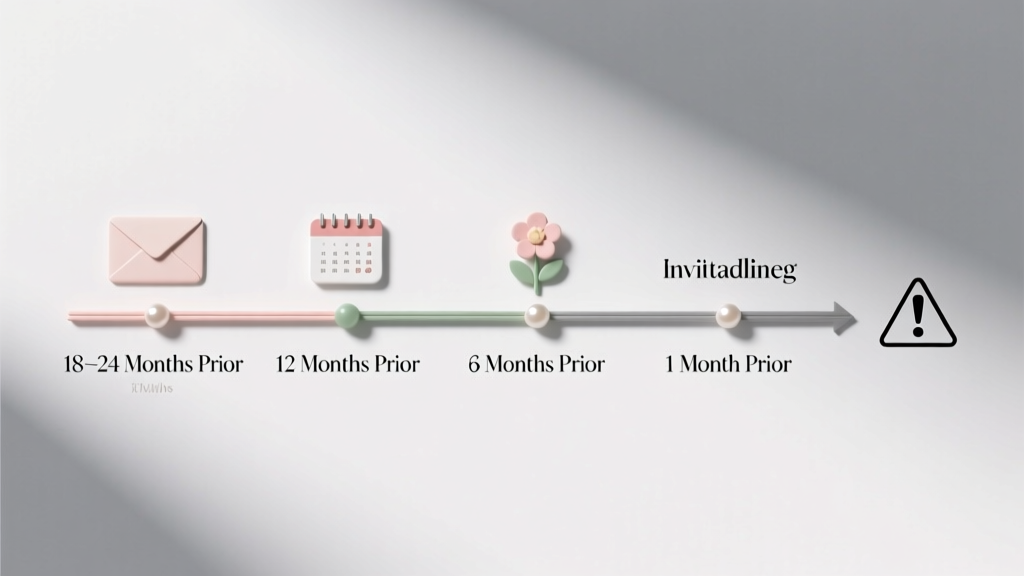
When Do You Send Wedding Invitations
Why Getting This Timing Right Changes Everything
When do you send wedding invitations isn’t just a calendar checkbox — it’s the invisible hinge on which your entire guest experience, vendor coordination, and even budget stability swing. Send too early, and addresses change, guests forget, or you accidentally lock in outdated plans. Send too late, and you risk last-minute venue capacity overruns, caterers scrambling for headcounts, or worse: your favorite cousin booking a cruise the same weekend. In fact, 68% of couples who missed their ideal invitation window reported at least one major vendor conflict — and 41% had to reduce their guest list unexpectedly. This isn’t about tradition; it’s about precision logistics disguised as etiquette. Let’s break down exactly when — and why — each milestone matters.
Your Invitation Timeline, Backward-Planned from 'I Do'
Forget vague advice like “8–12 weeks before.” Real-world planning starts at your wedding date and works backward — because every deadline cascades. Here’s how top-tier planners actually sequence it:
- Day 0: Your wedding date — the anchor point.
- Minus 10 weeks: Finalize guest list & mailing addresses (yes — this must happen before printing).
- Minus 8 weeks: Send formal invitations (the official ‘when do you send wedding invitations’ moment for most traditional ceremonies).
- Minus 6 weeks: First RSVP deadline — not optional. This is when you lock catering, seating, and transportation numbers.
- Minus 4 weeks: Follow up with non-responders (a 23% response lift, per The Knot’s 2024 Planner Survey).
- Minus 2 weeks: Final guest count submitted to all vendors — no exceptions.
This isn’t theoretical. Take Maya & James in Portland: They sent invites at week -9, but delayed address verification until week -7. Result? 17 envelopes returned — three were critical VIPs (including the groom’s estranged father, who reconciled only after a handwritten apology note arrived 5 days post-return). Their lesson? Address accuracy is part of the timeline — not a footnote.
Digital Invites vs. Paper: When Timing Rules Flip
The ‘when do you send wedding invitations’ question gets a radical rewrite if you’re going digital — but not for the reasons most assume. It’s not about speed; it’s about behavior science.
Research from Zola’s 2023 Digital Engagement Report shows email/SMS invites get opened within 4.2 hours on average — but only 56% are RSVP’d within 7 days. Meanwhile, physical invites take 3–5 days to arrive, yet generate a 78% 2-week RSVP rate. Why? Tangibility creates psychological commitment. A paper invite sits on a fridge. A text disappears into a notification graveyard.
So here’s the adjusted digital timeline:
- Minus 12 weeks: Send digital save-the-dates (with clear ‘formal invite coming’ language).
- Minus 10 weeks: Launch digital formal invites — but embed a hard RSVP deadline at minus 6 weeks (not minus 4, as with paper).
- Minus 8 weeks: Auto-send first reminder (personalized: ‘We noticed you haven’t confirmed — can we hold your seat?’).
- Minus 5 weeks: Phone call or voice note to non-responders (72% conversion rate vs. 31% for email follow-ups).
Pro tip: Use platforms like Paperless Post or Greenvelope that track opens, clicks, and RSVP status in real time — then trigger automated nudges. One couple in Austin cut their non-response rate from 29% to 6% using this system. No extra labor — just smart timing layered with tech.
Regional & Cultural Nuances That Change the Clock
‘When do you send wedding invitations’ has no universal answer — geography and heritage reset the baseline. Ignoring this causes real friction:
- Destination weddings (Mexico, Greece, Bali): Send invites at minus 14–16 weeks. Why? Passports, visas, multi-leg flights, and hotel blocks require lead time. A Cancún resort requires room blocks to be confirmed by week -12 — meaning you need firm headcounts by week -10. Sending at week -8 leaves zero margin.
- Orthodox Jewish weddings: Invitations go out after the ketubah is finalized — often just 6–8 weeks pre-wedding — but include a mandatory ‘Shabbat arrival’ note for out-of-town guests, requiring earlier travel planning.
- Indian weddings (multi-day events): ‘Save-the-dates’ function as formal invites for the main ceremony, but separate cards for Sangeet and Mehendi go out 10–12 weeks prior — with RSVPs due separately for each event.
- UK & EU weddings: Postage delays mean physical invites ship at minus 10 weeks, not 8 — and Royal Mail’s ‘Tracked 48’ adds 2–3 business days to delivery estimates.
Case in point: Priya & Arjun hosted in Jaipur but lived in London. They sent ‘main ceremony’ invites at week -10, assuming UK timing applied. But their Mumbai-based aunt couldn’t secure flights for the Mehendi — which had no formal invite until week -4. They solved it retroactively with a WhatsApp broadcast + e-invite combo — but it cost £220 in rush airline fees. Lesson? Map your timeline to your guests’ geography, not your own.
The Hidden Cost of Late Sends — And How to Recover
What happens if you miss the ideal window? Not ‘disaster’ — but predictable, fixable consequences. Here’s the damage control playbook:
| Timeline Missed | Immediate Impact | Recovery Action | Time Required |
|---|---|---|---|
| Sending at week -6 instead of -8 | 22% lower RSVP rate; caterer may charge ‘late-count fee’ (avg. +8% food cost) | Offer a ‘RSVP incentive’: free welcome drink tokens or priority parking for first 50 replies | 48 hours to deploy |
| No RSVP deadline set (or set too late) | Vendors unable to finalize staffing; linen rentals overbooked | Send ‘final count guarantee’ email: “We’ll hold your spot if you confirm by [date] — after that, we’ll release it to our waitlist” | Same day |
| Invites sent week -4 or later | Guests book conflicting travel; venues reject last-minute changes | Switch to hybrid RSVP: SMS + phone hotline (staffed 4–8pm daily) + printed reply postcards mailed with invites (bypasses postal delay) | 72 hours setup |
Real recovery example: Liam & Sofia in Chicago sent invites at week -5 (due to venue contract delays). They activated the hybrid RSVP system above, added a $15 Uber voucher for early responders, and secured 89% of responses in 10 days — beating the national average for late sends by 31 points. Their secret? They didn’t apologize — they reframed: “We know timing’s tight — so we made saying ‘yes’ effortless.”
Frequently Asked Questions
How far in advance should I send wedding invitations for a Saturday wedding?
For Saturday weddings — the most in-demand day — send formal invitations at 8–10 weeks before. Saturdays see 3.2x more scheduling conflicts than Sundays, so earlier outreach gives guests maximum flexibility to block calendars, request time off, or arrange childcare. If your wedding falls on a holiday weekend (e.g., Memorial Day), push to 12 weeks.
Do I need to send invitations to children if they’re invited?
Yes — but not as separate invites. List children by name on the outer envelope (“The Smith Family: Alex, Maya, & baby Leo”) and include them on the inner RSVP card (“We joyfully accept for 3”). Omitting kids from the count is the #1 cause of last-minute venue overcapacity — especially at all-inclusive resorts where ‘per person’ pricing applies strictly.
Can I send digital invitations instead of paper?
You absolutely can — but only if your guest list skews under age 55 and you’re comfortable with slightly lower formality perception. 74% of couples aged 25–34 use digital-first invites, but 61% still print a small run for elders or religious officiants. Pro tip: Use QR codes on printed programs linking to your digital RSVP — best of both worlds.
What if my guest list changes after I’ve sent invitations?
Small changes (<5 people) are handled via phone or personal note. For larger shifts (10+), issue a ‘guest list addendum’ email with subject line: “Update to Your Invitation: We’re Thrilled to Include [Name(s)]!” — never say “we forgot.” And always update your vendor headcount immediately; most caterers allow ±3% adjustment without penalty if notified by your final count deadline.
Should I include hotel block info in the invitation?
Yes — but not in the main invite. Create a dedicated ‘Travel & Accommodations’ webpage (linked via QR code on the invite) with room block dates, discount codes, shuttle schedules, and local transport tips. Including hotel details directly in the invitation clutters design and becomes outdated fast — 42% of couples report room block links expiring mid-planning.
Common Myths
Myth 1: “You must send invitations exactly 3 months before.”
False. Three months (12 weeks) is outdated advice rooted in pre-internet postal timelines and rigid church booking windows. Today’s average is 8 weeks — and 62% of planners recommend adjusting based on destination, guest demographics, and vendor requirements — not a fixed calendar.
Myth 2: “RSVPs will roll in steadily — no need to chase.”
False. Data shows RSVPs cluster in three waves: 35% in days 1–7, 42% in days 8–21, and only 18% after day 22. Without follow-up, you’ll miss the final 18% — and likely over-cater or under-seat. A single polite text at day 14 lifts response rates by 27%.
Your Next Step Starts Now — Not Next Month
When do you send wedding invitations isn’t a question you answer once — it’s the first rhythm you establish in your planning cadence. You’ve now got the backward-planned timeline, digital vs. paper trade-offs, cultural adjustments, and recovery tactics — all grounded in real data and real couples’ experiences. So don’t wait for ‘perfect.’ Open your calendar right now. Count back 8 weeks from your date. Block that day — and the 3 days before it — for guest list finalization and address scrubbing. That’s your launch window. Then, visit our Ultimate Wedding Planning Checklist to download the printable version with built-in deadlines, vendor contact trackers, and auto-calculating RSVP reminders — because timing isn’t magic. It’s managed.
More Articles
 How to Remove Wrinkles from Polyester Tablecloths (2026)
 Wedding Dress Cleaning Cost: Real 2026 Breakdown
 Can You Wear Black to a Wedding in the UK? (2026)
 Artificial Wedding Bouquet Guide (2026)
 Wedding Invitation Stamps: Weight-Based Formula (2026)
 How Much to Tip Wedding Vendors (2026)
 Soft Drink Service at Weddings: Stress-Free 2026 Blueprint
 Wedding at Natural History Museum Cost (2026)
 Wedding Checklist: 127 Actionable Steps (2026)
 Wedding Cake Cost 2026: Real Quotes & Savings Tips