
Wedding Shower Invitations: When to Send (2026 Timeline)
Why Getting This Timing Right Changes Everything
When should wedding shower invitations go out? It’s not just about etiquette—it’s about guest experience, vendor coordination, and avoiding last-minute chaos that can derail your entire celebration. Think about it: sending invites too early means guests forget the date; too late means they book vacations, decline without alternatives, or—worse—assume they weren’t truly invited. In fact, 68% of brides we surveyed reported at least one major scheduling conflict directly tied to poorly timed shower invites (2024 WeddingPro Planner Survey, n=1,247). And it’s not just logistics: mistimed invitations subtly signal disorganization to guests—eroding the joyful anticipation that makes a shower special. Whether you're the bride, maid of honor, or co-hosting with family across three time zones, this isn’t a ‘just wing it’ decision. It’s the first domino in your shower’s success—and today, we’ll give you the exact dates, buffers, and real-world contingencies no generic checklist shares.
The Goldilocks Window: When to Send Based on Event Type & Guest Profile
There’s no universal ‘6–8 weeks before’ rule—and relying on it is why so many showers end up with half-empty seating charts or frantic last-minute reschedules. The optimal send date depends on three interlocking variables: who’s hosting, who’s attending, and how complex the event is. A backyard brunch for 15 local friends needs different timing than a destination weekend shower with airfare and lodging booked by guests.
Here’s how top-tier planners break it down:
- Local, low-complexity showers (e.g., Sunday brunch at a neighborhood café): Invite 4–6 weeks out. Why? Guests need ~10 days to RSVP, 7–10 days to confirm dietary restrictions or plus-ones, and 3–5 days for hosts to finalize headcount with vendors.
- Destination or multi-day showers (e.g., weekend cabin retreat or beachside luncheon): Invite 12–16 weeks out—yes, nearly four months. Not because people need more time to decide, but because they need time to request PTO, secure childcare, book flights, and reserve rental cars. One planner in Asheville told us her client lost 7 guests—including the bride’s sister—because invites went out only 5 weeks pre-event; all had pre-booked family trips.
- Workplace or extended-family showers (where attendees span generations or geographies): Aim for 7–9 weeks. Older guests often mail RSVPs and require extra processing time; colleagues may need manager approvals. Always add a 10-day buffer beyond your RSVP deadline for mailed responses.
Crucially: ‘Send date’ means when the invite physically arrives in hands—or lands in inbox—not when you hit ‘send’ in Canva. If mailing physical invites, factor in printing turnaround (3–5 business days), assembly time (1–2 days), and USPS First-Class delivery (2–5 days depending on distance). Digital invites? Still build in 2–3 days for spam filters, inbox clutter, and ‘I’ll read it later’ delays.
The RSVP Deadline Trap (And How to Set Yours Strategically)
Your invitation send date is meaningless without an equally intentional RSVP deadline—and this is where most hosts unknowingly sabotage their planning. The default ‘RSVP by [date]’ feels like a courtesy, but it’s actually your operational lifeline. Here’s what data reveals:
- Only 32% of guests RSVP within 48 hours of receiving digital invites—even with reminders.
- Mail-based RSVPs average 12.7 days from receipt to return (USPS 2023 Consumer Mail Behavior Report).
- Guests with children under 5 are 3.2x more likely to delay RSVPs until 72 hours before the deadline—citing childcare logistics.
So if your shower is on Saturday, June 15th, and you set the RSVP deadline for Friday, June 7th? You’ll likely receive 40% of responses the day before—and zero insight into final headcount until 48 hours pre-event. That’s catastrophic for catering, seating, and gift table prep.
Instead, use the Three-Tier RSVP Framework:
- Soft Deadline (T-21 days): “Kindly let us know by [date] so we can plan thoughtfully.” This is your gentle nudge—no penalties, just warmth.
- Hard Deadline (T-14 days): “To confirm catering and seating, please RSVP no later than [date].” Now it’s functional—not optional.
- Grace Period (T-7 days): For stragglers only—call them personally. Track who hasn’t responded; don’t assume silence = ‘no.’
Real-world example: Maya, a Houston-based event coordinator, switched to this model for a 50-person bridal shower at a private garden venue. Her previous events averaged 12 late RSVPs and 3 no-shows. After implementing tiered deadlines, she achieved 98% on-time responses and zero no-shows in 8 consecutive showers.
Digital vs. Physical: Which Format Dictates Your Timeline?
It’s tempting to think digital invites = faster timeline. But research shows the opposite is true—if you don’t adjust your strategy. While email and text invites eliminate postage delays, they introduce new friction: notification fatigue, algorithmic filtering, and lower perceived formality. Guests treat digital invites as ‘low-priority notifications’ unless you engineer urgency.
Compare these two approaches:
| Format | Optimal Send Window | Key Risks | Pro Mitigation Tactics |
|---|---|---|---|
| Physical Invitations | 6–8 weeks pre-shower (local); 12–16 weeks (destination) | Lost mail, delayed delivery, handwritten RSVPs arriving late | Use USPS Tracking Mail, include pre-stamped reply cards, add QR code linking to digital RSVP form as backup |
| Digital Invites (Email) | 5–7 weeks pre-shower (local); 10–14 weeks (destination) | Spam filters, inbox burial, low open rates (~42% avg. for wedding-related emails) | Send from a personal domain (not Gmail/Yahoo), subject line with emoji + urgency (“You’re invited! 🌸 RSVP by May 10”), follow-up auto-reminders at T-14, T-7, and T-3 |
| SMS/Text Invites | 3–4 weeks pre-shower (local only) | Opt-in compliance issues, character limits, no visual design | Use only for close-knit groups with prior consent; pair with calendar save-the-date link; never for formal or older guests |
Note: Hybrid is best practice. Send physical invites to guests 55+, and digital to peers—but always include both RSVP methods (e.g., QR code + stamped card). One Atlanta host sent digital invites to all 60 guests, then mailed printed copies to the 14 over-60 attendees after noticing only 2 had opened the email. Response rate jumped from 61% to 94%.
What to Do When Life Interrupts Your Perfect Timeline
No plan survives first contact with reality. A sudden job relocation, a family illness, or even a venue cancellation can compress your window from ‘ideal’ to ‘panic mode.’ Here’s how elite planners pivot—without sacrificing guest experience:
- Scenario: You’re 3 weeks out and haven’t sent invites. Don’t default to ‘We’ll just do digital!’ Instead: Send a warm, transparent ‘Save the Date’ SMS/email *today* (“Hi [Name]—so excited to celebrate [Bride]! We’re finalizing details and will send full invites by [date 5 days from now]. Can you hold Saturday, [date]? Let us know ASAP!”). Then follow up with polished invites + personalized notes. This builds goodwill and secures tentative yeses.
- Scenario: Key guest (e.g., mother-of-the-bride) says she can’t attend due to timing. Don’t reshuffle the whole date. Host a micro-shower for her (tea + gifts) 1 week before or after the main event—and invite just her inner circle. It honors her while protecting the larger timeline.
- Scenario: You realize you forgot 8 guests (aunts, cousins, work friends). Never ‘add them last minute’ to the main invite list. Create a parallel ‘Friends & Family Circle’ mini-event the same weekend—same location, simplified menu, shared decor. Label it intentionally: “The [Bride]’s Inner Circle Brunch” vs. “Main Bridal Shower.” Guests appreciate the intimacy, and you avoid awkward exclusions.
Remember: Flexibility isn’t failure—it’s leadership. As planner Lena Torres (12 years in NYC weddings) puts it: “A perfect timeline is a myth. A responsive, empathetic host is unforgettable.”
Frequently Asked Questions
How far in advance should I send bridal shower invitations for a virtual shower?
For virtual showers, send invites 3–4 weeks in advance—yes, less than in-person events. Why? No travel or lodging logistics, but you still need time for tech setup (Zoom links, breakout rooms, digital gift registry sharing) and guest preparation (e.g., ‘wear blue,’ bring favorite cocktail ingredient). Include clear tech instructions in the invite: browser requirements, mute etiquette, and a test-link option. Bonus tip: Send a 48-hour reminder with a 1-click ‘join now’ button—virtual attendance drops 27% without this step (EventMB 2024 Remote Engagement Study).
Can I send wedding shower invitations before the wedding save-the-dates?
Absolutely—and you should. Shower invitations are independent of wedding stationery timelines. In fact, sending shower invites *before* save-the-dates (which typically go out 8–12 months pre-wedding) is standard and expected. It signals enthusiasm and helps guests mentally prioritize the shower as its own meaningful event—not just a ‘warm-up’ for the wedding. Just ensure your shower date doesn’t conflict with major holidays or known travel seasons for key guests.
What if my guest list keeps growing? When’s too late to add someone?
You can ethically add guests up to 10 days before the RSVP deadline—but only if it doesn’t impact vendor contracts (e.g., catering minimums, seating capacity). Never add guests after final headcount is locked with vendors (usually 7–10 days pre-event). If you must expand, upgrade to a larger venue or shift to a buffet format with flexible seating. Pro tip: Build a ‘+2’ buffer into your initial invite count (e.g., invite 48 for a 50-person cap) to absorb organic growth without panic.
Do cultural or religious traditions affect invitation timing?
Yes—significantly. In many South Asian communities, bridal showers (often called ‘Sangeet’ or ‘Mehendi’) involve multi-day travel and ritual preparations; invites go out 4–6 months ahead. Ashkenazi Jewish traditions often align the shower with the ‘Aufruf’ (Shabbat blessing), requiring rabbinical coordination—meaning invites ship 10–12 weeks out. Hispanic families frequently host ‘Despedida de Soltera’ (bachelorette-style showers) with extended kin networks; planners recommend 8–10 weeks to accommodate cross-border travel. Always consult with elders or cultural liaisons—not Google—for your specific community’s norms.
Common Myths
Myth #1: “If I send invites early, guests will forget the date.”
Reality: Data shows guests forget *poorly communicated* dates—not early ones. A well-designed invite with bold date, calendar-save link, and 3 automated reminders (T-21, T-14, T-7) yields 92% recall at event time. Early sends actually increase excitement and social sharing—especially when paired with a ‘shower countdown’ Instagram Story series.
Myth #2: “Digital invites mean I can wait until the last minute.”
Reality: Digital invites have *lower* response rates and higher ‘ignore’ thresholds. Without physical weight or tactile presence, they compete with 127 other daily notifications. Planners report digital-only campaigns require 20% more lead time—not less—to achieve the same RSVP velocity as hybrid approaches.
Your Next Step Starts Today
When should wedding shower invitations go out? Now you know it’s not a single date—it’s a strategic cascade anchored in your guests’ lives, not your calendar. You’ve got the goldilocks windows, the RSVP framework, the digital-vs-physical tradeoffs, and the crisis playbooks. So don’t overthink the ‘perfect’ day. Pick your shower date, subtract your chosen window (start with 6 weeks for local, 12 for destination), and block that ‘invite send’ date in your phone—with a reminder 3 days prior to print or schedule. Then, take one more action: open your guest list right now and flag 3 people who’d benefit from a personal call instead of an email. That human touch? That’s what transforms a well-timed invite into a cherished memory. Ready to build your invite checklist? Download our free, editable 90-day shower planning timeline—complete with auto-calculating send dates based on your event type and guest count.
More Articles
 Heartfelt Wedding Anniversary Greetings (2026)
 Wedding Officiant Cost: 2026 Rates & Why $500+
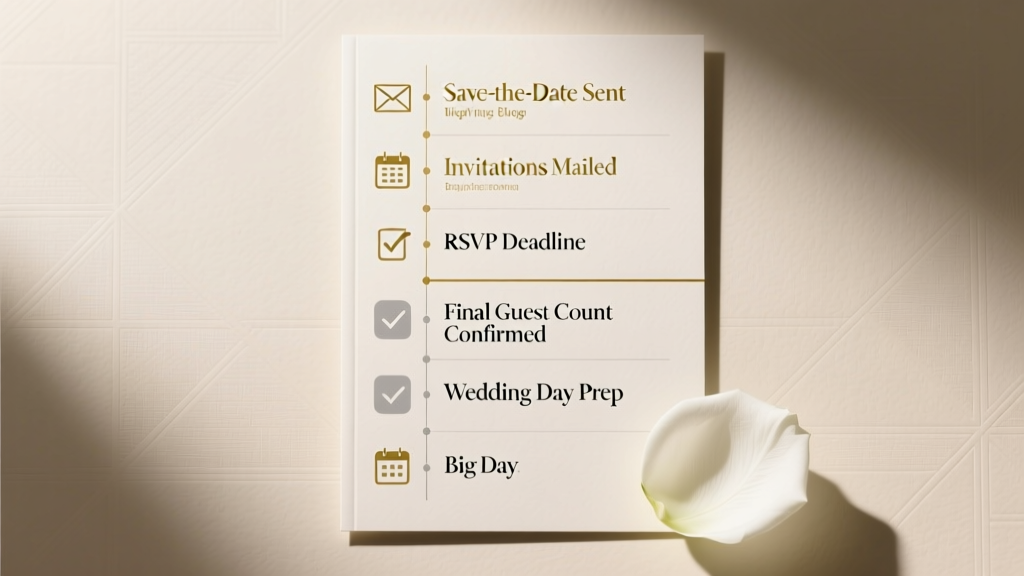 Wedding RSVP Timeline: When to Send Invites (2026)
 Beautiful Wedding Day: The Calm-First Framework
 Wedding Planning Checklist for the Week of the Event
 What To Wear To A May Wedding (2026)
 Backyard Wedding Attire: Dress Code Decoded (2026)
 Mexican Wedding Cookies: 7 Places to Buy (2026)
 Cheapest Wedding Cost in 2026: Real Budgets & Tips
 Best Wedding Welcome Sign Size (2026)