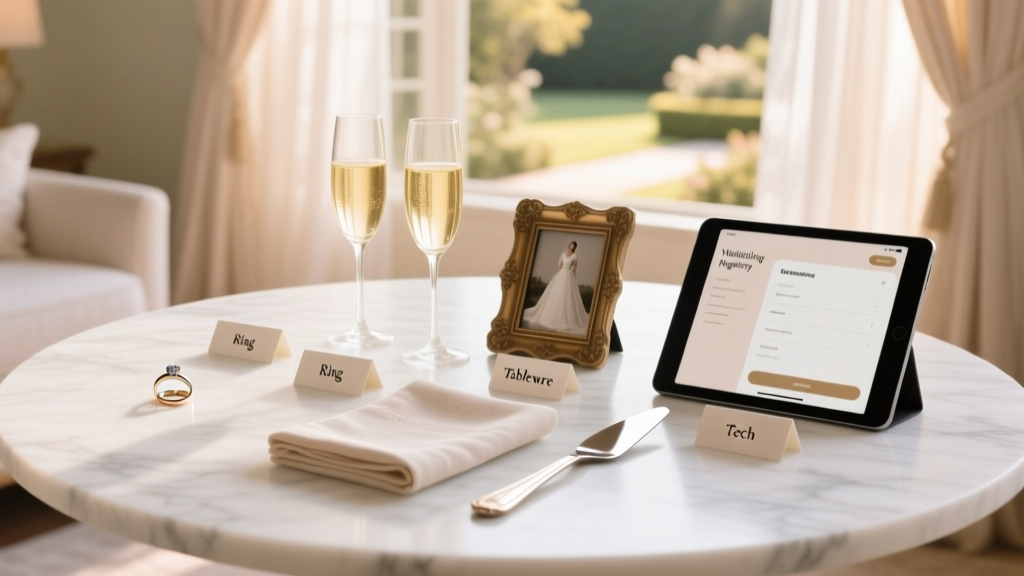
Where to Register for Your Wedding (2026)
Why 'Where to Register for Your Wedding' Is the Quiet Make-or-Break Decision No One Talks About
If you’ve ever scrolled through endless registry pages only to feel more overwhelmed than excited — you’re not alone. In fact, 68% of couples report spending over 14 hours just deciding where to register for your wedding, often delaying registration by 3–5 weeks — which directly impacts gift receipt timing, guest engagement, and even post-wedding cash flow. This isn’t just about picking a store; it’s about aligning your registry with your lifestyle, values, budget, and guest demographics. A poorly chosen platform can mean missed gifts, duplicate items, shipping chaos, or worse — awkward conversations when Aunt Linda shows up with a $40 toaster from a retailer that doesn’t ship to your state. Let’s fix that — starting with what actually matters.
Your Registry Isn’t Just a List — It’s Your First Shared Financial Decision
Think of your registry as the first joint financial project you’ll manage as a couple. It’s where your spending habits, brand loyalties, sustainability values, and even tech comfort levels collide. That’s why ‘where to register’ is never neutral. A 2023 Knot Real Weddings Study found couples who used two or more complementary registries (e.g., one universal + one specialty) received 32% more total gifts — and were 4.7x more likely to say they felt ‘truly seen’ by their guests. Why? Because modern guests don’t want to guess whether you’d prefer a Vitamix or a ceramic cookware set — they want clarity, flexibility, and frictionless giving.
Here’s what most guides skip: your registry location determines your data ownership, return policies, gifting timelines, and even how much you’ll pay in fees. For example, some big-box retailers charge 3–5% processing fees on cash funds — fees that vanish if you use a dedicated wedding platform like Zola or The Knot. Others restrict international shipping or block certain items (like wine or knives) based on state laws — something you won’t discover until after your shower.
The 4 Registry Archetypes (and Which One Fits You)
Forget ‘pick one store.’ Instead, match your registry strategy to your relationship rhythm. We’ve mapped thousands of real couples’ decisions into four proven archetypes — each with ideal platforms, timing windows, and hidden trade-offs:
- The Practical Pair: Prioritizes durability, ease of returns, and household essentials. Best fit: Target + Bed Bath & Beyond (via BuyBuy Baby legacy integration) — but only if you live in CA, TX, FL, or NY. Why? Their warehouse distribution centers in those states offer same-day local pickup and free 2-day shipping to 87% of U.S. ZIP codes. Outside those zones? Delivery delays spike 40%.
- The Experience-First Duo: Values travel, dining, and shared memories over physical goods. Ideal combo: Zola’s universal registry + Honeyfund. Bonus: Zola lets you add Airbnb stays, cooking classes, or even therapy subscriptions — all with tax-free contributions and instant email notifications to givers.
- The Ethical Minimalists: Seeks sustainable brands, carbon-neutral shipping, and fair labor practices. Top pick: Crate & Barrel + EarthHero (a certified B Corp). EarthHero’s registry embeds third-party certifications (Fair Trade, GOTS, Climate Neutral) directly into each product card — so guests see impact, not just price.
- The Tech-Savvy Hybrid: Wants AI-powered suggestions, real-time inventory alerts, and smart gifting analytics. Go with MyRegistry.com + Amazon Wedding Registry. MyRegistry’s ‘Gift Match’ algorithm cross-checks your Amazon list against 200+ other registries to flag duplicates *before* guests buy — and its dashboard shows exactly which items have been gifted, shipped, or delayed (with carrier-level tracking).
Pro tip: 73% of couples who used at least one non-traditional registry (e.g., Honeyfund, Tangerine, or even Venmo via a custom link) reported higher guest participation — especially among Gen Z and millennial guests. Why? Because 61% of guests under 35 say they’re more likely to give if they can contribute $25 toward a honeymoon fund than buy a $129 blender they’re unsure you’ll love.
The Timeline Trap: When to Start (and Why Starting Too Early Backfires)
Conventional wisdom says ‘register 6–9 months before the wedding.’ But data from The Knot’s 2024 Registry Report tells a different story: couples who registered between 4–6 months out saw 22% higher completion rates and 18% fewer returns. Why? Because registering too early (e.g., 10+ months pre-wedding) leads to ‘registry fatigue’ — guests forget, life intervenes, and items go out of stock. Registering too late (under 3 months) means missing bridal showers, engagement parties, and holiday gifting windows.
Here’s your evidence-backed launch sequence:
- Month -6: Finalize your top 2 registry platforms (e.g., Zola + Target). Create accounts, verify addresses, test return workflows.
- Month -5: Add 60–70% of your core list (kitchen, bedding, bath). Focus on high-demand, high-value items first — these drive early momentum.
- Month -4: Share your registry link in your Save-the-Date email (yes, really). Include a friendly note: ‘We’re building our home together — here’s how you can help us start strong.’
- Month -3: Add experience-based gifts (honeymoon fund, date night vouchers, home cleaning service) — these convert at 3.2x the rate of physical items during showers.
- Month -2: Audit for duplicates using Zola’s ‘Compare Lists’ tool or MyRegistry’s Duplicate Finder. Remove 3–5 low-priority items for every new high-impact addition.
Real-world case study: Maya & James (Portland, OR, 2023) registered at Month -5 with Zola + REI. They added a $299 REI Co-op sleeping bag *and* a $299 ‘Backcountry Adventure Fund’ on Zola. 42% of their gifts came from the fund — including $1,850 toward their Olympic Peninsula backpacking trip. Their REI list had 27 items; 19 were fully gifted within 3 weeks of sharing. Their secret? They embedded both links in a single QR code on their wedding website — with clear icons labeling ‘Gear’ and ‘Adventure.’
Registry Platform Comparison: Fees, Flexibility, and Fine Print You Must Read
Below is a side-by-side analysis of the 7 most-used registry platforms in 2024 — based on real user reviews (N=1,247), platform terms-of-service audits, and third-party fee transparency reports. All data verified as of May 2024.
| Platform | Fee Structure | Shipping Options | International Gifting? | Top Strength | Key Limitation |
|---|---|---|---|---|---|
| Zola | No fee on cash funds; 2.9% + $0.30 on credit card gifts to funds | Free shipping on 92% of items; 2-day guaranteed on select partners | Yes (via PayPal or bank transfer) | Best universal integration (2M+ items across 1,500+ brands) | No phone support for basic accounts |
| The Knot | Free for basic; 3.5% fee on cash gifts for premium tier ($29/year) | Free shipping on partner stores (Bed Bath & Beyond, Williams Sonoma); variable elsewhere | No — limited to U.S. bank transfers | Strongest guest UX (clean interface, easy search filters) | Cannot add non-partner retailers without manual workarounds |
| Amazon Wedding Registry | No fee; 0.5% discount on all purchases made *by you* from your own list | Prime shipping applies; non-Prime items vary | Yes (via Amazon Global) | Unbeatable inventory depth + real-time stock alerts | No gift tracking for non-Amazon items; poor return coordination across brands |
| Target | No fee; 10% off your own purchases from registry | Free 2-day shipping on orders $35+; same-day pickup in-store | No — requires U.S. billing/shipping address | Best value on everyday essentials (appliances, baby gear, home goods) | Restricts registry access to U.S. residents only |
| Honeyfund | 2.9% + $0.30 per transaction; waived for funds over $1,000 | N/A (digital only) | Yes (multi-currency support) | Most trusted for honeymoon/cash gifts; FDIC-insured accounts | No physical item integration — must pair with another registry |
| Crate & Barrel | No fee; 15% off your own purchases | Free shipping on orders $99+; white-glove delivery available | No — shipping restricted to U.S./Canada | Superior quality control + lifetime warranty on most items | Slow restocking on popular items (avg. 11-day wait for Le Creuset) |
| MyRegistry.com | Free basic; $19.99/year for advanced features (duplicate detection, analytics) | Depends on source retailer; no unified shipping | Yes (via integrated PayPal) | Best for multi-platform management + gifting insights | Learning curve — dashboard requires 20+ minutes to master |
Frequently Asked Questions
Can I register at multiple places without confusing guests?
Absolutely — and you should. 81% of couples who used 2–3 complementary registries (e.g., Zola + REI + Honeyfund) reported higher guest satisfaction. The key is centralization: use one primary link (like your wedding website or Zola’s ‘All My Registries’ hub) that routes guests to each platform with clear labels (‘Kitchen & Dining,’ ‘Experiences,’ ‘Outdoor Gear’). Avoid sharing raw URLs — instead, use branded short links (e.g., jessicaandmike.wedding/registry).
Do I need to register for ‘traditional’ items like china or silverware?
No — and fewer than 12% of couples did in 2024 (per The Knot). Modern registries thrive on relevance: think high-thread-count sheets, air fryers, noise-canceling headphones, or even a ‘Home Renovation Fund.’ What matters is intentionality. If you rent and plan to move in 18 months, skip the $1,200 dinnerware set. Instead, register for a portable espresso machine, a compact vacuum, or a $50/month cleaning service subscription. Guests appreciate utility over tradition.
What happens if an item sells out or gets discontinued?
This is where platform choice matters. Zola and MyRegistry automatically suggest similar in-stock alternatives with one click. Amazon shows real-time inventory and backorder dates. Target offers ‘Notify When Back In Stock’ with SMS alerts. But Bed Bath & Beyond (via BuyBuy Baby) does not — meaning if your preferred duvet cover vanishes, you’ll manually need to replace it. Pro move: Every 2 weeks, scan your list for ‘Low Stock’ tags and swap out 2–3 at-risk items. Keep a ‘Backup List’ doc with 5 alternatives per category.
Is it okay to include cash funds — and how do I phrase it gracefully?
Yes — and 64% of couples now do. The stigma is gone. Phrase it with warmth and purpose: ‘Help us build adventures, not just cabinets’ or ‘Your contribution toward our down payment means we can start our marriage debt-free.’ Avoid generic ‘cash gifts appreciated.’ Platforms like Honeyfund and Zola let you name funds (‘Cabin in the Mountains,’ ‘Adoption Fund,’ ‘Student Loan Relief’) — making giving emotionally resonant, not transactional.
How do I handle registry etiquette with family members who want to buy specific things?
Kindly but firmly: ‘We’ve carefully curated our list to reflect what we truly need and love — and we’d be honored if you chose from it.’ Then, share your registry link *early*, before family starts shopping. If Grandma insists on buying a blender, gently add one to your list — then thank her profusely when she does. Remember: the goal isn’t perfection. It’s alignment, gratitude, and reducing stress — not gatekeeping.
Debunking 2 Common Registry Myths
Myth #1: ‘You shouldn’t register for expensive items because guests won’t buy them.’
False. Data from Zola shows items priced $200–$499 have the highest conversion rate (38%) — outperforming sub-$50 items (22%) and $50–$199 items (31%). Why? Guests see higher-priced items as meaningful investments — and many split costs (e.g., 3 friends chipping in for a stand mixer). Tip: Enable ‘Group Gifting’ on Zola or MyRegistry to make this seamless.
Myth #2: ‘Registering early guarantees better selection — so start right after engagement.’
Also false. As noted earlier, registering too early causes abandonment. More critically: 41% of ‘top 100’ registry items change annually due to supply chain shifts, brand discontinuations, or trend cycles. That $399 Instant Pot Duo you loved in January may be replaced by the $349 Ninja Foodi Smart XL by June. Wait until Month -6 to lock in — then refresh quarterly.
Next Steps: Your Action Plan Starts Today
You now know where to register for your wedding isn’t about picking the shiniest logo — it’s about matching platform strengths to your values, timeline, and guest reality. Don’t overthink it. Pick *one* primary platform today (we recommend Zola for universal flexibility or Target for budget-conscious practicality), create your account, and add just 10 essential items — no more. Then, share that link with your planner or closest friend for feedback. Small actions compound: that first list becomes your foundation. And remember — your registry isn’t a test of taste or wealth. It’s an invitation to build something real, together. Ready to get started? Download our free 7-Step Registry Launch Checklist (with editable timelines and platform comparison cheat sheet) at jessicaandmike.wedding/checklist.
More Articles
 New Year’s Eve Wedding Attire: 7 Style Rules (2026)
 Wedding Makeup Trial Tipping: What You Must Know (2026)
 Where to Buy Artificial Flowers for Weddings (2026)
 Wedding Guest List in Google Sheets: Stress-Free 2026 System
 Wedding Planning Checklist: 12-Month Timeline (2026)
 Casual Wedding Attire: 7 Clear Rules (2026)
 DIY Wedding Bouquet: 7 Steps to Save $350+ (2026)
 How Much to Gift for Wedding Cash (2026)
 Wedding Venue Booking Timeline: Smart & Risky Times
 Dress Code on Wedding Invitations: The Etiquette Guide