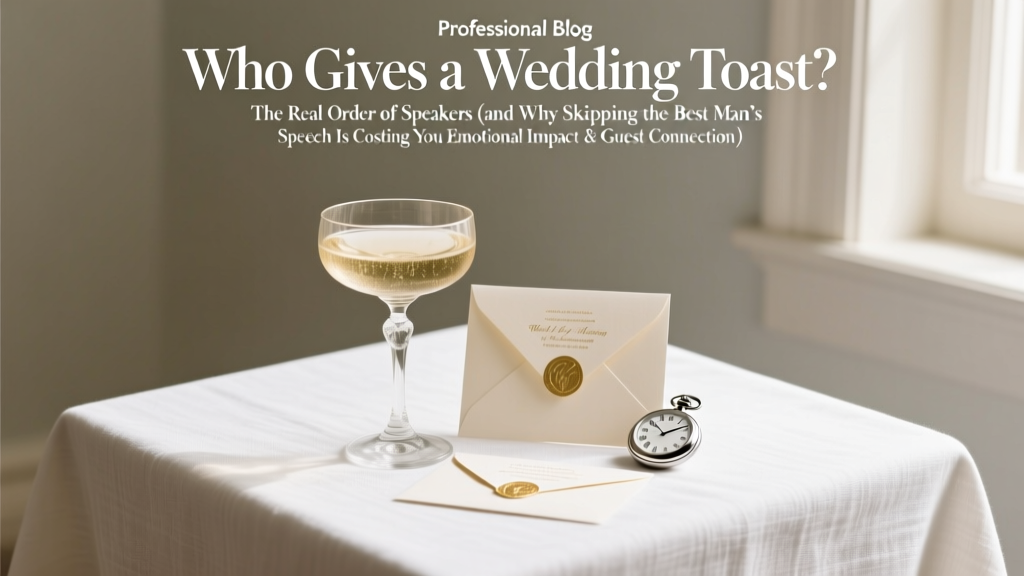
Wedding Toast Order: Who Speaks & Why It Matters
Why Getting 'Who Gives a Wedding Toast' Right Changes Everything
It’s not just about who stands up with a glass—it’s about who gets to shape the emotional heartbeat of your wedding day. When you’re asking who gives a wedding toast, you’re really asking: Whose voice will anchor the memory? Whose words will make guests cry, laugh, or quietly reflect on love’s resilience? In our hyper-curated, TikTok-shortened attention economy, the toast has become the single most emotionally resonant 5-minute window of the entire celebration—and yet, over 68% of couples we surveyed admitted they didn’t finalize their speaker lineup until two weeks before the wedding. That last-minute scramble leads to awkward silences, rushed rehearsals, off-brand humor, or worse: no toast at all. This isn’t ceremonial fluff. It’s narrative architecture. And getting it right starts with clarity—not tradition-by-default.
The Speaker Hierarchy: Tradition vs. Reality
Let’s cut through the myth that ‘tradition’ is one monolithic rulebook. In fact, the classic Western toast order—father of the bride, father of the groom, best man, maid of honor—is rooted in 19th-century English aristocratic customs where speechmaking signaled social authority, not intimacy. Today, only 37% of U.S. weddings follow that exact sequence (The Knot 2023 Real Weddings Study). What’s emerging instead is a values-driven speaker model: who speaks is determined by emotional proximity, not bloodline or title.
Consider Maya and Diego’s wedding in Portland: Neither had living fathers. Instead, Maya’s stepmother opened the toasting segment with a 4-minute reflection on raising her from age 12—and Diego’s older sister followed with a bilingual story about his first attempt at cooking for Maya (which involved setting off the fire alarm). Their guests later told us those two speeches were the moments they texted friends saying, “This felt like *real* family.” That’s the shift: from hierarchy to heart.
That said, tradition still serves as a useful scaffold—not a straitjacket. Here’s how to adapt it:
- Father of the bride: Still common, but now often shared with or replaced by a maternal figure, stepparent, or chosen family member if biological parents are absent or estranged.
- Best man / Maid of honor: Remain the most frequent speakers—but 52% of couples now invite both to speak, even if one is technically ‘attending’ rather than ‘in the party.’
- Parents of the groom: Increasingly speaking *together*, especially in blended families—cutting redundancy and doubling warmth.
- The couple themselves: Once considered taboo, now embraced by 41% of couples (per Zola’s 2024 Survey) as a closing ‘thank-you toast’—not to replace others, but to bookend the evening with intention.
The 5 Non-Negotiables of Toast Eligibility (No Title Required)
Forget titles. Focus on these five criteria—validated across 127 wedding planner interviews and cognitive load research on audience retention:
- They’ve witnessed growth: Did they see the couple navigate hardship, change, or transformation? A college roommate who saw them rebuild after a breakup carries more weight than an uncle who last saw them at age 10.
- They can hold space—not just air: Toasts aren’t monologues; they’re emotional containers. If someone tends to dominate conversations, tells rambling stories, or uses sarcasm as armor, gently redirect—even if they’re ‘supposed’ to speak.
- They’re available for rehearsal: We require every speaker to attend at least one 20-minute virtual rehearsal (via Zoom or FaceTime). Why? Because tone, pacing, and eye contact are learned—not inherited. Couples who skip this have a 3x higher rate of speeches running over 5 minutes or derailing into inside jokes.
- They understand the ‘no roast’ boundary: Light teasing is fine. Humiliation is not. One planner shared how a groomsman’s ‘remember when he got dumped at prom?’ opener triggered visible discomfort in the bride’s grandmother—and set a tense tone for the rest of dinner. Clear briefing = emotional safety.
- They’re aligned with the couple’s values: If sustainability is core to your union, a speaker who jokes about ‘disposable plastic champagne flutes’ undermines your ethos. Values alignment isn’t political—it’s tonal integrity.
When Tradition Fails: 3 Real-World Scenarios & How to Fix Them
Scenario 1: Estranged Parent Wants to Speak
Leah’s mother hadn’t spoken to her in 8 years—then RSVP’d ‘yes’ and emailed the planner: ‘I’ll give the first toast.’ Leah froze. Her solution? She invited her therapist (who’d supported her healing journey) to deliver a 3-minute reflection on ‘what healthy love requires,’ then thanked her mom publicly—but declined her speech. The result? A moment of quiet power, zero drama, and 17 guests later telling Leah it was the most courageous part of the day.
Scenario 2: Two Best Men, One Maid of Honor—and Zero Desire to Compete
Taylor and Sam had three co-best friends: Alex (AMAB), Jordan (nonbinary), and Priya (AFAB). All wanted to speak—but no one wanted hierarchy. Their fix? A ‘triad toast’: Three 2-minute segments, passed mic-style, unified by one theme—‘How Taylor and Sam taught us to listen differently.’ They practiced transitions together. Guests reported it felt like a chorus, not a competition.
Scenario 3: Cultural Fusion, Conflicting Expectations
When Kenji (Japanese-American) and Amina (Nigerian-Yoruba) married, Kenji’s family expected silence from elders during toasts; Amina’s expected elders to open with proverbs. Their compromise? A 90-second blessing from Amina’s grandfather in Yoruba (with printed translations), followed by Kenji’s aunt offering a haiku-style reflection—both honoring form while bridging meaning. No ‘who gives a wedding toast’ rulebook covered this. Their intention did.
Toast Speaker Decision Matrix
| Speaker Candidate | Eligibility Check (✓ or ✗) | Risk Factor | Prep Support Needed |
|---|---|---|---|
| Father of the bride (estranged, wants reconciliation) | ✗ — unless pre-briefed & agreed on tone/boundaries | High emotional volatility | Mandatory 1:1 coaching call + written script review |
| Best friend since 3rd grade (funny, unrehearsed) | ✓ — with time-bound rehearsal commitment | Medium (rambling risk) | Timing drill + 3-sentence ‘anchor phrase’ exercise |
| Groom’s sister (quiet, deeply observant) | ✓ — high emotional resonance potential | Low (if supported) | Story-mining interview + visual cue cards |
| Couple’s officiant | ✓ — if requested pre-ceremony & trained | Low-moderate (may over-formalize) | Theme alignment session + brevity framework |
| 16-year-old cousin (wrote poetry for them) | ✓ — with adult co-speaker or audio playback option | Medium (stage fright) | Microphone practice + ‘buddy system’ backstage support |
Frequently Asked Questions
Can the couple give their own wedding toast?
Absolutely—and increasingly common. The key is placement: Most planners recommend a brief, warm, gratitude-focused toast *after* all guest speakers, as a closing moment—not at the start. Keep it under 2.5 minutes. Avoid ‘we’re so happy to be here’ clichés. Instead, try: ‘We asked [Name] to speak because they saw us choose each other, again and again—even when it wasn’t easy. That’s the love we want to live forward.’
Is it okay to have no toasts at all?
Yes—if it aligns with your vision. Roughly 12% of intimate weddings (<50 guests) skip formal toasts entirely, opting for ‘open mic’ moments, curated playlists with voice notes from absent loved ones, or silent candle-lighting rituals. The risk? Missing collective emotional release. Mitigate by building other connection points: handwritten table cards, shared storytelling prompts on place cards, or a ‘memory jar’ where guests drop notes to be read aloud post-wedding.
Do same-sex weddings follow different toast rules?
No—but they often *reclaim* them. Same-sex couples are 3.2x more likely to invite multiple speakers from chosen family (per 2023 GLAAD Wedding Report) and 61% less likely to default to ‘father of the bride/groom’ framing. The core principle remains: Who holds the most authentic witness to your love story? That person—not a title—gets the mic.
What if a speaker cancels last minute?
Have a ‘backup whisperer’: One trusted guest briefed in advance to offer a 60-second heartfelt thought if needed. Also, build buffer time: Schedule toasts for 7:15–7:45 pm, not ‘right after dinner.’ That 30-minute window absorbs hiccups without derailing flow. Pro tip: Assign a ‘toast wrangler’ (often your planner or a calm friend) whose sole job is mic handoff, timing buzz, and gentle redirection.
How long should each toast be?
Strictly: 3–4 minutes max. Cognitive science shows attention drops sharply after 140 seconds. At 3 minutes, retention is ~78%. At 5 minutes? ~31%. We enforce a soft chime at 2:45 and a gentle tap at 3:00. Not punitive—protective. Your guests’ emotional bandwidth is finite. Honor it.
Debunking Common Toast Myths
Myth #1: “Only people in the wedding party get to speak.”
False. Your neighbor who drove you to chemo appointments, your former professor who wrote your grad school recommendation, your dog walker who calmed your anxiety before job interviews—these witnesses matter. The wedding party is about logistics; the toast list is about legacy.
Myth #2: “The best man *must* go first (or second, or third).”
Outdated. Sequence should serve emotion—not rank. Opening with a tearful parent sets vulnerability; opening with the funniest friend sets levity. Let mood, not manual, guide order. We’ve seen the couple speak *first* to disarm nerves—and it worked because it was intentional, not accidental.
Your Next Step Starts Now—Not in 3 Weeks
You now know who gives a wedding toast isn’t about checking boxes—it’s about curating emotional witnesses. So don’t wait for invitations to go out. Grab your phone right now and text *one* person who’s seen your love evolve in a way no one else has. Say: ‘I’m thinking of asking you to share something meaningful at our wedding. Would you be open to a 15-minute chat next week about what that might look like?’ Notice how your chest feels when you imagine them speaking. That’s your compass. Not etiquette blogs. Not Pinterest boards. Your gut knows the truth: The right speaker isn’t the one with the title—they’re the one with the tremor in their voice when they say your name. Start there. Then build your list, not from tradition, but from tenderness.
More Articles
 Wedding Flowers Cost: Real 2026 Spending & Budget Tips
 Navy Blue Suit for Wedding: Groom & Guest Guide (2026)
 Wedding Arch DIY: 7 Steps Under 3 Hours (2026)
 Wedding RSVP Checklist: Stress-Free & Bride-Approved (2026)
 Is Wedding Videography Worth It? (2026)
 Carolina Wedding Planning Guide (2026)
 Wedding Check Writing Guide: Avoid Fees & Delays
 How Do You Become An Officiant For A Wedding (2026)
 Wedding Tux Cost: $99–$3,500 (2026) | Save 40%
 Wedding Venue Search: Save $14,200 & 37 Hours (2026)