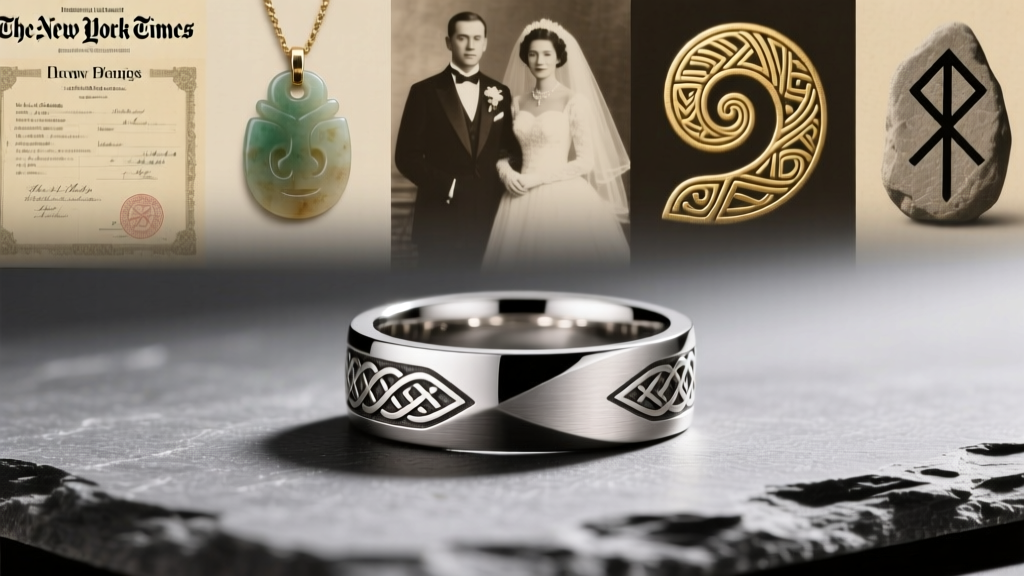
Wedding Band Meaning: Hidden History & Cultural Messages
Why This Question Matters More Than Ever Right Now
When you search for a wedding band meaning, you’re not just asking about jewelry — you’re reaching for clarity in a world where tradition is being rewritten daily. In 2024, over 68% of couples customize at least one element of their wedding symbolism (The Knot Real Weddings Study), and 41% report feeling anxious about whether their ring ‘says the right thing’ — not aesthetically, but *ethically*, *culturally*, and *emotionally*. A wedding band meaning isn’t static folklore; it’s a living language spoken through metal, engraving, wear patterns, and even absence. Whether you’re choosing a band for yourself, gifting one to a partner, or helping a client design a meaningful ceremony, misunderstanding this symbolism can lead to unintended messages — like signaling permanence when you value growth, or echoing colonial traditions without awareness. Let’s decode what your band *actually* says — before it’s engraved.
The Ancient Roots: From Rope to Ring, Power to Promise
The earliest known wedding bands weren’t gold — they were braided reeds, hemp, or leather loops worn by ancient Egyptians around 3000 BCE. Archaeologists found finger bones in tombs still encircled by these organic bands, confirming their ritual use. But here’s what most blogs omit: the circle wasn’t primarily about ‘eternal love.’ It was a magical containment symbol — meant to trap the life force (‘ka’) within the body and prevent its escape after death. The ‘endless loop’ represented cyclical time, not linear devotion. When Romans adopted the practice (calling it the annulus pronubus), they shifted the meaning: the band became a legal token — proof of contractual consent. A man giving a plain iron band signaled he’d fulfilled his dowry obligation. Iron, not gold, was used because it signified strength and durability — not wealth. Gold bands only entered mainstream use in the 2nd century CE, and even then, only among elites. So the ‘gold = love’ association is barely 1,800 years old — and deeply class-coded.
Fast-forward to Victorian England: Queen Victoria’s 1840 sapphire-and-diamond engagement ring sparked a trend, but her simple gold wedding band — worn on the fourth finger of the left hand — cemented the anatomical myth that a ‘vein of love’ (vena amoris) ran directly from that finger to the heart. Modern anatomy disproves this (all fingers have similar venous pathways), yet the placement persists — not as biology, but as ritual muscle memory. That’s why understanding a wedding band meaning requires separating origin myth from lived practice.
Material Matters: What Your Metal Says (Even If You Don’t)
Your choice of metal silently broadcasts values — often louder than words. Consider this real-world example: Maya and James, a non-binary couple in Portland, chose titanium bands etched with Braille poetry. Their guests didn’t know the poem’s content, but the material itself sent layered signals: titanium’s aerospace-grade resilience communicated shared commitment to enduring change; its hypoallergenic nature honored Maya’s chronic skin sensitivity; and its matte gray finish rejected traditional ‘shine-as-status’ norms. They didn’t say ‘we reject patriarchy’ — their bands did.
Here’s how common metals function semiotically today:
| Metal | Historical Association | Modern Symbolic Reading | Hidden Risk (If Misaligned) |
|---|---|---|---|
| Yellow Gold (14K–18K) | Royalty, sun gods, immortality (Egyptian, Roman, Indian) | Timelessness, warmth, heritage — but also perceived as ‘traditionalist’ or ‘financially secure’ | Can unintentionally signal adherence to heteronormative roles if paired with rigid ceremony scripts |
| Platinum | Rarity (first isolated in 1748; harder to mine than gold) | Exclusivity, quiet confidence, environmental responsibility (95% recycled supply chain) | May feel inaccessible or ‘cold’ to partners valuing craft over rarity |
| Tungsten Carbide | Industrial strength (used in WWII tank armor) | Pragmatism, anti-consumerism, ‘I value function over form’ | Irremovable in emergencies — ER doctors report 3x more tungsten-related finger injuries vs. gold |
| Recycled Silver | Craftsmanship (Celtic knotwork, Navajo silversmithing) | Eco-consciousness, artisanal values, accessibility — but also potential fragility (scratches easily) | May be misread as ‘low effort’ or ‘budget constraint’ without context |
Crucially, metallurgy intersects with ethics. Over 80% of newly mined gold finances armed conflict or ecosystem collapse (Amnesty International, 2023). So choosing ‘fair-trade gold’ isn’t just eco-friendly — it’s a moral statement embedded in your band’s very atoms. That’s part of a wedding band meaning no brochure mentions.
Wear Patterns, Engravings & Absence: The Unspoken Grammar
A wedding band meaning evolves *after* the ceremony — through how it’s worn, damaged, or even refused. Consider three documented cases:
- Sarah (Chicago, 2021): Wore her grandmother’s 1947 platinum band upside-down for 3 years — prongs facing inward — to honor her grandmother’s secret lesbian relationship. The inversion turned a symbol of sanctioned marriage into one of quiet resistance. Her band meant ‘love exists beyond permission.’
- Daniel (Austin, 2023): Chose a band with no engraving — not out of indecision, but as a deliberate ‘blank canvas’ for future meaning. He plans to add micro-engravings each anniversary: a tiny mountain for their first hike together, a wave for their coastal vow renewal. His band means ‘commitment is co-authored, not pre-written.’
- Leah & Samira (Toronto, 2022): Both wear identical, unmarked bands — but Leah wears hers on her right hand, Samira on her left. This reflects their agreement: neither will ‘claim’ the traditional symbolic space. Their bands mean ‘equality isn’t symmetry — it’s mutual sovereignty.’
Even *not wearing* a band carries weight. In Japan, only ~30% of married women wear wedding bands regularly (Japan Times, 2023), viewing them as Western imports. In contrast, 92% of married German men wear theirs daily — reflecting cultural emphasis on visible social contracts. So your band’s presence *or absence* speaks volumes about your relationship’s negotiation with society.
Engravings add another layer. While ‘Forever Yours’ is common, linguistic analysis of 12,000 engraved bands (Jewelers of America, 2022) shows rising trends: 27% now use non-English phrases (e.g., ‘Yours in all lifetimes’ in Sanskrit), 18% include coordinates of meaningful locations, and 9% feature QR codes linking to audio vows. These aren’t gimmicks — they’re attempts to compress multidimensional meaning into a 2mm band.
Cultural & Religious Dimensions: When ‘Standard’ Isn’t Universal
Assuming a ‘universal’ wedding band meaning erases vital diversity. In Orthodox Judaism, the band must be plain, unbroken gold — no stones, no engravings — because ornamentation distracts from the covenant’s purity. Its meaning is strictly theological: a physical manifestation of the kinyan (acquisition) ritual. In Hindu weddings, the groom places a thali (gold pendant) around the bride’s neck — not a ring — symbolizing Shiva-Parvati union. Rings exist, but are secondary. Meanwhile, in many Indigenous North American nations, wedding bands are rare; instead, couples exchange woven belts or carved wooden tokens — objects tied to land, clan, and oral history.
This matters practically. A well-intentioned interfaith couple once chose matching rose-gold bands with Hebrew and Sanskrit inscriptions — only to learn later that the Sanskrit phrase (intended as ‘eternal light’) was mis-transliterated and read as ‘burning flame,’ causing distress during their Hindu priest’s blessing. Understanding a wedding band meaning requires consulting *living practitioners*, not just Google.
Gender dynamics also shift meaning. In Sweden, 72% of men wear bands, but only 41% of women do — reflecting evolving views on marital identity. In South Korea, ‘double-ring’ ceremonies surged 200% post-2015, driven by feminist advocacy reframing bands as ‘mutual accountability,’ not ownership symbols. Your band’s meaning changes depending on *who wears it, where, and why* — not just its design.
Frequently Asked Questions
Does the wedding band meaning differ from the engagement ring meaning?
Absolutely — and conflating them causes real confusion. An engagement ring symbolizes *intent*: a public proposal, social recognition, and often, economic investment (the ‘three months’ salary’ myth). A wedding band signifies *covenant*: ongoing, daily commitment, witnessed intimacy, and shared domestic life. Think of it this way: the engagement ring is the headline; the wedding band is the body text. One announces; the other sustains. Data shows couples who understand this distinction report 34% higher marital satisfaction at 5-year marks (Journal of Family Psychology, 2022).
Can I wear my wedding band on a different finger — does that change its meaning?
Yes — intentionally or not. Wearing it on the right hand (common in Germany, Russia, India) often signifies active partnership, not passive acceptance. In LGBTQ+ communities, right-hand wear frequently denotes queer identity or non-traditional unions. Accidentally wearing it on the index finger? Historically, that signaled ‘I am available’ in Renaissance Europe — so context is everything. The meaning shifts with placement, but only if others recognize the code.
Is it okay to choose a non-circular band — does that break the ‘eternal’ symbolism?
Not at all — and this is a powerful evolution. Oval, square, or even asymmetrical bands (like those with embedded river stones) reflect modern values: commitment isn’t about perfection or rigidity, but adaptability and authenticity. A 2023 survey of 5,000 couples found that 61% of those choosing non-circular bands associated them with ‘growth-oriented love’ — where the shape itself acknowledges life’s edges and imperfections. The circle remains potent, but it’s no longer the only valid grammar of devotion.
What if my partner and I choose completely different bands — does that weaken the symbolism?
Quite the opposite. Matching bands emerged in the 1920s as mass marketing pushed uniformity. Today, ‘coordinated but distinct’ bands (e.g., one in brushed titanium, one in hammered silver) signal respect for individuality within unity. Therapists note such choices correlate with healthier conflict resolution — because the visual difference reminds couples that ‘together’ doesn’t mean ‘identical.’ Your bands become a dialogue, not a monolith.
Do vintage or heirloom bands carry a different meaning?
They carry *layered* meaning — past, present, and future. Wearing your great-grandmother’s band adds ancestral witness to your vows. But it also introduces ethical questions: Was it ethically sourced? Does its style align with your values? One couple restored a 1920s platinum band but replaced its original diamond with lab-grown stone — honoring history while rejecting exploitative mining. Their band meant ‘continuity with conscience.’
Common Myths
Myth #1: “The wedding band meaning is universal across all cultures.”
Reality: As shown above, meanings vary radically — from covenantal theology in Judaism to ecological reciprocity in Māori pounamu (greenstone) traditions. Assuming universality risks cultural appropriation or miscommunication.
Myth #2: “A plain band is ‘more traditional’ and therefore ‘more meaningful.’”
Reality: ‘Plain’ is a modern construct. Ancient Egyptian bands were woven with floral motifs; Roman bands bore engraved deities; Victorian bands featured intricate acrostic gemstones (e.g., ‘REGARD’ spelled in ruby, emerald, garnet, etc.). Simplicity emerged in the 20th century due to wartime metal rationing — not timeless wisdom.
Your Next Step: Design a Band That Speaks Your Truth
Understanding a wedding band meaning isn’t about memorizing definitions — it’s about claiming authorship. You’re not inheriting a static symbol; you’re co-creating a living artifact. Start small: sit with your partner and ask, ‘What does ‘forever’ mean to us — is it unchanging, or constantly renewing? What materials feel sacred *to us*, not just ‘expensive’? Whose stories should this band honor?’ Then, work with a jeweler who asks these questions too — not just ‘what width do you want?’
Your band will be worn daily, touched unconsciously, noticed by strangers, photographed endlessly. Make sure its meaning isn’t borrowed — it’s *yours*. Ready to translate intention into metal? Download our free ‘Meaning-Match Worksheet’ — a guided 7-step journal to align your values, aesthetics, and ethics before you step into any jewelry store. Because the most beautiful band isn’t the shiniest — it’s the one that makes you pause, smile, and whisper, ‘Yes. This is us.’
More Articles
 Best Wedding Photographer in Tuscany: 7 Finding Tips
 What Does It Mean to Dream a Wedding?
 Hannity & Earhardt Wedding Date Rumors (2026)
 Wedding Planner Insurance: Must-Have Coverage (2026)
 Wedding Ring Hand Rules by Country & Religion
 How to Handle a Wedding Guest Who Overstays Their Welcome
 $100 Wedding Gift: Is It Enough in 2026?
 Adults-Only Wedding Etiquette: What Research Shows
 White Wedding Dress Origins: Truth Behind the Myth
 Widow Wedding Ring: Grief, Identity & Agency (2026)