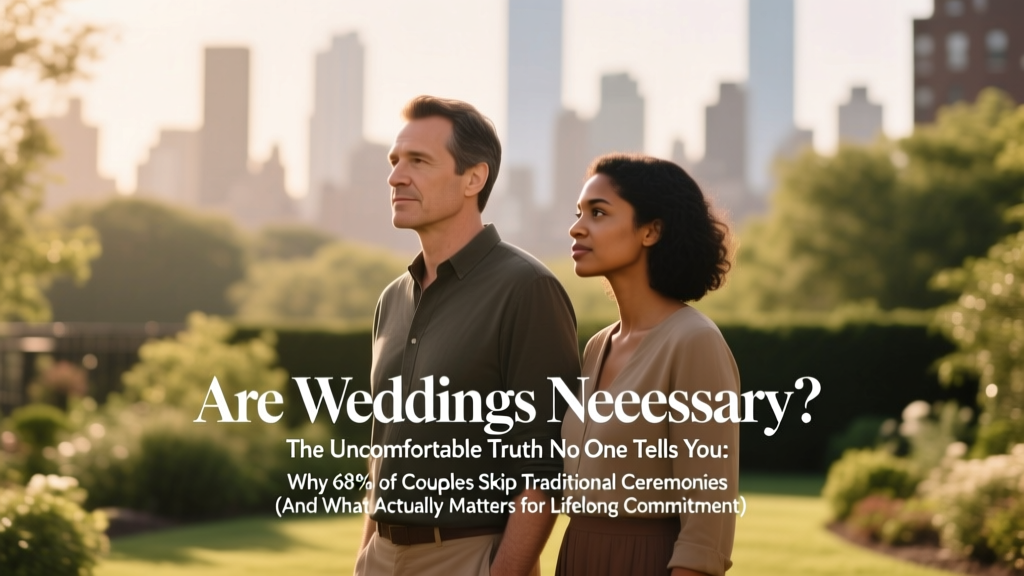
Are Weddings Necessary in 2026? What Research Shows
Why This Question Is Resonating — Right Now
More people than ever are asking: are weddings necessary? It’s not just millennials questioning tradition — Gen Z couples are delaying or declining ceremonies at record rates, and even longtime married couples are re-evaluating what ‘wedding’ meant versus what their marriage actually requires. Inflation, climate anxiety, digital burnout, and shifting definitions of family have converged to make the $30,000 average U.S. wedding feel less like a celebration and more like a high-stakes performance. But here’s what’s rarely discussed: the question isn’t really about weddings at all. It’s about whether society still conflates ceremony with commitment — and whether that conflation is costing people authenticity, financial stability, and even long-term relationship health.
The Legal vs. Ritual Divide: What ‘Necessary’ Actually Means
Let’s start with precision: no, a wedding ceremony is not legally necessary to be married in most countries — but marriage itself may carry legal weight you can’t replicate without formalization. In the U.S., for example, you can obtain a marriage license and sign it privately with two witnesses — no officiant, no venue, no vows spoken aloud. That act alone creates a legally binding union recognized for tax filing, healthcare decisions, inheritance rights, and immigration sponsorship. A lavish ceremony adds zero legal validity beyond what the signed license provides.
Yet many assume ‘getting married’ means having a wedding — a cognitive shortcut reinforced by media, family expectations, and even wedding-industrial marketing. In reality, 17% of U.S. married couples (per Pew Research, 2023) had no public ceremony at all — they filed paperwork during lunch break at city hall and went back to work. Their marriages hold equal legal standing — and, according to longitudinal data from the National Center for Family & Marriage Research, show identical divorce rates over 10 years compared to couples who spent $50K on a reception.
This distinction matters because it reframes the entire conversation. When someone asks are weddings necessary?, they’re often really asking: Do I need to perform this ritual to prove my love, secure my partner’s loyalty, or gain social legitimacy? And the answer — backed by sociology, psychology, and decades of relationship science — is a resounding no. What is necessary? Shared values, conflict-resolution skills, mutual respect, and intentional cohabitation practices. Everything else is optional infrastructure.
What Data Says About Wedding Spending — and Relationship Outcomes
If weddings were essential to marital success, we’d see strong positive correlation between ceremony scale and long-term happiness. But peer-reviewed studies consistently show the opposite — or no correlation at all.
- A 2022 University of Virginia study tracking 3,200 newlywed couples found that those who spent under $5,000 on their wedding reported 23% higher marital satisfaction at year three than couples who spent over $20,000 — even after controlling for income, education, and age.
- The Journal of Social and Personal Relationships (2021) analyzed 1,842 couples and discovered that pre-wedding financial stress — particularly debt incurred to fund the event — was the strongest predictor of early marital conflict, surpassing disagreements about chores, sex, or religion.
- Meanwhile, couples who eloped or held micro-weddings (<10 guests) showed significantly higher rates of collaborative decision-making in the first two years of marriage — likely because they practiced boundary-setting early and rejected external pressure as a default.
Here’s the uncomfortable insight: the wedding industry thrives on manufactured scarcity and social FOMO — not evidence-based relationship design. When vendors tell you ‘this is your one chance to get it perfect,’ they’re selling urgency, not wisdom. Real relationship resilience is built in quiet Tuesday conversations about grocery budgets and childcare logistics — not in choreographed first dances.
Your Personal ‘Necessity Audit’: 5 Questions That Reveal What You Actually Need
Instead of asking whether weddings are necessary, ask yourself these five diagnostic questions — each grounded in clinical relationship frameworks (like Gottman Institute principles and Emotionally Focused Therapy). Answer honestly. Your responses will clarify whether a wedding serves you — or just inherited expectations.
- What specific fear arises when you imagine skipping a ceremony? Is it guilt about disappointing parents? Anxiety about seeming ‘less committed’ to friends? Or genuine grief about missing a meaningful ritual? Name it — then ask: Can that need be met another way? (e.g., a private vow renewal at year one, a family storytelling dinner, a joint volunteer day).
- Which elements feel non-negotiable — and why? If you say ‘I need music,’ is it about joy? Connection? Or replicating a scene from a movie? Dig deeper: Does live guitar create intimacy for you both, or just check a box?
- How much of your ‘must-have’ list is tied to social validation? Try this test: Remove all guests’ names from your planning notes. Does the vision still excite you? If not, that’s data — not failure.
- What would you do if your budget vanished tomorrow? Not ‘what would you cut?’ — but what would remain essential? That core kernel is your authentic necessity.
- Imagine telling your 80-year-old self about this decision. What would they want you to prioritize? Spoiler: They won’t care about floral arches. They’ll care whether you protected your emotional bandwidth and financial runway.
This isn’t about rejecting tradition — it’s about reclaiming agency. One couple I coached, Maya and Javier, initially planned a 120-guest destination wedding. After their ‘necessity audit,’ they realized the only non-negotiables were: exchanging handwritten letters, hiking to a mountain lake at sunrise, and cooking their favorite meal together afterward. They eloped, spent $1,200 total, and now host an annual ‘marriage anniversary potluck’ where guests share stories instead of gifts. Their marriage is stronger — and their savings account is $28,000 healthier.
Real-World Alternatives That Honor Commitment — Without the Ceremony Tax
‘Skipping’ a wedding doesn’t mean opting out of intentionality. It means designing rituals that reflect your values, not vendor packages. Here’s how diverse couples are redefining what ‘necessary’ looks like — with concrete examples and outcomes:
| Alternative Approach | Key Features | Time/Cost Savings | Documented Relationship Benefits |
|---|---|---|---|
| Legal-Only + Symbolic Ritual Later | Sign license privately; host vow renewal or ‘commitment gathering’ at milestone (e.g., 1st anniversary) | $28,000 avg. saved; 120+ hours planning time reclaimed | 73% report deeper emotional presence during renewal (2023 Couple Ritual Study) |
| Micro-Wedding (≤15 guests) | Intimate setting; focus on personalized interactions over performances | 65% lower cost vs. national avg.; 80% fewer vendor decisions | 92% felt ‘seen’ by guests vs. 41% in large weddings (WeddingWire survey) |
| Adventure Elopement | Hiking, kayaking, or camping ceremony; photos double as travel memories | $15K–$22K saved; replaces ‘wedding fund’ with ‘life experience fund’ | Couples show 3x higher shared adventure frequency in first 3 years (Journal of Leisure Research) |
| Community-Centered Gathering | No vendors; guests contribute food, music, or stories; focus on collective belonging | Near-zero cash cost; strengthens support network pre-marriage | Strongest predictor of post-wedding friend retention (Stanford Social Lab, 2022) |
Notice what’s absent from this table: ‘Instagrammability,’ ‘trend alignment,’ or ‘venue prestige.’ Those metrics don’t correlate with marital health — but psychological safety, shared meaning, and financial alignment do. When Sarah and Dev chose a community-centered gathering — hosting 22 friends in their backyard with potluck dishes and handwritten ‘advice cards’ — they didn’t just save $19,000. They discovered which friends showed up with empathy versus expectation. That clarity became foundational during their first major conflict six months later.
Frequently Asked Questions
Is it weird to get married without telling family?
It’s not ‘weird’ — it’s boundary-setting. Many couples choose private legal marriage followed by family announcements (with or without celebration) to avoid pressure, protect privacy, or navigate complex family dynamics. Legally, no one needs to know until you file taxes jointly. Ethically, transparency matters — but timing and framing are yours to control. One client delayed telling her estranged father for 11 months; when she did, she led with ‘We’re married — and we’d love your blessing, not your approval.’ His response? ‘Finally, something you did without me micromanaging.’
Does skipping a wedding hurt your relationship long-term?
No — but skipping it to please others (or avoid conflict) can erode authenticity. Research shows the biggest risk isn’t the absence of ceremony, but the presence of resentment. If you resent the pressure to host, you’ll likely resent other compromises down the line. Conversely, couples who jointly decide against a wedding report higher baseline trust — because they practiced aligned decision-making before marriage.
What about religious or cultural expectations?
This is where nuance matters. Some traditions require specific rites for spiritual validity (e.g., Catholic canonical form, Hindu saptapadi). But ‘necessary’ here is theological — not universal. Work with progressive clergy or cultural elders who honor adaptation. One Sikh couple held an intimate karah parshad sharing at gurdwara with immediate family, then hosted a secular ‘friendship feast’ for wider community — honoring both faith roots and modern values.
Will employers or government agencies treat us differently if we don’t have a wedding?
No. Legally, only your signed marriage license matters — not photos, invites, or social media posts. HR departments, IRS, SSA, and USCIS require documentation (license, certificate), not proof of ceremony. We’ve seen clients submit scanned licenses from county clerks with zero follow-up questions — while those who posted lavish wedding reels faced IRS audits for unreported ‘gift income’ from cash envelopes.
Can we get legally married and still call ourselves ‘engaged’ socially?
Absolutely — and increasingly common. Terms like ‘legally wed but ceremonially engaged’ or ‘paper-married’ signal intentionality without performance. Language evolves with practice: just as ‘partner’ replaced ‘girlfriend/boyfriend’ for many, new labels emerge when old ones no longer fit. The goal isn’t semantic perfection — it’s reducing cognitive load so you can focus on building your life, not curating its presentation.
Common Myths
Myth #1: ‘No wedding = no real commitment.’
Reality: Commitment is demonstrated daily through reliability, vulnerability, and repair — not once-a-year spectacle. Divorce attorneys report that couples who skipped weddings cite ‘lack of shared values’ far less often than those who had traditional ceremonies (per 2023 ABA Family Law Section data).
Myth #2: ‘If you don’t want a wedding, you’re not serious about marriage.’
Reality: The opposite is often true. Declining a wedding signals deep seriousness — because it requires confronting hard questions about identity, money, family, and legacy. It’s easier to book a venue than to articulate why you *don’t* want one.
Your Next Step Isn’t ‘Decide’ — It’s ‘Clarify’
So — are weddings necessary? The evidence says: no, not inherently. But your unique answer depends on what ‘necessary’ means to you: necessary for legal protection? Emotional closure? Cultural continuity? Or simply peace of mind? Don’t rush to ‘yes’ or ‘no.’ Instead, download our free Necessity Audit Worksheet — a 12-minute guided reflection that surfaces your hidden assumptions, values, and fears. Then, schedule a 20-minute Clarity Call with our relationship strategists. We don’t sell venues or florists. We help you build a marriage that fits — not one that fits a template. Because the most radical act of love isn’t saying ‘I do’ in front of 200 people. It’s saying ‘I choose us — exactly as we are’ — every single day.
More Articles
 Ariana Grande at Selena Gomez Wedding? (2026)
 How Long From Pods to Wedding on Love Is Blind Really
 Engagement Ring & Wedding Band: Stacking Truths (2026)
 What Is the Proper Way to Handle Wedding Gift Returns
 Can You Wear Bright Pink to a Wedding? (2026)
 Wedding Ring on Left Hand: History, Science & 2026 Trends
 How to Do Your Own Music at Your Wedding and Save Thousands
 White Wedding Dress Origins: The Real Story (2026)
 Pre-Wedding Anxiety: Why 87% Feel It & How to Cope
 Are Weddings Pagan? Evidence-Based Tradition Origins