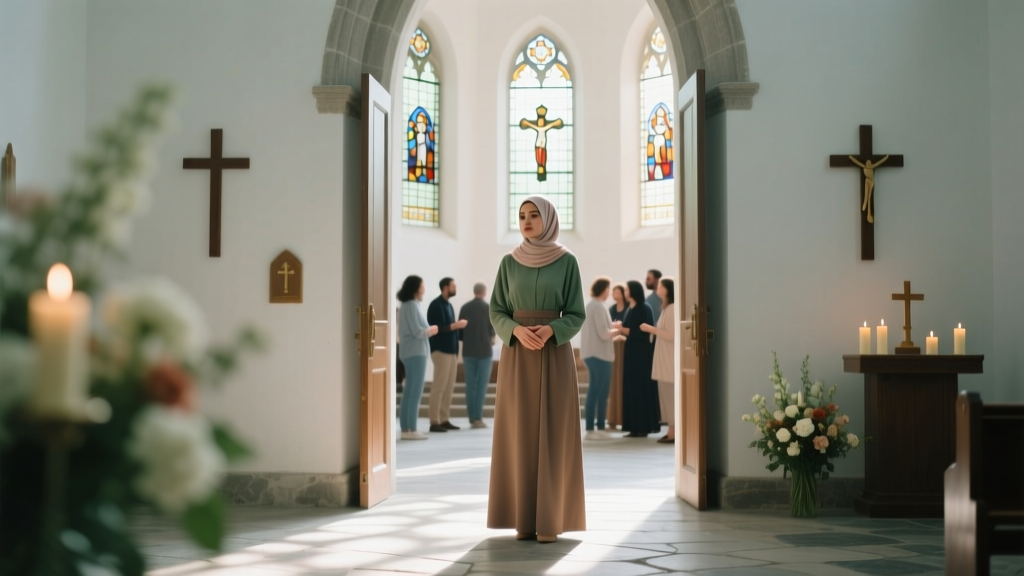
Muslim at Church Wedding: What Scholars Say
Why This Question Matters More Than Ever
Can a Muslim go to church for wedding? That question isn’t just theological—it’s deeply personal, often arising at life’s most emotionally charged moments: when your sibling, best friend, or cousin invites you to celebrate their marriage in a space that feels spiritually unfamiliar. With over 1.9 billion Muslims globally and rising interfaith marriages in the U.S., UK, Canada, and Southeast Asia, this isn’t a hypothetical—it’s a daily reality for millions. Yet confusion persists: Is stepping into a church inherently prohibited? Does attending imply endorsement of Christian doctrine? What if the ceremony includes prayers, icons, or communion? In this article, we cut through oversimplified fatwas and cultural taboos with evidence-based guidance from qualified scholars across four major schools of thought (Hanafi, Shafi‘i, Maliki, and Hanbali), real-world case studies, and actionable protocols—so you can show up with confidence, compassion, and conviction.
What Islamic Jurisprudence Actually Says
The short answer is: yes, a Muslim can go to a church for a wedding—but with important conditions rooted in intention (niyyah), conduct, and context. Classical jurists didn’t issue blanket bans on entering non-Muslim places of worship; rather, they evaluated each situation based on three pillars: purpose, participation, and perception. For example, Imam Ibn Qudamah (Hanbali) wrote in Al-Mughni that entering a church is permissible if one does not intend to venerate its symbols, nor participate in rituals, nor remain silent during acts of shirk (associating partners with Allah). Similarly, contemporary scholars like Dr. Yasir Qadhi and Mufti Abdur-Rahman ibn Yusuf emphasize that attendance is permitted for legitimate social reasons—such as honoring family ties (silat al-rahim)—provided no act contradicts tawhid (monotheism).
Let’s break down the key conditions:
- Intention matters more than location: Entering a church solely to attend a loved one’s wedding—not to pray, bow, or affirm Christian theology—is widely accepted across madhhabs.
- No active participation in ritual elements: Standing for hymns, lighting candles, receiving communion, or reciting Trinitarian blessings crosses clear boundaries. Observing quietly, applauding after vows, or sharing a meal afterward does not.
- Respectful dress and demeanor: Modest attire (e.g., covered shoulders, loose fit) signals reverence for the occasion—and avoids unintended distraction or misrepresentation of Islamic values.
- Avoiding prolonged presence during core worship segments: Many scholars advise arriving after the liturgical service begins (e.g., skipping the Eucharist portion) or stepping out briefly during consecration prayers—especially if icons or crucifixes are central to that moment.
A compelling real-world example comes from Toronto, where Aisha Rahman—a practicing Sunni Muslim—attended her sister’s Catholic wedding at St. Michael’s Cathedral. She arrived 20 minutes before the ceremony, wore a navy abaya with a silk headscarf, sat in the back row, quietly observed the vows and ring exchange, excused herself during the consecration and communion, and rejoined for the recessional and reception. Her imam later affirmed her approach aligned with the principle of darurah (necessity) and maslaha (public interest), especially given her sister’s emotional need for her presence.
How to Prepare—Before, During, and After the Wedding
Attending respectfully isn’t passive—it’s intentional preparation. Here’s your step-by-step roadmap:
- Clarify the ceremony structure: Ask the couple or planner for the order of service. Identify which parts involve doctrinal affirmations (e.g., Apostles’ Creed, baptismal vows) versus neutral elements (vows, music, processional).
- Consult your local imam or trusted scholar: Share specifics—denomination (Catholic, Anglican, Pentecostal?), whether icons/crucifixes dominate the sanctuary, whether guests are invited to kneel or receive blessings. Personalized fatwa beats generic internet advice.
- Prepare gentle exit strategies: Practice polite phrases like *“I’d love to support you fully—I’ll step out briefly during the communion portion, then rejoin for photos”*—framed as care, not critique.
- Bring halal food options if needed: Many churches host receptions onsite. Coordinate ahead to ensure dietary needs are met—or bring discreet snacks to avoid compromising principles.
- Follow up with sincerity: Send a handwritten note thanking the couple—not just for the invite, but for trusting you with their joy. That gesture often deepens interfaith understanding far more than debate ever could.
Importantly, this isn’t about “compromise”—it’s about strategic presence. As Sheikh Omar Suleiman notes: *“Islam doesn’t ask us to withdraw from society; it asks us to engage with wisdom. Your quiet dignity in that pew may plant seeds of curiosity in others—and strengthen bonds that open doors for future dialogue.”*
What Denominations & Contexts Change the Equation
Not all church weddings carry identical theological weight. The denomination, geography, and even architectural design influence scholarly assessments. Below is a comparative analysis grounded in fatwa databases (Dar al-Ifta Egypt, ISNA Fiqh Council, UK Muslim Law Council):
| Church Tradition | Key Features Impacting Permissibility | Scholarly Consensus Level | Recommended Precautions |
|---|---|---|---|
| Anglican / Episcopal | Often minimal iconography; emphasis on scripture & vows; communion optional for guests | High consensus: Permissible with standard conditions | Confirm if Eucharist is included; if so, plan brief absence |
| Roman Catholic | Required Mass with transubstantiation; prominent crucifixes & saints’ images; kneeling expected | Moderate consensus: Permissible only with strict non-participation & strategic timing | Avoid sitting near altar; exit before consecration; skip communion line entirely |
| Pentecostal / Non-Denominational | Varies widely—some use crosses but no icons; others include spontaneous prayer, altar calls, or laying on of hands | Variable consensus: Requires advance review of service flow | Ask for a printed program; identify “participation zones” (e.g., raised hands, altar call); sit toward rear |
| Orthodox (Greek, Russian) | Heavy use of icons, incense, prostrations; liturgy highly sacramental and non-negotiable | Low consensus: Most scholars advise against attendance unless absolutely necessary (e.g., parent’s wedding) | If attending: Enter only for vows/recessional; avoid crossing yourself or bowing; do not enter sanctuary proper |
This table reveals a crucial insight: Permissibility isn’t binary—it’s contextual. A wedding at a modern, low-liturgy evangelical chapel poses different considerations than one inside Istanbul’s historic Hagia Irene Orthodox Church. Always prioritize specificity over generalization.
Frequently Asked Questions
Can I wear hijab in a church?
Yes—absolutely. Wearing hijab is an act of worship and identity, not disrespect. In fact, many Christian clergy appreciate the visible commitment to faith it represents. If ushers offer head coverings (common in Orthodox or Catholic settings), politely decline with gratitude—your hijab fulfills the same purpose with authenticity. Just ensure your style aligns with modesty standards: avoid sheer fabrics or tight fits that draw undue attention.
What if the officiant asks me to pray aloud with everyone?
You are not obligated—and should kindly but firmly decline. Say something like, *“I deeply respect your tradition, and I’ll hold my own silent intention for your marriage.”* Most officiants understand; if pressed, refer them to your imam’s guidance. Remember: silence isn’t passive—it’s principled. The Prophet ﷺ remained silent during pagan oaths in pre-Islamic Mecca, modeling dignified non-participation.
Does attending make me complicit in shirk?
No—if your intention is solely to honor kinship, not endorse doctrine. Complicity requires active affirmation or facilitation. Scholars distinguish between shahada (witnessing) and mushahada (observing). Watching a wedding isn’t testifying to Christian beliefs—it’s witnessing love, commitment, and community. As Dr. Shadee Elmasry clarifies: *“You don’t become responsible for another’s belief by being present—just as Christians aren’t accountable for our salah by seeing us pray.”*
Can I take photos inside the church?
Yes—with two caveats: (1) Avoid photographing altars, crucifixes, or icons in close-up (seen as disrespectful in many traditions); (2) Never post images that could be misconstrued as participation (e.g., you kneeling beside the couple). Focus on candid moments—laughter, embraces, cake cutting. When in doubt, ask the couple first: *“Is there any area you’d prefer I not photograph?”* It shows respect and builds trust.
What if my parents forbid me from going?
This requires compassionate navigation. First, listen deeply—what fears drive their objection? Is it theological concern, social stigma, or past negative experiences? Then share reputable fatwas (e.g., from Al-Azhar’s Fatwa Center or Yaqeen Institute) and walk them through your planned boundaries. Offer to invite your imam for a family discussion. Sometimes, parental resistance softens when they see your preparation reflects ihsan (excellence), not indifference.
Common Myths Debunked
Myth #1: “Entering any church automatically invalidates wudu or makes you ‘unclean.’”
False. Wudu is invalidated only by specific physical acts (e.g., passing gas, deep sleep, touching private parts)—not by location. Classical texts like Fath al-Qadir explicitly state that buildings themselves don’t carry ritual impurity unless contaminated by najasah (e.g., urine, blood). Churches are neutral spaces—like malls or libraries—unless ritually soiled.
Myth #2: “If you attend, you must convert—or at least pretend to believe.”
Completely false—and harmful. Authentic interfaith presence rejects performance. You’re not there to assimilate; you’re there to embody akhlaq (character): patience, honesty, and kindness. One Chicago imam shared how his teenage daughter attended her Lutheran friend’s wedding wearing hijab and carrying a Quran-shaped bookmark—quietly signaling her identity while fully engaging in celebration. That visibility, he said, sparked respectful conversations for weeks afterward.
Final Thoughts & Your Next Step
So—can a Muslim go to church for wedding? Yes. But more importantly: how you go transforms it from a logistical question into a spiritual opportunity. Your presence—grounded in knowledge, intention, and grace—can affirm love without compromising creed, strengthen family bonds without diluting faith, and model Islam’s balance of conviction and compassion. Don’t rush to decide based on hearsay or fear. Instead, take one concrete action today: email your local imam with the wedding details and ask for a 15-minute consultation. Bring this article, highlight the table comparing denominations, and co-create a personalized plan. That small step bridges uncertainty and assurance—and honors both your deen and your humanity. Because at its heart, this isn’t about churches or ceremonies. It’s about showing up—for those you love, and for the version of Islam that breathes with mercy, wisdom, and unwavering truth.
More Articles
 Engagement Ring vs Wedding Ring: 5 Key Differences (2026)
 Is Wedding Stories Still Broken in 2026?
 How to Wish a Wedding Couple (7 Powerful Ways)
 Millie Bobby Brown’s Wedding Guest List (2026)
 What to Do If a Family Member Wants to Take Over Planning
 Who Pays for the Man's Wedding Ring? (2026)
 WEDS Wheels Reps Legit? 4 Red Flags to Check (2026)
 How to Write Wedding Vows That Make Everyone Cry
 Wedding Anniversary Wishes: 7 Emotional Strategies (2026)
 How To Match Person With Hidden