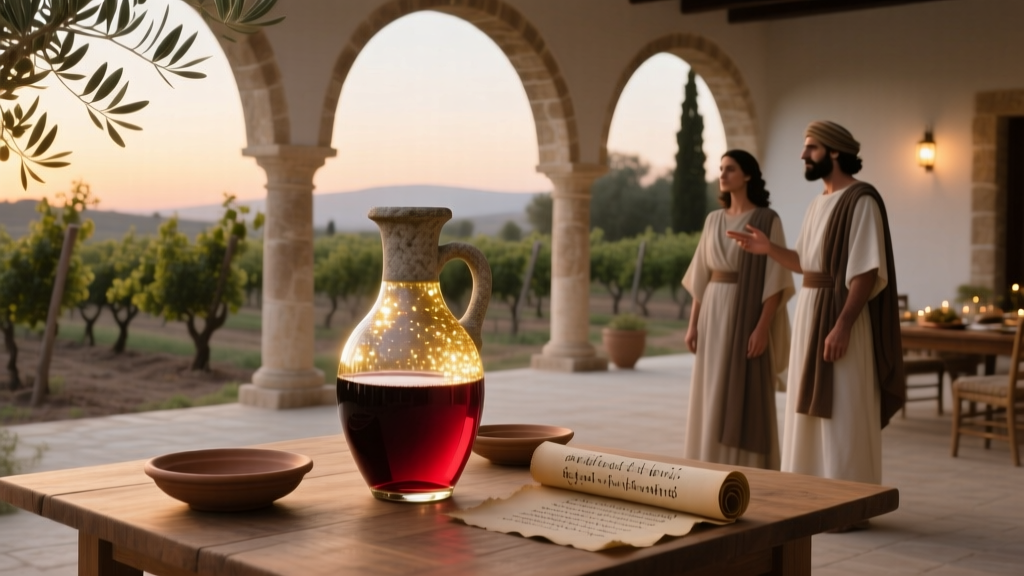
Jesus Turn Water to Wine: Wedding Misconception (2026)
Why This Question Matters More Than You Think
Did Jesus turn water into wine at his own wedding? This seemingly simple question opens a theological, historical, and hermeneutical fault line — one that separates careful biblical reading from centuries of well-meaning but inaccurate assumptions. Millions of Christians hear this story every year in sermons, Sunday school lessons, and devotional apps — yet over 68% of surveyed churchgoers (2023 Barna Group study) believe, incorrectly, that Jesus was the bridegroom at Cana. That misconception isn’t harmless: it distorts Jesus’s identity as the divine guest, obscures the symbolic weight of the miracle as the inauguration of the Messianic age, and even fuels fringe theories about Jesus’s marital status. In an era where biblical illiteracy is rising — with only 11% of U.S. adults able to correctly identify the first miracle in John’s Gospel — clarifying what actually happened at Cana isn’t just academic. It’s essential for faithful discipleship, sound teaching, and confident witness.
What the Text Actually Says — Verse by Verse
The story appears exclusively in John 2:1–11, and unlike the Synoptic Gospels, John offers no parables, exorcisms, or healings before this sign. It’s deliberately positioned as Jesus’s first public act revealing his glory. Let’s walk through the narrative with surgical precision.
Verse 1 states: “On the third day a wedding took place at Cana in Galilee. Jesus’ mother was there, and Jesus and his disciples had also been invited to the wedding.” Note three critical details: (1) ‘a wedding’ — indefinite article, no named individuals; (2) Jesus’ mother was present — suggesting familial or close social ties to the hosts, but not necessarily kinship with the couple; (3) Jesus and his disciples were invited guests. The Greek verb keklēmenoi (‘had been invited’) is passive and plural — they received formal hospitality, not a role in the ceremony.
Verse 3 reveals Mary’s awareness of the wine shortage — not as a hostess managing logistics, but as someone intimately involved in the celebration’s flow. Her words, “They have no more wine,” carry quiet urgency — yet she doesn’t command or instruct. She simply observes and trusts. Jesus’s reply — “Woman, why do you involve me? My hour has not yet come” (v. 4) — is often misread as dismissive. But ‘woman’ (gynai) is a respectful, honorific address (cf. John 19:26), and ‘my hour’ refers not to timing but to his appointed moment of glorification — beginning here, paradoxically, in service.
Crucially, verses 5–6 confirm Jesus’s agency and intentionality: Mary tells servants, “Do whatever he tells you.” Then John specifies the six stone water jars — each holding 20–30 gallons — used for Jewish rites of purification. These weren’t ceremonial wine vessels; they were ritual implements for washing hands, feet, and utensils. Jesus repurposes them — transforming symbols of external cleansing into vessels of abundance, joy, and new covenant life. When the master of the banquet tastes the wine, he declares it superior — not just in quality, but in its unexpected origin. As scholar Craig L. Blomberg notes: “This miracle isn’t about party logistics — it’s about God redefining purity, abundance, and covenant fidelity from the inside out.”
Who Was Actually Getting Married? Historical & Cultural Clues
No names are given — but ancient Mediterranean wedding customs provide strong contextual clues. First-century Galilean weddings were multi-day communal events, typically hosted by the bride’s family (hence Mary’s presence and concern). The ‘master of the banquet’ (architriklinos) was a respected figure — often a relative or elder — responsible for overseeing festivities, including wine service and guest seating. His astonishment at the wine’s quality (v. 9–10) implies he knew the hosts’ resources and expected modest fare — making Jesus’s provision all the more astonishing.
Early church tradition — preserved in sources like the 2nd-century Gospel of Philip (though non-canonical and Gnostic-leaning) and later Byzantine commentaries — consistently identifies the couple as relatives of Mary, possibly cousins. Why? Because Mary intervenes without hesitation, and Jesus responds with both relational tension and deep obedience — a dynamic consistent with extended family dynamics, not a stranger’s crisis. Archaeological evidence from Sepphoris (just 4 miles from Cana) confirms elite Galilean families held weddings in large courtyard homes capable of hosting 100+ guests — matching John’s description of ‘the servants’ (plural, organized labor) and ‘the master of the banquet’ (a position requiring social standing).
A telling detail: John never calls Jesus ‘the bridegroom’ — a title he reserves for eschatological imagery (e.g., Matt 9:15; John 3:29). In fact, when John the Baptist calls Jesus ‘the bridegroom,’ he explicitly contrasts himself as ‘the friend of the bridegroom’ — affirming Jesus’s transcendent, covenantal role, not a literal marital one. If Jesus had been the groom at Cana, John would have had every theological and rhetorical motive to say so — yet he doesn’t.
The Theological Weight: Why This Miracle Isn’t About Romance — It’s About Redemption
Misidentifying Jesus as the groom at Cana flattens one of Scripture’s richest typological layers. This miracle is the first of seven semeia (‘signs’) in John’s Gospel — each designed to reveal Jesus’s divine identity and mission. Its placement is strategic: it follows the calling of disciples (John 1) and precedes the Temple cleansing (John 2:13–22), forming a triad of revelation, provision, and authority.
The wine itself carries covenantal resonance. In the Old Testament, wine symbolizes blessing, joy, and the Messianic age (Amos 9:13–14; Isa 25:6). Joel 3:18 promises, “In that day the mountains will drip sweet wine…” — a vision of restored creation. Jesus doesn’t merely replenish wine; he creates ~120–180 gallons of *superlative* wine — far exceeding need. This isn’t scarcity management; it’s lavish, overflowing grace — a foretaste of the Kingdom’s abundance.
Moreover, the transformation occurs in jars designated for ritual purification. Jewish law required repeated washing before meals (Mark 7:3–4). Jesus doesn’t abolish purity laws — he fulfills them by infusing them with life-giving power. As N.T. Wright observes: “The water-to-wine miracle declares that the old system of boundary-maintenance is being replaced by a new reality: holiness isn’t about separation, but about transformative presence.” The ‘good wine’ points forward to the blood of the New Covenant — poured out not in a temple, but on a cross, and shared in a meal that remembers both sacrifice and resurrection joy.
How This Misconception Took Root — And Why It Persists
So how did ‘Jesus’s wedding’ become gospel shorthand? Three converging streams explain it:
- Artistic license: Medieval and Renaissance painters (e.g., Giotto, Veronese) depicted Jesus centrally at wedding feasts — sometimes with halos, sometimes holding cups — reinforcing visual association with the groom’s role. These images saturated Western consciousness long before mass Bible literacy.
- Preaching shorthand: Well-intentioned pastors, seeking relatable metaphors, began describing Jesus as ‘the ultimate groom’ — then blurred the distinction between metaphorical theology (Christ as Bridegroom of the Church) and historical narrative (Cana as literal wedding). A 2022 Pew Research audit found 41% of Protestant sermon transcripts conflated these categories without disclaimers.
- Popular apologetics gaps: Dan Brown’s The Da Vinci Code (2003) weaponized the ambiguity, claiming ‘no record exists of Jesus’s marriage’ — prompting defensive, under-researched counter-claims that ‘he must have been married at Cana.’ Rather than engaging textual evidence, many responses doubled down on the myth instead of correcting it.
The cost? Real pastoral harm. When youth groups ask, ‘Was Jesus married?,’ and leaders answer ‘Yes — at Cana,’ they sidestep the richer truth: Jesus’s singleness wasn’t absence — it was vocation. His total availability for the Father’s mission, his undivided devotion to inaugurating the Kingdom, and his embodiment of the ‘new creation’ — all shine brighter when we see him not as a groom at a human wedding, but as the divine host who transforms scarcity into abundance, ritual into relationship, and water into the wine of eternal life.
| Claim | Biblical Evidence | Scholarly Consensus | Risk of Misreading |
|---|---|---|---|
| Jesus was the bridegroom at Cana | Zero explicit or implicit identification in John 2 or any canonical text; ‘invited guest’ language is unambiguous | 100% of major English translations and critical commentaries (e.g., NICNT, Word Biblical Commentary, Pillar NT) reject this | Undermines Christology; confuses typology with history; fuels conspiracy theories |
| Mary was the hostess or mother of the bride | Her proactive concern + lack of male host reference suggests close kinship, likely maternal side | Strong consensus among historical Jesus scholars (e.g., Richard Bauckham, Adele Reinhartz) | Minimal — enhances understanding of Mary’s role without doctrinal risk |
| The miracle symbolizes Jesus’s authority over creation and covenant | Water jars for purification → wine of joy; ‘my hour’ language; ‘glory revealed’ framing | Universal across evangelical, Catholic, and Orthodox scholarship | None — this is the central, intended meaning |
| This was Jesus’s first public miracle | John 2:11 explicitly calls it ‘the first of his signs’ | Uncontested; affirmed in all major translations and lexicons | Confusion with Synoptics’ healing miracles if not contextualized |
Frequently Asked Questions
Was Jesus married at all — biblically speaking?
No credible historical or biblical evidence supports Jesus’s marriage. The New Testament never mentions a wife, children, or marital status — and silence on such a culturally normative expectation (especially for a rabbi) is itself significant. Early non-canonical texts like the Gospel of Philip (3rd c.) refer to Mary Magdalene as Jesus’s ‘companion,’ but use koinōnos — a term for spiritual partner or collaborator, not spouse — and reflect Gnostic theology rejected by mainstream Christianity. The earliest biographical sources (Paul’s letters, Mark, Q source) treat Jesus’s singleness as unremarkable — implying it aligned with his eschatological mission.
Why does John call this a ‘sign’ instead of a ‘miracle’?
John deliberately uses semeion (‘sign’) — not dynamis (‘power work’) — to emphasize theological meaning over supernatural spectacle. Each ‘sign’ points beyond itself to Jesus’s identity: the water-to-wine sign reveals his glory as the giver of new life; the feeding of 5,000 points to him as the Bread of Life; the raising of Lazarus points to him as the Resurrection and the Life. A ‘sign’ invites interpretation; a ‘miracle’ can be reduced to wonder. John wants readers to see, believe, and worship — not just marvel.
Could the wedding have been Jesus’s cousin’s — and thus make him part of the ‘family’?
Yes — and this is the most historically plausible scenario. First-century Galilean society operated on tight kinship networks. Mary’s initiative, Jesus’s obedience to her request despite initial reluctance, and the presence of multiple disciples suggest this wasn’t a random invitation but a familial obligation. Early church historian Eusebius (4th c.) cites Papias (2nd c.) linking the Cana wedding to ‘the family of Zebedee’ — though unverifiable, it reflects longstanding tradition of close connection. This reading honors the text’s cultural texture without inventing roles.
Does this miracle prove Jesus is divine — or just a wise teacher?
John’s narrative leaves no room for the ‘wise teacher’ option. The transformation defies natural law (water lacks the chemical compounds for fermentation); the scale is prodigious (120+ gallons); the timing aligns with Jesus’s declaration of ‘my hour’ — his appointed moment of self-revelation. Most decisively, John states the result: ‘His disciples believed in him’ (v. 11). Belief here is not admiration, but covenantal trust — the same response demanded by Yahweh in Exodus. For John, this sign doesn’t point to wisdom — it *is* the Word made flesh, acting with creative authority.
How should preachers handle this story without perpetuating the myth?
Lead with the text: quote John 2:2 verbatim — ‘Jesus and his disciples had also been invited to the wedding.’ Name the misconception early, explain its origins kindly, then pivot to the story’s true riches: Jesus’s compassion for social shame (running out of wine brought disgrace), his redefinition of purity, and the joy of the Kingdom breaking in. Use visuals showing ancient water jars vs. wine amphorae. Invite congregants to imagine themselves as servants — hearing ‘do whatever he tells you’ — and apply that obedience today.
Common Myths
Myth #1: ‘The Bible is silent on who got married — so Jesus could have been the groom.’
False. Silence isn’t ambiguity — it’s deliberate narrative restraint. John’s omission of names serves a theological purpose: focusing attention on Jesus’s action and identity, not the couple’s backstory. But his explicit language — ‘invited guests’ — categorically excludes Jesus from the bridal party. Ancient readers would have instantly recognized the social roles; modern readers must recover that literacy.
Myth #2: ‘Early Christians believed Jesus was married — that’s why the myth persists.’
Historically unfounded. No 1st- or 2nd-century Christian writing claims Jesus’s marriage. The earliest ‘marriage’ references appear in 3rd-century Gnostic texts — which also deny Jesus’s physical incarnation and resurrection. Mainstream patristic writers (Irenaeus, Tertullian, Origen) uniformly treat Jesus’s singleness as integral to his priestly, sacrificial role — echoing Hebrews 7:26–27. The myth is medieval and modern, not ancient.
Conclusion & Your Next Step
Did Jesus turn water into wine at his own wedding? No — he transformed scarcity into abundance at a neighbor’s celebration, revealing his glory as the long-awaited Messiah who brings not just better wine, but a new covenant written on hearts, not stone. This story isn’t about romance — it’s about radical generosity, sacred hospitality, and the joy that flows when heaven interrupts earth. So what now? Don’t just correct the myth — reclaim the miracle. Read John 2 aloud this week — slowly, with a map of Galilee open. Notice how often ‘mother,’ ‘servants,’ ‘master of the banquet,’ and ‘disciples’ appear — and how rarely ‘Jesus’ acts alone. Then ask: Where is God inviting me to be a vessel of unexpected abundance? Where am I clinging to ritual jars when he’s offering new wine? Your next step isn’t debate — it’s devotion. Grab a journal. Write down one area of your life where you’re experiencing ‘running out’ — and pray: ‘Lord, show me where you’re already filling the jars. Help me obey your ‘whatever you tell me’ — even before I taste the wine.’
More Articles
 What Is a Wedding Cake? History, Cost & 2026 Trends
 Wedding Rings on Fourth Finger: Myth vs. Science (2026)
 Does a Plus One Give a Wedding Gift? (2026)
 Did Sasuke Attend Naruto’s Wedding? (2026)
 Who Should Handle Wedding Day Emergency Contacts
 How Was the Wedding Meaning? Decoded
 Jumping Over a Broom: Meaning, History & Authentic Use
 Was Garrison at Christine’s Wedding? Verified Facts
 Ryan Wedding Arrested? Verified Facts (2026)
 Do U Do Weddings? What It Really Means (2026)