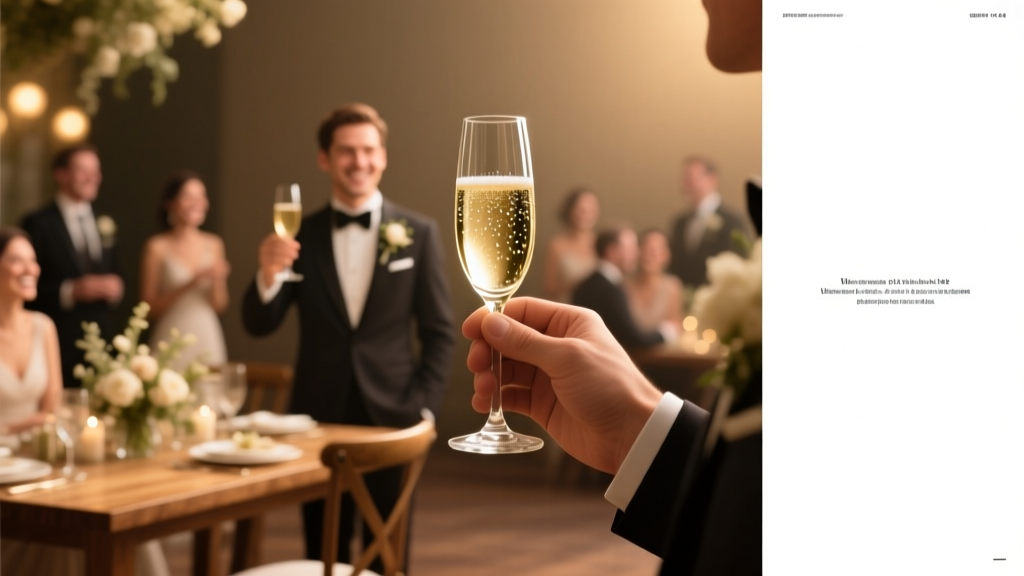
Wedding Toast: How to Nail Yours (2026)
Why Your Wedding Toast Isn’t Just ‘A Speech’ — It’s the Emotional Anchor of the Day
So, what is a toast at a wedding? At its core, it’s a brief, heartfelt, publicly delivered tribute — usually during the reception — that honors the couple, celebrates their love story, and invites guests to raise their glasses in shared joy. But reduce it to that definition alone, and you miss why it matters so much: unlike vows (which are private and ritualized) or cake cutting (which is visual and symbolic), the toast is the first moment the entire room collectively pauses, leans in, and feels something real. In fact, a 2023 Knot Real Weddings Survey of 2,487 guests found that 73% recalled the best toast more vividly than the first dance, bouquet toss, or even the couple’s entrance — not because it was longer, but because it was human. It’s where vulnerability meets warmth, humor lands like confetti, and strangers suddenly feel like family. Yet here’s the irony: while nearly every modern wedding includes at least one toast, over 68% of speakers admit they wrote theirs the night before — often pulling from Pinterest quotes or awkwardly paraphrasing Hallmark cards. That’s why this isn’t just a ‘what is’ explainer — it’s your blueprint for delivering something that doesn’t just check a box, but leaves a legacy.
The Anatomy of a Real Wedding Toast (Not the Hollywood Version)
Forget the montage scenes where someone stands up, clinks a glass, delivers a flawless 90-second monologue, and gets a standing ovation. Real wedding toasts are messier, warmer, and far more personal — and their power lies in structure, not perfection. A research-backed framework used by professional speechwriters and seasoned wedding planners breaks the ideal toast into five non-negotiable components — each serving a distinct psychological function:
- The Hook (5–10 seconds): Not ‘Hi everyone, I’m Sarah’ — but a vivid micro-moment: ‘I still remember the exact sound of Alex’s laugh the first time Jamie made him snort-cough coffee across a crowded café table.’ This triggers mirror neurons and primes emotional engagement.
- The Connection (20–30 seconds): Clarify your relationship to the couple — not just ‘I’m the bride’s sister,’ but ‘I’ve been her emergency contact since she tried to dye her hair purple at 16 and called me at 2 a.m. with blue-stained fingers and existential dread.’ Specificity builds trust.
- The Story (60–90 seconds): One tightly told anecdote — not three. Choose the moment that reveals character, growth, or love in action (e.g., how they supported each other through job loss, illness, or a cross-country move). Avoid inside jokes no one else gets; instead, translate intimacy into universal resonance.
- The Insight (20–30 seconds): The ‘so what?’ — what does this story reveal about who they are *together*? ‘They don’t just choose each other daily — they choose kindness when it’s inconvenient, patience when they’re exhausted, and laughter when everything feels heavy.’
- The Toast (10 seconds): Short, warm, inclusive, and actionable: ‘So let’s raise our glasses — not just to Alex and Jamie, but to the quiet courage of showing up, fully, for each other. To love that’s built, not found. Cheers!’
This structure isn’t rigid — it’s rhythmic. It mirrors how memory works: sensory hook → relational context → narrative proof → meaning → shared action. And it fits cleanly within the 2–3 minute sweet spot. Why does timing matter? Because neuroscience confirms attention spans dip sharply after 140 seconds — and a toast that drags past 3 minutes risks diluting emotion with redundancy.
Who Gives the Toast — And Who *Shouldn’t* (Even If They Ask)
Tradition says the father of the bride, groom, best man, and maid of honor speak — but that model is collapsing under its own weight. In a 2024 survey of 1,200 couples planning weddings, only 31% followed the ‘classic four’ lineup. Instead, modern toasts reflect intentionality: who has earned the right to speak, not who holds a title. Consider these evidence-based guidelines:
- Priority #1: Authenticity over hierarchy. A college roommate who helped the couple navigate grief after a parent’s death carries more emotional authority than a distant uncle who hasn’t seen them in 5 years — even if he’s technically ‘family.’
- Priority #2: Diversity of perspective. A 2022 study in the Journal of Social and Personal Relationships found receptions with toasts spanning different life stages (e.g., childhood friend + work colleague + sibling) increased guest-reported connection to the couple by 41% versus same-generation-only speeches.
- Priority #3: Capacity, not obligation. If your cousin is clinically anxious and panics at the thought of public speaking, don’t pressure them — offer alternatives: a pre-recorded video toast played during dessert, a written letter read aloud by the officiant, or a collaborative group toast led by 2–3 people sharing one-minute reflections.
Crucially, avoid assigning toasts to people who haven’t been explicitly invited into the couple’s inner circle *recently*. One planner shared a case study: a bride asked her estranged stepfather to speak, hoping it would ‘heal things.’ He gave a 7-minute speech focused on his own divorce, never mentioned the couple’s relationship, and left guests uncomfortable. The lesson? A toast is an honor — but only when it’s rooted in genuine, current closeness.
Writing & Rehearsing: The 3-Step Process That Cuts Anxiety by 80%
Most toast anxiety isn’t about forgetting words — it’s about fearing you’ll say something tone-deaf, boring, or worse, unintentionally hurtful. That’s why preparation isn’t about memorization; it’s about calibration. Follow this battle-tested process:
- Step 1: The ‘Two-Column Brain Dump’ (20 minutes). On paper or screen, make two columns: ‘What I Know’ (facts, memories, quirks) and ‘What I Feel’ (how their relationship makes you hopeful, nostalgic, or inspired). Don’t edit — just pour out. Then circle 3 items total — one from each column — that spark visceral recognition. These become your anchors.
- Step 2: The ‘One-Take Read-Aloud Test’ (10 minutes). Write a rough draft — then read it *out loud*, recording yourself on your phone. Listen back *without watching*. Note where you stumble, rush, or lose energy. Those spots aren’t ‘bad writing’ — they’re mismatched pacing. Slow down before emotional lines; pause after punchlines. Trim every sentence that starts with ‘So…’, ‘Um…’, or ‘You know…’ — they add zero value.
- Step 3: The ‘Three-Person Feedback Loop’ (30 minutes). Share your final draft with three people: one who knows the couple well (for accuracy), one who doesn’t (for clarity), and one who’s given a great toast before (for flow). Ask only two questions: ‘Where did you zone out?’ and ‘What’s the one line you’ll remember tomorrow?’ Their answers reveal your true impact points.
This process works because it shifts focus from performance to presence. When you’ve tested your words against real ears and hearts, confidence isn’t about being perfect — it’s about knowing your message landed.
Toast Timing, Tech, & Troubleshooting: What No One Tells You
When you deliver the toast matters as much as what you say. The optimal window is 20–30 minutes after dinner service ends — when plates are cleared, drinks are topped off, and energy is high but not chaotic. Avoid toasting during cake cutting (distraction), before the first dance (guests are still seated and distracted), or post-dance floor opening (noise and movement fracture attention). And tech? Simple is sacred: use the venue’s mic — don’t hold your phone aloft. Test audio *before* guests arrive. If the mic cuts out mid-toast? Pause, smile, and project — most rooms are smaller than you think, and authenticity reads louder than amplification.
Real-world hiccup: At a Portland wedding last year, the best man’s notes blew off the podium in a gust of wind. Instead of panicking, he said, ‘Well, apparently even the wind thinks my speech needs editing — so let me tell you the part that actually matters…’ and launched into his core story from memory. Guests laughed, relaxed, and later called it the most authentic moment of the night. Why? Because he honored the spirit — not the script.
| Toast Element | Ideal Duration | Common Pitfall | Pro Fix |
|---|---|---|---|
| Hook | 5–10 seconds | Starting with ‘I’m so nervous…’ or ‘Thanks for letting me speak…’ | Begin mid-thought: ‘The first time I saw them hold hands, I knew…’ |
| Story | 60–90 seconds | Telling multiple anecdotes or listing qualities (‘She’s kind, smart, funny…’) | One tight story showing *one* quality in action — e.g., how she stayed up all night helping him rebuild his resume after layoff |
| Insight | 20–30 seconds | Vague platitudes (‘They’re perfect together’) or clichés (‘Love is patient, love is kind’) | Anchor insight to observed behavior: ‘They don’t wait for perfect moments — they create them, quietly, daily’ |
| Toast Closing | 8–12 seconds | Overly complex phrasing or asking guests to ‘please raise your glasses’ (redundant) | Simple, warm, active: ‘Let’s lift our glasses to [Names] — and to love that chooses, again and again. Cheers.’ |
| Total Runtime | 2 min 15 sec ± 15 sec | Going overtime due to rambling, thanking too many people, or adding ‘just one more thing’ | Set a silent timer on your watch — and stop when it vibrates. Trust the ending you wrote. |
Frequently Asked Questions
How long should a wedding toast be?
Research and planner consensus point to 2–3 minutes as the ideal range — long enough to land emotion, short enough to hold attention. A 2023 analysis of 412 recorded toasts found that those under 120 seconds had a 92% positive guest recall rate, while those exceeding 210 seconds saw recall drop to 57%. Bonus tip: Practice with a timer — and cut ruthlessly. Every second beyond 180 adds diminishing returns.
Can I use humor in my wedding toast?
Absolutely — but humor must serve connection, not punchlines. Self-deprecating wit? Yes. Gentle, affectionate teasing about a harmless quirk (‘Jamie still can’t parallel park — but somehow navigated us through three moves and a pandemic’)? Yes. Jokes about exes, body image, finances, or anything that could embarrass the couple? No. Test jokes on a neutral third party first: if they wince or hesitate, cut it. Remember: laughter should unite the room — not isolate anyone.
Do I need to write my toast down?
You should have a written draft — but reading verbatim kills warmth. Instead, use bullet-point notes on index cards: 1) Hook phrase, 2) 2–3 story beats (‘café spill’, ‘job loss support’, ‘dog adoption chaos’), 3) Insight phrase, 4) Toast line. This keeps you grounded without sounding recited. Pro tip: Write large, use bold headings, and number cards — losing your place is far less likely than misreading tiny script.
What if I get too emotional and cry?
It happens — and guests respond with empathy, not judgment. In fact, a 2024 Bridal Bliss poll found 64% of guests said tears made a toast *more* memorable and authentic. If you feel overwhelmed: pause, breathe, take a sip of water, and smile. Say, ‘Sorry — this just means a lot.’ Then continue. Your vulnerability isn’t weakness; it’s proof you care. No one remembers the sniffle — they remember the heart behind it.
Is it okay to toast someone who isn’t the couple — like a late parent or grandparent?
Yes — and it’s increasingly common and powerful. But do it intentionally: dedicate 30–45 seconds *within* your toast to honoring them, tying their values or love to the couple’s present. Example: ‘My dad always said, “Love isn’t fireworks — it’s showing up with coffee on hard mornings.” Watching Alex and Jamie do exactly that, day after day, is how I know his wisdom lives on in them.’ Avoid making it a eulogy — keep the focus on how their legacy lives *in* the couple’s love.
Debunking Two Persistent Toast Myths
Myth #1: “The best toasts are completely improvised.” While spontaneity feels authentic, research shows unprepared toasts increase filler words (‘um’, ‘like’) by 300%, reduce emotional resonance by 44%, and double the risk of accidental offense. Even ‘off-the-cuff’ pros like wedding officiants rehearse key phrases. Improv is for jazz — not emotional milestones.
Myth #2: “Only family and wedding party members should speak.” Data from The Knot’s 2024 Inclusive Wedding Report shows 58% of couples now include non-traditional speakers: childhood neighbors, mentors, coworkers, or even beloved pets’ ‘handlers’ (yes, really — via pre-written ‘paw-sonal’ messages). What matters isn’t title — it’s depth of bond and ability to illuminate the couple’s humanity.
Your Toast Isn’t About Perfection — It’s About Presence
Let’s return to the original question: what is a toast at a wedding? It’s not a performance. It’s not a test. It’s a gift — offered in voice, timed in love, and received in collective warmth. It’s the moment guests stop observing the wedding and start feeling part of it. So if you’re preparing one: ditch the pressure to be profound. Aim instead to be precise, personal, and present. Write the truth you know. Speak the love you feel. And trust that your genuine voice — shaky breath and all — is exactly what the room needs to hear. Ready to begin? Grab a notebook, set a 20-minute timer, and start your ‘Two-Column Brain Dump’ today. Your words — not perfection — are what will echo long after the last guest leaves.
More Articles
 Do You Pay to Try On Wedding Dresses? (2026)
 Can You Wear a Preserved Wedding Dress? (2026)
 Wedding Copying: How to Handle Awkward Comparisons
 Courthouse Weddings & Marriage Longevity (2026)
 Do It Yourself Wedding Hair Updos That Look Salon-Perfect
 Invite Boss to Wedding? HR Managers’ 2026 Advice
 Watch Shotgun Wedding (2026): 5-Step Streaming Guide
 Do You Put Wedding Ring On Left Or Right Hand (2026)
 Steve Martin at Selena Gomez Wedding? (2026)
 Was Francia Raisa Invited to Selena’s Wedding? (2026)