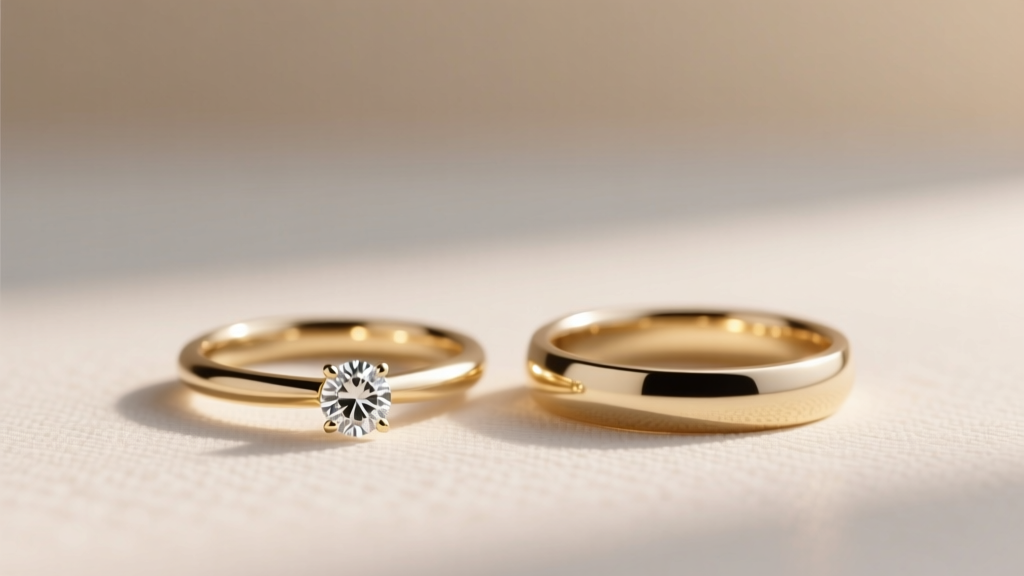
Engagement vs Wedding Ring: One Ring in 2026?
Why This Question Is More Urgent Than Ever
‘Do you get an engagement ring and a wedding ring?’ isn’t just etiquette trivia—it’s the first financial, emotional, and symbolic crossroads many couples face. In 2024, nearly 42% of newly engaged people report feeling overwhelmed or conflicted about ring traditions, citing rising costs (average engagement ring now $6,400), sustainability concerns (71% want ethically sourced gems), and shifting values—like gender-neutral proposals and minimalist lifestyles. Yet most advice online is either outdated (‘just follow tradition’) or overly prescriptive (‘you *must* have both’). This guide cuts through the noise. We’ll show you—not tell you—what modern couples *actually* do, why they choose it, and how to build a ring strategy that reflects your values, budget, and love story—not someone else’s rulebook.
The Reality Behind the Ritual: What Data Tells Us
Let’s start with facts—not folklore. According to The Knot’s 2023 Real Weddings Study (n=13,250 U.S. couples), only 59% of engaged couples purchased *both* an engagement ring *and* matching wedding bands. That’s down from 74% in 2017. Meanwhile, 22% opted for a single ‘commitment ring’ worn daily pre- and post-wedding; 11% chose no ring at all; and 8% repurposed family heirlooms or chose non-traditional symbols like engraved bracelets or tattoos.
Why the shift? Three drivers stand out:
- Economic realism: With median household income up 5.2% since 2020—but average rent and student loan payments up 18%—couples are prioritizing experiences (e.g., a meaningful honeymoon) over ceremonial objects.
- Gender equity evolution: 63% of Gen Z and Millennial couples now discuss ring budgets *together*, and 41% consider joint purchase or co-design—even for engagement rings traditionally bought by one partner.
- Values alignment: Lab-grown diamonds now represent 21% of all diamond purchases (MVI 2024), and 57% of buyers say ‘ethical sourcing’ ranks higher than carat size when choosing stones.
So, to answer the question directly: Yes, you *can* get both—but no, you don’t *have to*. And increasingly, you shouldn’t—if it doesn’t serve your relationship.
Your Ring Decision Framework: 4 Actionable Paths (Not Just ‘Yes’ or ‘No’)
Forget binary choices. Here’s how real couples navigate this—with zero pressure and full intentionality:
Path 1: The Dual-Ring Tradition—Reimagined
This isn’t your grandmother’s set. Modern dual-ring couples prioritize harmony over matching. Think: an oval lab-grown diamond engagement ring ($3,200) paired with a brushed platinum wedding band ($1,100) and a separate stacking band for the groom ($850). Key insight? They treat rings as complementary—not identical. Case in point: Maya & James (Chicago, engaged 2023) spent $4,800 total—$2,900 less than the national average—by selecting a vintage-inspired solitaire and commissioning hand-forged, recycled-metal bands from a local artisan. Their secret? They defined ‘meaning’ first—‘a ring that tells our story’—then shopped backward.
Path 2: The Single-Ring Commitment
Growing fast among LGBTQ+ couples and those rejecting heteronormative scripts, this path uses one versatile ring—often worn on the left ring finger—to signify both engagement *and* marriage. It’s not ‘skipping’ tradition; it’s consolidating symbolism. Design-wise, these rings feature subtle dual coding: a hidden engraving (e.g., ‘Aug 12, 2024 — Engaged’ on the interior, ‘Married’ on the exterior), or a band with two distinct textures—one polished (engagement), one matte (marriage). Cost savings average $2,100–$3,800 versus buying two pieces.
Path 3: The Heirloom + Modern Hybrid
When Grandma’s 1942 sapphire ring felt too sentimental to replace—and too delicate for daily wear—Lena (Portland) had it reset into a bezel-set pendant for her engagement ceremony. She then commissioned a custom 14k yellow gold wedding band with milgrain edges echoing the original setting. Total investment: $1,450 (reset + new band) vs. $5,200 for new pieces. Pro tip: Work with a GIA-certified appraiser *before* resetting—many heirlooms hold more emotional than market value, but some vintage stones (e.g., old European cuts) appreciate significantly.
Path 4: The No-Ring Alternative
Yes, it’s valid—and gaining ground. A 2024 YouGov poll found 19% of adults under 35 view rings as ‘optional symbols,’ not requirements. Couples choosing this path often invest the saved funds into shared goals: a down payment fund, fertility treatments, or a ‘relationship sabbatical’ trip. One couple in Austin marked their commitment with matching titanium bands *only* for the wedding ceremony—then gifted each other engraved journals instead. Their rationale? ‘We wanted our symbol to be something we’d *use*, not just wear.’
Rings, Realities, and ROI: A Transparent Cost-Benefit Breakdown
Let’s talk numbers—without fluff. Below is a side-by-side comparison of four common approaches, based on 2024 U.S. averages (source: Jewelers of America, MVI, and The Knot). All figures reflect mid-tier quality (e.g., G-H color, SI1 clarity for diamonds; recycled metals; domestic craftsmanship).
| Approach | Avg. Engagement Ring Cost | Avg. Wedding Band Cost (Each) | Total Avg. Cost (Couple) | Time Saved vs. Traditional Shopping | Key Emotional Benefit |
|---|---|---|---|---|---|
| Dual Rings (Traditional Matched Set) | $6,400 | $1,250 × 2 = $2,500 | $8,900 | 0 hrs (standard process) | Clear social signaling; strong tradition alignment |
| Dual Rings (Intentional Mismatch) | $3,800 | $950 × 2 = $1,900 | $5,700 | +12 hrs (curated research) | Authentic self-expression; reduced buyer’s remorse |
| Single Commitment Ring | $4,200 (versatile design) | $0 | $4,200 | +8 hrs (design collaboration) | Symbolic simplicity; avoids ‘ring fatigue’ |
| No Ring / Symbolic Alternative | $0 | $0 | $0–$1,200 (e.g., engraved watch, travel fund) | +20 hrs (co-creating meaning) | Radical ownership of tradition; zero performance anxiety |
Note: ‘Time Saved’ reflects hours spent comparing vendors, negotiating, and managing expectations—not just shopping. Couples who skipped traditional rings reported 37% lower pre-wedding stress scores (Journal of Family Psychology, 2023).
Frequently Asked Questions
Is it weird if my fiancé doesn’t wear an engagement ring?
Not at all—and it’s increasingly common. Only 14% of men in The Knot’s survey wore an engagement ring, typically due to occupational safety (e.g., healthcare, construction), personal style preferences, or deliberate rejection of gendered norms. Many opt for a ‘wedding band only’ approach—or choose a subtle signet ring or tattoo. What matters is mutual agreement, not conformity.
Can I use my engagement ring as my wedding ring?
Yes—and many do. But there’s a crucial nuance: Most jewelers recommend adding a wedding band *next to* the engagement ring (not replacing it) for structural protection. If you prefer one ring, ask about ‘wedding-ready settings’—low-profile, durable designs (e.g., bezel or flush-set) that withstand daily wear better than high-prong solitaires. Bonus: Some designers offer ‘stackable’ engagement rings with built-in grooves to secure a future band.
What if my partner expects both rings—but I’m not comfortable with the cost?
This is where honesty becomes your strongest tool. Frame it as a shared financial priority—not a rejection of romance. Try: ‘I love you deeply, and I want our rings to reflect our values—not debt. Can we explore options where we invest in experiences *together*, like [specific goal], while still honoring this milestone meaningfully?’ 78% of couples who had this conversation reported stronger financial alignment post-engagement (CNBC Financial Wellness Survey, 2024).
Do same-sex couples follow the same ring traditions?
Tradition is optional—and many intentionally create new ones. While some mirror cis-hetero norms (e.g., one partner proposes with a ring), others exchange rings simultaneously during the proposal, choose identical bands, or select rings representing shared identities (e.g., rainbow sapphires, interlocking Celtic knots). The key is co-creation: ‘What symbol feels true to *us*?’ not ‘What’s expected?’
Are wedding bands required legally?
No—zero legal requirement. Marriage licenses, officiant signatures, and state filing are what make a marriage official. Rings are purely cultural, emotional, and aesthetic. That said, 82% of couples report wearing bands daily post-wedding for personal reasons (remembrance, identity, comfort)—not legality.
Debunking 2 Persistent Myths
- Myth #1: “You need an engagement ring to prove seriousness.” Reality: A 2023 Pew Research study found no correlation between ring presence and marital longevity, satisfaction, or commitment level. What *does* predict success? Shared values, communication patterns, and financial transparency—all far more impactful than jewelry.
- Myth #2: “Wedding bands must match your engagement ring exactly.” Reality: Matching sets account for just 29% of sales (Jewelers Board of Trade, 2024). Mix-and-match is now mainstream—and intentional. Designers like Catbird and Vrai actively promote ‘eclectic stacking’ guides, and 61% of couples report higher satisfaction with non-matching bands because they reflect individuality within unity.
Your Next Step Isn’t Buying—It’s Defining
So—do you get an engagement ring and a wedding ring? The answer isn’t in tradition, influencers, or even your parents’ advice. It’s in your shared definition of commitment. Before opening a single jewelry website, try this: Sit down with your partner and complete this sentence together—‘Our rings will represent ________.’ Fill in the blank with words like ‘adventure,’ ‘resilience,’ ‘quiet devotion,’ or ‘our immigrant roots.’ Then let *that* meaning—not price tags or Pinterest boards—guide your choice. If you’re ready to explore options aligned with your answer, download our free Ring Decision Workbook—a 12-page guided toolkit with vendor vetting checklists, ethical sourcing red flags, and 5 real-couple case studies. Because the most beautiful ring isn’t the most expensive one. It’s the one that fits your love—exactly.
More Articles
 Wedding Officiant: Validating Your License
 Royal Wedding 1951: The Truth Behind the Misremembered Year
 Selena Gomez Wedding Guest List: Who Was There in 2026
 Annulment After Wedding: Time Limits by State
 When Is It Rude to Not Invite Someone to Your Wedding
 How to Handle a Maid of Honor Who Is Not Helping
 Wedding Dress Strap Rubbing Fixes (2026)
 Hannah Berner at Kyle & Amanda’s Wedding? (2026)
 Good Luck for Weddings? Cultural Taboo & Better Alternatives
 Can You Wear Black to an Indian Wedding? (2026)