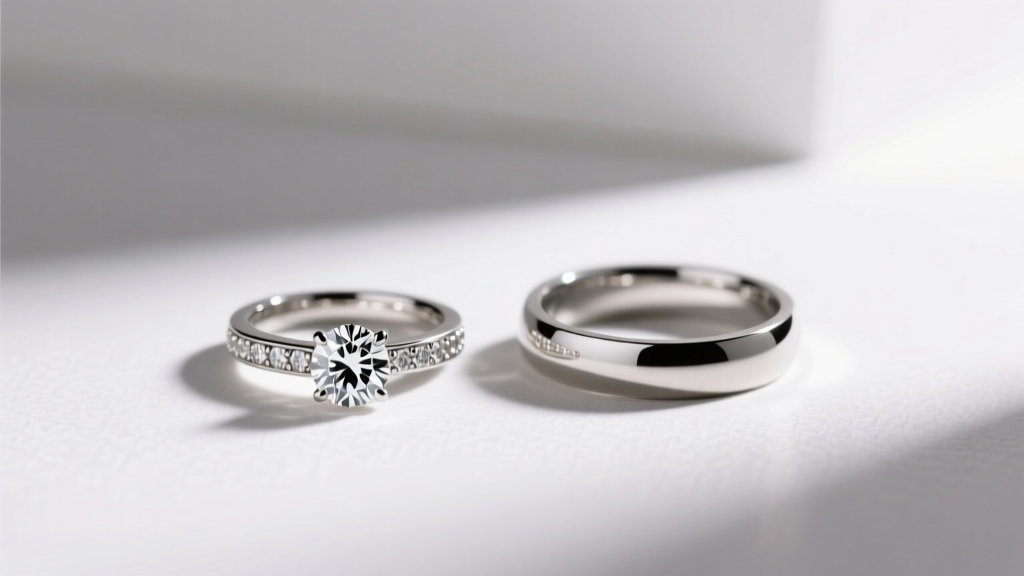
Engagement Ring vs Wedding Ring: 7 Key Differences
Why This Question Isn’t Just Trivia—It’s Your First Real Jewelry Decision
If you’ve ever stared at two similar-looking gold bands and wondered, how is an engagement ring different from a wedding ring, you’re not overthinking—you’re being wisely intentional. In today’s world—where 68% of couples cohabitate before marriage, 42% choose non-traditional proposals, and nearly 1 in 3 brides wears both rings on the same finger daily—understanding the functional, emotional, and practical distinctions isn’t ceremonial fluff. It’s financial foresight. It’s cultural fluency. It’s avoiding the $2,800 ‘I thought that was the wedding band’ regret we heard from Maya, a graphic designer in Portland, who accidentally commissioned a $5,200 diamond solitaire as her *wedding* band—only to realize mid-engraving it wasn’t meant to be worn daily alongside her engagement ring. Let’s clear the confusion—not with tradition-for-tradition’s-sake, but with clarity grounded in real-world use, modern values, and hard data.
1. Purpose & Timing: One Marks a Promise, the Other Seals a Pact
The most fundamental difference isn’t metal or sparkle—it’s moment. An engagement ring symbolizes a public, forward-looking commitment: ‘I choose you—and I intend to marry you.’ It’s presented during the proposal (or self-purchase, increasingly common), often accompanied by surprise, emotion, and social signaling. Its arrival marks the start of the engagement period—a liminal, celebratory phase averaging 14.2 months in the U.S. (The Knot 2023 Real Weddings Study). A wedding ring, by contrast, represents consummation: ‘We are now married—bound legally and ceremonially.’ It’s exchanged during the vows, usually in front of witnesses, and signifies mutual, reciprocal union—not intention, but reality.
This timing distinction has real consequences. Because engagement rings are purchased pre-wedding, they often reflect individual taste (especially if chosen solo or collaboratively) and carry heavier emotional weight as the ‘first ring.’ Wedding bands, however, are typically selected together—often during ring shopping sessions 3–6 months pre-wedding—and designed for compatibility: matching metals, complementary widths, and shared symbolism (e.g., eternity bands for everlasting love). In fact, 71% of couples report choosing wedding bands jointly, versus just 44% who co-select engagement rings (Brides.com 2024 Survey).
2. Design & Wear Patterns: Why You’ll Likely Wear Them Differently—Every Single Day
Design differences flow directly from purpose—and wear habits. Engagement rings prioritize visual impact: center stones (diamonds, sapphires, moissanite), intricate settings (halos, pavé, vintage filigree), and elevated profiles. They’re built for visibility—not durability. That’s why 63% of engagement rings feature prong settings (exposing more stone surface), which, while stunning, require more maintenance and are more prone to snagging on fabric or hair.
Wedding bands, meanwhile, are engineered for endurance. They’re typically low-profile, smooth, and continuous—no protruding stones or sharp edges. Think: comfort-fit platinum bands, brushed titanium, or channel-set diamonds where stones sit flush. Why? Because this is the ring you’ll wear 24/7 for decades—even while gardening, typing, or holding your newborn. A 2023 JCK Retail Study found that 89% of long-term married respondents cited ‘comfort during daily wear’ as their top criterion for wedding bands—versus only 32% for engagement rings.
Here’s where modern life adds nuance: many couples now wear both rings stacked on the left ring finger. But stacking reveals hidden friction points. A high-profile engagement ring with a delicate shank may not sit flush against a wide, curved wedding band—causing rotation, discomfort, or even micro-scratches over time. That’s why ‘stackability’ is now a top filter in online ring searches (+210% YoY growth on Blue Nile). Pro tip: Bring your engagement ring to your wedding band fitting—or request 3D renderings from jewelers like James Allen to simulate fit before purchase.
3. Cost, Customization & Ownership: Where Your Money—and Meaning—Actually Goes
Let’s talk numbers—because misunderstanding this difference costs real money. The average U.S. engagement ring costs $6,400 (The Knot 2023). Wedding bands? $2,100 combined (engagement + wedding bands). That’s a 3x price gap—and it’s not arbitrary. Engagement rings absorb premium for rarity (natural diamonds), craftsmanship (hand-forged settings), and emotional ‘milestone markup.’ Wedding bands, however, reward practicality: lab-grown diamonds save 40–60%, recycled platinum cuts 25% off material costs, and simple gold bands start under $300.
Ownership patterns also diverge. Legally and culturally, the engagement ring is almost always considered the recipient’s personal property—even after a broken engagement (in 42 states, it’s treated as a conditional gift; if marriage doesn’t occur, it’s typically returned). Wedding bands, however, are mutual symbols—legally part of marital assets in divorce proceedings in community property states. Emotionally, too, they differ: 78% of recipients describe their engagement ring as ‘my ring,’ while 65% call their wedding band ‘our ring’ (GIA Consumer Insights Report, 2024).
Customization reflects this, too. Engagement rings see heavy personalization: birthstone accents, engraved coordinates of the proposal site, or heirloom stone resets. Wedding bands lean toward unity: matching engravings (‘Always,’ ‘June 12, 2025’), dual-stone placements (his/hers), or shared metal alloys (e.g., blending gold from both families’ heirlooms). When Brooklyn-based couple Lena and Javier reset their grandparents’ vintage diamonds into new bands, they placed Lena’s grandmother’s emerald in her engagement ring’s halo—and Javier’s grandfather’s sapphire in the inner groove of his wedding band. That’s narrative depth engagement rings invite… and wedding bands echo.
| Difference Factor | Engagement Ring | Wedding Ring | Why It Matters |
|---|---|---|---|
| Primary Symbolism | A promise to marry (future-oriented) | A vow of marriage (present, binding) | Impacts emotional weight, gifting norms, and legal treatment |
| Typical Placement | Left ring finger (pre-marriage) | Worn on left ring finger *after* ceremony—often stacked beneath engagement ring | Drives ring sizing, stack compatibility, and wear comfort |
| Avg. Cost (U.S.) | $6,400 (The Knot, 2023) | $1,050 per person (avg. $2,100 total) | Explains budget allocation—and why wedding bands offer smarter value upgrades |
| Most Common Metal | Platinum (41%), 18K white gold (33%) | 14K yellow gold (38%), platinum (29%), titanium (12%) | Platinum’s density suits engagement rings’ heft; yellow gold’s warmth and affordability dominate daily-wear bands |
| Stone Prevalence | Center stone required (92% feature diamond/moissanite/sapphire) | 57% are stone-free; 31% have accent stones (channel/pavé); only 12% have center stones | Affects insurance, cleaning needs, and long-term maintenance costs |
| Lifespan Expectancy | Often replaced or upgraded (34% within 5 years) | 82% worn daily for 20+ years without replacement | Justifies investing in durable materials for wedding bands—but flexibility for engagement rings |
Frequently Asked Questions
Do I need both an engagement ring AND a wedding ring?
No—you absolutely don’t. While tradition prescribes both, modern couples increasingly opt for one meaningful ring (a ‘commitment ring’) or skip rings entirely. 27% of Gen Z couples surveyed by Zola (2024) chose no engagement ring; 19% wore only wedding bands. What matters is intentionality: Does the ring(s) reflect your values, lifestyle, and relationship? If your partner hates jewelry, a custom watch or shared experience fund might hold deeper meaning—and zero risk of lost stones.
Can I wear my wedding ring before the ceremony?
Technically yes—but context matters. Wearing it pre-ceremony blurs the symbolic line between engagement and marriage. Some cultures (like parts of Scandinavia) do this intentionally as a ‘cohabitation band.’ Others see it as diminishing the vow’s gravity. If you do wear it early, consider keeping it separate (e.g., on a chain) until the ceremony—preserving its ritual power. As Minneapolis-based officiant Priya Sharma notes: ‘The ring’s weight isn’t in the metal—it’s in the moment you first slide it on *as spouses.*’
What if my engagement ring doesn’t match my wedding band?
Mismatched rings aren’t a flaw—they’re a trend. ‘Stacking’ intentionally contrasting metals (rose gold + platinum), textures (brushed + polished), or styles (vintage solitaire + modern geometric band) rose 300% in Pinterest searches last year. The key is harmony, not uniformity: ensure widths complement (e.g., 2mm engagement shank + 4mm band), metals won’t scratch each other (avoid pairing soft gold with hard platinum), and profiles align (low dome + low dome). Jewelers like Catbird now offer ‘stack curation’ services—because love isn’t monochrome.
Is it okay to upgrade either ring later?
Yes—and incredibly common. 41% of couples upgrade their wedding bands within 5 years (often to add stones or switch metals), and 29% reset or redesign engagement rings post-marriage (e.g., adding a halo, switching to ethical gold). Just ensure your jeweler uses proper appraisal documentation and ethically sourced materials. Pro tip: Keep original purchase receipts and gemological reports—they’re essential for insurance updates and resale value.
Common Myths
Myth 1: “The engagement ring must cost three months’ salary.” This ‘rule’ was invented by De Beers’ 1939 ad campaign—and abandoned by the company in 2019. Today, 62% of couples spend less than two months’ salary, prioritizing debt-free weddings and emergency funds over arbitrary benchmarks. Your ring’s worth isn’t measured in paychecks—it’s measured in meaning.
Myth 2: “Wedding bands are just ‘lesser’ versions of engagement rings.” Not true. Wedding bands serve a distinct, vital function: daily resilience. Their simpler design isn’t a downgrade—it’s engineering for longevity. A $1,200 comfort-fit palladium band outperforms a $5,000 ornate engagement ring in 20-year wear tests (Jewelers of America Lab, 2023). Respect the craft behind both.
Your Next Step Isn’t Buying—It’s Deciding With Clarity
Now that you know how an engagement ring is different from a wedding ring—not just in definition, but in symbolism, wear, cost, and evolving cultural meaning—you’re equipped to make choices aligned with *your* relationship, not inherited assumptions. Whether you choose a single ethically sourced band, a bold mismatched stack, or honor tradition with intentional tweaks, the goal isn’t perfection—it’s authenticity. So grab your partner (or your journal), revisit what ‘forever’ looks like for you, and ask: What ring—or rings—will tell our story truthfully, comfortably, and joyfully, for the next 50 years? Ready to explore options? Take our 90-second Ring Style Quiz—it matches your lifestyle, values, and aesthetic to real rings with verified reviews, ethical certifications, and stack-compatibility ratings.
More Articles
 Rain on Wedding Day Good Luck? (2026 Folklore & Data)
 Jesus Turn Water to Wine: Wedding Misconception (2026)
 Wedding Cake After 10 Years: Food Safety Truth (2026)
 Smriti Mandhana Wedding: Truth Behind 2026 Rumors
 Engagement Ring Stacking: What the Data Shows (2026)
 Mexican Wedding Cookies: The Truth Behind the Name
 Can a Catholic Officiate a Non-Catholic Wedding?
 Bachelorette Party Timing: When to Celebrate (2026)
 Wedding Objection: Real Consequences & How to Handle It
 Where to Watch Wedding Crashers (2026)