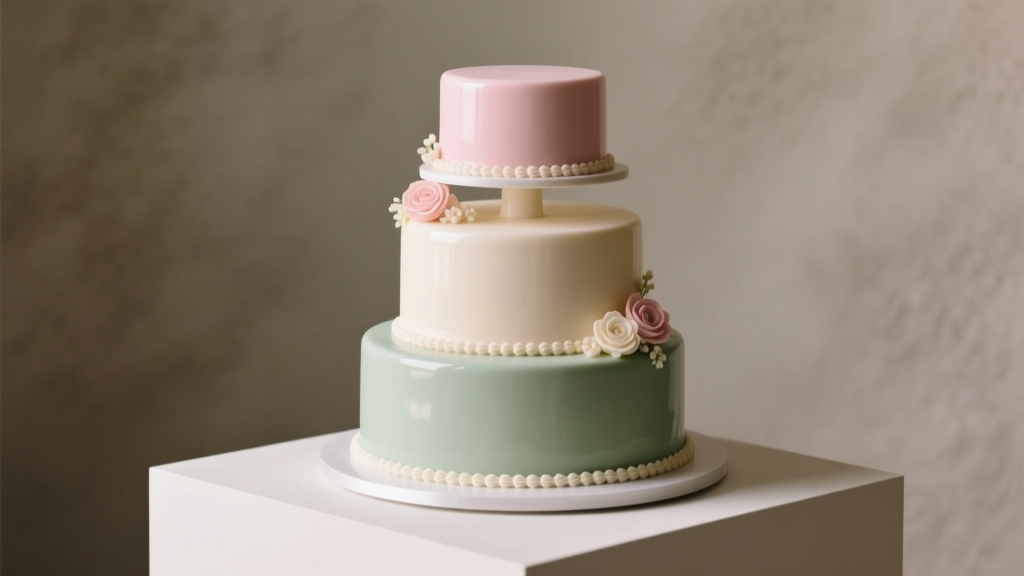
# How to Assemble a 3-Tier Wedding Cake Without It Collapsing on You
The moment you slide that top tier into place and step back to admire your work is one of the most satisfying feelings in baking. But getting there? That's where most home bakers and even some professionals lose their nerve. The good news: assembling a 3-tier wedding cake is entirely learnable, and with the right technique, structural failure is almost entirely preventable.
## What You Need Before You Start
Assembly begins long before you stack a single tier. Each cake layer must be fully chilled — ideally 2–4 hours in the refrigerator after the final crumb coat and frosting. Cold cakes are firm cakes, and firm cakes don't bulge or slide.
Gather these supplies:
- **Cake boards** (one per tier, cut to match each tier's diameter)
- **Plastic or wooden dowels** (at least 4–5 per tier)
- **A serrated knife or dowel cutter**
- **A level** (a small bubble level from a hardware store works perfectly)
- **Offset spatula and bench scraper**
- **A large, sturdy base board** (at least 4 inches wider than your bottom tier)
Skipping any of these — especially the dowels — is the single biggest cause of collapsed wedding cakes.
## How to Dowel Each Tier Correctly
Doweling is the structural skeleton of a tiered cake. Without it, the weight of upper tiers compresses the lower ones, causing bulging, leaning, or full collapse.
**Step-by-step doweling process:**
1. Place the second tier (still on its cake board) centered on top of the bottom tier temporarily. Use a toothpick to lightly trace its outline.
2. Remove the second tier. Insert one dowel straight down through the center of the traced circle, mark it at the exact height of the frosting surface, then pull it out.
3. Cut all remaining dowels to that same length — this is critical. Uneven dowels create a tilted platform.
4. Insert 4–5 dowels in a circle pattern inside the traced outline, plus one in the center for tiers over 10 inches.
5. Repeat this process for the second tier before placing the third.
For a standard 3-tier cake (12", 9", 6"), you'll use roughly 10–12 dowels total. Plastic bubble tea straws are a popular, food-safe alternative to wooden dowels and are easier to cut cleanly.
## Stacking the Tiers Without Disaster
With dowels in place, you're ready to stack. Work on a non-slip surface and have a second pair of hands nearby if possible.
1. **Add a small dab of buttercream** on top of the doweled tier — this acts as adhesive and prevents sliding.
2. **Lower each tier straight down**, using the cake board as a handle. Don't drag or slide it into position.
3. **Check level immediately** after placing each tier. Press gently on the high side to correct any tilt before the buttercream sets.
4. **Pipe a small border** where tiers meet to hide any gaps and reinforce the join visually.
For extra security on tall or heavy cakes, a single long central dowel (a sharpened wooden dowel or food-safe rod) driven through all tiers into the base board acts as a spine. This is standard practice for cakes traveling more than 20 minutes by car.
## Transporting and Displaying Your Assembled Cake
Most wedding cake disasters happen in transit, not during assembly. A few non-negotiable rules:
- **Transport tiers separately** whenever possible and assemble on-site. Stack only the bottom two tiers for transport if you must move an assembled cake.
- **Keep the car cold.** Run the AC for 10 minutes before loading. Buttercream softens above 75°F (24°C).
- **Place the cake box on a non-slip mat** (a rubber shelf liner works perfectly) in the trunk or footwell — never on a seat.
- **Drive smoothly.** Acceleration and hard braking cause more damage than bumpy roads.
At the venue, assemble on the display table itself whenever possible. Bring your offset spatula and extra frosting to touch up any joins disturbed during transport.
## Two Mistakes That Catch Even Experienced Bakers Off Guard
**Myth 1: "The cake boards are optional if my frosting is stiff enough."**
Frosting is not structural. Without a rigid cake board under each tier, the dowels have nothing solid to rest against, and the tier will eventually sink. Always use boards.
**Myth 2: "I can assemble the full cake the night before and refrigerate it assembled."**
Refrigerating a fully assembled cake overnight causes condensation when it returns to room temperature, which can dissolve fondant details and cause buttercream to weep. Assemble no more than 3–4 hours before the reception, or transport tiers separately and stack on-site.
## You've Got This
A 3-tier wedding cake is a project, not a miracle. With chilled tiers, properly cut dowels, and a steady hand, the structure will hold — and the result will be exactly as impressive as you imagined. Practice the stacking technique once on dummy tiers (styrofoam rounds from a craft store) before the real event, and you'll walk into wedding day with genuine confidence.
Ready to take it further? Try adding a central support rod for cakes over 3 tiers, or explore ganache as a base coat for a firmer, more heat-stable finish than buttercream alone.
 How to Handle Wedding Registry Items That Are Too Expensive
 Can You Wash a Wedding Dress in the Washer?
 My Big Fat Greek Wedding on Netflix (2026)
 Wedding Anniversary Wishes That Make Them Cry (2026)
 Was Kristen Doute at Stassi’s Wedding? (2026)
 Dreaming of Wedding: 7 Psychological Truths (2026)
 Are The Engagement Ring And Wedding Ring Different (2026)
 Can a Priest Officiate a Wedding? (2026)
 Happy Wedding Anniversary Wishes for Husband (2026)
 Champagne Wedding Attire: 7 Color Rules (2026)