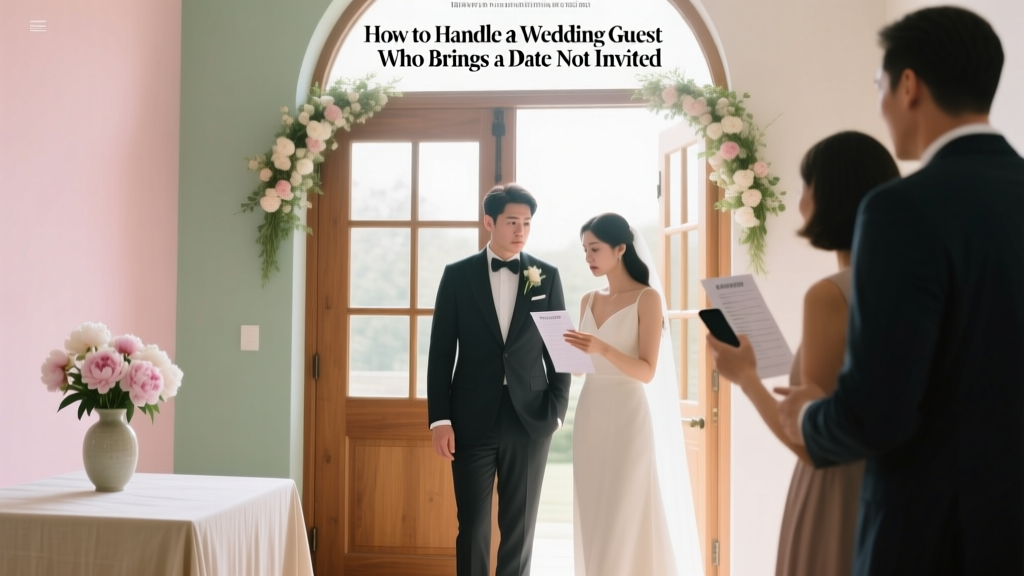
How to Handle a Wedding Guest Who Brings a Date Not Invited
How to Handle a Wedding Guest Who Brings a Date Not Invited
You spent weeks (or months) building a guest list that fits your budget, venue capacity, and vision. So when you hear that someone plans to bring a date who wasn’t invited—or worse, they arrive with an unexpected plus-one—it can feel equal parts awkward and infuriating. You’re not being “bridezilla” or “groomzilla” for caring. Guest count affects everything: seating charts, catering, rentals, bar packages, favors, and even fire-code limits.
This situation is also surprisingly common, especially with modern wedding trends like casual “open invite” messaging, digital RSVPs, and looser social norms around plus-ones. The good news: you can handle it kindly and firmly without turning your wedding into a conflict zone.
Quick Answer: What should you do if a guest brings a date who wasn’t invited?
Address it privately and calmly, and stick to your original invitation boundaries. If you find out before the wedding, reach out and clarify that the invitation is only for the named guest(s). If the uninvited date shows up on the day, have a designated point person (planner, coordinator, or trusted friend) handle it discreetly—offering solutions only if they truly exist (like an extra seat), and declining if they don’t.
You do not have to accommodate an uninvited guest. Etiquette supports you setting the guest list, and you’re allowed to protect your budget and plans. The goal is to be gracious while staying consistent.
Why this happens (and why it feels so personal)
Most uninvited plus-one situations come from misunderstanding rather than malice. A guest might assume:
- “Everyone gets a plus-one.”
- “We’ve been dating for a few months, so it counts.”
- “The RSVP card didn’t say ‘one,’ so I can add someone.”
- “It’s a casual wedding—surely it’s fine.”
Other times, it’s more direct: a guest ignores the envelope, adds a name to the RSVP, or shows up with a date and hopes you’ll feel too polite to push back.
“Couples are often surprised by how many people interpret ‘and guest’ when it’s never written,” says Marisa Kline, a fictional but realistic wedding planner in Chicago. “That’s why I recommend making the invitation and online RSVP very explicit—names, headcount, and a gentle line like ‘We have reserved __ seat(s) in your honor.’ It prevents 90% of these issues.”
Traditional etiquette vs. modern wedding norms
Traditional approach: Plus-ones are typically offered to married, engaged, or long-term partnered guests, and to members of the wedding party. Single guests don’t automatically receive a date, especially at smaller weddings. Invitations are addressed to the invited individuals; anyone not named is not invited.
Modern approach: Many couples choose to give more plus-ones for guest comfort, especially at destination weddings or when guests won’t know many people. But modern doesn’t mean “open door.” It still hinges on what you can host.
Current trends complicate this: micro weddings, higher per-person costs, and intimate venues mean couples are tighter than ever on headcount. At the same time, digital invites and wedding websites can feel less formal, which makes some guests more likely to assume flexibility.
Bottom line: Whether you’re going traditional or modern, clarity wins.
Scenario 1: You find out before the wedding (best-case timing)
If a guest texts, emails, or casually mentions they’re bringing someone not on the invite, handle it promptly. Waiting makes it harder.
What to say (simple and firm):
- “I’m so glad you can make it! We’re keeping the guest list limited, so we’re only able to host the guests named on the invitation.”
- “We’d love to celebrate with you, but we aren’t able to add extra plus-ones. Thank you for understanding.”
If they already wrote in a name on the RSVP:
- “I saw the RSVP update—thank you! Just a heads-up: we have one seat reserved for you. We can’t accommodate an additional guest.”
A real-couple-style example: “My cousin wrote in ‘+ Taylor’ on the RSVP,” says Jenna (fictional), who had a 75-person wedding. “I called her and said, ‘I’m so happy you’re coming. We’re capped at the venue limit, so it’s just you.’ She was a little embarrassed, but it was fine—and honestly, I was relieved I didn’t ignore it.”
Scenario 2: They show up with an uninvited date (day-of plan)
This is the moment couples dread. The key: you shouldn’t be the one handling it. Put a plan in place ahead of time.
Choose a gatekeeper: wedding planner, venue coordinator, a strong-willed sibling, or a trusted friend who can stay calm. Brief them on your rules: “Only names on the list get in,” or “If there’s an extra seat, we can consider it.”
If you have capacity (rare, but possible):
- Ask catering/venue quietly if there’s an extra meal and chair without impacting service.
- If yes, your gatekeeper can say: “We weren’t expecting an additional guest, but we can accommodate tonight. Please know seating is tight.”
If you don’t have capacity (most common):
- Your gatekeeper can say: “I’m so sorry, we’re at full capacity and can only host the guests on the list.”
- Then they can offer a face-saving option: “You’re welcome to join us, and your guest can head home (or to the hotel/restaurant nearby).”
“Couples worry this will cause a scene,” says David Nguyen, fictional venue manager. “But when it’s handled calmly at check-in—like any event with a guest list—it usually stays quiet. The only time it explodes is when couples confront it emotionally in the middle of cocktail hour.”
Scenario 3: It’s a close family member or VIP guest
This is the trickiest. If it’s your mom’s best friend, a favorite aunt, or a groomsman, you may feel pressure to bend. Before you do, ask:
- Are we breaking our own boundary in a way that feels unfair to others?
- Will this create a domino effect (“If they brought someone, why can’t I?”)?
- Do we truly have space and budget?
If you decide to allow it, do it intentionally—not resentfully. If you decide not to, be consistent and kind: “We love you, and we wish we could. We’re at the limit.”
How to prevent uninvited plus-ones (your best defense)
1) Use names on the invitation envelope.
“Ms. Jordan Lee” is clearer than “Jordan Lee + Guest.” Only use “and Guest” if you truly mean it.
2) Make the RSVP headcount unmistakable.
On paper RSVPs: “We have reserved 1 seat in your honor.”
On online RSVPs: restrict entries to invited names and display the number of seats reserved.
3) Add a gentle line on your wedding website FAQ.
Try: “Due to limited capacity, we’re only able to host those listed on the invitation. Thank you for understanding!”
4) Train your inner circle.
Tell parents and wedding party: no last-minute additions, no “I told them it would be fine,” no unofficial plus-ones.
5) Be consistent with plus-one rules.
If you’re offering plus-ones for the wedding party, decide whether you’re also offering them to out-of-town singles, long-term partners, or guests who won’t know others. A consistent policy prevents awkward exceptions.
Related questions couples often ask
What if the uninvited date is a serious partner I didn’t know about?
If you made a genuine mistake (you didn’t realize someone had moved in with a partner, or you overlooked a long-term relationship), consider whether you can fix it—especially if it impacts the guest’s comfort. If your numbers are tight, you can still say no, but acknowledge it kindly: “I’m so sorry—I didn’t realize. We’re unfortunately at capacity.”
What if they say they “can’t come” without their date?
That’s their choice. You can respond warmly: “We’ll miss you, but we understand.” Avoid negotiating against your budget.
What if they bring a child who wasn’t invited (or your wedding is adults-only)?
Use the same principle: clarity and consistency. Have a point person reiterate the policy and offer any realistic alternatives (like recommending a sitter service or suggesting the parent attend solo if the child can’t be accommodated).
Should I confront them after the wedding if I let it slide?
If it truly disrupted your wedding—extra cost, family stress, seating chaos—it can be worth a calm follow-up. Keep it factual: “We were surprised by the additional guest; please check with us in the future.” If it didn’t impact anything, you may decide it’s not worth reopening.
Conclusion: You’re allowed to protect your guest list
An uninvited plus-one is awkward, but it’s also manageable. Clear communication, a consistent plus-one policy, and a day-of gatekeeper keep the situation from stealing your joy. You can be gracious and still say no—and that combination is what good wedding etiquette looks like today.
More Articles
 Madea’s Destination Wedding Filming Location (2026)
 How to Tie a Corset Wedding Dress: 5 Steps to Perfect Lacing
 Jax and Brittany’s Wedding Cost Breakdown (2026)
 What Episode Is the Red Wedding? S3E9 Breakdown
 Wedding Band Order: The Historical Truth (2026)
 White Wedding Dress Symbolism in 2026
 Wedding Band Required? Legal Rules & 2026 Trends
 What the Bible Says About Wedding Rings
 Black Wedding Dress: Yes in 2026—Style Tips & Symbolism
 Was Taylor Swift at Hailee Steinfeld’s Wedding? (2026)