## Your Guests Are Arriving in 2 Hours — Is Your Seating Display Ready?
Place cards are one of those wedding details that seem simple until the day arrives and you're standing over 150 tiny folded cards wondering where table 7 went. Done right, they guide guests effortlessly to their seats and add a polished, personal touch to your reception. Done wrong, they create a bottleneck at the entrance and a headache for you. Here's how to get it right.
---
## Step 1: Choose Your Place Card Style
Before you can set anything up, you need to decide what type of place card you're using. The most common options:
- **Flat cards** — Simple, affordable, easy to print at home. Best for modern or minimalist weddings.
- **Tent/fold cards** — Stand upright on their own, highly visible. Great for long banquet tables.
- **Escort cards** — Displayed at a central table near the entrance, directing guests to their table number. Guests then find their specific seat via a place card at the table.
- **Seating chart display** — A single large board listing all guests alphabetically by last name with their table assignment. Eliminates individual cards entirely and reduces congestion.
**Pro tip:** For weddings over 100 guests, a seating chart display or escort card table is far more efficient than individual place cards alone. Guests can find their name in seconds rather than shuffling through a pile.
---
## Step 2: Organize Before You Arrive at the Venue
The biggest mistake couples make is bringing a box of unsorted cards to the venue. Sort everything in advance:
1. **Alphabetize by last name** — This is how guests will search. Never sort by table number.
2. **Group by table** — After alphabetizing for the display, keep a second sorted set by table number for your coordinator.
3. **Use a master spreadsheet** — Print a backup list with guest name, table number, and meal choice (if applicable). Your venue coordinator will thank you.
4. **Label the back of each card** — Lightly pencil the table number on the back. If a card falls or gets misplaced during setup, it's instantly recoverable.
For escort card tables, place cards in small labeled sections (A–F, G–L, etc.) so guests can navigate quickly.
---
## Step 3: Set Up the Display at the Venue
Arrive with enough time — plan for at least 45–60 minutes for this task alone if you have over 80 guests.
**For an escort card table:**
- Use a table near the reception entrance, not inside the dining room.
- Arrange cards in alphabetical rows with clear section labels.
- Add a small sign: *"Find your name to discover your table."*
- Weight cards down if the venue has open doors or outdoor airflow — a small decorative stone or clip works perfectly.
**For individual place cards at tables:**
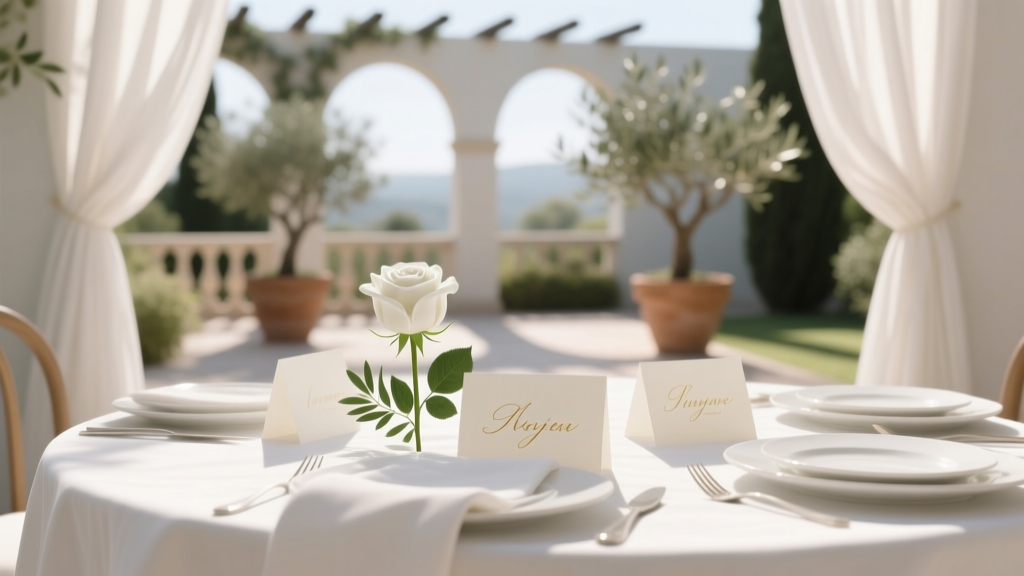
- Set cards above the dinner plate or on top of the folded napkin.
- For round tables, start at the seat closest to the table number marker and work clockwise.
- Double-check every seat has a card before guests arrive.
**For a seating chart board:**
- Mount it at eye level, well-lit, and visible from 10 feet away.
- List names as *Last, First* for fastest scanning.
- Include table numbers prominently next to each name.
---
## Step 4: Handle Last-Minute Changes Like a Pro
RSVP changes happen. Someone cancels the week before; a plus-one appears the day of. Build a buffer:
- **Print 10–15% extra blank cards** in your design. A fine-tip pen in your wedding emergency kit lets you handwrite additions on the spot.
- **Keep a "day-of changes" envelope** with your coordinator containing any reprinted cards for late swaps.
- **Designate one person** (not you, the couple) to manage the place card table during cocktail hour. This is a perfect job for a trusted bridesmaid or the venue's day-of coordinator.
---
## Common Myths About Wedding Place Cards
**Myth 1: "Place cards are only necessary for large weddings."**
Even at a 40-person dinner, assigned seating prevents the awkward scramble and ensures your carefully planned table dynamics — keeping feuding relatives apart, seating elderly guests near the exit — actually happen. Place cards signal intentionality and make every guest feel considered.
**Myth 2: "Guests will find their seats faster without place cards."**
Open seating sounds relaxed, but it reliably causes delays as guests negotiate, defer to each other, and cluster near the entrance. A well-organized escort card table or seating chart moves 150 guests to their seats in under 10 minutes. Unassigned seating at that scale can take 20–30 minutes and often leaves guests at awkward half-empty tables.
---
## Your Next Step
Setting up place cards for a wedding comes down to three things: choose the right format for your guest count, sort and label everything before you arrive, and assign one person to manage the display during the event.
**Start today:** Open a spreadsheet, list every confirmed guest alphabetically by last name, and assign table numbers. That single document is the foundation for every place card format — and it'll save you hours of stress on the wedding day.
 Is My Fair Wedding Still on TV in 2026?
 Sapphire Wedding Anniversary: How Many Years? (2026)
 Does David's Bridal Rent Wedding Dresses? (2026)
 Blake Lively Plantation Wedding Rumor — Fact Check (2026)
 Do You Need a Wedding Ceremony? (2026)
 Wedding Ring Without Marriage: When It’s Okay (2026)
 25th Wedding Anniversary Silver: Truth & Modern Ideas
 Delete Bed Bath & Beyond Wedding Registry (2026)
 Italian Wedding Soup Noodles: Acini di Pepe Explained
 Was Taylor Swift at Hailee Steinfeld’s Wedding? (2026)