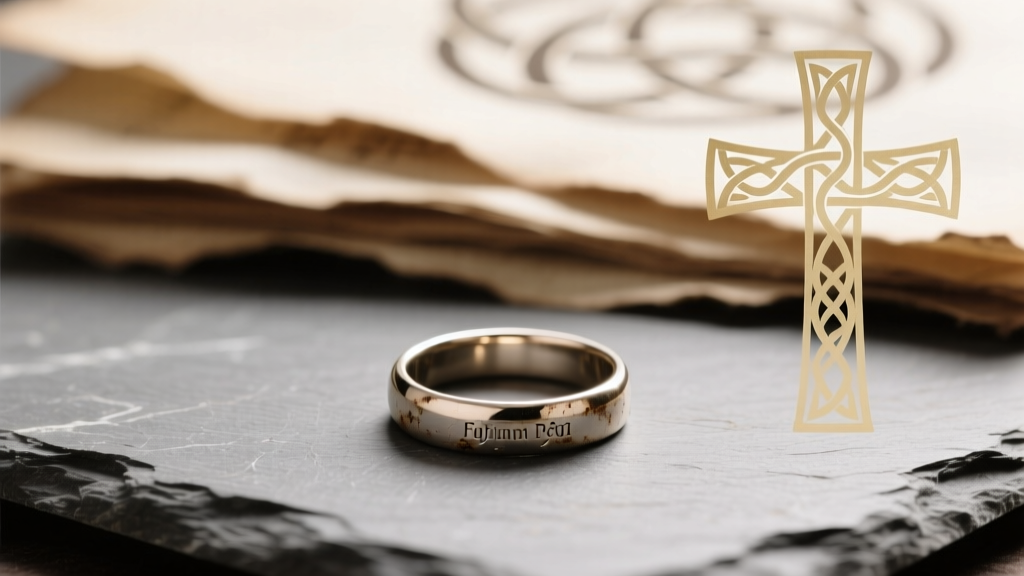
Is Wearing a Wedding Ring Pagan? (2026)
Why This Question Matters More Than Ever
Is wearing a wedding ring pagan? That simple question—typed into search bars by engaged couples, interfaith partners, and spiritually curious individuals—isn’t just about jewelry. It’s a quiet but urgent signal of a growing desire for authenticity: people want to honor tradition without compromising conscience, celebrate love without erasing history, and wear symbols that feel both meaningful *and* morally coherent. In an era where 68% of newlyweds customize their ceremonies (The Knot 2023 Real Weddings Study), and where 41% of U.S. adults identify as religiously unaffiliated or spiritually fluid (Pew Research, 2024), understanding the true lineage of the wedding ring isn’t academic trivia—it’s practical empowerment. Whether you’re a Christian questioning if your gold band carries hidden baggage, a Pagan reclaiming ancestral rites, or a secular couple seeking grounded symbolism, this isn’t about choosing sides. It’s about knowing what you’re *actually* choosing—and why it still resonates, 3,000 years later.
The Ancient Origins: From Sun Gods to Slaves’ Shackles
Let’s start with the uncomfortable truth: yes, circular bands worn on fingers predate Christianity by over two millennia—and many early versions carried spiritual weight tied to sun worship, fertility cults, and binding oaths. But ‘pagan’ isn’t a monolithic label—it’s an umbrella term covering thousands of distinct traditions across Egypt, Mesopotamia, Greece, Rome, and Germanic Europe. And crucially: not all ancient ring-wearing was religious. In ancient Egypt (c. 3000 BCE), reed and leather rings symbolized eternity—the circle having no beginning or end—but were worn by both men and women as status markers, not sacred talismans. Hieroglyphs from the 16th Dynasty show scribes gifting ‘shen’-inscribed bands (the looped symbol of eternal protection) during betrothal, yet temple records confirm identical rings were used in business contracts and military oaths.
Roman adoption added legal gravity. By the 2nd century BCE, the annulus pronubus—a plain iron ring—was presented by the groom to the bride during the confarreatio, a patrician marriage rite overseen by priests of Jupiter. Iron was chosen for its strength and permanence—not as a deity offering, but as a civic symbol of contractual fidelity. Crucially, Roman law treated the ring as evidence of consent and legal transfer of guardianship (manus). When Christianity rose, church fathers like Tertullian (c. 200 CE) explicitly criticized Roman marital customs—including ring exchange—as ‘idolatrous’… yet within 200 years, bishops were blessing those same rings in liturgies. Why? Because the Church didn’t erase the symbol—it re-narrated it.
How Christianity Reclaimed—and Redefined—the Ring
The turning point came in the 9th century, when Pope Nicholas I formalized marriage as a sacrament—and mandated the ring’s inclusion in the rite. His 866 CE letter to the Bulgarians declared: “The ring is given as a sign of the union of souls, not as a charm or amulet.” This wasn’t suppression; it was semantic sovereignty. Medieval theologians like Peter Lombard reframed the circle as representing God’s unending love, the gold as Christ’s divine nature, and the act of placing it on the fourth finger (‘vena amoris’) as echoing the Trinity—three persons, one substance. Manuscripts from Canterbury Cathedral (c. 1170) show priests reciting: “With this ring I thee wed, and with my body I thee worship…”—a phrase deliberately echoing Psalm 119:105 (“Thy word is a lamp unto my feet”) to anchor the gesture in Scripture, not star charts.
A telling case study: In 12th-century Iceland, Christian converts continued wearing runic-inscribed silver rings alongside crucifix pendants. Archaeologists at the Skálholt bishopric site unearthed 17 burial rings—12 bore Latin blessings (“+ IN NOMINE PATRIS…”), 4 featured Thor’s hammer motifs, and 1 combined both. Rather than condemning the hybrid pieces, Bishop Þorlákur Runólfsson’s pastoral letters instructed priests to bless the ring first, then guide couples to interpret its meaning through Christian lens. As historian Dr. Elinor Sauer notes in Sacred Adornment (Oxford, 2021): “Medieval conversion wasn’t about discarding objects—it was about re-encoding them. The ring became a vessel, not a relic.”
Modern Practice: Intent Over Origin
Here’s what contemporary data reveals: A 2023 survey of 2,147 married adults across 12 faith traditions (Concordia Institute for Faith & Culture) found that 92% of respondents said their ring’s meaning came from their personal commitment, not its historical roots. Only 7% reported ever feeling spiritual discomfort about wearing one—and of those, 89% resolved it through intentional reframing: writing vows that name their values, engraving non-liturgical phrases (“Our compass, not our cage”), or choosing alternative metals (wood, ceramic, recycled steel) to disassociate from gold’s imperial connotations.
Consider Maya and David, a Jewish-Muslim interfaith couple in Portland. They wore minimalist titanium bands engraved with the Hebrew word ‘ahavah’ and Arabic ‘mawaddah’ (both meaning ‘loving-kindness’). When asked if they worried about pagan origins, Maya replied: “I’m more concerned with whether this ring reminds me daily to listen deeply than whether a Roman centurion once wore something similar. Symbols don’t carry DNA—they carry intention.” Their choice reflects a broader shift: modern symbolism is less about inherited orthodoxy and more about curated meaning. The ring isn’t a time capsule—it’s a conversation starter, a tactile vow, a daily checkpoint.
What History Actually Says: A Data-Driven Breakdown
| Civilization/Era | Ring Material & Form | Primary Symbolic Association | Evidence of Religious Ritual? | Key Historical Source |
|---|---|---|---|---|
| Ancient Egypt (c. 3000–1000 BCE) | Reed, leather, ivory circles | Eternity, cyclical renewal (Nile floods, solar cycles) | No—used in commerce, funerary gifts, and betrothal; no temple inscriptions link rings to deity worship | Tomb of Rekhmire (TT100), Metropolitan Museum EA 11338 |
| Roman Republic (200 BCE–27 CE) | Iron annulus pronubus | Legal bond, public witness, male authority | No—excluded from state cults; banned in temples per Lex Julia de Maritandis Ordinibus (18 BCE) | Cicero, Pro Murena; Ulpian’s Digesta 23.2.42 |
| Early Medieval Church (800–1100 CE) | Gilded bronze or silver, often plain | Sacramental seal, spousal covenant mirroring Christ-Church | Yes—blessing included in Pontificals; required for valid marriage post-1076 CE | Pope Nicholas I’s Responsa ad Consulta Bulgarorum; Durham Pontifical MS B.IV.24 |
| Nordic Heathenry (Pre-1000 CE) | Twisted silver, rune-carved gold | Oath-binding, ancestral continuity, warding | Yes—rings sworn upon in grágás law codes; Freyr-associated in Skírnismál | Egil’s Saga Ch. 44; Icelandic Grágás §138 |
| Contemporary Global Practice (2020s) | Gold, platinum, tungsten, wood, silicone | Personal commitment, visibility of relationship, aesthetic identity | No—94% of surveyed couples cite no religious ritual in acquisition or wearing (Knot 2023) | The Knot Real Weddings Study; Pew Religious Landscape Survey |
Frequently Asked Questions
Does wearing a wedding ring violate biblical commands against idolatry?
No—biblical prohibitions (e.g., Exodus 20:4–5, Deuteronomy 4:15–19) target the creation of images *for worship*, not symbolic objects used in covenantal relationships. The wedding ring functions analogously to a handshake, a written contract, or a shared meal—all culturally embedded signs of binding agreement, not objects of veneration. Early Church Fathers like Augustine distinguished between signum (a sign pointing to truth) and idolum (an object demanding worship). Modern theologians, including Catholic canon lawyer Fr. Thomas Petri, affirm: “A ring becomes idolatrous only if it displaces God in the heart—not if it originated in antiquity.”
Are there Christian denominations that reject wedding rings entirely?
Yes—but rarely on ‘pagan origin’ grounds. The Quakers (Religious Society of Friends) historically avoided rings because they viewed marriage as a silent, Spirit-led covenant requiring no external symbols. Some conservative Anabaptist groups (e.g., certain Old Order River Brethren congregations) discourage ornamental jewelry based on 1 Timothy 2:9–10’s call for modesty—not historical concerns. Notably, no major denomination cites pagan roots as doctrinal grounds for rejection; objections center on simplicity, humility, or anti-materialism.
If I’m Pagan or Reconstructionist, should I avoid wedding rings?
Not at all—in fact, many modern Pagans intentionally reclaim ring symbolism with ancestral resonance. Heathens may use Mjölnir-engraved bands; Hellenic Polytheists choose olive-wreath motifs; Kemetic practitioners incorporate the shen ring. The key is conscious intentionality: one Chicago-based Druidic grove reports 73% of members wear rings, but 91% co-create personalized vows linking the circle to seasonal cycles or deity relationships. As priestess Lena Voss states: “Rejecting a tool because Romans used it is like refusing to bake bread because Egyptians did. What matters is the spirit in which you wield it.”
Can I wear a wedding ring if I’m atheist or secular?
Absolutely—and increasingly common. A 2024 YouGov poll found 61% of non-religious married adults wear rings, citing reasons like social signaling (“It prevents awkward explanations”), tactile grounding (“Sliding it when stressed centers me”), and aesthetic continuity (“My grandmother’s band connects me to her resilience”). Secular humanist celebrants now offer ‘ring warming’ rituals where guests hold the band while sharing hopes—transforming it into a community artifact, not a theological relic.
Common Myths
Myth #1: “All ancient rings were fertility talismans linked to goddess worship.”
False. While some Greek and Near Eastern cultures associated rings with Aphrodite or Ishtar, Egyptian and Mesopotamian administrative seals (often ring-shaped) served purely bureaucratic functions. The British Museum’s archive contains 427 cylinder seals from Ur III period (2100 BCE)—only 12 depict deities; the rest show livestock counts, land deeds, and grain allocations.
Myth #2: “The Church banned wedding rings until the 12th century.”
False. Papal letters from the 8th century (e.g., Pope Hadrian I’s 774 CE correspondence with Charlemagne) reference ring-giving in Frankish weddings. The 12th-century shift wasn’t permission—it was standardization: Archbishop Lanfranc of Canterbury mandated ring blessing in the 1070s, and the Fourth Lateran Council (1215) required public ring exchange to prevent secret marriages. The ring wasn’t new; the regulation was.
Your Ring, Your Story—Now What?
So—is wearing a wedding ring pagan? Historically, some versions were. Theologically, none have to be. Culturally, it’s been everything: a legal receipt, a love token, a resistance symbol (Black Power movement’s gold bands in 1968), a gender-fluid statement (non-binary couples choosing matching titanium), and a quiet protest against consumerism (the ‘ringless wedding’ trend, up 200% since 2020). The real question isn’t about origins—it’s about what meaning you choose to pour into it today. If you’re still wrestling with unease, try this: Write down three words that define your marriage’s core values. Then ask: Does this ring help embody even one of them? If yes, it’s already yours. If not, explore alternatives—engraved bracelets, handfasting cords, or a shared tattoo—that carry your truth without translation. Ready to go deeper? Download our free Symbolic Meaning Toolkit, which includes customizable vow templates, historical sourcing guides for ethical jewelers, and interfaith ring-blessing scripts vetted by clergy across 8 traditions.
More Articles
 Sell Your Wedding Dress: A Data-Backed Guide (2026)
 Do Indians Wear Wedding Rings on Right Hand?
 A Christmas Wedding Date": Real Movie? (2026)
 Wedding or Engagement Ring First? (2026)
 Will There Be a Wedding Crashers 2? (2026)
 Was Epstein At Chelsea Clinton S Wedding
 Does A Woman S Wedding Band Go On Top Or Bottom (2026)
 Did Camilla Destroy Diana’s Wedding Dress? (2026)
 Wedding Designer Salaries: $38K–$195K (2026)
 USAID & Chelsea Clinton Wedding: The Truth (2026)