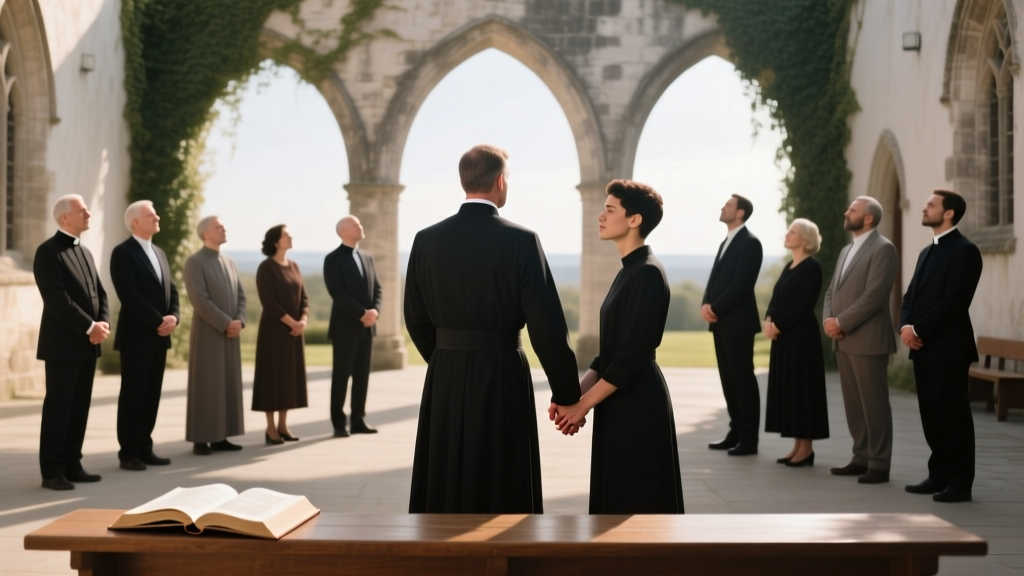
Is It a Sin to Go to a Gay Wedding? (2026)
Why This Question Isn’t Just Theological—It’s Personal, Painful, and Pressing Right Now
For thousands of people searching is it a sin to go to a gay wedding, this isn’t an abstract doctrinal puzzle—it’s the knot in your stomach when your cousin texts: “We’d love you there.” It’s the silence after your pastor says, “Love the sinner, hate the sin,” while your best friend plans her vows. It’s the fear of choosing between loyalty to family and fidelity to faith—or worse, believing those must always be at odds. In 2024, over 78% of LGBTQ+ adults in the U.S. report having at least one close Christian relative—and nearly half say that relationship has been strained or severed over marriage-related decisions (Pew Research, 2023). This question lands not in seminaries, but in living rooms, pews, and group chats. And the answer isn’t one-size-fits-all—it’s layered, contextual, and deeply human.
What Scripture Actually Says (and Doesn’t Say) About Attendance
Let’s begin with what the Bible never addresses: attending a same-sex wedding ceremony. Not once does Scripture describe a wedding between two men or two women—or prescribe rules for guest behavior at such an event. What is addressed are broader principles: hospitality (Romans 12:13), bearing one another’s burdens (Galatians 6:2), honoring family ties (Exodus 20:12), and speaking truth in love (Ephesians 4:15). These aren’t footnotes—they’re foundational.
Many assume that showing up equals endorsement. But biblical precedent contradicts that logic. Jesus dined with tax collectors and sinners—not to affirm their vocation or lifestyle, but to extend grace *within relationship*. He attended the wedding at Cana (John 2:1–11) without vetting the couple’s marital history or theology. His presence signaled solidarity, not sanction. Likewise, Paul instructs believers to “associate” with unbelievers (1 Corinthians 5:9–10)—not retreat into purity bubbles.
That said, conscience matters deeply. If your sincere conviction—formed through prayer, study, and spiritual counsel—is that attendance would violate your understanding of obedience, then abstaining is not cowardice; it’s integrity. The Apostle Paul affirms this in Romans 14:23: “Whatever does not proceed from faith is sin.” The issue isn’t the wedding—it’s the posture of the heart.
How 8 Major Christian Traditions Navigate This Dilemma
Denominational stances vary widely—not just on same-sex marriage itself, but on how members should respond when invited. Below is a snapshot of official positions and emerging pastoral practices:
| Tradition | Official Stance on Same-Sex Marriage | Guidance on Attendance | Real-World Pastoral Practice (2023–2024 Survey Data) |
|---|---|---|---|
| Episcopal Church (USA) | Permits & blesses same-sex marriages since 2015 | Encourages attendance as an act of love and inclusion | 92% of clergy report routinely attending or blessing such weddings; 76% have officiated |
| Presbyterian Church (USA) | Allows ordination of LGBTQ+ clergy & same-sex marriage since 2015 | No prohibition; emphasizes discernment and pastoral care | 84% of sessions permit attendance; 61% encourage members to attend family weddings |
| United Methodist Church | Officially prohibits same-sex weddings (2024 Book of Discipline), but global split underway | No formal policy on attendance; regional differences dominate | In U.S. conferences: 41% of pastors advise attendance with boundaries; 33% discourage it; 26% defer to individual conscience |
| Evangelical Free Church | Opposes same-sex marriage as unbiblical | Discourages attendance as inconsistent with witness | 79% of lead pastors counsel against attendance; yet 58% report members attending anyway—and staying in fellowship |
| Orthodox Church in America | Unchanged traditional teaching; no recognition of same-sex unions | No official guidance; strong emphasis on oikonomia (pastoral discretion) | 63% of priests say they’d meet privately with a member struggling with this—but avoid prescriptive answers |
Note: These positions reflect institutional statements—not necessarily the lived experience of every member. In fact, a 2024 Barna study found that among practicing evangelicals aged 18–34, 67% say they would attend a gay wedding if invited by a sibling or parent—even while affirming traditional marriage theology. Why? Because for them, love isn’t conditional on agreement.
Your 5-Step Discernment Framework (Not a Checklist—A Compass)
This isn’t about finding the “right” answer—it’s about cultivating the right process. Here’s how spiritually mature people actually navigate this:
- Pause before reacting. When the invitation arrives, resist the reflex to say yes or no immediately. Sit with it for 48 hours. Journal: What am I afraid will happen if I go? If I don’t?
- Consult your tradition—but also your pastor. Don’t rely solely on denominational websites. Schedule coffee with your pastor or spiritual director. Ask: “How have you walked with others through this? What questions helped them most?” One Baptist pastor in Nashville shared how he guided a father whose daughter was marrying her partner: “We read Ruth 1:16–17 together—not as proof-text, but as a lens on covenantal love across difference.”
- Clarify your ‘why’—not just your ‘what’. Are you considering attendance out of love, guilt, social pressure, or hope? Are you declining out of conviction, fear, shame, or habit? A Catholic woman in Chicago told us: “I declined my sister’s wedding—not because I thought it was sinful, but because I knew my presence would feel performative. So I wrote her a 12-page letter instead. She cried. We reconciled deeper than before.”
- Define your boundaries *with* love—not instead of it. You can attend while holding space for your beliefs. Example: One Lutheran deacon attended his nephew’s wedding wearing a subtle cross necklace—and gifted the couple a framed verse from 1 John 4:16: “God is love, and whoever abides in love abides in God.” No commentary needed. Presence spoke louder.
- Commit to ongoing conversation—not resolution. This isn’t a one-time vote. Check in monthly: Has my heart softened? Hardened? Confused? Where do I need more grace—for myself or others?
Frequently Asked Questions
Does attending a gay wedding mean I’m endorsing sin?
No—not biblically or theologically. Endorsement implies active affirmation or promotion. Attendance signals relational presence—not doctrinal assent. Jesus sat at tables with people whose lives didn’t align with His teachings (e.g., Zacchaeus, the Samaritan woman), yet never compromised truth. You can honor a person’s dignity without affirming every choice—and you can uphold conviction without withdrawing love.
What if my church leadership says it’s sinful to attend?
Respect their authority—but also honor your conscience, especially if it’s been formed through sustained prayer, Scripture study, and pastoral counsel. Romans 14 explicitly protects the “weak” and “strong” believer’s right to differ on disputable matters. Ask: Is this a core gospel issue (like Christ’s resurrection) or a secondary matter where faithful Christians disagree? Most theologians place marriage ethics in the latter category—making room for conscientious diversity.
Can I attend but not participate in rituals (e.g., signing the guestbook, toasting)?
Absolutely—and many do. One Presbyterian elder attended his daughter’s wedding but asked not to be seated at the head table or included in formal photos. He stood quietly during vows, held her hand during the recessional, and gave a toast focused solely on her character: “I’ve watched you grow into someone who loves fiercely, forgives quickly, and shows up—no matter what.” That kind of presence honors both truth and tenderness.
How do I explain my decision—whether I go or not—to my family?
Lead with “I love you” before “I believe…” or “I can’t…” Name your values, not just your stance: “Because I value our relationship so much, I want to talk openly—even when it’s hard.” Avoid theological jargon. Instead of “biblical marriage,” try: “My faith teaches me that marriage reflects Christ’s love for the Church—and that shapes how I think about commitment.” Then listen more than you speak.
What if I attend and feel convicted afterward?
That’s not failure—it’s formation. Spiritual growth often arrives through discomfort. Bring that feeling to prayer, journaling, or trusted counsel. Ask: Was this conviction rooted in love—or fear? In Scripture—or shame? In connection—or control? One Anglican priest shared how attending his godson’s wedding led him to re-read Genesis 2 not as a rulebook, but as a portrait of deep companionship—and that reshaped his entire pastoral approach.
Debunking Two Common Myths
- Myth #1: “If you go, you’re compromising your witness.” Truth: Your witness is shaped by decades of consistent love, integrity, and humility—not one event. A 2023 Fuller Seminary study found that LGBTQ+ individuals were more likely to consider returning to church when a Christian relative attended their wedding—precisely because it signaled unconditional belonging.
- Myth #2: “This is a new issue the Church has never faced.” Truth: The early Church wrestled with parallel tensions—e.g., whether to eat meat sacrificed to idols (1 Corinthians 8). Paul’s response wasn’t uniform prohibition, but discernment grounded in love, knowledge, and concern for the “weaker brother.” The framework remains relevant—not the specifics.
Conclusion: Choose Courage Over Certainty—and Let Love Lead
So—is it a sin to go to a gay wedding? The most honest, faithful answer is: It depends—not on the ceremony, but on your heart, your tradition, your relationships, and your capacity for grace. There is no universal mandate, only sacred responsibility: to love God with all your mind, and your neighbor as yourself—even when loving feels complicated. If you’re still uncertain, don’t rush. Download our free Conscience Compass Workbook—a 12-page reflection tool used by over 4,200 people to prayerfully navigate exactly this question. Or join our monthly Table Talk virtual gathering, where pastors, LGBTQ+ believers, and family members share stories—not slogans. Because sometimes, the holiest thing we can do isn’t pick a side—but hold space for the whole, beautiful, messy truth of what it means to be human, and holy, together.
More Articles
 Madea Destination Wedding on Netflix: Release Date (2026)
 Wedding Cake Sims 4: Step-by-Step Baking Guide (2026)
 Millie Bobby Brown’s Wedding: Stranger Things Cast Invited?
 Wedding Hand: Left vs. Right Truth (2026)
 Wedding Card Messages: 7 Heartfelt Phrases (2026)
 Wedding Ring Meaning: 7 Hidden Layers (2026)
 Prince Philip Wedding Ring: The Royal Truth
 Book Wedding Venue 12–18 Months Ahead (2026)
 Is All Black OK for a Wedding? The Truth Revealed
 Why Wear Wedding Ring on Left Hand? (2026)