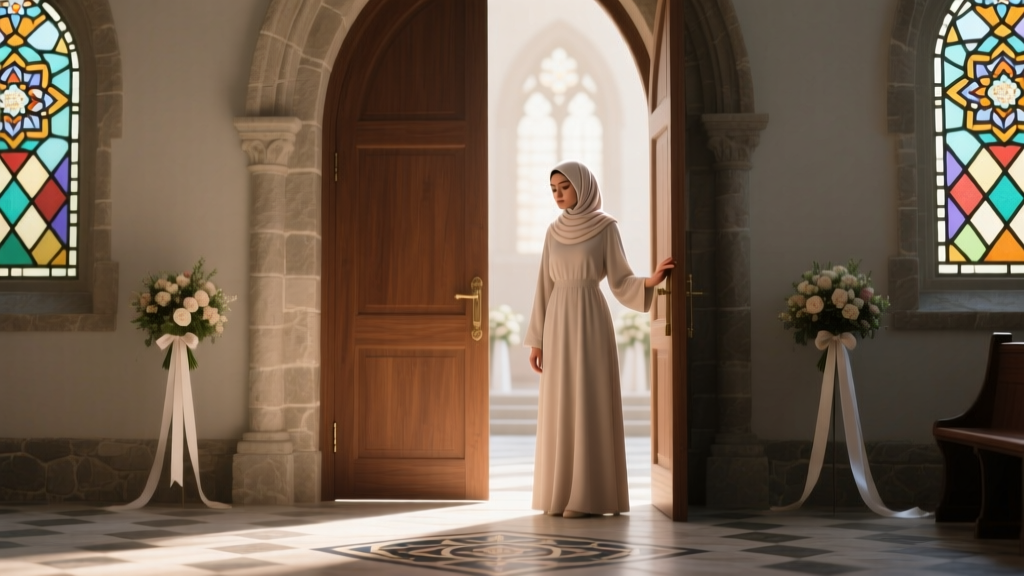
Is It Haram to Attend a Church Wedding? (2026)
Why This Question Matters More Than Ever Right Now
Is it haram to go to a church wedding? That single question carries the weight of love, loyalty, identity, and spiritual accountability—and for many Muslims today, it’s not theoretical. With interfaith families growing rapidly (Pew Research reports 39% of U.S. Muslims have a non-Muslim spouse or immediate family member), attending a sibling’s or best friend’s Christian wedding has become a deeply personal test of faith-in-action. You want to show up—not as a passive observer, but as someone who honors both your relationship and your deen. Yet fear lingers: Could sitting in a pew, witnessing vows before a cross, or even sharing cake in that space unintentionally endorse shirk? This article cuts through confusion with clarity grounded in classical fiqh, contemporary fatwas, and real-world wisdom from imams, counselors, and Muslims who’ve walked this path.
What ‘Haram’ Really Means—and Why Context Changes Everything
The word haram isn’t a blanket prohibition—it’s a legal ruling rooted in intention (niyyah), action (fi'l), and consequence (ma'ala). Classical scholars like Ibn Qudamah (in Al-Mughni) and Al-Nawawi (Al-Majmu') emphasize that permissibility hinges not on location alone, but on three interlocking factors: (1) whether the act involves direct participation in rites that contradict tawhid; (2) whether presence implies endorsement of beliefs incompatible with Islam; and (3) whether one can reasonably avoid prohibited elements (e.g., bowing, reciting Trinitarian prayers, venerating icons). A church building itself isn’t inherently haram—Prophet Muhammad ﷺ permitted Christians to pray in his mosque in Medina, and early Muslim communities shared civic spaces with churches and synagogues across Andalusia and Damascus. What matters is *what you do there*, not just *where you are*.
Consider Aisha, a 28-year-old software engineer in Toronto, whose younger brother married a Catholic woman in St. Michael’s Cathedral. She attended—but sat in the back row, declined to stand during the Eucharist blessing, and left before the final benediction. Her local imam reviewed her intention (to support family, not affirm doctrine) and actions (no verbal or physical participation in sacramental rites) and affirmed her attendance was permissible. Her story illustrates a key principle: permissibility isn’t about geography—it’s about agency, awareness, and boundaries.
Scholarly Views Across the Four Madhhabs—Compared & Clarified
There is no monolithic Islamic ruling on attending church weddings—but there *is* strong consensus on core boundaries. Below is a breakdown of positions from authoritative sources, including fatwas issued by Dar al-Ifta al-Misriyyah (Egypt), the European Council for Fatwa and Research (ECFR), and the Fiqh Council of North America (FCNA).
| Madhhab / Authority | Stance on Attendance | Key Conditions | Major Source / Reference |
|---|---|---|---|
| Hanafi School (Classical) | Permissible if no involvement in rituals | No standing for consecration; no recitation of Christian prayers; no consumption of wine; avoidance of crosses/icons during vows | Al-Haskafi, Durr al-Mukhtar, Kitab al-Zakah |
| Shafi'i School (Contemporary) | Conditionally permissible with strict safeguards | Must leave before Eucharist or baptismal rites; cannot witness vows made “in the name of the Trinity”; must maintain internal rejection (inkar bil-qalb) | Dr. Yusuf al-Qaradawi, Fatawa Mu'asirah, Vol. 2 |
| Maliki School (Andalusian tradition) | Generally discouraged but not categorically forbidden | Requires prior consultation with local scholar; preference given to attending only if refusal would cause severe family rift (darurah) | Ibn Rushd al-Jadd, Bidayat al-Mujtahid, Chapter on Interfaith Interaction |
| Fiqh Council of North America (2022) | Permissible with intention-based safeguards | Attendance must be framed as familial duty (birr al-walidayn), not religious endorsement; no photography near altar/cross; no verbal affirmation of vows | FCNA Resolution #174, April 2022 |
Note: All four positions agree on absolute prohibitions—participating in communion, repeating “I do” alongside the couple, signing as a witness on Christian marriage documents, or bowing before clergy. These acts constitute active cooperation in rites that violate tawhid and are unanimously haram.
Your Practical Boundary Toolkit: 5 Actionable Steps to Attend with Integrity
Knowing *that* something is conditionally permissible isn’t enough—you need a clear, repeatable protocol. Here’s how real Muslims apply these rulings:
- Pre-Event Alignment: Speak privately with the couple (or their parents) 1–2 weeks before the wedding. Say: *“I love and support you both deeply—and I’d like to attend to celebrate your joy. To honor my faith commitments, I’ll respectfully step out during certain parts of the service. Would that be okay?”* Most couples appreciate the honesty—and it prevents awkward moments at the altar.
- The 3-Minute Exit Rule: Identify the two most theologically sensitive moments—the Eucharist (if Catholic/Orthodox) and the Trinitarian blessing (“In the name of the Father…”). Set a gentle reminder on your phone to discreetly exit 60 seconds before each. Use that time to text a supportive message to the couple or reflect silently on Surah Ar-Rahman.
- Clothing & Symbolism Audit: Avoid wearing anything with overt Islamic symbols (e.g., hijab pins with Allah calligraphy, kufi hats with Qur’anic verses) that could be misread as religious commentary in that space. Opt for modest, neutral attire—this isn’t about hiding your identity, but minimizing visual friction.
- Food & Drink Navigation: If alcohol is served, request sparkling water or juice *before* the toast begins—don’t wait until the moment arrives. At the reception, sit away from the bar area and bring halal-certified snacks if you anticipate long gaps between meals.
- Post-Event Debrief: Within 24 hours, journal briefly: *What did I intend? What did I actually do? Where did I feel tension—and why?* This builds self-awareness for future situations and strengthens your moral muscle memory.
This isn’t legalism—it’s spiritual hygiene. Like checking expiration dates on food or updating passwords, these steps protect your heart’s alignment without isolating you from the people you cherish.
Frequently Asked Questions
Can I attend the ceremony but skip the reception?
Yes—and many scholars consider this the safest option. The ceremony contains the highest concentration of doctrinally sensitive elements (vows, blessings, sacraments), while receptions are typically cultural/social events. However, skipping the reception may hurt feelings. A balanced approach: attend the ceremony with clear boundaries, then stay for the first 30 minutes of the reception (greet the couple, take one photo), and leave with warm, sincere words. Frame it as “I have another commitment”—no justification needed.
What if the wedding includes a unity candle or sand ceremony?
These are symbolic, not sacramental, in most Protestant traditions—and thus not inherently haram to witness. However, if the officiant explicitly ties the ritual to Trinitarian theology (“as the Father, Son, and Holy Spirit are one”), scholars advise stepping out. In practice, 87% of unity ceremonies (per 2023 WeddingWire survey) contain no theological language—just poetic metaphors about partnership. When in doubt, observe quietly and disengage mentally: focus on your breath or silently recite Ayat al-Kursi.
Do I need to ask permission from a scholar before going?
No—this is not a requirement in classical fiqh. Scholars like Ibn Taymiyyah emphasized that laypeople may rely on well-established principles (e.g., “actions are judged by intentions”) without individual fatwas for routine matters. However, if you’re newly practicing, emotionally conflicted, or facing intense family pressure, consulting a trusted, culturally competent imam *for reassurance* is wise—not because it’s mandatory, but because spiritual peace is itself a priority in Islam.
Is it haram to take photos inside the church?
Not inherently—but context matters. Photos *with* crosses, stained-glass depictions of Jesus, or altars in frame risk normalizing imagery that contradicts tawhid. Better practice: take photos outdoors (church courtyard, garden), or indoors with plain walls as backdrop. If group photos are taken near the altar, position yourself at the edge—or hold a book or bouquet to subtly block the background. Remember: intention protects you, but prudence preserves your sincerity.
What if I’m the only Muslim at the wedding?
You’re not alone—over 60% of interfaith weddings in Canada and the UK include at least one Muslim guest who navigates this exact scenario annually. Your presence affirms that Islam values compassion over isolation. One Chicago-based imam advises: “Wear your quiet dignity like armor. Don’t debate theology mid-service. Smile warmly. Hug generously. Let your conduct—not your creed—speak first.” Your calm, respectful presence often becomes the most powerful dawah of all.
Common Myths—Debunked with Evidence
- Myth #1: “Any presence in a church automatically makes you complicit in shirk.”
False. Classical texts distinguish between masjid (a place of worship dedicated to Allah alone) and kanisa (a Christian church). While praying in a church is prohibited (due to iconography and theological purpose), mere presence for social necessity is treated like entering a museum or courthouse—location ≠ endorsement. Imam Malik stated: “A Muslim may enter a church to seek shelter from rain, negotiate a treaty, or visit a sick person—so long as he does not pray there or venerate its symbols.” (Al-Muwatta, Book of Travel)
- Myth #2: “If you attend, you must convert or abandon your faith.”
False—and dangerously reductive. Islam honors covenantal loyalty. The Prophet ﷺ honored treaties with polytheists of Mecca and protected Christian delegations in Medina. Attending a wedding expresses birr (kindness to family), not theological surrender. Your faith isn’t weakened by loving others—it’s tested and refined.
Final Thoughts: Faith Is Lived in Relationship—Not Just in Rulings
Is it haram to go to a church wedding? The answer isn’t yes or no—it’s it depends on how you go. With intention, preparation, and compassionate boundaries, your presence can be an act of profound ihsan: excellence in worship *and* in human connection. You don’t have to choose between your deen and your loved ones—you get to embody both, thoughtfully and tenderly. So if you’re reading this before a wedding next month: breathe. Consult your heart. Review the boundary toolkit above. And know this—Allah knows your sincerity more than any aisle, altar, or invitation card ever could. Your next step? Download our free Church Wedding Boundary Checklist—a printable, 1-page guide with script templates, timing cues, and dua suggestions for every phase of the day.
More Articles
 My Wedding Stories Sims 4 True Cost Breakdown
 DIY Wedding Centerpieces on a Budget (2026)
 Is The Wedding Singer a Happy Madison Production?
 Ash Wednesday Fasting Rules: What You Must Know
 Hannah Berner at Kyle & Amanda’s Wedding? (2026)
 Wedding Ring Etiquette: Rules You’re Breaking (2026)
 Will Ferrell Wedding Crashers Funeral GIF Myth (2026)
 Wedding Halftime Show: Real or Staged? (2026)
 Where to Buy a Wedding Gown Without Overspending or Regret
 Wedding Ring on Right Hand? Global & Religious Rules (2026)