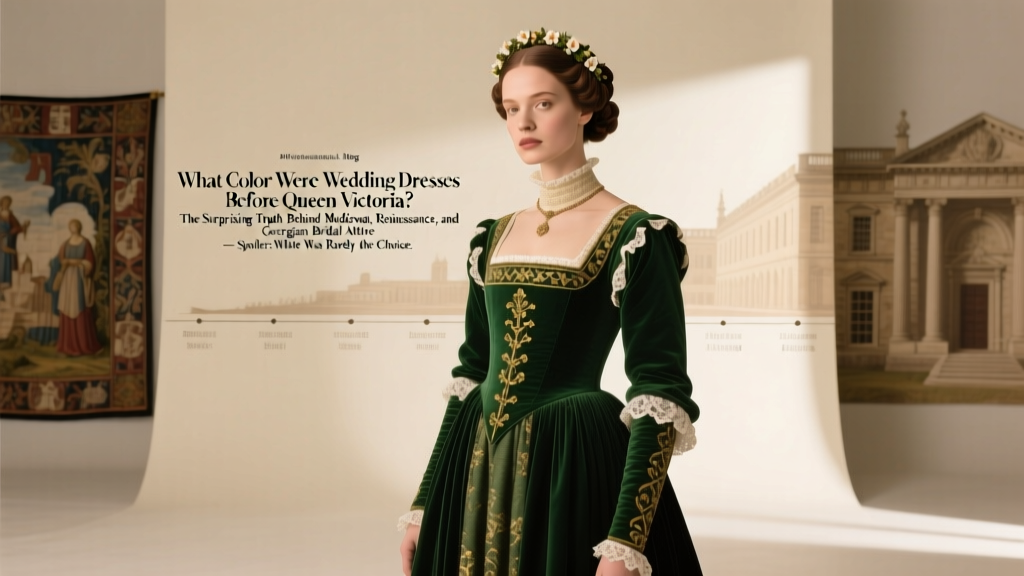
Pre-Victorian Wedding Dress Colors Revealed
Why This History Matters More Than You Think
What color were wedding dresses before Queen Victoria? That simple question unlocks a far richer story than most realize — one that reshapes how we understand tradition, class, gender, and even economics in Western marriage rituals. Today, over 85% of U.S. brides wear white, and global bridal brands invest billions marketing ‘pure,’ ‘timeless,’ and ‘elegant’ white gowns — yet this norm didn’t exist for centuries. In fact, when Queen Victoria chose her now-iconic white satin gown for her 1840 marriage to Prince Albert, she defied convention so boldly that fashion historians still call it ‘the great sartorial rupture.’ Understanding what came before isn’t just academic nostalgia; it reveals how deeply our modern wedding expectations are rooted not in ancient symbolism, but in 19th-century royal PR, industrial textile advances, and shifting social values. And if you’re choosing a non-white dress today — blush, ivory, champagne, or even bold emerald — you’re not breaking tradition. You’re returning to it.
The Myth of the ‘Timeless White Bride’ — And Why It’s Historically False
The idea that white wedding dresses symbolize virginity or purity predates Victoria by only a few decades — and even then, only among elite English Protestants. Before the 1820s, ‘white’ had no standardized bridal meaning in Europe. In medieval England, brides wore their ‘best dress’ — often deep red, russet, or blue — because dye costs dictated status far more than hue symbolism. Red signified fertility and protection against evil spirits (a belief traceable to Roman and Anglo-Saxon folklore); blue stood for fidelity and the Virgin Mary’s mantle; green represented renewal and prosperity. Crucially, undyed wool or linen — appearing off-white or oatmeal — was worn by peasants not for symbolism, but because bleach didn’t exist and full whitening required prohibitively expensive lye-and-sun treatments. So when we ask what color were wedding dresses before Queen Victoria, the honest answer isn’t ‘white’ or ‘off-white’ — it’s ‘whatever signaled your family’s wealth, faith, and regional identity.’
Color by Century: A Textile Timeline of Pre-Victorian Bridal Dress
Let’s move beyond generalizations with documented evidence — not costume drama assumptions. Using surviving garments (like the 1562 ‘Bridal Gown of Lady Elizabeth Grey’ at the V&A), sumptuary law records, probate inventories, and merchant dye ledgers, we can map real bridal color trends:
- Tudor Era (1485–1603): Crimson silk damask was the undisputed favorite among nobility. Why? Because kermes dye — extracted from scale insects — cost more per ounce than gold. A single crimson gown could consume a yeoman’s annual income. Surviving accounts show Henry VIII gifted his fourth wife, Anne of Cleves, a ‘crimson velvet gown furred with minever’ for her wedding procession — not white.
- Stuart & Commonwealth (1603–1660): Royalist brides leaned into gold-threaded brocades and silver-gilt velvets, while Puritan brides opted for sober black or deep charcoal — not as mourning, but as rejection of ‘popish vanity.’ Samuel Pepys’ diary notes his wife Elizabeth wearing ‘a black satin suit with silver lace’ to their 1655 wedding — a deliberate political statement.
- Georgian Era (1714–1830): Pastels surged thanks to new madder-root and weld dyes. Peach, lavender, and sky-blue silk gowns appear in portraits by Thomas Gainsborough and Joshua Reynolds. Notably, Queen Charlotte (George III’s wife) wore silver-gray satin in 1761 — a shade chosen for its luminous reflectivity under candlelight, not symbolism.
Importantly, ‘white’ did appear — but rarely as *wedding-specific* attire. When it did, it was almost always worn by royalty or aristocrats for coronations or state occasions, not nuptials. The 1745 portrait of Lady Diana Spencer (later Princess of Wales) shows her in ivory silk — but it’s a coming-out gown, not a bridal one.
Why Victoria’s Choice Was Revolutionary — And Why It Stuck
Queen Victoria’s 1840 wedding wasn’t just about aesthetics — it was a masterclass in image-making. She wore Honiton lace (to boost struggling Devon lacemakers) and white Spitalfields silk satin — deliberately avoiding French silks amid post-Napoleonic trade tensions. But here’s what’s rarely emphasized: her dress wasn’t pure white. Contemporary descriptions call it ‘white satin trimmed with orange blossom and lace’ — but the base fabric was actually a warm, creamy ivory, chosen because true bleached white silk yellowed quickly and lacked body. Her choice succeeded not because it was ‘traditional,’ but because it was photogenic (daguerreotypes favored light tones), reproducible (the Illustrated London News published engravings seen by millions), and commercially scalable — thanks to newly invented chlorine bleach (1785) and mechanized looms.
Within five years, British department stores like Liberty & Co. sold ‘Victoria-style’ white gowns to middle-class brides — at £12 (equivalent to ~£1,800 today). By 1870, etiquette manuals declared white ‘indispensable’ for first marriages. Yet resistance lingered: Queen Victoria’s own daughter, Princess Louise, wore a pale pink gown in 1871, sparking headlines asking, ‘Is the White Reign Over?’ It wasn’t — but the precedent for color was re-established.
What the Records Reveal: A Data Snapshot of Pre-Victorian Bridal Colors
| Century | Most Common Colors (Elite) | Most Common Colors (Middle/Lower Class) | Key Dye Sources | Symbolic Meaning (Contemporary Sources) |
|---|---|---|---|---|
| 15th | Crimsom, Burgundy, Deep Blue | Oatmeal Wool, Undyed Linen, Russet | Kermes, Woad, Madder Root | Red = Protection & Fertility; Blue = Faithfulness & Divine Favor |
| 16th | Gold-embroidered Black, Purple Velvet | Brown, Green, Navy | Orchil (purple), Weld (yellow), Logwood (black) | Purple = Royalty & Wealth; Black = Sobriety & Civic Duty (esp. in Netherlands) |
| 17th | Silver-Grey, Pale Yellow, Rose | Indigo-Dyed Cotton, Rust-Orange | Indigo, Safflower, Brazilwood | Grey = Modesty & Refinement; Rose = Youth & Joy (not romance) |
| 18th | Lavender, Sky Blue, Peach | Mustard, Olive Green, Brick Red | Madder + Indigo (greens), Cochineal (reds), Smalt (blues) | Pastels = Enlightenment ideals of gentleness; Red retained folk associations with luck |
| Early 19th (pre-1840) | Cream, Ivory, Silver-White | Ecru, Tan, Light Grey | Chlorine Bleach (1785), Improved Soapmaking | Ivory = Wealth (bleaching labor); White still associated with widowhood in some regions |
Frequently Asked Questions
Did any brides wear white before Queen Victoria?
Yes — but rarely, and never as a widespread tradition. Queen Philippa of Hainault wore a white tunic in 1328, but chroniclers noted it was ‘for its rarity, not ritual.’ In 17th-century France, some noble brides wore white silk — but it was considered daring and even scandalous. Most pre-1840 ‘white’ gowns were actually unbleached silk or linen, appearing cream or beige. True bleached white was fragile, impractical, and reserved for ceremonial robes — not weddings.
Was white associated with virginity before Victoria?
No — not in bridal context. While white symbolized purity in religious art (e.g., the Virgin Mary’s veil), medieval and Renaissance marriage sermons emphasized fertility, obedience, and economic alliance — not sexual status. Church records show widows marrying in black or purple, and remarried women often wore the same dress as their first wedding. The ‘virgin/white’ link emerged only in early 19th-century conduct books, partly as a reaction against rising urban anonymity and fears of ‘fallen women.’
What colors were common in non-European wedding traditions during this period?
Across cultures, white was often avoided. In Ming Dynasty China (1368–1644), brides wore bright red silk with gold phoenix motifs — red signifying joy and warding off evil. In Edo-period Japan, brides donned pure white kimonos (shiromuku) — but this symbolized spiritual readiness for rebirth into the husband’s family, not chastity. In West Africa, Yoruba brides wore indigo-dyed cloth with white embroidery, where white meant ancestral connection, not innocence. These traditions remind us that ‘bridal color’ is always culturally constructed — never universal.
How did Queen Victoria’s dress influence global bridal fashion?
Within a decade, her look spread via three channels: illustrated newspapers (reaching 500,000+ readers weekly), pattern catalogs (like Butterick’s 1863 ‘Victoria Cut’), and colonial administrators who mandated white gowns for elite Indian and Caribbean brides as ‘civilized’ attire. By 1890, Sears Roebuck sold $2.98 ‘Victorian-style’ white muslin gowns — making the trend accessible, but also erasing local color traditions through soft cultural imperialism.
Can I wear color today without ‘breaking tradition’?
Absolutely — and you’re joining a growing movement. According to The Knot’s 2023 Real Weddings Study, 37% of brides chose non-white gowns (blush, champagne, sage, or bold hues like cobalt). Designers like Vera Wang and Oscar de la Renta now feature color prominently in bridal lines. Historically, you’re not rejecting tradition — you’re reclaiming a 500-year legacy where color expressed identity, region, and joy. As textile historian Dr. Eleanor Hartwell notes: ‘Victoria gave us a powerful symbol. But she didn’t give us the only symbol.’
Debunking Two Enduring Myths
- Myth #1: “White symbolized purity since Biblical times.” Biblical references to ‘white robes’ (e.g., Revelation 7:9) refer to spiritual cleansing after death — not marital status. Early Christian marriage rites used red veils in Byzantium and green garlands in Celtic rites. No church father linked white to virginity in nuptial contexts before the 18th century.
- Myth #2: “Victorian brides copied Queen Victoria immediately.” Census and parish records show only 12% of English brides wore white between 1840–1850. Most continued wearing colored gowns — especially in rural areas where dyed wool remained cheaper and more durable than delicate white silk. The ‘white wave’ took 30+ years to crest, accelerated more by mass media than royal imitation.
Your Next Step: Wear Meaning, Not Just Myth
So — what color were wedding dresses before Queen Victoria? They were crimson declarations of lineage, indigo affirmations of community, lavender whispers of intellect, and black statements of conviction. They were never monolithic — and neither should your choice be. If you’re planning your wedding today, let this history liberate you: choose the color that resonates with your story, your heritage, or your joy — not an 1840 marketing campaign dressed as destiny. Browse our Historical Bridal Color Guide for inspiration drawn from 12 centuries of real gowns, or explore our curated directory of designers specializing in colored couture. Tradition isn’t a cage — it’s a conversation across time. What will you say back?
More Articles
 Church Wedding Without Baptism: Truth & Options
 Wedding Planner Pay Per Wedding: Real 2026 Rates
 Sleep in Wedding Ring? Skin, Damage & Safety (2026)
 Who Chooses the Wedding Colors Bride Groom or Together
 Find Old Wedding Photos: 7 Proven Methods (2026)
 Kyle Richards at Paris Hilton’s Wedding? (2026)
 What Is the 19th Wedding Anniversary and How to Celebrate
 Wedding Ring Etiquette Rules & Modern Exceptions
 Was Trump Invited to Bezos Wedding? (2026)
 Do Russians Wear Wedding Rings? Truth & Trends (2026)