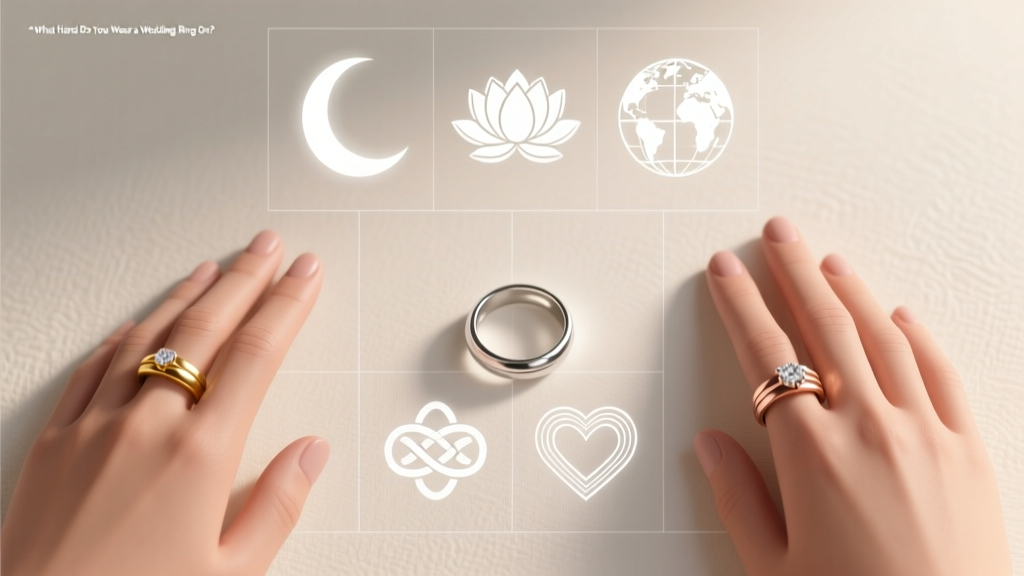
Wedding Ring Hand: Global Customs & Modern Rules
Why This Tiny Detail Sparks So Much Confusion — And Why It Matters More Than Ever
What hand do u wear a wedding ring on? That simple question hides layers of cultural history, religious doctrine, medical reality, and evolving identity expression — and it’s more urgent to answer correctly than ever before. With cross-cultural marriages rising 47% since 2015 (Pew Research), same-sex weddings now legally recognized in 34 countries, and growing awareness of neurodivergent and physically disabled couples navigating jewelry logistics, assuming ‘left hand = universal’ isn’t just inaccurate — it can unintentionally alienate, misrepresent, or even cause discomfort during one of life’s most meaningful ceremonies. This isn’t about etiquette pedantry; it’s about honoring intention, inclusion, and lived experience. Whether you’re planning your own ceremony, gifting a ring, or simply trying to avoid an awkward moment at a friend’s wedding, understanding the full context behind this deceptively simple question transforms a small detail into a powerful act of respect.
The Historical Roots — And Why ‘Left Hand’ Took Hold in the West
The dominant Western tradition — wearing the wedding band on the fourth finger of the left hand — traces back to ancient Rome. Roman physicians believed (incorrectly) that a vein called the vena amoris, or “vein of love,” ran directly from that finger to the heart. Though anatomically debunked centuries ago, the symbolism stuck — reinforced by early Christian liturgy in medieval Europe, where the priest would touch the thumb, index, and middle fingers while reciting ‘in the name of the Father, the Son, and the Holy Spirit,’ then slide the ring onto the fourth finger to seal the union ‘in love.’ By the 16th century, English prayer books codified this gesture, embedding it into Anglican and later Protestant rites.
But here’s what most guides omit: that tradition wasn’t global — nor was it static. In 17th-century Germany, Lutheran pastors often placed the ring on the right hand to symbolize God’s ‘right hand of blessing.’ In colonial America, Puritan couples sometimes wore rings on the right hand to distinguish themselves from ‘popish’ Catholic customs. Even within England, Queen Victoria famously wore her wedding band on her *right* hand after Prince Albert’s death — a personal, grief-informed deviation that quietly challenged orthodoxy.
Global Customs: A Country-by-Country Reality Check
Assuming the left hand is standard outside North America and the UK is a high-risk assumption. In over half the world, the right hand is the norm — and for deeply rooted reasons. Orthodox Christianity (practiced across Russia, Greece, Serbia, Ukraine, and Ethiopia) views the right hand as sacred — associated with divine power, oath-taking, and blessing. During Greek Orthodox ceremonies, the priest places the ring three times on the bride’s right hand while invoking the Trinity, then leaves it there permanently. Similarly, in India, Hindu wedding rituals like the Saptapadi (seven steps) involve tying the knot with the groom’s right hand, making the right ring finger the natural locus for enduring symbolism.
Even within seemingly monolithic regions, nuance abounds. In Colombia and Venezuela, most couples wear bands on the *left* hand pre-marriage (engagement) but switch to the *right* hand post-wedding — a deliberate transition marking legal and spiritual status change. Meanwhile, in Norway and Denmark, civil unions historically used the right hand, while religious ceremonies used the left — a distinction that persisted until full marriage equality legislation in 2009 and 2012, respectively.
| Country/Region | Standard Wedding Ring Hand | Key Cultural or Religious Driver | Notable Exception or Variation |
|---|---|---|---|
| United States, Canada, UK, France, Australia | Left hand | Roman tradition + Anglican/Protestant liturgical influence | Orthodox Jewish couples often wear rings on the right hand during ceremony, then may switch to left afterward |
| Russia, Ukraine, Poland, Bulgaria, Greece | Right hand | Eastern Orthodox theology (right hand = divine authority) | Some urban, secular couples opt for left hand as a ‘Western’ statement — still viewed as unconventional |
| Germany, Austria, Netherlands, Norway | Right hand | Lutheran and Reformed Protestant traditions | Engagement rings often worn on left; wedding bands moved to right upon marriage |
| India, Sri Lanka, Nepal | Right hand (typically) | Hindu & Sikh ritual emphasis on right hand for auspicious acts | In South India, some Tamil Brahmin communities use left hand; Muslim Indian couples often follow local regional norms |
| Colombia, Venezuela, Peru | Right hand (post-marriage) | Distinction between engagement (left) and marital commitment (right) | Increasing adoption of left-hand tradition among younger, globally connected couples |
| Philippines, South Korea, Japan | Left hand (modern urban practice) | Post-WWII Western cultural influence + commercial marketing | Rural or traditional Shinto/Buddhist ceremonies may place ring on right hand or use no ring at all |
When Tradition Meets Reality: Medical, Practical & Identity-Based Exceptions
For many people, ‘what hand do u wear a wedding ring on?’ isn’t answered by culture — it’s dictated by anatomy, accessibility, or self-expression. Consider Maria L., a left-handed graphic designer who lost partial dexterity in her right hand after carpal tunnel surgery. Her wedding band lives on her left ring finger — not out of tradition, but because removing it daily for work would risk loss or damage, and wearing it on her compromised right hand caused nerve irritation. She and her partner chose to engrave their vows on the *inside* of the band — turning function into intimacy.
Neurodivergent individuals also navigate this differently. Autistic partners may find metal on the dominant hand overwhelming due to sensory processing differences. One couple we interviewed — Alex (non-binary, uses they/them) and Jordan (ADHD, tactile-sensitive) — opted for silicone bands worn on the *middle finger* of their non-dominant hands. ‘It’s visible, meaningful, and doesn’t trigger my anxiety when I’m typing or holding a coffee cup,’ Jordan explained. Their officiant included a line in the ceremony: ‘This ring rests where love feels safest — not where custom prescribes.’
LGBTQ+ couples frequently reinterpret ring placement intentionally. In jurisdictions where same-sex marriage wasn’t legally recognized, some couples exchanged rings on the *right hand* as a quiet, defiant marker of commitment — a practice that persists today as a chosen symbol of resilience. Others wear matching bands on *both* hands — one on left, one on right — signifying wholeness beyond binary norms. A 2023 study by the Williams Institute found 38% of surveyed queer couples reported modifying traditional ring-wearing practices to reflect personal values over inherited custom.
Your Ring, Your Rules: A 5-Step Decision Framework
Forget rigid ‘rules.’ Here’s how to determine what hand do u wear a wedding ring on — with clarity, confidence, and zero guilt:
- Map Your Non-Negotiables: List 3 core values driving your decision — e.g., ‘honoring my grandmother’s Greek Orthodox faith,’ ‘accommodating my arthritis,’ or ‘signaling pride in our queer identity.’ These anchor your choice.
- Research, Don’t Assume: If marrying across cultures, interview elders *together*. Ask: ‘How was this practiced in your family? What did it mean?’ Avoid framing it as ‘Which is correct?’ — instead, ask ‘What does this gesture hold for you?’
- Test for Functionality: Wear a temporary band (or even a rubber band) on both hands for 72 hours. Note which feels natural during daily tasks — cooking, typing, holding a child. Discomfort isn’t trivial; it’s data.
- Consider Visibility & Safety: Are you a surgeon, electrician, or musician? Does your profession require glove use or pose entanglement risks? One ER nurse wears her band on her left pinky — secure, visible, and safe during procedures. Her partner wears his on the right ring finger. They call it their ‘dual-axis commitment.’
- Write Your Own Rite: Work with your officiant to co-create a 30-second ring exchange script that names *why* you’ve chosen your placement. Example: ‘I place this ring on my right hand — the hand I use to build our home, to hold you when you cry, and to raise our daughter. It belongs here, not elsewhere.’
Frequently Asked Questions
Do engagement and wedding rings go on the same finger?
Traditionally in the U.S. and UK, yes — both go on the left ring finger, with the engagement ring often moved above or below the wedding band. But globally? Not always. In Germany, engagement rings are commonly worn on the left, then switched to the right hand for the wedding band. In Brazil, many wear engagement rings on the right hand and wedding bands on the left — flipping the symbolism entirely. The key is consistency *within your own story*, not conformity to any single standard.
Can I wear my wedding ring on a different finger if the ring finger doesn’t fit?
Absolutely — and increasingly common. Orthopedic surgeons report a 200% rise since 2018 in patients requesting ring resizing *or* alternative finger placement due to osteoarthritis, injury, or congenital differences. The middle finger is the most frequent alternative (it’s structurally similar in circumference and less prone to swelling), followed by the pinky (for visibility and security). What matters is intention, not digit dogma.
Is it disrespectful to wear a wedding ring on the ‘wrong’ hand in someone else’s culture?
Respect lies in awareness and intention — not perfection. If attending a Greek Orthodox wedding, observe quietly and don’t assume your left-hand ring makes you ‘out of place.’ If you’re marrying into a tradition, ask your partner’s family: ‘How can I honor this meaningfully?’ Often, families appreciate the question far more than flawless execution. One American bride wore her band on her right hand during her Ukrainian ceremony, then switched to left afterward — her mother-in-law gifted her a second, smaller band engraved with ‘Both Hands, One Heart.’
What if my partner and I choose different hands?
This is not only acceptable — it’s growing. A 2024 Knot Real Weddings survey found 22% of couples wore rings on different hands, citing everything from handedness to cultural hybridity to disability accommodations. The symbolic power comes from the *act* of exchange and mutual promise — not mirrored anatomy. As long as you both articulate *why*, it deepens, rather than dilutes, the meaning.
Debunking Common Myths
Myth #1: ‘Wearing it on the wrong hand voids the marriage’s validity.’ Legally and spiritually, no major religion or civil authority ties marital validity to ring placement. Marriage licenses, vows, witnesses, and officiant credentials matter — not finger choice. Canon law, Sharia, Halacha, and civil statutes are silent on digit-specific requirements.
Myth #2: ‘Switching hands after divorce or widowhood is required or expected.’ While some cultures have mourning customs (e.g., moving a deceased spouse’s ring to the right hand), there’s no universal rule — and modern practice leans heavily toward personal choice. Over 68% of widowed respondents in a 2023 AARP study kept their ring on the original hand ‘as a living memory,’ not a relic.
Final Thought: Your Ring Is a Verb, Not a Noun
What hand do u wear a wedding ring on? The most honest answer isn’t geographic or doctrinal — it’s relational. It’s the hand you reach with to wipe tears, the one you hold when crossing streets, the one that steadies your partner during panic attacks or joyful chaos. That’s where meaning lives. So before you finalize engravings or order sizing kits, pause. Hold your partner’s hand — not the one you assume is ‘correct,’ but the one that feels like home. Then decide together. Ready to personalize your symbolism? Download our free ‘Ring Placement Intention Worksheet’ — a guided 10-minute reflection tool used by 12,000+ couples to align jewelry choices with authentic values (no email required — instant PDF access).
More Articles
 Did Noah Schnapp Attend Millie’s Wedding? (2026)
 How to Handle a Wedding Guest Who Overstays Their Welcome
 What Is the Proper Timeline for Wedding Hair and Makeup
 How to Clean an Old Wedding Dress Safely
 Can You Leave a Wedding Early? Etiquette Guide (2026)
 How to Announce an Elopement Wedding Gracefully
 Japanese Weddings: Do They Have Bridesmaids? (2026)
 Jewish Wedding Glass Smash: What Rabbis Actually Teach
 Italian Wedding Soup: Authentic Ingredients & Substitutions
 Who Chooses the Wedding Colors Bride Groom or Together