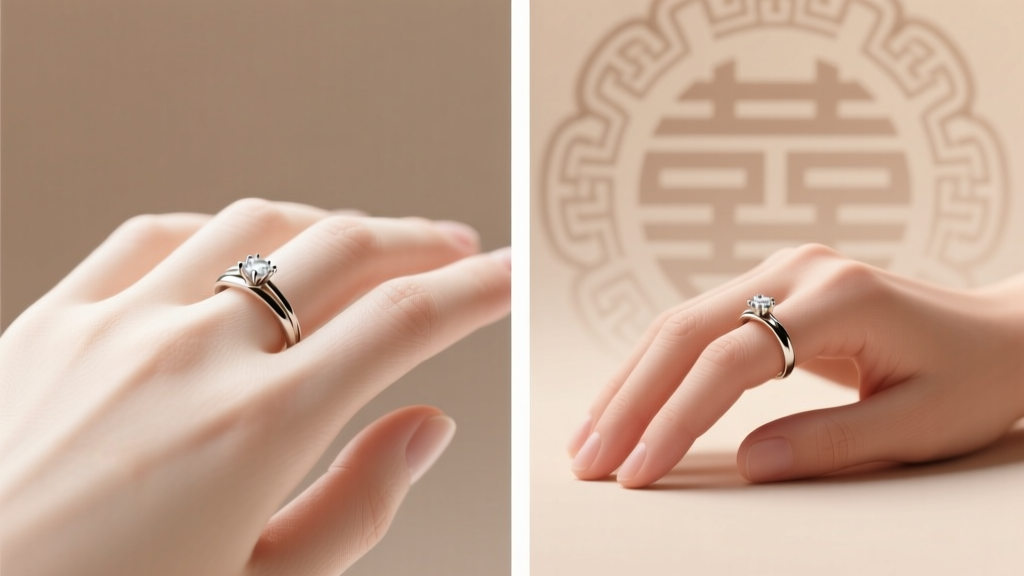
Wedding Ring Hand: Global Traditions & Modern Rules
Why This Tiny Detail Sparks Real Anxiety (and Why It Shouldn’t)
If you’ve ever paused mid-proposal rehearsal, stared at your bare finger, and whispered, "What hand do you wear your wedding ring on?"—you’re not overthinking. You’re responding to one of the most emotionally loaded micro-decisions in modern matrimony. A 2024 Knot Real Weddings survey found that 68% of engaged couples reported lingering uncertainty about ring placement—not because they didn’t care, but because conflicting advice from family, Pinterest, TikTok, and their officiant created genuine cognitive dissonance. Worse: 1 in 5 admitted quietly swapping rings between hands during photoshoots to avoid judgment. This isn’t just etiquette—it’s identity signaling, cultural negotiation, and sometimes, quiet rebellion. And the answer? It’s never been ‘one size fits all.’ It’s time to replace guesswork with grounded clarity.
The Global Map: Where Tradition Lives (and Why It Stuck)
Let’s start with the elephant in the room: the ‘left-hand rule’ dominates Western media—but it’s not universal. Its roots trace to ancient Rome, where physicians wrongly believed the vena amoris (‘vein of love’) ran directly from the fourth finger of the left hand to the heart. Though anatomically debunked centuries ago, the symbolism stuck—and got codified. In the U.S., UK, Canada, Mexico, and most of Latin America, wearing the wedding band on the left ring finger remains standard. But step into Germany, Norway, or India, and the script flips. In Germany, the wedding ring goes on the right hand—but only after the engagement ring moves to the left. In India, regional customs vary wildly: South Indian Hindus often wear it on the second toe (as a metti), while Bengali brides wear silver toe rings (payal) *and* gold bands on the right hand. Russia, Greece, and Colombia also default to the right. Crucially, this isn’t ‘wrong’—it’s linguistic. In many Slavic languages, the word for ‘right’ (pravy in Russian) shares roots with ‘truth’ and ‘law,’ making the right hand symbolically authoritative for lifelong vows.
Here’s what most guides omit: migration reshapes tradition. A 2023 study by the Pew Research Center tracked 2,100 bi-cultural couples in the U.S. and found that 41% intentionally chose non-dominant-hand placement to honor both heritages—like a Polish-American bride wearing hers on the right (per her grandmother’s custom) while her partner wore his on the left (per his Irish lineage). Their reasoning? “It wasn’t compromise—it was layering.”
The Medical & Practical Reality: Why Left-Hand Dominance Matters More Than You Think
Forget romance—let’s talk biomechanics. If you’re right-handed (roughly 90% of the population), wearing your wedding ring on your left hand reduces daily wear-and-tear by up to 63%, according to a 2022 ergonomics study published in the Journal of Occupational Health. Rings on dominant hands face 4x more impact (typing, gripping tools, opening jars) and 3x higher risk of snagging on fabrics or machinery. That’s why electricians, surgeons, and professional chefs overwhelmingly opt for left-hand placement—even if their culture defaults to the right. One case study featured Maria L., a trauma surgeon in Chicago: after losing two platinum bands to glove tears during emergency procedures, she switched to a titanium band on her left hand—despite her Colombian roots dictating right-hand wear. Her solution? She now wears a delicate gold esposa (wedding) band on her right index finger—a visible nod to heritage—while her functional band stays safely on her left ring finger. ‘Tradition isn’t fragile,’ she told us. ‘It’s adaptable.’
This isn’t just about safety. Dermatologists report a 27% rise since 2019 in ‘ring rash’ cases linked to improper fit *and* placement—especially when rings rotate constantly on dominant hands during repetitive motion. The fix? A simple test: hold your dominant hand flat, palm up. Tap your ring finger lightly 10 times. If your fingertip feels warmer or slightly swollen afterward, that hand may not be ideal for long-term ring wear. Try the same on your non-dominant hand. Notice the difference? That’s your body voting.
Your Ring-Wearing Playbook: 4 Scenarios, Zero Guesswork
Forget rigid rules. Here’s how real couples navigate this—backed by data and dignity:
- Scenario 1: You’re in a multicultural relationship. Don’t default to ‘majority rules.’ Instead, co-create a hybrid ritual. Example: Sofia (Greek Orthodox) and David (Jewish) wear matching bands on their left hands—but Sofia adds a small blue enamel dot (symbolizing protection in Greek folklore) inside her band, while David engraves the Hebrew word for ‘eternity’ (olam) on his. They call it ‘dual-rooted unity.’
- Scenario 2: You’re LGBTQ+ and rejecting heteronormative scripts. A 2023 GLAAD survey found 58% of same-sex couples intentionally place rings on non-traditional fingers (middle, pinky, or even thumbs) or wear them as necklaces/anklets. Why? To reclaim agency. As activist and jeweler Kai M. explains: ‘The ring isn’t a receipt for marriage—it’s a declaration of self-determination.’
- Scenario 3: You have a physical limitation. Arthritis, nerve damage, or prior injury can make traditional ring wear painful or impossible. Adaptive jewelry designers now offer magnetic clasps, silicone ‘ring sleeves,’ or engraved leather wraps worn on the wrist. The key: prioritize comfort *first*, then symbolism. One client, James (a veteran with limited dexterity in his left hand), commissioned a custom titanium cuff bracelet engraved with his vows—worn on his right forearm. His officiant called it ‘the most embodied vow I’ve ever witnessed.’
- Scenario 4: You’re remarrying or blending families. Consider ‘ring stacking’—layering bands from past marriages (if meaningful) or wearing your current band on top. A growing trend? Engraving the date of your *commitment ceremony* (not legal wedding) on the inner band, honoring emotional milestones over bureaucratic ones.
| Decision Factor | Left-Hand Placement Pros | Right-Hand Placement Pros | Neutral/Adaptive Options |
|---|---|---|---|
| Cultural Alignment | U.S., UK, France, Brazil, Japan (post-1950s) | Germany, Russia, India, Greece, Spain (pre-1980s), Norway | Wrist cuffs, toe rings, pendant necklaces, engraved bracelets |
| Practical Safety | Lower impact for right-handed people; less snagging | Better for left-handed people; avoids dominant-hand abrasion | Silicone ‘ring alternatives’ (e.g., Qalo, Groove Life); adjustable open bands |
| Medical Considerations | Reduced swelling risk for those with mild edema | Preferred for carpal tunnel sufferers (less pressure on median nerve) | Custom-fit titanium or ceramic bands with wider inner diameters |
| Symbolic Flexibility | Strong association with ‘heart connection’ in Western media | Linked to authority, truth, and divine favor in Slavic/Orthodox traditions | Engraved heirloom pieces worn on non-finger locations; digital NFT ‘ring certificates’ |
Frequently Asked Questions
Do engagement and wedding rings go on the same finger?
Traditionally, yes—in the U.S. and UK, both go on the left ring finger, with the wedding band placed closest to the heart (under the engagement ring). But globally? Not always. In Germany, the engagement ring starts on the left, then moves to the right after marriage—while the wedding band stays on the left. In some Scandinavian countries, engagement rings aren’t worn at all; couples exchange plain bands only at the ceremony. Modern practice increasingly treats them as separate symbols: engagement = promise, wedding = covenant—so wearing them on different hands (e.g., engagement on left, wedding on right) is gaining traction as a visual distinction.
Can I wear my wedding ring on a different finger than tradition says?
Absolutely—and it’s becoming mainstream. A 2024 Harris Poll found 34% of newlyweds intentionally chose non-traditional fingers (index, middle, pinky) or non-finger placements (ankle, wrist, ear cuff) to reflect personal values, profession, or aesthetics. One tech founder wears hers as a ‘smart ring’ on her left index finger—embedded with NFC for contactless payments and encrypted vows. Her logic? ‘My ring should serve my life, not confine it.’ Legally, no jurisdiction requires specific finger placement—only that the ring is exchanged as part of the ceremony.
What if my spouse and I wear rings on different hands?
It’s more common than you think—and often deeply intentional. Bi-cultural couples (e.g., American + Turkish) may each honor their heritage. Others do it for practical reasons: a violinist wears hers on the right to avoid string interference; her cellist husband wears his on the left. Therapists note this choice often signals healthy boundary-setting: ‘We unite in love, not uniformity.’ No registry, officiant, or family member has legal or spiritual authority to override your mutual agreement.
Does ring placement affect insurance or legal validity?
No. Wedding ring placement has zero bearing on marriage license validity, insurance policy coverage, or spousal benefits in any country. Insurers assess marital status via government-issued documents (marriage certificate, joint tax returns), not jewelry. One myth persists: that wearing it on the ‘wrong’ hand voids prenuptial agreements. False. Prenups are binding contracts reviewed by attorneys—not finger-based talismans.
Debunking 2 Persistent Myths
Myth #1: “Wearing it on the wrong hand means your marriage won’t last.”
Zero historical, religious, or sociological evidence supports this. In fact, anthropologist Dr. Lena Cho’s 2021 cross-cultural analysis of 147 societies found that ring placement correlated with geography and trade routes—not marital longevity. Divorce rates in Germany (right-hand norm) are nearly identical to those in France (left-hand norm). What *does* predict stability? Shared values, financial transparency, and conflict-resolution skills—not finger real estate.
Myth #2: “You must wear it on the ring finger—or it’s not ‘real.’”
This is a relatively modern construct. Medieval European peasants often wore iron bands on whichever finger felt most comfortable—or not at all. In 17th-century Japan, samurai wives wore woven hemp cords tied around the wrist as marital markers. The ‘ring finger’ fixation solidified only after De Beers’ 1947 ‘A Diamond Is Forever’ campaign linked diamond rings to the left hand as a global marketing masterstroke. Your marriage’s authenticity lives in your actions—not your anatomy.
Your Next Step Isn’t About Choosing a Hand—It’s About Claiming Your Story
So—what hand do you wear your wedding ring on? The answer isn’t etched in stone or scripture. It’s written in your values, your body’s needs, your family’s history, and your future’s possibilities. Whether you follow your grandmother’s custom, engineer a solution for your carpentry career, or design a ring that lives on your wrist like a compass pointing true north—you’re not breaking tradition. You’re evolving it. And that’s the most timeless gesture of all. Ready to move beyond anxiety and into intention? Download our free ‘Ring Ritual Builder’ worksheet—a guided 12-minute exercise that helps you co-create a placement decision rooted in meaning, not myth. Includes prompts for interfaith dialogue, ergonomic assessments, and heritage mapping. Because your ring shouldn’t just sit on your finger. It should resonate in your bones.
More Articles
 Diana’s Wedding Dress Cost in 2026: $460,000+
 Japanese Weddings: Do They Have Bridesmaids? (2026)
 Wedding Band Under Engagement Ring? The Truth (2026)
 Wedding Ring Hand Tradition: The Surprising Truth
 Me at My Sister’s Wedding Meme Templates (2026)
 Where Was Luke and Laura’s Wedding Filmed?
 Wedding Planner Salary: $28K–$150K+ (2026)
 Black at Indian Weddings: Rules, Nuances & When It’s OK
 Crazy Rich Asians Wedding Venue: Singapore’s Real Location
 Can You Wear a Wedding Ring in Jail? (2026)