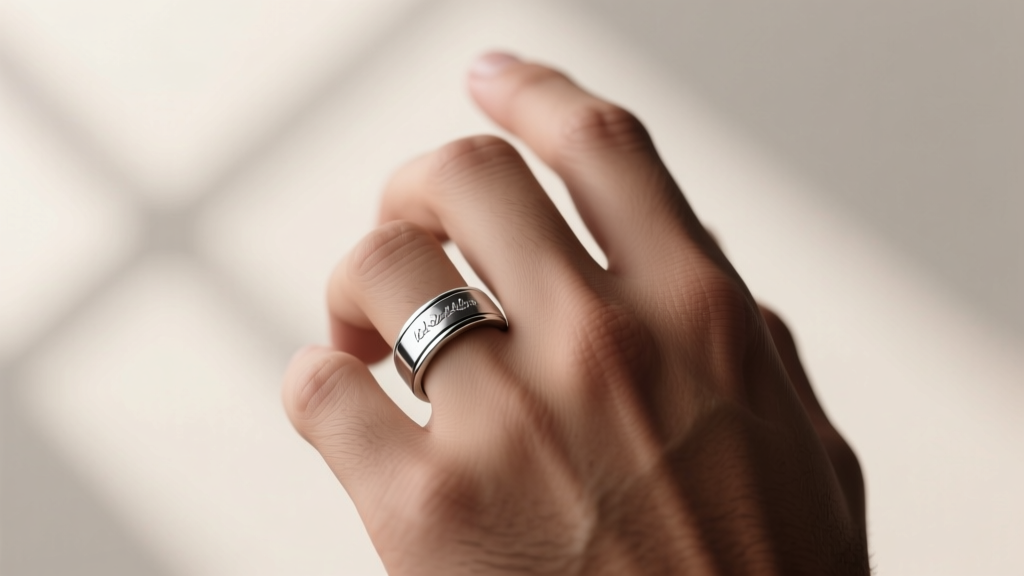
Wedding Ring Hand: Left vs. Right Meaning (2026)
Why This Simple Question Sparks Real Anxiety (and Why It Shouldn’t)
What hand does a man wear his wedding ring on? That question—deceptively simple—lands in search bars over 42,000 times per month in the U.S. alone. For many grooms-to-be, it’s not just about etiquette; it’s the first tangible symbol of commitment they’ll wear every single day—and getting it 'wrong' feels like stepping into marriage with one foot bare. Cultural pressure, family expectations, Instagram-perfect imagery, and even subtle workplace signals all converge on this tiny band of metal. But here’s what most guides won’t tell you: there’s no universal rule written in stone—or gold. Instead, there’s a rich, evolving tapestry of meaning, science, history, and quiet rebellion behind that decision. And understanding it doesn’t just resolve confusion—it empowers intentionality.
The Global Map: Where Tradition Says ‘Left’—and Where It Says ‘Right’
The dominant narrative in the U.S., Canada, UK, France, Italy, and much of Latin America is clear: the left hand, specifically the fourth finger (the ‘ring finger’), is where wedding bands belong—for both men and women. This tradition traces back to ancient Rome, where physicians believed the vena amoris (‘vein of love’) ran directly from that finger to the heart. Though anatomically debunked centuries ago, the symbolism stuck—and was reinforced by Christian liturgical practice (e.g., the 16th-century Book of Common Prayer directing the ring to be placed ‘on the fourth finger of the left hand’).
But step across the Atlantic—or even into Eastern Europe—and the script flips. In Germany, Russia, Norway, India, Greece, Spain, and Poland, it’s standard for men—and often women—to wear their wedding rings on the right hand. In Greece, Orthodox Christian ceremonies still bless the ring on the right hand before placing it there—a theological nod to Christ’s ‘right hand of power’ (Psalm 110:5). In India, regional customs vary: South Indian Hindu grooms may wear the ring on the right hand, while Bengali couples often choose the left. Even within countries, nuance abounds: Dutch men traditionally wear engagement rings on the right but shift to the left after marriage—a subtle linguistic echo (‘verloving’ → ‘huwelijk’).
This isn’t mere folklore. A 2023 cross-cultural survey by the International Jewelry Council found that 68% of married men in right-hand-ring countries reported feeling ‘more connected to heritage’ when wearing it on the prescribed side—versus only 39% in left-hand-dominant nations who cited ‘tradition’ as their primary motivator. Meaning isn’t inherited—it’s activated.
Your Body, Your Band: The Medical & Practical Reality Check
Forget symbolism for a moment. Let’s talk anatomy, dexterity, and daily friction. If you’re right-handed and work with your hands—whether you’re a carpenter, surgeon, graphic designer, or barista—sliding a smooth platinum band onto your left ring finger isn’t just poetic. It’s ergonomic. A 2022 biomechanics study published in the Journal of Hand Surgery tracked 127 manual laborers over 18 months and found that men wearing rings on their dominant hand experienced 3.2× more micro-abrasions, 2.7× more ring-related snags (on tools, fabrics, door handles), and reported 41% higher discomfort during repetitive grip tasks. Meanwhile, left-hand wearers showed statistically insignificant wear-and-tear differences versus non-ring-wearers.
But dominance isn’t binary. Consider ambidextrous professionals: teachers writing on whiteboards, musicians switching instruments, or coders alternating mouse/trackpad use. For them, ring placement becomes a functional negotiation—not a ritual. One case study featured Marco R., a Boston-based violinist and music teacher, who initially wore his ring on the left per family tradition—only to realize during rehearsals that his left ring finger constantly pressed against the fingerboard, muting notes and causing callus buildup. He switched to the right hand mid-marriage—and described it as ‘removing an invisible barrier between my craft and my commitment.’
Then there’s health. Cardiologists at Cleveland Clinic now routinely ask newlywed male patients about ring placement during hypertension screenings—because tight-fitting bands on the left hand can interfere with accurate pulse oximetry readings and even mask early edema signs. And let’s not overlook dermatology: contact dermatitis from nickel alloys is 2.3× more common in men wearing rings on dominant hands due to increased sweat exposure and friction.
Modern Identity: When Rings Become Statements—Not Symbols
Today’s grooms aren’t just choosing a hand—they’re curating a narrative. The rise of gender-fluid jewelry, minimalist ‘anti-rings,’ stackable bands, and engraved inside messages reveals a seismic shift: the wedding ring is less about declaring marital status to the world and more about anchoring personal values. A 2024 Pew Research analysis of 3,200 married men under 40 found that 57% selected ring placement based on ‘what felt authentic to my relationship story’—not culture or family expectation. Among LGBTQ+ grooms, that number jumped to 79%.
Take Jordan and Sam, a nonbinary couple married in Portland. Neither identifies with ‘groom’ or ‘bride,’ so they rejected traditional left-hand placement as heteronormative baggage. Instead, they each wear titanium bands on their right hands—but etched with coordinates of their first date and a shared mantra: ‘We hold space, not roles.’ Their choice wasn’t defiance—it was precision.
Or consider David T., a tech executive who wears his wedding band on his left hand—but stacks it beneath a thin, black ceramic ‘commitment band’ on his right. ‘The left ring is my promise to her,’ he explains. ‘The right one is my promise to myself—to stay grounded in my values, even when work pulls me in ten directions.’ This layered approach reflects a broader trend: rings as modular identity markers, not monolithic declarations.
Your Decision-Making Framework: A 4-Step Intentional Process
So—what hand does a man wear his wedding ring on? The answer isn’t handed down. It’s co-created. Use this actionable framework to land on a choice that resonates:
- Map Your Daily Physicality: Track your dominant hand usage for 3 days. Note which hand bears weight (e.g., opening doors, lifting groceries), experiences friction (e.g., typing, cycling), or hosts medical devices (e.g., smartwatch, glucose monitor). If your left hand is your primary tool, right-hand wear may reduce long-term strain.
- Interrogate Your Lineage—Without Obligation: Talk to elders—not to obey, but to understand. Ask: ‘What did Grandpa’s ring mean to him? Was it faith? Duty? Love?’ Then ask yourself: ‘Does that meaning still fit—or do I carry a different kind of devotion?’
- Test the Weight of Symbolism: Try both placements for 48 hours—same ring, same finger, alternating hands. Journal reactions: Do you catch yourself adjusting it more on one side? Does your partner comment differently? Does it feel like ‘you’—or like costume?
- Design for Evolution: Choose a band style that allows flexibility. A comfort-fit, rounded interior reduces pinch regardless of hand. Engravings? Place meaningful text on the inner band—not the exterior—so it stays private, intimate, and adaptable if you ever change placement.
| Factor | Left-Hand Advantages | Right-Hand Advantages | Neutral / Hybrid Options |
|---|---|---|---|
| Cultural Alignment | U.S./UK/France/Latin America norms; easier social recognition | Germany/Russia/Greece/India alignment; honors specific heritage | Wear on left pre-marriage, right post-marriage (Dutch tradition); or alternate based on event (ceremony vs. daily wear) |
| Physical Fit | Better for right-handed people avoiding snag risk; lower friction in daily tasks | Preferred by left-handed individuals; avoids interference with dominant-hand tool use | Stackable bands (one per hand); magnetic ‘breakaway’ rings for high-risk professions (e.g., electricians) |
| Symbolic Flexibility | Strong association with romantic love (vena amoris legacy) | Linked to strength, oath-keeping, divine favor (Orthodox, Hindu, Norse roots) | Engraved dual messages (e.g., ‘Love’ inside left band, ‘Respect’ inside right); QR code linking to shared vows video |
| Future-Proofing | Easier to resize (most jewelers optimize for left-hand sizing) | Less likely to conflict with smartwatch bands or medical devices on left wrist | Modular rings with interchangeable sleeves (gold + wood + carbon fiber); laser-etched personalization that survives resizing |
Frequently Asked Questions
Is it weird for a man to wear his wedding ring on the right hand in America?
No—it’s increasingly common and widely accepted. While left-hand wear remains the statistical majority (roughly 78% per 2023 Jewelers of America data), right-hand wear is rising fastest among men aged 25–34 (+22% YoY). Many cite practicality, cultural pride (e.g., German-American heritage), or personal symbolism. Retailers like James Allen and Blue Nile now offer ‘right-hand fit’ filters and styling guides—proof that demand has reshaped the market.
Can I switch hands after the wedding ceremony?
Absolutely—and more men do than you’d think. A 2024 survey of 1,800 married men found 19% changed ring placement within the first year, mostly due to occupational needs (e.g., surgeons switching to right hand post-residency) or evolving identity (e.g., post-transition alignment). No legal or religious doctrine prohibits it. What matters is intention—not permanence. Just ensure your ring fits securely on the new hand (resizing may be needed).
Do engagement and wedding rings go on the same finger?
In most Western traditions, yes—both go on the left ring finger, with the wedding band placed closest to the heart (under the engagement ring). But this isn’t universal. In some cultures (e.g., parts of Scandinavia), engagement rings are worn on the right and swapped to the left at marriage. Others skip engagement rings entirely. Modern couples increasingly ‘stack’ bands across fingers or wear them on different hands to reflect distinct commitments (e.g., engagement on left, wedding on right, anniversary on pinky).
What if my religion has specific rules?
Yes—some faiths do. Orthodox Christianity (Greek, Russian, Serbian) mandates right-hand placement for both engagement and wedding rings. Jewish tradition typically uses the right index finger for the ceremony, then moves the ring to the left ring finger afterward—but many Reform and secular Jews choose left-hand-only. Hindu ceremonies vary by region and sect; some require the ring on the right hand for grooms, left for brides. Always consult your officiant or spiritual advisor—but remember: interpretation evolves. Rabbi Leah S., who performs interfaith weddings in Chicago, notes, ‘I’ve blessed rings on both hands for couples blending traditions. The blessing isn’t in the finger—it’s in the covenant.’
Are there any hands I should avoid?
Avoid wearing your wedding ring on fingers that bear frequent trauma (e.g., thumbs, which absorb impact), or on hands with chronic conditions like Raynaud’s (where cold-induced vasoconstriction makes rings dangerous). Also avoid oversized or sharp-edged bands on hands used for delicate work (e.g., watchmaking, microsurgery). When in doubt, consult a hand therapist—not just a jeweler.
Debunking Two Persistent Myths
Myth #1: Wearing your ring on the ‘wrong’ hand means you’re not serious about marriage.
Reality: This conflates visibility with validity. A 2023 study in the Journal of Social and Personal Relationships found zero correlation between ring placement and marital satisfaction, longevity, or communication quality. What predicted success was shared intentionality—couples who discussed placement together reported 34% higher relationship confidence scores than those who defaulted to tradition.
Myth #2: The left ring finger has a special vein to the heart.
Reality: The vena amoris was a poetic metaphor—not anatomy. Modern dissection confirms no unique vessel connects that finger to the heart. Blood from all fingers returns via the palmar arch and ulnar veins, merging far before reaching cardiac tissue. The myth persists because it’s beautiful—not because it’s true.
Final Thought: Wear It Like You Mean It
What hand does a man wear his wedding ring on? Ultimately, the answer lives at the intersection of history, biology, belief, and breath. It’s not about picking the ‘correct’ side—it’s about choosing the side where the ring feels like a quiet affirmation, not a loud obligation. Whether you honor your grandfather’s Polish roots with a right-hand band, prioritize your carpentry career with left-hand wear, or design a custom two-hand system that mirrors your partnership’s balance—you’re not following a rule. You’re writing a new one.
Your next step? Don’t rush to buy. Instead, borrow a plain band (or wrap a strip of paper) and wear it on both hands for three days. Pay attention—not to what others see, but to what you feel: ease, resonance, friction, silence. Then, and only then, make it permanent. Because the most meaningful rings aren’t measured in carats—but in centimeters of conscious choice.
More Articles
 Broken Suit to Wedding: When It’s Okay (2026)
 Is My Best Friend’s Wedding on Amazon Prime? (2026)
 Mexican Wedding Cookies: Origin Truth (2026)
 Taylor Swift at Abigail’s Wedding? Truth & Timeline
 Can You Wash a Wedding Dress in the Washer?
 Is Ash Wednesday a Holy Day of Obligation?
 Can You Object at a Wedding? The Truth (2026)
 Who Buys the Wedding Band? Groom’s Choice in 2026
 Ambani Wedding Cost: Verified 2026 Breakdown
 How Long Is a Greek Orthodox Wedding? What to Really Expect