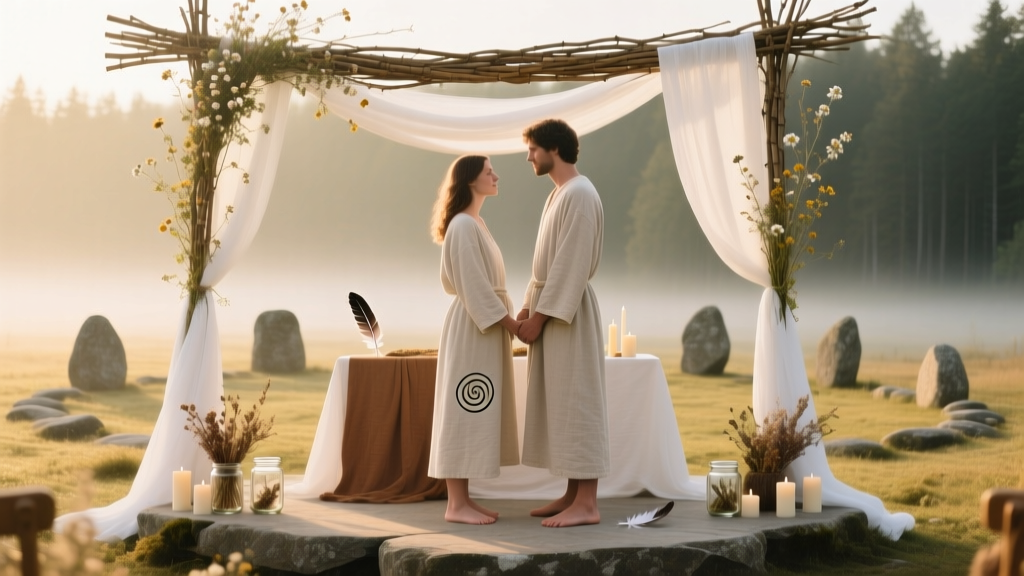
Pagan Wedding: What Actually Happens (2026)
Why 'What Is a Pagan Wedding?' Isn’t Just a Definition Question—It’s a Cultural Reckoning
If you’ve ever typed what is a pagan wedding into Google—and you’re not a practitioner—you’re likely standing at the edge of something deeper: a growing cultural shift where spirituality, ecology, consent, and ancestral reverence are reshaping how love is honored. In 2024, over 12% of U.S. couples surveyed by The Knot cited ‘non-religious but spiritually meaningful’ as their top ceremony priority—and many of those are choosing paths rooted in modern Paganism. But here’s the truth no one tells you upfront: a pagan wedding isn’t defined by pentacles or chanting under the moon alone. It’s defined by intentionality, reciprocity with nature, and radical personal sovereignty. And if you’re asking what is a pagan wedding, you’re probably wrestling with bigger questions: Can it be legally binding? Does it exclude non-Pagans? Is it ‘too weird’ for your family? Let’s settle that—not with dogma, but with lived practice, legal clarity, and real stories from couples who’ve walked this path.
What Is a Pagan Wedding? Beyond the Stereotypes
At its core, what is a pagan wedding resolves to this: a consciously crafted, spiritually grounded marriage rite that honors immanent divinity—found in nature, human relationships, seasonal cycles, and ancestral wisdom—rather than transcendent, hierarchical deities. Unlike doctrinal religions, modern Paganism (encompassing traditions like Wicca, Druidry, Heathenry, Hellenism, and eclectic earth-centered paths) has no central authority, no required creed, and no universal liturgy. That means no two pagan weddings look alike—but nearly all share five non-negotiable pillars:
- Consent as Sacred Act: Every ritual element—from handfasting cords to vow wording—is co-created and mutually agreed upon. No ‘default’ script exists.
- Nature as Co-Officiant: The land, season, weather, or local ecosystem isn’t backdrop—it’s active participant. A rainstorm during a Beltane wedding? Not an omen; it’s welcomed as blessing.
- Cyclical Timeframe: Dates align with lunar phases, solstices, equinoxes, or cross-quarter days (e.g., Samhain, Imbolc)—not just convenience.
- Ancestral & Lineage Awareness: Even in non-heritage paths, couples often honor biological ancestors, chosen family, or historical spiritual lineages through spoken tribute or symbolic offerings.
- Embodied Ritual: Touch, breath, shared food/drink, fire, water, herbs—sensory engagement isn’t decorative. It’s how meaning is anchored in the body.
Take Maya and Eli, a queer couple in Asheville, NC, whose 2023 Lammas wedding included planting an apple sapling together while reciting vows woven from Appalachian folk songs and Quechua gratitude prayers. Their officiant? A certified celebrant trained in both Wiccan liturgy and interfaith trauma-informed facilitation. Legally, they obtained their license in advance and had a civil signing *before* the ritual—making their pagan ceremony purely spiritual, yet fully recognized. Their story reveals the quiet revolution happening: what is a pagan wedding today means spiritual authenticity married to pragmatic legality.
How Pagan Weddings Actually Work—Step-by-Step (No Robes Required)
Forget vague mysticism. Here’s how couples translate intention into action—without needing a coven, degree, or years of study:
- Clarify Your ‘Why’: Ask: ‘What do we want this ceremony to *do*?’ (e.g., ‘Heal generational divorce wounds,’ ‘Affirm our polyamorous family unit,’ ‘Honor my Indigenous roots alongside my partner’s Celtic ancestry’). This shapes every subsequent choice.
- Choose Your Framework (Not Doctrine): Select a tradition—or blend—that resonates. Wiccan-based ceremonies emphasize duality (God/Goddess); Druidry centers on land and language; Heathen rites focus on oath-swearing and ancestral witness. Crucially: You don’t need initiation. You need resonance.
- Design the Container: Decide on structure: Circle casting? Elemental invocations? Handfasting? These aren’t mandatory—but if used, they must serve your ‘why.’ Example: A couple recovering from addiction replaced ‘wine sharing’ with passing a clay cup of spring water—symbolizing renewal, not intoxication.
- Legalize Separately: In all 50 U.S. states and most Commonwealth nations, pagan ceremonies are not automatically legally binding. You must secure a marriage license and have it signed by an authorized officiant (a judge, ordained minister, or certified celebrant—many pagan-friendly ones exist).
- Invite With Integrity: Provide context. Instead of ‘Come celebrate our pagan wedding,’ try: ‘We’re honoring our love with a nature-centered ceremony rooted in ancient earth traditions. All beliefs welcome—we’ll explain symbols as we go.’
This approach transforms anxiety into agency. One Portland couple printed ‘Ritual Glossary’ cards for guests: ‘Handfasting = binding with intent, not magic rope.’ ‘Cakes & Ale = shared nourishment, not sacrament.’ Clarity disarms discomfort.
The Legal, Logistical & Inclusive Realities
‘Is it legal?’ tops every FAQ list—and for good reason. The answer isn’t yes/no—it’s yes, if you plan intentionally. Here’s what actually works:
- Ordained Officiants: Organizations like Universal Life Church (ULC), American Marriage Ministries (AMM), and specific Pagan bodies (e.g., The Covenant of Unitarian Universalist Pagans—CUUPS) offer free or low-cost ordination. But caution: Some states (e.g., NY, NJ, VA) require additional registration or residency. Always verify with your county clerk.
- Celebrants vs. Clergy: Certified Life Celebrants (trained through organizations like INELDA or Celebrant Foundation) specialize in bespoke, non-dogmatic ceremonies—including pagan-aligned ones—and are legally authorized in 47 states. They charge $800–$2,500 but handle licensing, paperwork, and guest education.
- Inclusivity in Practice: A 2023 survey of 327 pagan-adjacent weddings found 68% included at least one non-Pagan ritual (e.g., Jewish breaking of glass, Hindu sindoor, Christian prayer) with full explanation and consent. The key? Framing syncretism as ‘honoring our whole selves,’ not dilution.
Real-world example: Lena (Filipina Catholic) and Raj (Sikh atheist) blended a Wiccan circle-casting with a Sikh ardas prayer and a Filipino ‘sablay’ cord-blessing. Their officiant—a CUUPS-ordained celebrant—wove threads of all three traditions into vows about ‘holding space across belief systems.’ Their families didn’t convert—they witnessed deep respect.
| Ritual Element | Traditional Symbolism | Modern Adaptations (2020–2024) | Legal/Practical Note |
|---|---|---|---|
| Handfasting | Binding hands with cords to symbolize union; origins in Celtic betrothal | Used for polyamorous triads (three cords); LGBTQ+ couples incorporating pronoun ribbons; neurodivergent couples using weighted fabric for sensory grounding | No legal weight. Must be paired with civil license signing. |
| Circle Casting | Creating sacred space by calling quarters (East, South, West, North) and elements | Replaced with ‘community circle’ where guests hold stones representing values; urban couples use city landmarks (e.g., ‘North = our shared apartment building’) for place-based meaning | Purely spiritual. No impact on legality. |
| Cakes & Ale | Sharing blessed food/drink to affirm life and community | Vegan, gluten-free, or alcohol-free versions standard; some replace with ‘shared soil’ (planting seeds) or ‘water blessing’ (pouring into a river) | Must comply with local health codes if served publicly. |
| Seasonal Timing | Solstices, equinoxes, or sabbats (e.g., Beltane = fertility, Samhain = ancestors) | Hybrid dates: e.g., ‘First Saturday after Spring Equinox’ for flexibility; virtual components for diaspora families | No legal restrictions—but venues book 12+ months ahead for peak dates (Beltane, Lughnasadh). |
Frequently Asked Questions
Can I have a pagan wedding if I’m not a Pagan?
Absolutely—and increasingly common. Many couples choose pagan frameworks because they value nature reverence, gender balance, anti-dogmatism, and co-creative ritual—not theological adherence. Think of it like using yoga philosophy for mindfulness without converting to Hinduism. What matters is sincerity, research, and respectful adaptation—not identity labels. Just avoid cultural appropriation (e.g., using Native American smudging without tribal permission or context).
Do pagan weddings require nudity, drugs, or animal sacrifice?
No—this is a persistent, harmful myth. Mainstream modern Paganism explicitly rejects coercion, intoxication, and harm. Nudity (skyclad) occurs in *some* private Wiccan rituals but is rare in public weddings. Drugs are prohibited in virtually all ethical Pagan communities. Animal sacrifice hasn’t been part of Western Pagan practice since antiquity and is illegal in most countries. Today’s pagan weddings prioritize consent, sobriety, and ecological ethics.
How do I explain this to conservative family members?
Lead with shared values, not terminology. Say: ‘We want our wedding to reflect what matters most—respect for nature, honoring our families, and building a loving home. Pagan traditions give us beautiful tools for that, like planting a tree together or writing vows about growth.’ Offer them a role: ‘Will you help us gather wildflowers for the altar?’ or ‘Could you share a story about your own marriage?’ Inclusion disarms fear faster than theology.
Are pagan weddings only for outdoorsy, hippie types?
Hardly. Urban pagans host ceremonies in art galleries, libraries, and even courthouses—adapting rituals to concrete, steel, and subway rhythms. A Brooklyn couple held theirs in a repurposed warehouse, using industrial pipes as ‘standing stones’ and projecting star charts onto brick walls. Another Chicago pair incorporated jazz improvisation into their ‘calling the quarters’—East became a saxophone solo, South a bassline. Paganism is about presence, not aesthetics.
Common Myths About Pagan Weddings
Myth #1: ‘Pagan weddings are inherently anti-Christian or hostile to other faiths.’
Reality: Most modern Pagan practitioners actively engage in interfaith dialogue. The 2022 Pagan Census found 73% attend non-Pagan religious services (funerals, holidays, weddings) with respect. Syncretic ceremonies are the norm—not the exception.
Myth #2: ‘You need decades of study or a coven to do this right.’
Reality: Authenticity > expertise. A couple in Austin held their first ritual—a simple candle-lighting with vows written on recycled paper—after reading one book and attending two open circles. Their officiant told them: ‘Your love is the liturgy. Everything else is decoration.’
Your Next Step Isn’t ‘Convert’—It’s ‘Curate’
So—what is a pagan wedding? It’s not a costume, a cult, or a loophole. It’s a declaration: We choose how our love is witnessed, grounded, and blessed—and we do it with eyes wide open. If this resonates, don’t start with theology. Start with your own story. What moments felt sacred in your relationship? When did nature feel like ally, not scenery? Whose voices do you want echoing in your vows? Answer those—and the rest unfolds. Ready to begin? Download our free Pagan Wedding Starter Kit (includes state-by-state officiant verification links, inclusive vow templates, and a ‘Myth-Busting Guest Letter’ you can personalize). Because the most powerful pagan ritual isn’t ancient—it’s the one you write today.
More Articles
 Is American Wedding on Netflix in 2026? (No — Here’s Where)
 Proposing at a Wedding: Truth, Risks & Timing (2026)
 Which Ring Goes First Wedding Band Or Engagement (2026)
 White Dress Shirt to Wedding: When It’s Okay
 Wedding Photographer Hourly Rate: Real Numbers (2026)
 What Is the Proper Wedding Toast Etiquette
 Who Wrote Four Weddings and a Funeral? (2026)
 Who Buys Wedding Rings in 2026? Data & Trends
 Legal Name Change After Marriage: Step-by-Step Guide
 Engagement vs Wedding Rings: 5 Key Differences (2026)