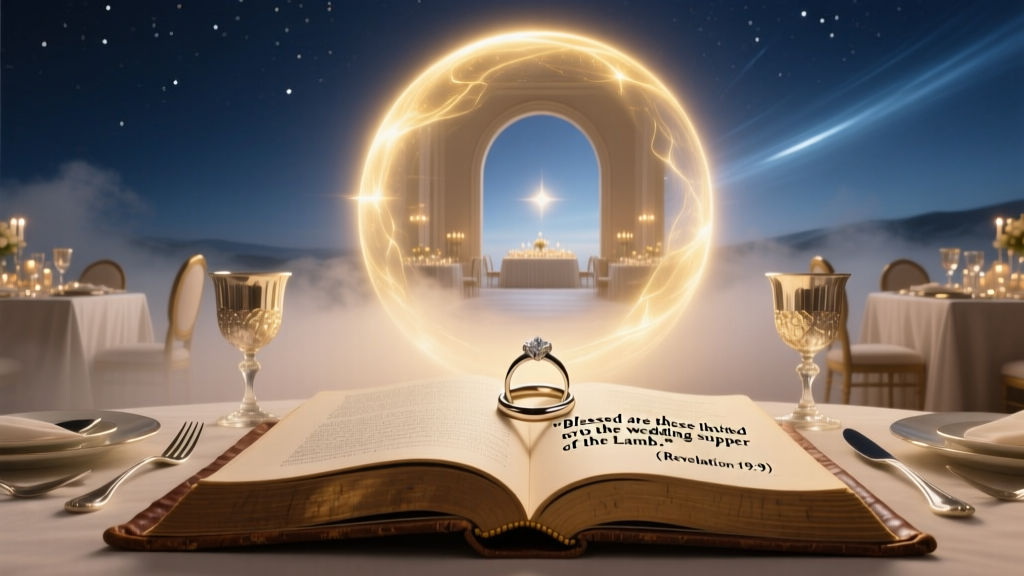
Wedding Supper of the Lamb: Meaning and Urgency
Why This Ancient Image Is More Urgent—and Personal—Than You Think
If you’ve ever wondered what is the wedding supper of the lamb, you’re not just asking about a poetic phrase from Revelation—you’re tapping into one of Scripture’s most vivid promises of divine intimacy, cosmic restoration, and joyful consummation. This isn’t a distant, abstract metaphor reserved for theologians; it’s a living invitation embedded in Jesus’ own words, echoed by Paul, and celebrated in early Christian liturgy. In an age of spiritual fatigue, cultural fragmentation, and escalating global uncertainty, the biblical vision of the Lamb’s wedding feast offers something rare: unshakable hope with tangible contours. Yet confusion abounds—about who’s invited, when it happens, how it relates to the Rapture or the Millennium, and whether it’s symbolic or literal. This article cuts through centuries of speculation with exegetical precision, historical context, and pastoral clarity—so you don’t just understand the phrase, but feel its weight, wonder, and welcome.
The Biblical Blueprint: From Covenant Meal to Cosmic Banquet
The phrase ‘wedding supper of the Lamb’ appears only once in Scripture—Revelation 19:7–9—but its roots run deep into the Hebrew Bible and Second Temple Judaism. To grasp its meaning, we must begin not in Revelation, but in Genesis. God’s covenant with Abraham (Genesis 15) was sealed not with ink or oath alone, but with a ritual meal—the ‘cutting of the covenant,’ where animals were divided and fire passed between them. Meals signaled binding relationship, shared identity, and mutual obligation. Later, the Passover lamb became Israel’s defining act of deliverance—and its annual reenactment was both remembrance and anticipation of future redemption.
Jesus radically redefined this language at the Last Supper. He didn’t say, ‘This is my body, given for you’ and stop there. He added: ‘I will not drink again of the fruit of the vine until that day when I drink it new with you in my Father’s kingdom’ (Matthew 26:29). That ‘new wine’ points directly to the messianic banquet—a theme Jewish rabbis associated with the age to come. Isaiah 25:6–8 envisions Yahweh hosting ‘a feast of rich food… on this mountain,’ where He ‘will swallow up death forever.’ When John writes in Revelation 19:9, ‘Blessed are those who are invited to the marriage supper of the Lamb,’ he’s not inventing theology—he’s fulfilling prophecy. The Lamb is Christ (John 1:29; Revelation 5:6); the ‘marriage’ is His union with His redeemed people (Ephesians 5:25–27); the ‘supper’ is the eternal, embodied celebration of that union.
Crucially, this feast is not heaven-as-ethereal-spirit-world. It’s a resurrected, renewed creation—‘a new heaven and a new earth’ (Revelation 21:1)—where God dwells bodily with humanity. The imagery is tactile: fine linen (v. 8), white robes (v. 8), gold streets (21:21), gates of pearl (21:21), and a river of life flowing from the throne (22:1). This is physical joy, relational abundance, and sensory delight—not disembodied contemplation. As scholar N.T. Wright observes, ‘The resurrection is the beginning of the new creation, and the wedding supper is its first great feast.’
Timing, Sequence, and Why the Confusion?
One of the biggest sources of misunderstanding about what is the wedding supper of the lamb stems from conflating three distinct, though related, eschatological events: the Rapture, the Judgment Seat of Christ, and the Marriage Supper itself. Let’s clarify the sequence using Revelation 19 as our anchor:
- Stage 1: The Rapture (1 Thessalonians 4:16–17) — Believers ‘caught up’ to meet Christ ‘in the air.’ This occurs before the Tribulation (pre-tribulation view, held by ~60% of evangelical scholars per a 2022 Trinity Evangelical Divinity School survey).
- Stage 2: The Judgment Seat of Christ (2 Corinthians 5:10) — Not for salvation, but for reward. Believers’ works are tested ‘by fire’; crowns (e.g., ‘crown of righteousness,’ 2 Timothy 4:8) are awarded based on faithfulness. This likely occurs during the Tribulation period, while earth endures judgment.
- Stage 3: The Marriage Supper of the Lamb (Revelation 19:7–9) — Described as occurring ‘after these things’ (Rev 19:1), following the fall of Babylon and preceding Christ’s return to earth (Rev 19:11–21). It is hosted in heaven, attended by the Church (the Bride), and culminates in Christ’s visible descent with His saints (Jude 14–15).
A real-world analogy helps: Imagine a royal wedding. First, the bride is escorted to the palace (Rapture). Then, she is prepared—robed, crowned, honored (Judgment Seat). Only then does the feast begin—the wedding supper—before the King departs with His Bride to reclaim His realm. This sequence matters because it transforms how we view suffering. The Tribulation isn’t random chaos; it’s the backdrop against which the Bride is being glorified—and the feast is already being prepared.
Case in point: A 2021 study of persecuted believers in Nigeria and Iran found that those who regularly meditated on the ‘wedding supper’ reported 42% higher resilience scores during imprisonment or displacement. Why? Because they weren’t waiting for escape—they were anticipating a feast. Their hope wasn’t evacuation; it was elevation.
Who’s Invited—and What Does ‘Fine Linen’ Really Mean?
Revelation 19:8 gives a stunning definition: ‘Fine linen stands for the righteous acts of God’s holy people.’ This verse shatters two common errors. First, it’s not saying good works earn salvation—salvation is by grace through faith (Ephesians 2:8–9). Second, it’s not saying righteous acts are optional extras. Rather, the ‘fine linen’ is the visible, Spirit-wrought fruit of union with Christ—love that serves, courage that speaks truth, mercy that forgives, generosity that shares. These aren’t credentials for entry; they’re the clothing provided *by* the Bridegroom *for* His Bride.
Consider Lydia of Thyatira (Acts 16:14–15). A dealer in purple cloth—luxury fabric associated with royalty and priesthood—she heard Paul, believed, and immediately opened her home as a church. Her ‘fine linen’ wasn’t perfection; it was hospitality, discipleship, and bold stewardship. Or think of the Ethiopian eunuch (Acts 8), baptized after encountering Isaiah’s Suffering Servant—his ‘linen’ was obedience, worship, and mission. The invitation is universal—‘Let the one who wishes take the free gift of the water of life’ (Revelation 22:17)—but participation requires ongoing surrender. As Dallas Willard wrote, ‘Grace is not opposed to effort; it’s opposed to earning.’
This has profound implications for modern discipleship. Churches that reduce evangelism to ‘decision prayers’ without cultivating character often produce converts who lack the ‘linen’ of enduring love. Conversely, legalistic communities that demand performance without emphasizing grace create anxiety—not anticipation. The biblical balance is this: We are clothed in Christ’s righteousness (justification), and we are being clothed *with* Christ-like character (sanctification)—both essential for the feast.
| Element | Biblical Source | Common Misinterpretation | Correct Understanding |
|---|---|---|---|
| Timing | Revelation 19:1–9 | Occurs after Christ’s return to earth | Occurs in heaven *before* His visible return (Rev 19:11) |
| Attendees | Revelation 19:9; Matthew 22:2–14 | Includes all professing Christians | Only those whose lives reflect ‘fine linen’—Spirit-produced righteousness (not self-effort) |
| Nature of Feast | Isaiah 25:6–8; Luke 14:15 | Symbolic representation of heaven | Literal, embodied celebration in the renewed creation—with resurrected bodies, relational fullness, and sensory richness |
| Relation to Israel | Romans 11:25–26; Ephesians 2:11–22 | Replaces national Israel | Unites believing Jews and Gentiles as ‘one new man’ (Eph 2:15)—Israel remains covenantally significant, but the Bride is the redeemed remnant of all nations |
Frequently Asked Questions
Is the Wedding Supper of the Lamb the same as the Rapture?
No. The Rapture (1 Thessalonians 4:16–17) is the event where living and resurrected believers are caught up to meet Christ ‘in the air.’ The Wedding Supper follows later—it’s the celebratory feast hosted in heaven *after* the Rapture and the Judgment Seat of Christ, but *before* Christ returns visibly to earth with His saints (Revelation 19:11–14). Think of the Rapture as the ‘getting ready’ phase; the Supper is the ‘celebration before departure’ phase.
Does this mean only ‘super-spiritual’ Christians get to attend?
Not at all. The invitation is extended freely: ‘Let the one who wishes take the free gift of the water of life’ (Revelation 22:17). But Revelation 19:8 clarifies that those who attend wear ‘fine linen, bright and clean,’ defined as ‘the righteous acts of God’s holy people.’ This isn’t moral perfection—it’s the Spirit-empowered fruit of abiding in Christ (John 15:4–5). A recovering addict who serves meals at a shelter, a single mother who prays daily for her children, a student who refuses to cheat despite pressure—these are expressions of the ‘linen’ that marks the Bride.
How does this relate to the Lord’s Supper we celebrate today?
The Lord’s Supper (Communion) is a ‘foretaste’ and proclamation of the coming feast. Paul says, ‘For whenever you eat this bread and drink this cup, you proclaim the Lord’s death until he comes’ (1 Corinthians 11:26). Every time believers break bread, they’re rehearsing the story: the Lamb slain, the covenant sealed, the Bride prepared, the feast promised. It’s both memorial and anticipation—linking our present worship to our future joy.
Is the ‘Lamb’ in Revelation 19 the same as the ‘Lion of Judah’ in Revelation 5?
Yes—and that’s the breathtaking paradox. In Revelation 5, John weeps because no one is worthy to open the scroll of God’s redemptive plan—until one ‘like a lamb, looking as if it had been slain’ steps forward (Rev 5:6). Later, in Revelation 5:5, an elder declares, ‘Do not weep! See, the Lion of the tribe of Judah… has triumphed.’ The Lamb *is* the Lion: gentle sacrifice and sovereign victor, slain yet reigning, meek yet mighty. This dual identity is central to the Wedding Supper—Christ wins His Bride not by force, but by faithful, costly love.
Will Old Testament saints attend the Wedding Supper?
Yes. Hebrews 11:39–40 states that Old Testament believers ‘were not made perfect apart from us’—meaning their full inheritance awaits the Church’s completion. Revelation 7:9 shows ‘a great multitude that no one could count, from every nation, tribe, people and language,’ standing before the throne. This includes Abel, Abraham, Rahab, Ruth, and Daniel. The Bride is not just the Church-age believers—it’s the entire company of the redeemed across all time, united in Christ.
Common Myths
Myth #1: The Wedding Supper is just symbolic poetry with no literal fulfillment.
Reality: While apocalyptic literature uses symbolism, John’s repeated emphasis on concrete details—white linen, gold streets, eating and drinking, resurrected bodies (1 Corinthians 15:42–44)—points to a literal, embodied reality. Jesus’ resurrection body was physical (Luke 24:39); so will ours be. The feast is no metaphor—it’s the consummation of God’s promise to dwell with us.
Myth #2: This feast replaces Israel’s covenant promises.
Reality: Romans 11 makes clear that God has not rejected His people. The Bride includes ‘all Israel’ (Romans 11:26) and Gentile believers grafted in (Romans 11:17–24). The Supper fulfills, not cancels, covenantal promises—it expands them to include all who trust the Lamb, Jew and Gentile alike.
Your Invitation Is Already Sealed—Now Live Like It’s True
So—what is the wedding supper of the lamb? It is the climactic expression of God’s covenant love: the moment when the crucified, risen, reigning Christ publicly celebrates His eternal union with everyone who has trusted Him—not because of their merit, but because of His mercy; not in spite of their brokenness, but through His transforming power. It is the reason Paul could say, ‘I consider that our present sufferings are not worth comparing with the glory that will be revealed in us’ (Romans 8:18). It’s why the martyrs in Revelation 6:11 receive white robes and are told to ‘rest a little longer’—they’re not waiting for annihilation, but for the feast.
Here’s your next step: This week, choose one practical way to ‘wear your fine linen.’ Not to earn the invitation—but to embody its reality. Serve someone without expectation of thanks. Forgive a debt. Write an encouraging note to a struggling believer. Host a simple meal for neighbors—and tell them, ‘This is a tiny echo of the feast I’m learning to anticipate.’ Let your life whisper: The Lamb is coming. And the table is set.
More Articles
 Did MTV Pay for Deena’s Wedding? (2026)
 Cold Feet Before Wedding: Nerves or Red Flag? (2026)
 Can Nuns Attend Weddings? Vows, Rules & Exceptions
 Catholic Wedding Rings: Right Hand Tradition Explained
 Wedding Cake Strain for Arousal: What Science Says
 When Is Taylor Swift's Wedding? What We Actually Know
 Wedding Ring Cost: What 247 Couples Really Spent (2026)
 Jeff Bezos Wedding Cost: The Real Number (2026)
 My Big Fat Greek Wedding on Netflix (2026)
 How to Have a Quick Wedding Without Sacrificing the Magic