## What Does a White Wedding Really Mean?
When Billy Idol screamed *"It's a nice day for a white wedding,"* millions of people sang along without questioning what the phrase actually means. Whether you're planning your own ceremony or simply curious about the tradition, the meaning behind a white wedding runs deeper than the color of a dress. Understanding its origins can help you make intentional choices — or confidently break the rules.
---
## The Victorian Origins of the White Wedding
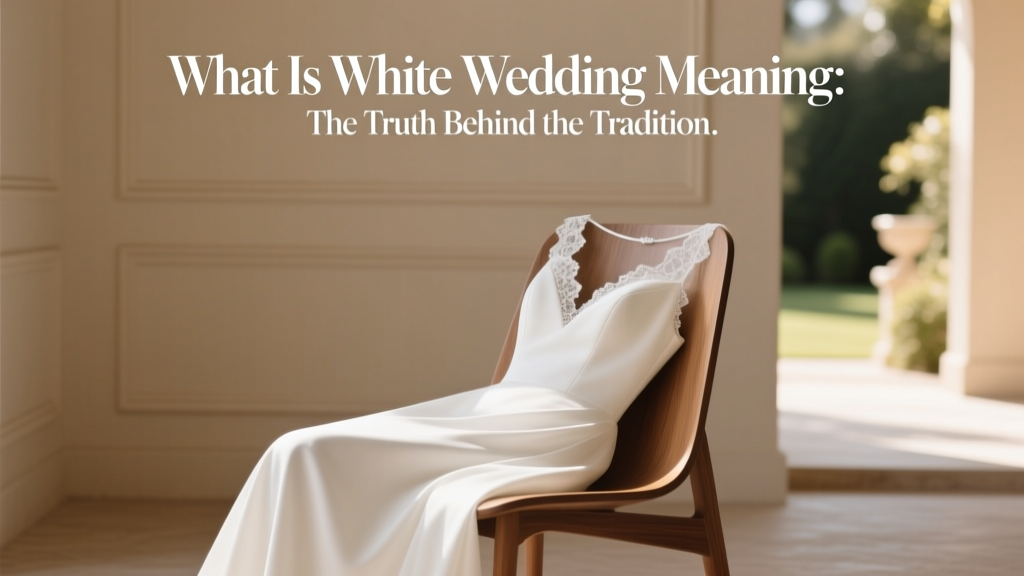
The white wedding tradition is surprisingly recent. Before Queen Victoria married Prince Albert in 1840, brides wore their best dress — in any color. White was actually impractical and associated with mourning in some cultures.
Victoria's choice of a white gown was a bold fashion statement, not a moral one. The wealthy elite quickly followed, and white became a symbol of **status and affluence** — only the rich could afford a dress worn once and kept pristine.
Key historical facts:
- **1840**: Queen Victoria popularizes the white wedding gown
- **1950s–60s**: White weddings become mainstream in Western culture
- **Today**: White remains dominant but is no longer the only accepted choice
---
## What White Symbolizes in a Modern Wedding
The white wedding meaning has evolved significantly. Today it carries several layered interpretations:
**1. Purity and new beginnings** — Not necessarily sexual purity, but the idea of starting fresh as a couple. A clean slate.
**2. Formality and ceremony** — White signals that this is a significant, intentional occasion set apart from everyday life.
**3. Cultural identity** — In Western weddings, white is a cultural shorthand for "traditional wedding." It communicates a shared visual language.
**4. Personal expression** — Many modern brides choose white simply because they love how it looks — and that's a completely valid reason.
The phrase "white wedding" itself has become synonymous with a **traditional, formal Western-style ceremony**, regardless of the exact shade of the dress.
---
## White Wedding Meaning Across Cultures
It's important to note that white carries very different meanings globally:
| Culture | White Symbolism |
|---|---|
| Western | Purity, new beginnings, tradition |
| Chinese | Mourning, funerals |
| Indian | Widowhood (traditionally) |
| Japanese | Sacred, pure — white kimonos are worn |
| Korean | Simplicity and purity |
If you're planning a multicultural wedding, understanding these distinctions helps you navigate family expectations with sensitivity and intention.
---
## Common Myths About White Weddings
**Myth #1: White means the bride is a virgin.**
This association was largely a 20th-century invention, not a historical fact. Queen Victoria — who popularized the white gown — chose it for fashion reasons. The purity narrative was layered on afterward by social convention. Today, virtually no one interprets a white dress as a statement about a bride's sexual history.
**Myth #2: You must wear white to have a "real" wedding.**
A white wedding is a style choice, not a requirement. Brides around the world wear red, gold, blue, and every color imaginable. The meaning of your wedding is defined by your commitment — not the color of your outfit. Choosing ivory, champagne, blush, or a completely different color doesn't make your ceremony any less valid or meaningful.
---
## What This Means for Your Wedding Planning
Understanding the white wedding meaning gives you freedom. You can:
- **Embrace the tradition** knowing it's rooted in fashion history, not rigid moral rules
- **Subvert it intentionally** by choosing a color that reflects your personality or cultural background
- **Blend traditions** — many couples incorporate white elements alongside colors meaningful to their heritage
The most important thing is that your choices feel authentic to you as a couple.
**Your next step:** Before you shop for a wedding dress, have an honest conversation with your partner about what visual and symbolic elements matter most to both of you. That conversation will make every decision — from dress color to décor — feel grounded and intentional.
 Best Planning for Guests: A Practical, Data-Driven Approach to Hospitality Excellence
 Was Francia Raisa Invited to Selena’s Wedding? (2026)
 Edmure Tully at Red Wedding: Why He Survived
 Do Men Wear Diamond Wedding Rings? (2026)
 What Is a Quaker Wedding? (2026)
 Why Do Couples Have a Cake Cutting Ceremony
 Best Jewelry for Checklist: A Practical, Data-Driven Selection Guide
 When Was Ryan Lochte's Wedding and His Olympic Legacy
 Are The Engagement Ring And Wedding Ring Different (2026)
 Wedding Rings While Sleeping: Dermatologist & Jeweler Tips