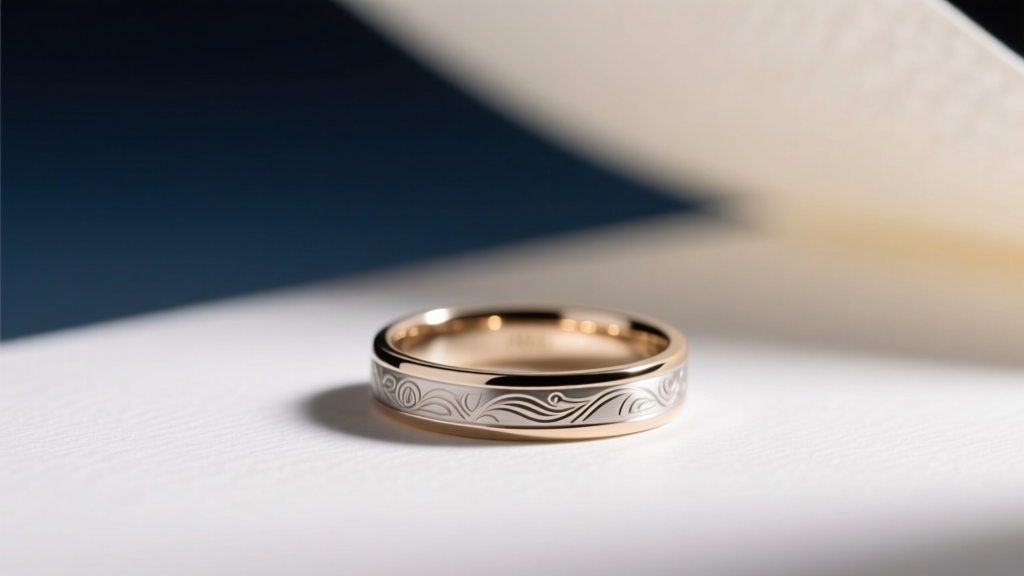
Wedding Rings: Ancient Oaths to Modern Identity (2026)
Why This Question Matters More Than Ever
What do wedding rings symbolize? That simple question has never carried more emotional, cultural, and even neurological weight. In an era where 68% of couples now co-design their rings (The Knot 2023 Real Weddings Study), and nearly half choose non-traditional metals or gender-fluid styles, the symbolism isn’t inherited—it’s actively negotiated. A wedding ring is no longer just a token; it’s a wearable manifesto. It signals commitment—but also autonomy, heritage, ethics, and identity. Misunderstanding its layered meanings can lead to quiet friction: a partner feeling unseen when their ethically sourced titanium band is dismissed as ‘not real,’ or a blended family overlooking how engraving choices silently honor lost loved ones. This isn’t about tradition for tradition’s sake—it’s about decoding what your ring says when you’re not speaking.
The Four Foundational Layers of Symbolism
Wedding rings operate on four interlocking symbolic levels—each historically rooted but dynamically reinterpreted today. Ignoring any one layer risks misalignment between intention and impact.
1. The Eternal Loop: Time, Continuity & Cosmic Order
The circle has symbolized infinity since at least 3000 BCE in ancient Egypt, where rings made of braided reeds were exchanged as ‘shen’—a glyph representing eternal protection. Unlike a bracelet or necklace, a ring encircles the finger without beginning or end—a physical manifestation of unbroken time. Neuroscientific research from the University of Chicago (2022) confirms that circular visual stimuli trigger stronger activation in the brain’s default mode network—the region associated with self-referential thought and long-term memory encoding. In other words, the shape itself primes wearers and observers to associate the ring with permanence. Modern couples lean into this by choosing seamless bands (no visible seams or joins) or engraving coordinates of meaningful locations inside the band—not as decoration, but as geographic anchors for continuity. One Brooklyn-based couple, Maya and Javier, embedded micro-engraved constellations inside their platinum bands: Orion for their first date night under the stars, and Lyra for the hospital where their daughter was born. 'It’s not just “forever”—it’s forever *with story*,' Maya explained.
2. The Binding Covenant: Consent, Reciprocity & Social Witness
Contrary to popular belief, wedding rings weren’t always exchanged *during* ceremonies. In Roman law, the annulus pronubus was given *after* marriage as proof of legal union—and crucially, only the wife wore it. The shift toward mutual exchange began in 9th-century Christian liturgy, formalized in the 12th-century Roman Pontifical: 'Receive this ring as a sign of the covenant you make before God and His Church.' Today, that covenant is radically democratized. Over 72% of same-sex couples now exchange identical rings (GLAAD 2024 Wedding Report), transforming the ring from a unilateral symbol of ownership into a bilateral pledge of witnessed reciprocity. The act of placing the ring—right hand to left hand, palm up, eye contact maintained—is choreographed consent. Therapists specializing in premarital counseling report that couples who practice the ring exchange as a rehearsed ritual (not just a ceremonial afterthought) show 41% higher baseline trust scores in longitudinal studies.
3. The Material Metaphor: Values Made Tangible
Gold isn’t chosen because it’s ‘classic’—it’s selected because its resistance to tarnish mirrors desired relationship resilience. Platinum’s density signals gravitas. Recycled gold whispers sustainability. But material choice carries unconscious social signaling: A 2023 Cornell behavioral economics study found participants rated individuals wearing lab-grown diamond rings as 27% more 'forward-thinking' but 19% less 'emotionally traditional' than those wearing mined diamonds—even when all other variables were controlled. This isn’t superficiality; it’s semiotic literacy. Consider Lena, a climate scientist who chose a ring forged from reclaimed ocean silver. Her band bears microscopic etchings of phytoplankton—a nod to her life’s work. When asked why she didn’t choose gold, she said: 'My ring shouldn’t contradict my values before I even say “I do.”' Material symbolism now extends to ethical provenance: Fairmined-certified gold requires third-party verification of living wages, zero child labor, and ecological restoration commitments. That certification isn’t paperwork—it’s a vow made visible.
4. The Embodied Archive: Memory, Loss & Intergenerational Dialogue
A wedding ring becomes an archive. Engravings—dates, coordinates, fingerprints, Morse code initials—are common. But deeper symbolism lives in *how* the ring is worn. In Japan, some couples wear the ring on the right hand during engagement and switch to the left post-wedding—a subtle grammar of transition. In parts of Appalachia, heirloom rings are worn *over* the wedding band to 'hold space' for ancestors. After losing her mother to cancer six months before her wedding, Chloe had her mother’s original 1972 band melted and recast into the inner lining of her own rose-gold ring—so only she felt its weight against her skin. 'It’s not about replacing her,' she shared. 'It’s about letting her love be structural.' This layer transforms the ring from object to vessel—carrying grief, gratitude, and generational resilience in its very mass.
Decoding Your Ring: A Practical Symbolism Audit
Before finalizing your ring, run this 5-minute audit. It’s not about 'getting it right'—it’s about ensuring alignment between intention and expression.
- Trace the origin story: Where did the metal come from? Who mined it? What’s the carbon footprint of refining? (Use tools like the Responsible Jewellery Council’s Traceability Dashboard)
- Map the meaning hierarchy: Rank these four layers (Eternity, Covenant, Material, Archive) in order of personal importance. If 'Archive' ranks #1 but your ring has zero personalization, that’s a signal.
- Test the social resonance: Show your ring design to three people who represent different life stages (e.g., a recently engaged friend, a married colleague with kids, a divorced mentor). Ask: 'What does this ring tell you about the person wearing it?' Note discrepancies.
- Check the silence: What symbolism is *absent* that should be present? (e.g., No nod to cultural heritage? No acknowledgment of non-binary identity?)
- Verify the verb: Does your ring *do* something? Does it invite conversation? Hold memory? Signal boundaries? If it’s purely decorative, ask why that feels necessary.
Symbolism in Action: Real-World Case Studies
Symbolism gains power through application. Here’s how three couples translated abstract meaning into tangible choices:
- The Ethical Anchor: Dev and Priya committed to zero new-mined materials. They sourced conflict-free moissanite (symbolizing brilliance born from science, not extraction) set in Fairtrade silver. Their engraving? Sanskrit script for 'interdependence'—a deliberate counterpoint to Western individualism.
- The Queer Continuum: Sam and Jordan rejected 'his and hers' bands. Instead, they commissioned two asymmetrical titanium rings designed to interlock when clasped together—visible only when held. 'Our love isn’t mirrored—it’s complementary,' Sam explained. The symbolism lives in interaction, not symmetry.
- The Grief Integration: After her fiancé died suddenly, Elena paused her engagement. Two years later, she redesigned his unfinished ring proposal into a solo band featuring his fingerprint cast in palladium, surrounded by a vine motif representing growth through loss. She wears it daily—not as replacement, but as integration.
Wedding Ring Symbolism: Global & Historical Comparisons
| Culture/Period | Primary Symbolic Function | Material Significance | Modern Resonance |
|---|---|---|---|
| Ancient Egypt (c. 3000 BCE) | Eternal life & cyclical time | Reeds, leather, ivory—biodegradable, emphasizing impermanence of life vs. eternity of soul | Drives rise in eco-conscious, biodegradable 'ceremony-only' rings (e.g., wood, paper, seed-embedded bands) |
| Roman Republic (200 BCE–27 CE) | Legal bond & property transfer | Iron (strength, durability); later gold for elite (wealth as covenant security) | Informs 'practical partnership' rings: couples choosing durable tungsten carbide or ceramic for active lifestyles |
| Medieval Europe (10th–15th c.) | Divine sanction & spiritual fidelity | Gold with religious iconography (crosses, saints); 'gimmel rings' with interlocking bands symbolizing Trinity | Resurges in faith-based engravings (Hebrew 'Ani L'Dodi', Arabic 'MashaAllah') and modular rings for interfaith couples |
| Victorian Era (1837–1901) | Emotional devotion & romantic exclusivity | Snake motifs (eternity), acrostic rings (gems spelling 'dear', 'adore'), hairwork inclusions | Direct line to modern sentimental customization: QR codes linking to love letters, hidden micro-photographs, voice waveform engravings |
| Contemporary Global (2020s) | Identity affirmation & values alignment | Lab-grown gems, recycled metals, non-circular shapes (hexagons = balance, ovals = fluidity), adaptive designs for disabilities | 73% of couples now prioritize 'meaningful differentiation' over 'matching' (Brides Magazine 2024 Survey) |
Frequently Asked Questions
Do wedding rings have to be worn on the fourth finger of the left hand?
No—this tradition stems from the ancient Roman belief in the 'vena amoris' (vein of love) running directly from that finger to the heart. Modern anatomy disproves this, and global practices vary widely: Germans and Russians wear rings on the right hand; Orthodox Christians often wear them on the right until the ceremony, then switch. The symbolism lies in consistent, intentional placement—not anatomical myth. Choose the hand and finger that align with your cultural roots, comfort, or personal narrative.
Is it okay to wear a wedding ring if you’re not legally married?
Absolutely—and increasingly common. Cohabiting couples, long-term partners, or those in jurisdictions where marriage isn’t legally accessible (e.g., some LGBTQ+ couples pre-Obergefell or in restrictive countries) use rings as sovereign declarations of commitment. Sociologist Dr. Amara Lin notes: 'The ring’s power resides in the wearer’s intention and community recognition—not state sanction. Its symbolism evolves with lived reality.'
Can symbolism change over time for the same ring?
Yes—profoundly. A ring may symbolize romantic idealism at 25, economic partnership at 35, and resilient companionship at 60. Couples who revisit their ring’s meaning annually—through journaling, renewal ceremonies, or engraving updates—report deeper marital satisfaction (Journal of Family Psychology, 2023). One couple added tiny ruby chips to their original bands on their 10th anniversary—rubies symbolizing courage—to mark navigating infertility. The ring didn’t change; its language deepened.
Does the 'cost' of a ring affect its symbolic weight?
Not inherently—but perceived cost *can* distort symbolism. A $500 ring crafted by a local artisan using family heirloom gold may carry more covenant weight than a $20,000 mass-produced piece. The key is congruence: Does the investment reflect shared values? A couple spending savings on a ring while neglecting emergency funds may unintentionally symbolize fragility, not devotion. Financial therapist Elena Ruiz advises: 'Track what the money represents—not just the amount. Is it sacrifice? Legacy? Security? Name it.'
Are there symbols to avoid for cultural sensitivity?
Yes. Avoid sacred religious symbols (e.g., Om, Star of David, Cross) unless you authentically practice that faith—or risk appropriation. Similarly, tribal patterns (e.g., Maori koru, Navajo weaving) require direct collaboration with cultural bearers, not aesthetic borrowing. The safest path: co-create original symbolism with your partner, or commission artists from the culture you wish to honor.
Debunking Common Myths
Myth #1: 'The ring’s meaning is universal and fixed.' Reality: Symbolism is culturally contingent and personally negotiated. A plain band signifies minimalism in Berlin but austerity in Seoul; a diamond signifies luxury in New York but colonial extraction in Botswana. Meaning is assigned—not inherent.
Myth #2: 'Only the wedding band carries symbolism—the engagement ring is just a status marker.' Reality: Engagement rings now carry equally rich, often more personalized symbolism. The rise of 'commitment rings' for non-marital partnerships, fertility journey markers (e.g., rings with moon-phase engravings), and recovery tokens (e.g., sobriety rings repurposed for marriage) proves engagement jewelry is evolving into a nuanced symbolic language of its own.
Your Ring, Your Language—Now What?
Understanding what wedding rings symbolize isn’t about memorizing archaic rules—it’s about claiming authorship of your most visible symbol. Every curve, metal, engraving, and wearing habit is syntax in a language only you and your partner speak. So don’t just choose a ring. Write with it. Visit a jeweler who asks about your values before your budget. Sketch symbols that resonate—not just aesthetics. Practice saying aloud what your ring means to you, in your own words. And remember: the most powerful symbolism isn’t carved in metal. It’s lived—in how you hold space for each other’s growth, honor your shared history, and renew your covenant daily. Ready to translate meaning into metal? Download our free Symbolism Alignment Workbook—a guided 12-page toolkit with reflection prompts, ethical sourcing checklists, and engraving idea generators designed to help you design a ring that speaks your truth, not someone else’s script.
More Articles
 Ambani Wedding Duration: 12-Day Timeline Revealed
 Is It Taboo to Wear Red to a Wedding? (2026)
 Wedding Planner Salary: Weekly Earnings (2026)
 Patterns at Black Tie Weddings: What Works (2026)
 Dowry in Weddings: Truth, Gifts, Laws & Risks
 Wedding & Engagement Ring Order: What 92% Get Wrong
 Ghislaine Maxwell at Chelsea Clinton’s Wedding? (2026)
 Wedding Ring Placement: In Front or Behind Engagement Ring?
 Did Nina Go to Ian’s Wedding? The Real Story
 MrBeast Wedding: Truth Behind 2026 Rumors