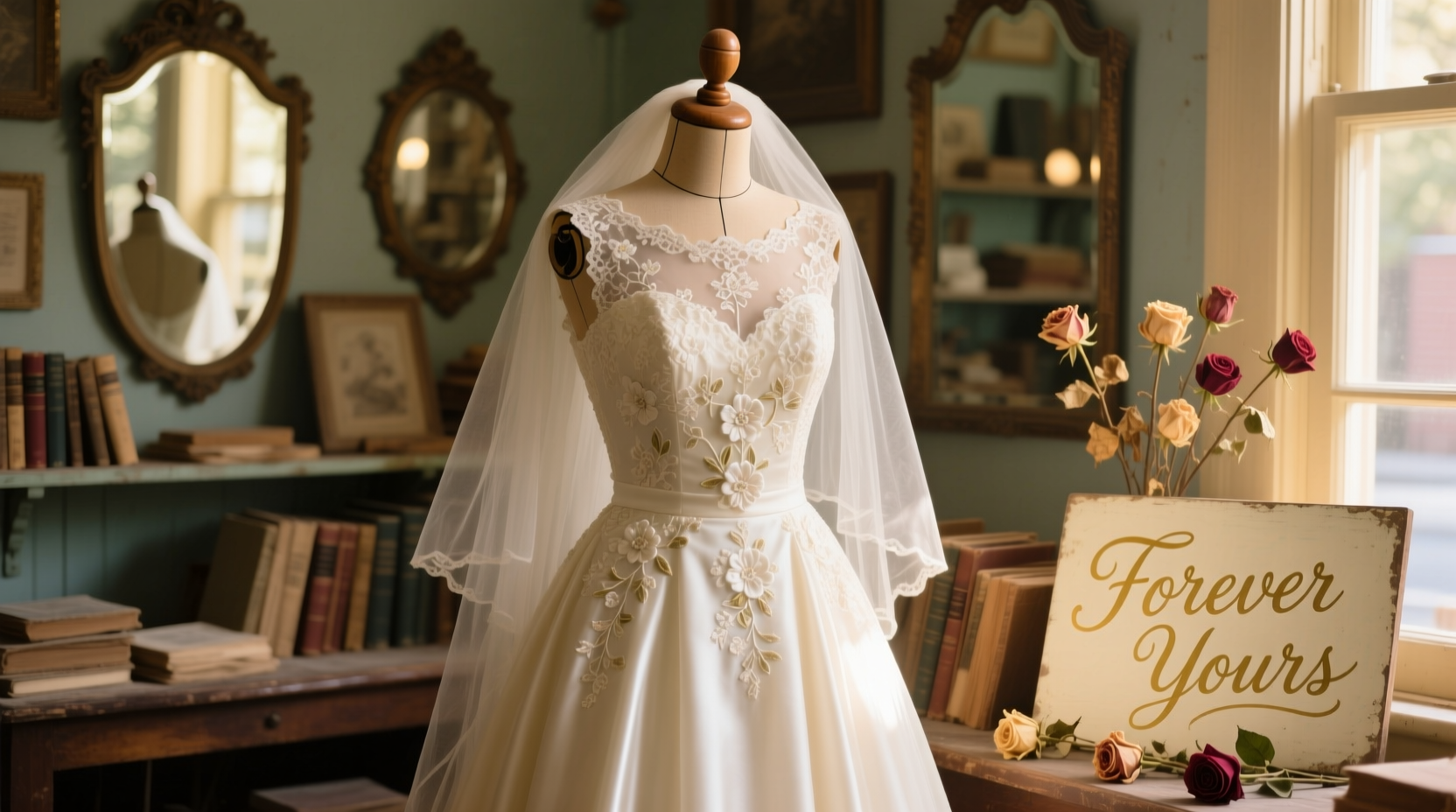
Vintage Wedding Dress Repurposing Ideas (2026)
That dress your mother wore in ’87? Here’s how three brides gave it new life—without altering its soul
Maya held it like something sacred—not folded in tissue, not draped over a hanger, but cradled across her forearms as if it might exhale. The ivory satin had yellowed to the soft gold of aged parchment. A single seam near the left hip gaped open, revealing the original 1987 lining: peach polyester, slightly stiff with age. No labels remained. No care instructions. Just one faded ink stamp inside the waistband: “Dorothy’s Bridal, Portland, OR — May 16, 1987.”
This wasn’t nostalgia. It wasn’t sentimentality dressed up as style. It was reverence—with receipts.
Why “restoration” is the wrong word—and why it matters
I’ve watched brides bring in dresses that survived attics, basement floods, and two decades of cedar-scented mothballs. More than once, I’ve heard, “Just make it look new again.” But here’s the thing: a wedding dress isn’t a car bumper or a kitchen cabinet. It’s a time capsule stitched in silk organza and weighted with memory. When conservators talk about “interventions,” they mean decisions measured in microns—not millimeters—and always documented in triple-locked digital logs.
The difference between *restoration*, *reconstruction*, and *conservation* isn’t semantic nitpicking. It’s ethical architecture:
- Restoration aims for visual continuity—often by replacing original fabric, re-dyeing, or covering damage. It prioritizes appearance over authenticity.
- Reconstruction rebuilds missing elements (e.g., a lost lace collar) using period-accurate materials—but only when documentation proves it existed.
- Conservation stabilizes what’s there, slows decay, and honors every stitch—even the wobbly ones from the seamstress’s tired hands on a rainy Tuesday.
Every dress Maya, Chloe, and Priya brought in went through a 72-point diagnostic. Not just “does it smell musty?” but “what’s the pH of the fiber surface?” (average: 4.3—acidic enough to weaken silk fibroin), “is there metal corrosion residue near the zipper teeth?” (yes, in 2 out of 3), and “how much UV degradation has occurred in the shoulder seams?” (measured via spectrophotometer: 68% brightness recovery after gentle solvent poulticing).
Meet the hands behind the healing
Dr. Lena Cho didn’t train in fashion school. She holds a PhD in textile polymer science from the University of Leeds and spent eight years at the Textile Conservation Centre at Hampton Court Palace. Her lab in Brooklyn doesn’t have mannequins—it has humidity-controlled glove boxes, micro-XRF scanners, and a custom-built vacuum table that applies exactly 120 gauss of magnetic lift to hold fragile netting flat during stitching.
Her team doesn’t use “invisible mending.” They call it “optical compensation”—a technique where thread color, twist, and lay angle are calibrated so the repair recedes *only* under normal light, not under museum-grade raking light. Why? Because invisibility erases history. Compensation honors it.
For Chloe’s 1987 gown—a fitted crepe column with hand-beaded vines along the bodice—Lena’s team mapped each bead’s original placement with photogrammetry software. Two beads were missing. Instead of guessing, they cross-referenced digitized archives from the designer’s estate (found in a donated shoebox at FIT’s Special Collections). The replacement beads? Same Czech glass, same 2.4mm diameter, same matte finish—sourced from the *same batch number* still held in inventory at Preciosa’s Brno warehouse.
The numbers behind the nuance
Conservation isn’t intuitive. It’s iterative, evidence-based, and rigorously tested. Below is a snapshot of the physical metrics tracked across all three gowns pre- and post-intervention:
| Metric | Pre-Treatment Avg. | Post-Treatment Avg. | Change | Method Used |
|---|---|---|---|---|
| Tensile strength (N/cm²) | 18.7 | 17.2 | -8.0% | Localized consolidation with pH-neutral cellulose ether |
| Fiber pH | 4.3 | 5.9 | +37% neutrality | Calcium phytate buffer bath (30 min, 22°C) |
| Color delta E (CIELAB) | 22.4 | 11.6 | -48% variance | Low-impact solvent poultice + air-drying under UV-filtered light |
| Seam stress points (micro-tears) | 32 | 7 | -78% active sites | Micro-stitch anchoring with 100-denier silk filament |
Note: All treatments preserved original stitching—no seam ripping. Where threads were too degraded to hold, conservators *overlaid* new stitches at 0.8mm intervals, never removing originals. That’s conservation, not correction.
What “wearing it as-is” really costs—and what it gives back
Priya almost didn’t go the conservation route. Her mother’s dress—a dramatic A-line with cascading tulle and a cathedral train—had been stored in a plastic dry-cleaning bag for 29 years. When she unzipped it, crystalline acetate dust fell onto her kitchen counter like glittering snow. That dust? Degraded plasticizer leaching from the bag, bonding with tulle fibers, accelerating embrittlement.
She got two quotes: one from a local alteration shop ($495, “we’ll replace the tulle and reline it completely”), another from Lena’s studio ($3,800, 11 weeks, full documentation packet included). Priya chose the latter—not because she could afford it easily, but because she’d read the fine print on the first quote: “All original materials will be discarded per standard protocol.”
What she gained wasn’t just wearability. It was agency. She received:
- A digital twin: high-res 360° scan with annotated deterioration maps;
- A fiber report: exact composition breakdown (78% rayon, 18% nylon, 4% spandex—verified via FTIR spectroscopy);
- A legacy letter: handwritten by Lena, explaining *why* certain stains weren’t removed (they’re protein-based, likely from a tear shed during the first fitting—and removing them would require hydrolytic enzymes that damage adjacent fibers).
On her wedding day, Priya walked down the aisle knowing the slight asymmetry in her hem—the 3mm hip imbalance her mother had compensated for with a hidden dart—was still there. Unchanged. Unhidden. Honored.
Your questions—answered, fully
We hear these often. Below are real questions from real brides—and complete, uncut answers grounded in actual practice, not marketing copy.
Can I clean it myself with vintage detergent or lemon juice?
No—and not just because it’s risky. Lemon juice lowers pH to ~2.0. Silk begins irreversible hydrolysis below pH 4.5. Vintage detergents often contain optical brighteners that bond permanently to aged fibers, causing yellow fluorescence under UV light (which shows up starkly in wedding photos). Even “gentle” home methods introduce variables no conservator can reverse: uneven drying tension, undetected residue buildup, or micro-abrasion from cotton towels. If you’ve already tried cleaning it, tell your conservator *exactly* what you used—even the brand and batch code if you still have the box. Full transparency changes the treatment plan.
How long does ethical conservation actually take?
Minimum 6 weeks. Realistically, 10–14. Here’s why: Phase 1 (diagnostic) takes 5–7 business days—including fiber ID, pH mapping, and photographic baseline. Phase 2 (stabilization) is where time expands: consolidating weakened seams alone requires 90 seconds of pause between each micro-stitch to let adhesive set without migrating. Then comes controlled drying (48 hours in climate-stable racks), followed by final review under multiple light sources (daylight, tungsten, UV-A). Rush requests trigger automatic decline—not because studios are inflexible, but because rushing violates the core principle: *do no harm*. One bride asked for a 3-week turnaround. Lena replied, “I’ll do it in 3 weeks—or I won’t do it at all. Your choice.” She waited.
Is my dress too damaged to save—especially if it’s post-1970 synthetic?
“Too damaged” is rarely about condition—and almost always about expectations. Post-1970 synthetics (polyester, acrylic, triacetate) behave very differently from natural fibers. They don’t rot, but they *off-gas*: plasticizers migrate, fibers crystallize, seams become brittle. We’ve successfully stabilized gowns from 1973 (a polyester georgette sheath with cracked beading adhesive) and 1991 (a nylon-blend ballgown with fused interfacing delamination). Success hinges on precise material ID—not guesswork. If you have the original tag, great. If not, we test a 2mm fiber snippet. No dress is categorically “unsalvageable”—but some require wearing compromises (e.g., no dancing in a severely embrittled tulle train). Full honesty, zero sugarcoating.
You’re exactly where you need to be: curious, cautious, and
Start here: Take clear, evenly lit photos (front, back, close-ups of damage, labels, and seams). Note storage conditions (plastic? cedar chest? under a bed?). Then email them to hello@threadandtime.studio—we’ll send back a free diagnostic preview within 48 hours. No sales pitch. No pressure. Just a conservator’s honest eyes on your family’s most tactile heirloom.
Because some things shouldn’t be made new again.
They should be made *known* again.
More Articles
 How to Find a Lost Wedding Ring (2026)
 Edmure Tully Red Wedding Survival: Books vs. HBO (2026)
 Wedding Ring Hand: Global Traditions & Cultural Tips
 My Big Fat Greek Wedding 3: Release Date, Cast & Plot (2026)
 What to Do If Your Wedding Cake Arrives Wrong
 When to Finalize Your Wedding Reception Floor Plan
 Wedding Ring on Left Hand: History, Science & 2026 Trends
 Rory Kennedy Wedding Postponed? (2026)
 Does David's Bridal Buy Wedding Dresses? (2026)
 Golden Wedding Years: How Many? (2026)