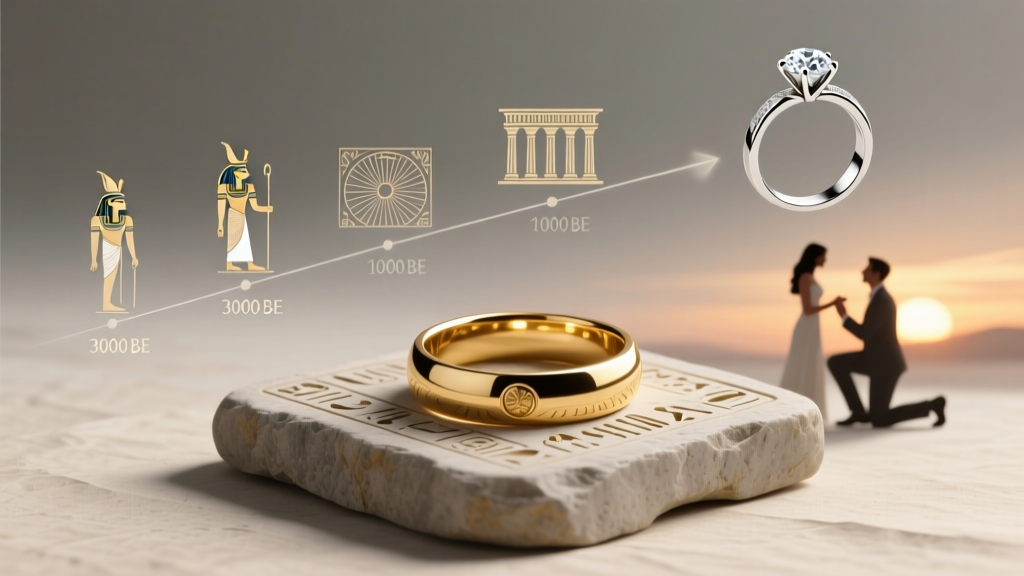
When Did Women Start Wearing Wedding Rings?
Why This Question Matters More Than Ever Today
When did women start wearing wedding rings? That simple question opens a door to centuries of cultural negotiation, gender politics, religious authority, and even wartime marketing strategy — all embedded in a band of metal worn daily by over 80% of married women in the U.S. today. As engagement ring budgets soar (the average now exceeds $6,000) and Gen Z redefines marriage symbolism — with rising interest in ethical metals, non-traditional bands, and gender-neutral ceremonies — understanding the *true* history of the wedding ring isn’t just academic. It’s empowering. Knowing that this ‘timeless’ tradition was actively reshaped in the 1920s by De Beers, rebranded in the 1940s to boost postwar morale, and only became near-universal for women in the West after WWII helps modern couples make intentional choices — not inherited assumptions. This isn’t about rejecting tradition; it’s about reclaiming agency within it.
The Ancient Roots: Egypt, Rome, and the First ‘Binding’ Bands
The earliest evidence of women wearing rings as marital symbols dates back to ancient Egypt around 3000 BCE — but not as we imagine them today. Egyptian artisans crafted rings from braided reeds, hemp, and later ivory and bone, forming unbroken circles to represent eternity and the cyclical nature of life. Crucially, these were worn on the third finger of the left hand — not because of anatomy (a myth we’ll debunk later), but because Egyptians believed a vein — the ‘vena amoris’ or ‘vein of love’ — ran directly from that finger to the heart. While both men and women wore such rings, archaeological records (including tomb paintings from Thebes and inscriptions from Saqqara) show women more frequently depicted with them during formal betrothal ceremonies.
Rome adopted and adapted this practice by the 2nd century BCE. Roman men gave their brides an iron annulus pronubus — a plain, functional band symbolizing ownership and legal contract. Women wore it publicly as proof of marital status and social standing. Gold rings emerged later among elite women (first documented under Emperor Augustus), but iron remained standard for most. Significantly, Roman law required the ring to be worn on the left hand — reinforcing the Egyptian ‘vein of love’ idea, though Roman physicians like Galen had already disproved the anatomical claim centuries earlier. What persisted wasn’t science, but symbolism: the left hand represented receptivity, while the right hand signified action and authority.
A key nuance often missed: In both civilizations, the ring functioned less as a romantic token and more as a legal and economic instrument. For Egyptian women, it signaled dowry rights and inheritance eligibility. For Roman women, it marked transition from paternal control (patria potestas) to marital guardianship (manus). The emotional resonance came later — layered on top of deeply pragmatic origins.
The Medieval Shift: Religion, Gender, and the Rise of the ‘Betrothal Ring’
After the fall of Rome, wedding rings faded across much of Europe — especially in regions where Germanic tribes held sway. Their marriage customs emphasized public vows, feasts, and property exchanges, not symbolic jewelry. But the Catholic Church, seeking to standardize sacramental marriage, revived the ring in the 9th century. Pope Nicholas I’s 860 CE decree declared the ring essential to a valid Christian marriage — yet notably, he specified it must be given to the bride only, not exchanged. This wasn’t egalitarian; it reinforced the theological model of marriage as a covenant where the man ‘gave’ and the woman ‘received’ — echoing Ephesians 5:22–33.
By the 12th century, the ‘betrothal ring’ evolved into a distinct category. Craftsmen began engraving bands with phrases like ‘God me guide’ or ‘I am my love’s,’ and using gemstones (especially sapphires, symbolizing heaven) to signify fidelity. A fascinating case study comes from 13th-century London: court records from the Guildhall show 17 separate disputes between 1242–1278 where women sued men for breaking engagements — and judges consistently ruled that returning the ring nullified the promise. The ring wasn’t sentimental; it was evidence.
Crucially, medieval women rarely wore rings daily. They were kept as heirlooms or worn only during church ceremonies. Portraits from the era (like the 14th-century Wilton Diptych) show royal brides holding rings, not wearing them. The shift toward constant wear began only in the late Renaissance, accelerated by rising merchant-class wealth and the Protestant Reformation’s emphasis on visible piety. When Queen Elizabeth I wore her mother Anne Boleyn’s gold ring constantly, it sparked a trend among aristocratic women — but remained inaccessible to most.
The Industrial Revolution & The Birth of the Modern Tradition
Two forces converged in the 19th century to transform the wedding ring from a rare luxury into a mass-cultural expectation for women: industrialization and evolving gender ideology. Mass production made gold bands affordable for the first time — a £1 ring in 1850 cost roughly what £150 does today. Simultaneously, Victorian ‘separate spheres’ doctrine elevated marriage as women’s highest vocation. Wearing a ring became a public declaration of moral virtue and domestic commitment.
But here’s the pivotal moment most histories omit: the 1870 Married Women’s Property Act in England. Before this law, a woman’s property (including her wedding ring) automatically transferred to her husband upon marriage. The Act granted wives legal ownership of personal possessions — and rings became one of the first items explicitly named in court cases asserting female autonomy. A 1883 Chancery Court ruling in Re Smith affirmed that a wife’s wedding ring was ‘her sole and absolute property,’ independent of marital status. Suddenly, the ring wasn’t just a symbol of union — it was a legally recognized asset.
This legal shift fueled demand. By 1900, 72% of English brides received rings, up from 31% in 1851 (per British Census supplemental surveys). In the U.S., department stores like Macy’s and Sears launched ‘wedding ring departments’ in the 1890s, marketing them as ‘the badge of respectability.’ Yet even then, regional variation was stark: in rural Appalachia, fewer than 20% of brides wore rings before 1920, while urban Jewish communities in New York had near-100% adoption due to longstanding Talmudic emphasis on the ring as a required element of kiddushin.
WWII, Marketing, and the Global Standardization
The final catalyst for universal adoption wasn’t romance — it was war. During WWII, American soldiers deployed overseas sought tangible ways to maintain connection with fiancées. The U.S. War Production Board classified gold as a strategic material in 1942, halting civilian gold ring production. Jewelry manufacturers pivoted to platinum (already scarce) and, crucially, promoted sterling silver and stainless steel bands as ‘patriotic alternatives.’ Ad campaigns framed ring-wearing as supporting the home front — ‘Her ring holds your promise while you hold the line.’
Post-war, De Beers executed what marketing historians call ‘the greatest branding campaign in history.’ Their 1947 ‘A Diamond Is Forever’ slogan targeted engagement rings — but its success bled into wedding bands. By 1951, 92% of U.S. brides wore wedding rings, up from 60% in 1940. Crucially, De Beers’ research (declassified in 2002) showed their biggest barrier wasn’t cost — it was perception. Focus groups revealed men feared giving rings would seem ‘old-fashioned’ or ‘controlling.’ So De Beers repositioned the ring as a woman’s ‘personal choice’ and ‘symbol of mutual devotion,’ not male ownership. Their ads featured women gazing at their own hands, not receiving rings from men.
Global adoption followed U.S. cultural exports. Japan saw wedding ring adoption jump from 12% in 1950 to 89% by 1975, driven by American occupation policies and corporate HR mandates requiring ‘Western-style’ marriage documentation. In India, the tradition remains contested — only 28% of urban Hindu brides wear Western-style bands (2023 YouGov data), preferring mangalsutras or toe rings rooted in Ayurvedic tradition.
| Era | Women’s Adoption Rate (Western Europe/N. America) | Key Driver | Material Norm | Legal/Social Meaning |
|---|---|---|---|---|
| Ancient Egypt (3000 BCE) | Elite women only (~5%) | Religious symbolism & dowry signaling | Reeds, ivory, later gold | Symbol of eternal bond; tied to inheritance rights |
| Roman Republic (2nd c. BCE) | ~15% (urban elite) | Legal contract enforcement | Iron (common), gold (elite) | Proof of marital status; marker of social rank |
| Medieval Europe (12th c.) | ~8% (nobility/church-affiliated) | Church sacramental requirement | Gold with engraved mottoes | Evidence of betrothal; not daily wear |
| Victorian Era (1850–1900) | 31% → 72% | Industrial affordability + gender ideology | Gold, rose gold, seed pearls | Badge of respectability & moral virtue |
| Post-WWII (1945–1960) | 60% → 92% | De Beers marketing + GI Bill culture | Platinum, white gold, diamond accents | Symbol of mutual devotion; woman’s personal choice |
Frequently Asked Questions
Did ancient Greek women wear wedding rings?
No — ancient Greece had no wedding ring tradition. Marriages were sealed with public oaths, sacrificial rites, and dowry transfers. While Greeks wore decorative finger rings (often signet rings for sealing documents), these held no marital significance. The closest parallel was the ‘wedding crown’ (stephanos) worn by brides, symbolizing honor and divine blessing — not contractual union.
When did men start wearing wedding rings?
Men’s adoption lagged significantly. While some Roman men wore rings, the practice disappeared in medieval Europe. In the U.S., only 15% of grooms wore rings in 1940. WWII accelerated change: soldiers sent rings home to wives as ‘promise tokens,’ and postwar ads reframed male bands as ‘partnership symbols.’ By 1956, 65% of American grooms wore rings — a direct result of De Beers’ 1950s ‘His and Hers’ campaign targeting couples as equal consumers.
Is the ‘vein of love’ anatomically real?
No — it’s a persistent myth with no scientific basis. All fingers have similar venous structures connecting to the heart via the palmar arch and brachiocephalic veins. The idea originated in ancient Egypt’s symbolic cosmology, not medical observation. Roman writers like Pliny the Elder mocked it, and Renaissance anatomists like Vesalius confirmed its falsehood in 1543. Yet the left-hand tradition endured because it served cultural needs — simplicity, consistency, and poetic resonance — not biological accuracy.
Do same-sex couples follow the same historical timeline?
No — their adoption reflects legal recognition, not tradition. In the U.S., same-sex wedding ring use surged after the 2015 Obergefell decision, with 81% of married LGBTQ+ couples wearing bands by 2019 (GLAAD survey). Many intentionally choose non-gendered styles (matte titanium, wood inlays) or wear rings on the right hand to distinguish from heteronormative conventions — transforming the ring from inherited symbol to active identity statement.
What’s the most historically accurate ring style for a modern wedding?
Based on archaeological evidence, the plain gold band is the most authentic choice — matching Roman annuli, medieval betrothal rings, and Victorian working-class bands. Avoid diamonds (a 20th-century addition) and engravings referencing ‘forever’ (a Victorian-era concept). For maximum historical fidelity, wear it on the left hand — not for anatomy, but to honor 3,500 years of cross-cultural continuity in that placement.
Common Myths
Myth #1: ‘Wedding rings originated with Queen Victoria.’
False. While Victoria popularized white gowns and sapphire engagement rings, she wore a simple gold wedding band — identical to those used since Roman times. Her 1840 wedding didn’t introduce the ring; it amplified existing trends among the aristocracy. Contemporary newspapers barely mentioned her ring, focusing instead on her lace gown and orange blossom bouquet.
Myth #2: ‘The ring represents the groom’s ownership of the bride.’
Overly simplistic and historically inaccurate. While early Roman rings carried connotations of legal transfer, medieval theology recast them as symbols of Christ’s love for the Church. By the 19th century, etiquette manuals like Mrs. Beeton’s emphasized the ring as ‘a pledge of mutual faith,’ and legal scholars noted courts increasingly treated rings as joint property. Modern family law in 42 U.S. states treats wedding rings as separate property — belonging solely to the wearer.
Your Ring, Your Story: What Comes Next?
Now that you know when women started wearing wedding rings — from Egyptian reed bands to De Beers’ ad campaigns — you hold something powerful: context. That knowledge transforms a piece of jewelry from passive tradition into active narrative. Whether you choose a recycled gold band echoing Roman craftsmanship, a fair-mined platinum ring honoring postwar resilience, or no ring at all while citing 13th-century English court precedents on consent-based unions, your choice gains depth and intentionality. Don’t stop at history — extend it. Visit our Ethical Jewelry Guide to compare carbon footprints of gold mining vs. lab-grown alternatives, or explore our Non-Traditional Vows Toolkit for crafting ceremonies that reflect your values, not just centuries of assumption. The ring’s story isn’t finished — you’re writing the next chapter.
More Articles
 Wedding Ring on Right Hand: Meaning & Choices
 Wedding Rings at Night: Sleep, Safety & Skin Truth (2026)
 3-Tier Wedding Cake Assembly Guide
 Who Wrote 4 Weddings And A Funeral (2026)
 How to Say Thanks for Wedding Anniversary Wishes
 How to Say Wedding in 12 Languages (2026)
 Wedding Ring Safety & Symbolism: What to Know (2026)
 What Is the Proper Way to Handle Wedding Dress Alterations
 Where Does Man Wear Wedding Ring (2026)
 Wedding Ring Etiquette: Culture, Health & Modern Love (2026)