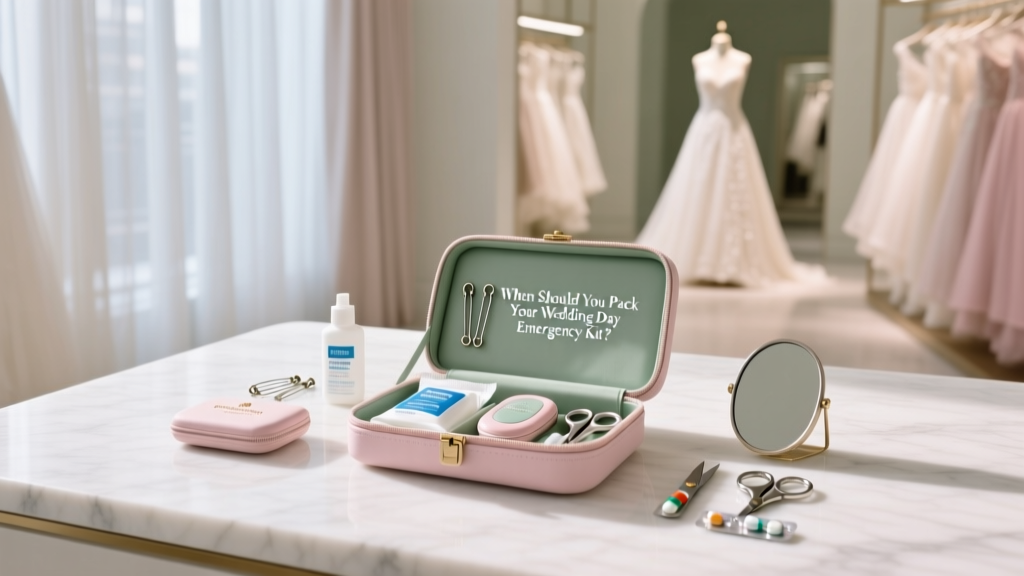
When Should You Pack Your Wedding Day Emergency Kit
When Should You Pack Your Wedding Day Emergency Kit?
You’ve booked the venue, you’ve chosen the outfits, and your timeline is finally coming together. Then someone mentions a “wedding day emergency kit,” and suddenly you’re wondering: when, exactly, are you supposed to pack it—during the week of the wedding, the night before, or the morning of?
This question matters because the whole point of an emergency kit is to prevent small issues from turning into big stress. A missing button, a blister, a stain, a headache—none of these should get to steal your calm. Packing at the right time means you’ll actually have what you need, where you need it, without creating one more last-minute task.
Quick Answer: Pack It 3–7 Days Before the Wedding
The best time to pack your wedding day emergency kit is about a week before the wedding (3–7 days out), then do a quick final check the day before to add last-minute items like fresh snacks, water, and any newly picked-up prescriptions.
If you’re traveling for your wedding or have multiple events (welcome party, rehearsal dinner, brunch), pack it even earlier—7–10 days out—so it’s not competing with travel prep.
Q: Why Not Pack the Morning Of?
A: Because “emergency kit” is supposed to reduce morning-of chaos, not become part of it. The morning of the wedding is when you’re most likely to forget key items (fashion tape, deodorant, pain reliever), misplace the kit, or leave it at home while rushing out the door.
Wedding planner Janelle Ortiz of Ortiz Events puts it simply: The wedding morning should be for getting ready and enjoying your people. If you’re running around looking for bobby pins and stain remover at 10 a.m., the kit isn’t doing its job.
Q: What Should Happen the Week You Pack It?
A: Think of packing as a two-step process: build the kit and then stage the kit.
- Build (3–7 days out): Gather everything while stores and pharmacies are still easy to get to, and you have time to replace items.
- Stage (1–2 days out): Put the kit where it must physically go—ideally already in the car, with your planner/coordinator, or with the designated “kit captain.”
Real-world example: Maya & Chris (married in Asheville) packed their kit the Tuesday before their Saturday wedding. Maya shared, We added blister patches after my shoe fitting on Thursday. By Friday, the kit was already in our hotel room, and I didn’t think about it again.
Q: Does Wedding Style Change the Timeline?
A: Yes. The right timing depends on how your wedding is structured and who has access to supplies.
Scenario 1: Traditional Venue Wedding with a Wedding Planner
If you have a full-service planner or day-of coordinator, pack the kit 5–7 days out and hand it off at your final walkthrough or rehearsal. Many planners prefer to store it with their “day-of tools” so it’s available during setup, photos, and reception.
Pro tip: Make a quick list of what’s inside and tape it to the kit. In the moment, your coordinator can grab what they need without digging.
Scenario 2: Modern DIY Wedding (Backyard, Airbnb, Nontraditional Spaces)
DIY weddings often mean more moving parts and fewer built-in backups. Pack the kit 7–10 days out, and consider making two kits:
- Getting-ready kit (hair/makeup area): fashion tape, blotting papers, bobby pins, deodorant, sewing kit
- Reception kit (near coordinator, bar manager, or a trusted friend): stain remover, bandages, safety pins, pain reliever, phone charger
This is especially helpful for trending “weekend wedding” setups, where guests are on-site for multiple events and you’re moving between locations.
Scenario 3: Destination Wedding or Travel Required
If you’re flying, pack the kit 10 days out so you can confirm what goes in carry-on vs. checked luggage. Keep essentials in your carry-on: any medication, blotting papers, mini deodorant, a tiny sewing kit (TSA-friendly), and bandages. Avoid packing full-size aerosols or anything that could leak.
Photographer Devon Lee notes: For destination weddings, I see couples arrive without the little fixes—like fashion tape or anti-chafe balm. Pack early, and pack duplicates if you can’t just run to your usual store.
Q: What’s the Modern Etiquette Around Who Packs It?
A: Traditionally, the maid of honor or a parent might handle “just in case” items. Modern weddings are more flexible—especially with mixed-gender wedding parties and nontraditional roles.
Current trend: couples assigning a specific person as the Wedding Day Kit Captain (a sibling, friend, or coordinator). The key etiquette point is simple: don’t assume someone will do it. Ask clearly and hand off the kit intentionally.
A good script: Would you be willing to keep our emergency kit with you on the wedding day? I’ll pack everything and label it. You’d just bring it to the getting-ready space and keep it nearby.
Actionable Tips to Pack at the Right Time (and Actually Use It)
- Create your kit list two weeks out so you can add items as you think of them (shoe-related, outfit-related, weather-related).
- Pack the core kit 3–7 days out (bandages, safety pins, stain remover, sewing kit, pain reliever, breath mints, mini lint roller, fashion tape).
- Do a “final add” the day before: snacks, bottled water, electrolyte packets, any day-of medication, a fresh razor if needed, and phone chargers.
- Label everything (especially if multiple people are getting ready together). A small pouch labeled “Bride,” “Groom,” or “Partner A/Partner B” prevents mix-ups.
- Stage it where it will be used: getting-ready room, coordinator’s tote, or a designated corner near personal items.
- Set a reminder on your phone for 7 days out (“Pack emergency kit”) and 1 day out (“Add perishables + stage kit”).
Related Questions Couples Ask (Edge Cases Included)
Q: What if we’re staying at a hotel the night before?
A: Pack the kit at home 3–7 days out, then move it to your overnight bag the day before. If you’re getting ready at the hotel, keep it in the room—not in the car trunk where it’s hard to access.
Q: Should we pack one kit or two?
A: If your getting-ready location and reception location are different, pack two or split the kit into two pouches. The most common mistake is having the kit at the ceremony site while the dress emergency happens at the hotel.
Q: We have a wedding party—should everyone bring their own supplies?
A: It’s fine to suggest basics (nude undergarments, backup tights, personal meds), but one shared kit is more reliable. You can also ask key people to “carry” one item: someone brings blister patches, someone brings a steamer, someone brings stain remover pens.
Q: What about outdoor weddings and weather?
A: Weather is why packing early helps—you have time to react. For hot-weather weddings, add anti-chafe balm, electrolyte packets, and blotting papers. For cooler weddings, add hand warmers and a wrap. If rain is possible, pack heel protectors and a few clear umbrellas.
Q: We’re trying to keep things minimal—do we really need a kit?
A: You can keep it small and still be prepared. A “mini wedding emergency kit” can fit in a makeup bag: safety pins, fashion tape, blister bandages, stain pen, pain reliever, mints, and a phone charger.
Conclusion: Pack Early Enough That You Can Forget About It
Pack your wedding day emergency kit 3–7 days before the wedding (earlier if you’re traveling), then do a quick final add the day before. The goal is simple: when something small pops up—and it usually does—you’ll have a calm, easy fix ready to go. That’s the kind of preparation that lets you stay present for the best parts of the day.
More Articles
 Do Men Wear Diamond Wedding Rings? (2026)
 Wedding Loan with Fair Credit: 7 Lenders & Approval Tips
 Is My Heart Will Go On the Perfect Wedding Song for You?
 What "Do You Take Thee" Really Means for Your Wedding
 Wedding Crashers Rated R: Language, Sex, Drugs & MPAA Cuts
 Wedding Ring to Bed: 7 Reasons Couples Remove It (2026)
 How to Handle a Wedding Guest Who Brings Children Uninvited
 Stevenson’s Wedding Prayer: Why It Still Moves Us
 Zola Wedding Website Views: Can You See Who Visited?
 Wedding Planner Salary: Weekly Earnings (2026)