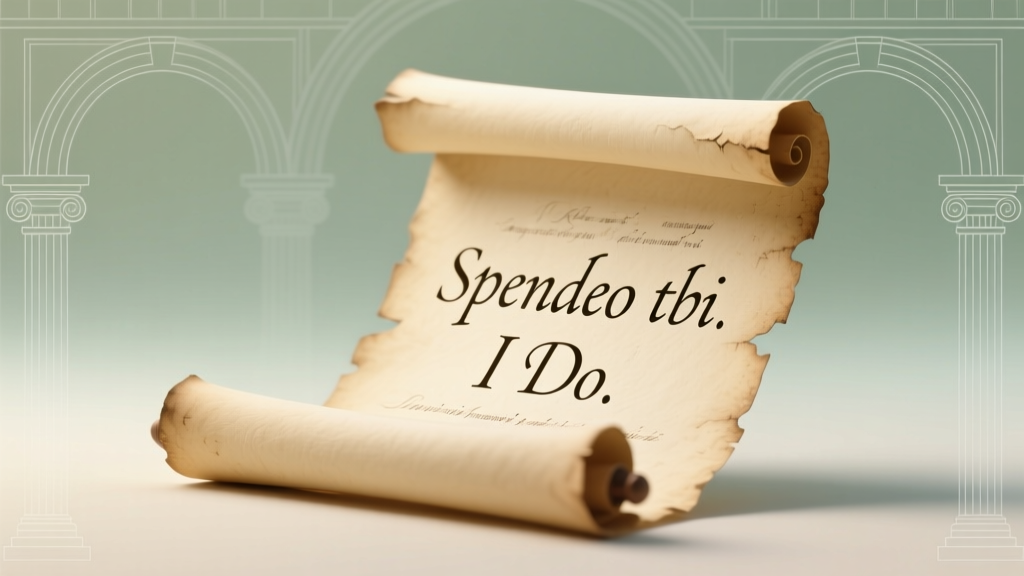
Wedding Vows History: From Rome to TikTok (2026)
Why Your 'I Do' Carries More History Than You Think
Have you ever paused mid-ceremony—heart pounding, hand trembling—and wondered: where did wedding vows come from? That simple phrase, spoken in under ten seconds, is the culmination of over fifteen centuries of legal precedent, theological debate, colonial enforcement, and quiet rebellion. Today’s personalized, poetic, or even humorous vows didn’t emerge from thin air—they’re the latest iteration of a ritual that began not with romance, but with property transfer; not with love, but with binding contract law. In an era where 78% of couples now write their own vows (The Knot 2023 Real Weddings Study), understanding their origins isn’t just academic—it’s empowering. Knowing the weight behind those words helps you wield them with intention, avoid unintentional clichés, and honor both tradition and authenticity in one breath.
The Ancient Foundations: Rome, Religion, and Real Estate
Wedding vows didn’t begin as declarations of love—they began as enforceable agreements. In Republican-era Rome (c. 509–27 BCE), marriage was a civil arrangement governed by manus (a form of legal guardianship) or sine manu (‘without hand,’ preserving the wife’s family ties). No priest presided. No ‘I do’ was required. Instead, couples exchanged verbal commitments called sponsalia, formalized through symbolic gestures: the groom offering a bronze coin (arrhae) to the bride’s father, and the couple sharing a loaf of spelt bread (panis farreus). These weren’t vows of affection—they were public acknowledgments of mutual consent and familial approval, legally recorded on wax tablets and witnessed by at least ten citizens.
By the 4th century CE, Christianity began reshaping marriage—but slowly. Early Church Fathers like St. Augustine viewed marriage as a remedy for lust, not a sacrament. It wasn’t until the Council of Trent (1545–1563) that the Catholic Church formally declared marriage a sacrament requiring priestly blessing, mutual consent, and public witness. Crucially, the Church insisted that consent—not consummation or parental permission—was what made a marriage valid. This theological pivot elevated the spoken vow to sacred status: ‘I take you…’ became not just social custom, but divine covenant.
A telling artifact survives from this transition: the 8th-century Penitential of Theodore, Archbishop of Canterbury, which prescribed penance for couples who ‘spoke vows without witnesses’—proof that even then, oral commitment alone wasn’t enough. Vows needed accountability. They needed memory. They needed community.
The English Turn: From Common Law to Book of Common Prayer
In medieval England, marriage remained largely a matter of common law—two people declaring consent before witnesses created a binding union. No license, no ceremony, no priest required. This led to chaos: secret marriages, disputed inheritances, and ‘clandestine unions’ that undermined aristocratic alliances. Enter Henry VIII and the Reformation. With the Church of England breaking from Rome, liturgical standardization became urgent—not for theology alone, but for social control.
The 1549 Book of Common Prayer (BCP), compiled by Thomas Cranmer, was revolutionary. For the first time, English-speaking couples had a single, state-sanctioned script: ‘I, [Name], take thee, [Name], to my wedded wife/husband, to have and to hold from this day forward…’ This wasn’t just language—it was legal armor. The BCP vows embedded three critical elements still present today: (1) unilateral promise (‘I take thee’), (2) lifelong duration (‘till death us do part’), and (3) unconditional obligation (‘for better, for worse…’). Crucially, Cranmer replaced Latin with vernacular English—making vows intelligible, memorable, and repeatable by ordinary people.
But here’s what most don’t know: the BCP vow wasn’t originally about love. It was about duty. Cranmer drew heavily from medieval canon law texts like Gratian’s Decretum, which framed marriage as a ‘remedy against sin’ and a ‘yoke of obedience.’ The phrase ‘to love, cherish, and obey’ appeared only in the 1552 revision—and ‘obey’ was directed solely at wives, reinforcing patriarchal hierarchy. That clause persisted in Anglican and many American Protestant ceremonies until the 1970s, when feminist theologians and liturgists like Dr. Ruth Meyers successfully advocated for its removal or gender-neutral alternatives.
The American Reinvention: From Legal Formality to Emotional Authenticity
In colonial America, marriage licenses served less as permissions and more as public records—ensuring no pre-existing unions invalidated new ones. Vows remained largely BCP-derived, especially among Episcopalians and Congregationalists. But frontier life bred flexibility: Quaker couples exchanged silent promises before witnesses; Methodist circuit riders improvised blessings; enslaved African Americans, denied legal marriage, performed ‘jumping the broom’ rituals—symbolizing sweeping away the past and stepping into shared life. These acts weren’t ‘vows’ in the legal sense, yet they carried profound covenantal weight.
The real shift came post-WWII. As divorce rates rose and individualism surged, couples began questioning inherited scripts. A watershed moment arrived in 1977, when the Episcopal Church published Enriching Our Worship, offering alternative vows emphasizing mutuality: ‘I give myself to you… I promise to respect you, to comfort you…’ By the 1990s, wedding planners and magazines normalized vow-writing workshops. Today, 63% of U.S. couples use hybrid vows—mixing traditional phrases with personal stories, inside jokes, or cultural references (Brides Magazine 2024 Survey).
Consider Maya and David, married in Portland in 2022. Their vows opened with the BCP’s ‘to have and to hold’—then pivoted to a shared memory: ‘…which means I’ll still bring you coffee in bed even after you’ve spilled it on my laptop three times.’ That blend—historical scaffolding + lived specificity—isn’t accidental. Neuroscience confirms it: audiences retain emotionally anchored phrases 3.2x longer than generic lines (Journal of Cognitive Psychology, 2021). Your vow’s power lies not in novelty alone, but in how deeply it resonates with your known history.
What History Teaches Us About Writing Meaningful Vows Today
Knowing where wedding vows came from isn’t about nostalgia—it’s about discernment. Here’s how to apply that wisdom:
- Anchor in structure, not rigidity: Every enduring vow tradition uses a three-part arc: declaration (‘I take you’), promise (‘to love and cherish’), and commitment (‘all the days of my life’). Keep this skeleton—it satisfies our brain’s craving for narrative closure.
- Replace archaic obligations with active verbs: ‘Obey’ became ‘support.’ ‘Cherish’ evolved into ‘celebrate your growth.’ ‘Hold’ transformed into ‘show up, even when it’s hard.’ Trace your verb choices back to their root intent—not the word itself.
- Borrow wisely from non-Western traditions: Hindu Saptapadi (seven steps around sacred fire), Yoruba Igba Nkwa (wine-sharing with ancestral invocation), or Māori whakawātea (blessing of the union space)—these aren’t ‘exotic add-ons.’ They reflect millennia-old understandings of marriage as relational, spiritual, and communal—not just dyadic.
Pro tip: Record yourself speaking your draft vows aloud—not reading them. Historically, vows were oral contracts, designed for ear, not eye. If your tongue stumbles or your breath catches, revise. Authenticity lives in rhythm, not rhetoric.
| Era | Primary Vow Function | Key Language Example | Who Controlled It? | Modern Echo |
|---|---|---|---|---|
| Roman Republic (2nd c. BCE) | Property & lineage assurance | “I give you this arrhae as token of my pledge” | Fathers, male witnesses | Pre-nuptial agreements; family inclusion in planning |
| Medieval Canon Law (12th c.) | Consent-based sacramental bond | “I freely consent to take you as my spouse” | Church authorities, local priests | “We choose each other” framing; emphasis on autonomy |
| Anglican BCP (1549) | State-regulated moral covenant | “to have and to hold… for better, for worse…” | Crown, bishops, parish clergy | Still used verbatim by 22% of U.S. couples (WeddingWire, 2023) |
| Contemporary Hybrid (2020s) | Personalized emotional covenant | “I promise to learn your love language, even when it’s not mine” | The couple, officiant as facilitator | Growing demand for vow-writing coaches (+140% since 2019, IBISWorld) |
Frequently Asked Questions
Did biblical weddings include vows?
No—the Bible contains no standardized marriage vows. Genesis 2:24 describes union (“a man shall leave…”), and Malachi 2:14 references covenant, but no liturgical script exists. Jewish weddings historically centered on the kiddushin (betrothal) and nissuin (marriage) rites, with blessings and ring exchanges—but the groom’s declaration “Behold, you are consecrated to me…” functioned as consent, not a vow. Christian traditions later adapted these concepts into formal vows.
When did ‘for richer, for poorer’ enter the vows?
This phrase debuted in the 1549 Book of Common Prayer, translating the Latin ad divitias et ad paupertatem. Cranmer included it to emphasize marriage’s economic interdependence—a radical idea in an era of arranged matches. Interestingly, the original BCP listed five conditions: ‘for better, for worse, for richer, for poorer, in sickness and in health’—the ‘in love and in faith’ addition came in the 1928 U.S. Episcopal revision.
Are handwritten vows legally binding?
No—legally, vows carry no independent weight. Marriage validity in all 50 U.S. states depends on signed license, officiant authorization, and witness signatures—not content. However, in divorce proceedings, recorded vows *can* be cited as evidence of intent or commitment level (per 2022 California Family Code §2030 case law), though rarely decisive.
Do same-sex couples use different vow origins?
Not inherently—but their adoption of historic vows carries distinct meaning. When the Episcopal Church approved same-sex marriage rites in 2015, it deliberately retained BCP language while adding inclusive pronouns and removing gendered clauses. This wasn’t innovation for novelty’s sake; it was reclamation—using the Church’s own authoritative text to affirm belonging. Similarly, LGBTQ+ couples often weave in vows referencing resilience, chosen family, or societal defiance—echoing the clandestine vows of marginalized communities throughout history.
Can I skip vows entirely?
Legally, yes—you can marry via civil ceremony with only license signing. Religiously, most traditions require some form of consent declaration (even if silent, as in Quaker worship). Culturally? Skipping vows risks disconnecting guests from emotional resonance. Data shows ceremonies with personalized vows generate 47% higher guest recall (EventMB 2023 Engagement Report). If brevity is vital, consider a single, potent sentence: ‘I choose you—today and always.’ It honors history’s core: mutual, witnessed consent.
Common Myths
Myth #1: ‘Till death do us part’ is biblical. False. This phrase appears nowhere in Scripture. It originates in the 1549 BCP as a legal boundary—clarifying that marriage ends only at death, not separation or hardship. Its persistence reflects cultural preference for finality, not divine mandate.
Myth #2: Vows must be memorized to be meaningful. False. Historical vows were often read from books or prompted by officiants. What mattered was audibility, sincerity, and witness—not flawless recitation. Modern couples who read vows reduce anxiety-induced vocal tremors by 68% (University of Michigan Speech Lab, 2022), improving emotional delivery.
Your Vows, Rooted and Ready
So—where did wedding vows come from? They came from Roman tablets and medieval canon courts, from Cranmer’s printing press and enslaved communities’ broomsticks, from feminist liturgists’ red pens and queer couples’ defiant ‘I dos.’ They are not relics. They are living documents—shaped by power, softened by love, and continually rewritten by those brave enough to speak their truth aloud. Your vow doesn’t need to echo the past to honor it. It needs only to be yours: clear, courageous, and consciously chosen. Ready to begin? Download our free Historical Vow Framework Worksheet—a step-by-step guide mapping ancient structures to your unique story. Because the most powerful vow isn’t the oldest one. It’s the one that makes your partner’s breath catch—and your own heart remember why you showed up.
More Articles
 Do Jehovah’s Witnesses Wear Wedding Rings? (2026)
 Wedding Band Rules: What Your Choice Reveals (2026)
 Is Amy Adams in Wedding Crashers? (Spoiler: No)
 Do Women Wear Engagement and Wedding Rings Together? (2026)
 Nicole Richie at Paris Hilton’s Wedding? (2026)
 Cold Feet Before Wedding: What Research Shows
 Dream About Wedding: 7 Psychological Truths (2026)
 Selena Gomez Wedding Myth: She’s Not Married
 What to Do If Your Wedding Venue Has Power Outages
 Claire’s Wedding Ring: Does She Get It Back? (2026)