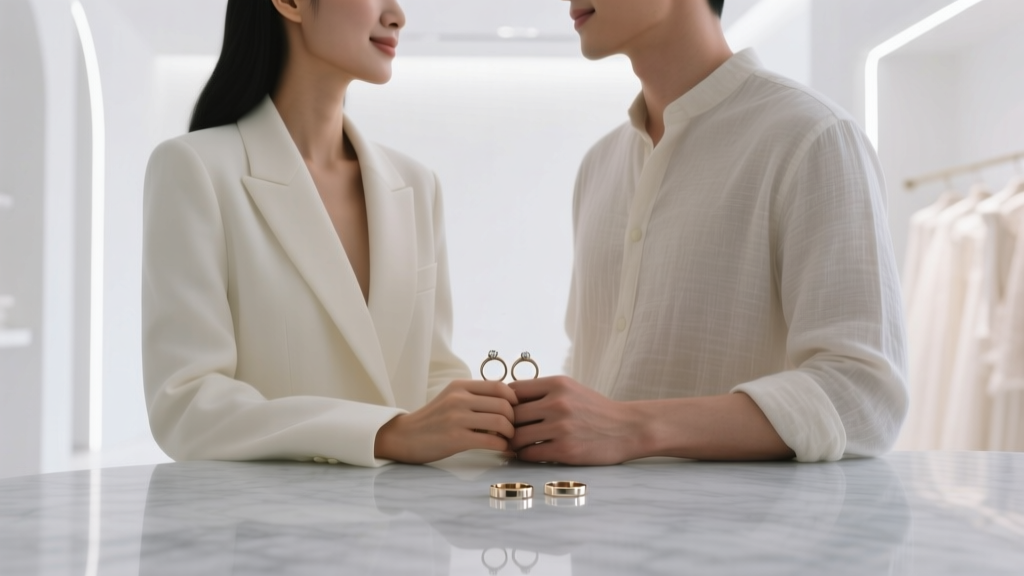
Who Chooses the Wedding Rings Bride or Groom
Who Chooses the Wedding Rings—Bride or Groom?
Picking wedding rings sounds simple until you’re actually doing it. Suddenly you’re juggling taste, budget, metal types, sizing, timelines, and the tiny emotional weight of choosing something you’ll (hopefully) wear every day for decades. It’s no wonder couples ask: who chooses the wedding rings—bride or groom?
The good news: there isn’t one “correct” rule anymore. Modern wedding etiquette is flexible, and the best choice is the one that fits your relationship, your finances, and your personal style.
Quick answer: Who chooses the wedding rings?
Most couples choose wedding rings together. Traditionally, each partner chose (and often paid for) the other person’s ring, but current wedding trends lean strongly toward joint shopping and joint decision-making—especially because rings are such personal, daily-wear items.
If you’re wondering what’s “proper,” the most widely accepted etiquette is this: the person who will wear the ring should have final say, even if it’s presented as a surprise.
Q: What does traditional etiquette say about choosing wedding rings?
Traditional Western etiquette often went like this:
- The groom purchased the bride’s ring (both the engagement ring and sometimes the wedding band).
- The bride purchased the groom’s wedding band.
- Rings were sometimes chosen with input from family, or based on classic styles.
That tradition still exists, especially in families that value clear roles or when a couple prefers that “classic” approach.
Wedding planner “Mara Ellison” (fictional), who works with couples across a range of budgets, explains it this way: “Traditions can be comforting, but rings are deeply personal. I tell couples: keep the sentiment, lose the stress. If you love the tradition, great—just make sure the wearer truly likes what they’ll wear daily.”
Q: What do modern couples usually do?
Modern etiquette tends to prioritize:
- Shared decision-making (shopping together, sending links, building a shortlist)
- Practical comfort (fit, lifestyle compatibility, durability)
- Personal style (mixing metals, non-traditional stones, minimalist or bold looks)
- Budget transparency (choosing rings that align with shared finances)
One real-world-style example: “Jules and Priya” (fictional couple) planned a small destination wedding and didn’t want guesswork. Jules says: “We set a total ring budget, then each picked what felt like ‘us.’ Priya went with a slim platinum band. I chose a wider matte gold band. They don’t match perfectly, but they match our style.”
This approach reflects a strong current wedding trend: intentional personalization over strict matching sets.
Q: Do the rings have to match?
No. Matching wedding rings are optional, not required. Many couples choose coordinated details (like the same metal or finish) rather than identical bands. Others go fully different—especially when one partner prefers a classic band and the other wants something more unique (like hammered gold, mixed metals, or a band with diamonds).
Jewelry designer “Caleb Nguyen” (fictional) notes: “The biggest trend I’m seeing is couples choosing rings based on lifestyle. People want comfort-fit bands, low-profile designs, and durable metals. Matching is a bonus, not the goal.”
Q: So who should choose—bride, groom, or both?
Here are the most common scenarios couples use, each with pros and cons.
Scenario 1: Choosing rings together (most common)
Best for: Couples who like making decisions as a team, want budget clarity, or have specific style preferences.
- Pros: Fewer surprises, better fit, fewer returns/resizes, shared excitement.
- Cons: Less “big reveal” energy.
Scenario 2: Each partner chooses the other’s ring (traditional approach)
Best for: Couples who love sentiment, gift-giving, or tradition.
- Pros: Romantic, meaningful, feels like a true gift.
- Cons: Risk of choosing a style the wearer won’t love; sizing can be tricky.
Tip: If you want this approach but fear getting it wrong, agree on guidelines first (metal type, width range, “must haves,” and “absolutely nots”).
Scenario 3: One partner chooses both rings (less common, but it happens)
Best for: Couples where one person enjoys shopping, has stronger opinions about jewelry, or is handling most planning tasks.
- Pros: Efficient, streamlined.
- Cons: Can cause resentment if it feels one-sided.
Make it work: The non-shopping partner should still approve final choices—at least via photos or an in-person try-on.
Scenario 4: Surprise ring with pre-approval (the “best of both” method)
Best for: People who love surprises but want to avoid disappointment.
- How it works: The wearer picks 3–5 options; the partner chooses one to buy.
- Why it’s popular: You get a surprise while staying within the wearer’s taste.
Q: Who pays for the wedding rings?
This is often tied to who chooses the rings. Traditional etiquette suggests each partner buys the other’s ring, but modern couples handle ring costs in many ways:
- Split the total cost 50/50
- Pay proportionally based on income
- Use a shared wedding budget
- Family contributions (a parent offers to cover rings, or an heirloom is used)
If you’re blending finances, it’s perfectly normal for wedding bands to come from a shared account. The key is agreeing on a number before anyone falls in love with a ring outside the plan.
Q: What if our tastes are totally different?
That’s common—and it doesn’t mean your rings need to look alike. Try these practical compromises:
- Coordinate one element: Same metal (both yellow gold), same finish (matte), or same engraving style.
- Pick a “daily band” plus an “occasion band”: One simple ring for everyday wear and a dressier one for special events.
- Focus on comfort and lifestyle: A nurse, mechanic, climber, or chef may need a different style than someone who works at a desk.
Couple experience: “Mina and Andre” (fictional) couldn’t agree on sparkle. Mina wanted diamonds; Andre wanted plain. Mina says: “We stopped trying to make them match. I chose a diamond band I loved, and Andre chose a simple tungsten band. We matched with an engraving inside: our wedding date and a line from our vows.”
Q: What are current wedding ring trends that affect this decision?
Several trends are shaping how couples choose wedding bands:
- Comfort-fit bands for everyday wear (especially popular for wider rings)
- Mixed metals (yellow gold + white gold accents, or two-tone bands)
- Lab-grown diamonds and moissanite for budget-friendly sparkle
- Stacking bands (multiple thin rings instead of one thicker band)
- Personalized engravings (coordinates, voice note soundwaves, fingerprints)
- Non-traditional materials (tungsten, titanium, ceramic, wood inlays)
These trends make it even more practical for each wearer to be involved—because lifestyle and comfort matter as much as appearance.
Q: What are the best tips for choosing wedding rings without stress?
- Decide “together or separate” early. Put it on your wedding planning checklist.
- Set a budget first. Even a rough range prevents awkward moments at the jewelry counter.
- Try rings on in person if possible. Ring width and comfort can feel very different than expected.
- Start shopping 3–4 months before the wedding. Custom bands, engraving, and resizing take time.
- Ask about resizing policies. Some materials (like tungsten) can’t be resized.
- Think about your everyday life. Do you work with your hands? Do you want to wear your ring to the gym? Do you need something low-profile?
- Make room for sentiment. An engraving, heirloom stone, or meaningful texture can matter more than a perfect match.
Related questions couples also ask
What if my partner wants a surprise ring, but I’m picky?
Do a “shortlist surprise.” Choose several rings you’d genuinely love, then let your partner pick. You’ll still get the emotional moment without the risk.
Can we use family heirloom rings?
Absolutely. Many couples reset heirloom diamonds into new bands or wear an inherited band as-is. If it needs resizing or repair, talk to a jeweler early.
What if one of us doesn’t want to wear a ring?
That’s more common than people think. Some couples choose a necklace, bracelet, tattoo, silicone band, or no jewelry at all. The meaning is in the agreement, not the object.
Do we buy wedding bands at the same place as the engagement ring?
Not required. Shopping around can save money and help you find the right style. Just confirm how the band will sit with the engagement ring if you plan to wear them stacked.
Conclusion: The “right” choice is the one you both feel good about
So, who chooses the wedding rings—bride or groom? Most couples choose them together, and the best etiquette is simple: the wearer should love what they’ll wear, and the couple should feel comfortable with the budget and process.
If you want to honor tradition, you can. If you want to do it your own way, you’re in excellent company. A wedding ring is a symbol of commitment—how you choose it can be just as personal as the ring itself.
More Articles
 50th Wedding Anniversary: Golden Milestone Truths (2026)
 Does Sasuke Attend Naruto’s Wedding? (2026)
 Wedding Ring Biblical? Scripture Says What Pastors Skip
 Engagement Ring & Wedding Band Matching: Truth 2026
 Megan Moroney Wedding Dress Rumor Debunked (2026)
 Usher at a Wedding: Honor or Hidden Emotional Labor?
 Wedding Crashers Characters’ Real Ages (2026)
 Can You Throw Rice at a Wedding? (2026)
 Did Johnny Gaudreau’s Sister Get Married? (2026)
 Wedding Ring on Right Hand? Global Traditions & Identity